Weekly tips, affirmations, and small actions to feel your best.

5 Early Warning Signs of Tonsil Stones (And How to Prevent Them)

Until you have one, you might not even know what tonsil stones are.

So… what are they?

Tonsil stones are hardened yellow or white bumps that appear on or within the tonsils. Small as a grain of rice, many people who acquire tonsil stones remain unaware of their presence.

After some time, the stones – which consist of food debris, dead cells, mucus, and saliva – can cause health complications. Bacteria and fungi also feed on tonsil stones, creating a distinct, unpleasant odor.

Why do tonsil stones appear? We’re all born with two tonsils, which reside in a kidney-bean-shaped crevice on both sides of the tongue near the pharynx. This area that constitutes our tonsils is full of nooks and crannies, allowing debris to settle. Over time, the debris may harden (or calcify) into stones.

What Are the Tonsil Stones?

The ‘tonsillolith’ produces five main (sometimes early) symptoms, provided the tonsil stone is large enough. Here are the symptoms you should know:
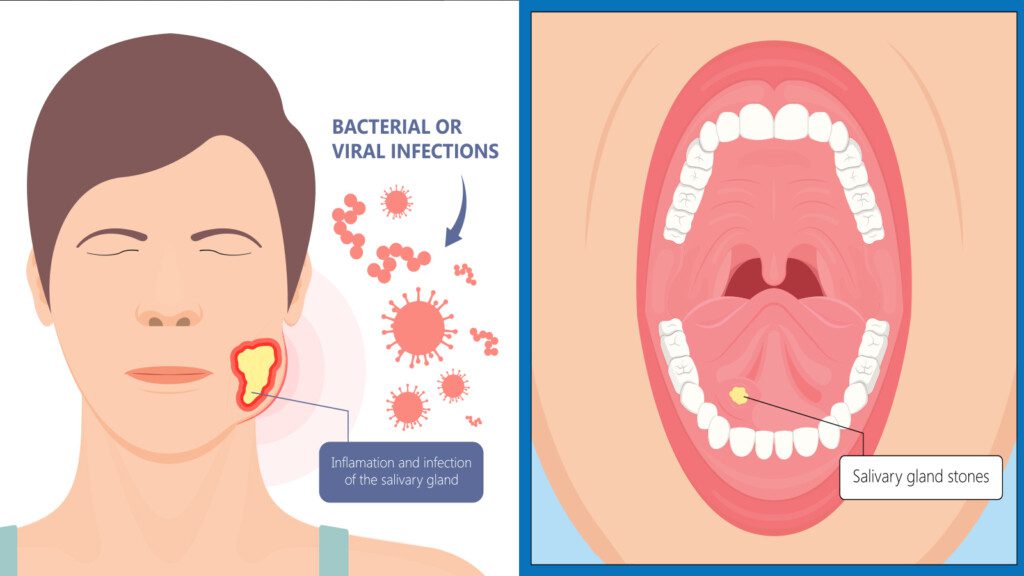
salivary stones

Learn seven causes of salivary stones aka mouth stones…and how to prevent them.

1. Bad breath

Also known as halitosis, progressively lousy breath often accompanies a tonsil stone. In one study of patients, researchers discovered that 75 percent of tonsil stones contain unstable sulfur compounds. Sulfur produces a notoriously bad smell, which is thought to be the catalyst for the terrible breath that accompanies the stones. This sulfur is produced by the anaerobic bacteria that feed on the stone’s debris.

2. Whitish or Yellowish Debris

While some tonsil stones are visible in the back of the throat, some are hidden. Stones that are just visible are often surrounded by a solid, plaque-like white substance (similar to the substance that appears on the tongue.) Additionally, the stone may appear as tiny rocks that stay trapped in your mouth.

3. Secondary oral health conditions

People who do not regularly brush or floss their teeth are more vulnerable to tonsil stones. Poor oral health may also contribute to a second condition, namely gum disease, oral infections, or tooth decay. Furthermore, untreated tonsil stones may produce plaque-like patches at the back of the throat.

4. Trouble swallowing

Swollen tonsils and tonsil stones can make it more difficult to swallow. Whether or not this symptom arises depends on the size and location of it. Difficulty swallowing is symptomatic of numerous medical conditions, so an exam may be necessary to determine the root cause.

5. Ear pain

Tonsil stones can grow any place in or around the tonsil. Due to shared nerve pathways, they may cause a person to feel pain in the ear, even though the stone itself is not touching the ear.

How to Get Rid of Tonsil Stones

There are several effective methods available for removing tonsil stones. While the success of these techniques may vary depending on individual cases, they can be beneficial in dislodging these troublesome formations. Let’s delve into some additional approaches:

  1. Nasal irrigation: They can sometimes be dislodged by performing nasal irrigation. This involves using a saline solution to flush out the nasal passages, which can help remove any trapped debris, including tonsil stones. This method targets the nasal cavity and can reach the tonsils, providing a thorough cleanse.
  2. Oral irrigators: Oral irrigators, such as water flossers, are commonly used for dental hygiene. But they can also be employed to tackle tonsil stones. By directing a stream of water at the back of the throat, these devices can dislodge and flush out the stones, effectively minimizing their presence.
  3. Non-alcoholic mouthwash: Rinsing your mouth with a non-alcoholic mouthwash can help alleviate the discomfort associated with this condition and contribute to their removal. The mouthwash’s antiseptic properties can assist in loosening the stones, making it easier to dislodge them.
  4. Saltwater gargling with added pressure: While gargling with salt water can help alleviate throat discomfort caused by this condition, applying additional pressure during gargling can enhance the dislodging process. Vigorously swishing the saltwater solution around your mouth and directing it toward the back of your throat increases the likelihood of dislodging the stones.
  5. Professional removal: In cases where self-removal methods prove ineffective or if you experience severe complications, seeking professional assistance is advisable. An otolaryngologist, or ENT specialist, can evaluate your condition and perform procedures such as laser treatment or surgical removal of the tonsils (tonsillectomy). Tonsil stones are most common in those who acquire chronic tonsillitis. The surgical removal of the tonsils (a tonsillectomy) eliminates the possibility of stones developing for this demographic. However, various research studies showing the high complication rate of the procedure (around 20 percent) and the severe conditions (e.g., deep infection of the tonsil or tonsil abscess) are giving some a second pause.

How to Prevent Tonsil Stones

Preventing tonsil stones is crucial for those who want to avoid the discomfort and inconvenience they can bring. In addition to the aforementioned techniques, there are a few more preventive measures you can incorporate into your daily routine:

  1. Practice good oral hygiene: Alongside regular brushing and flossing, paying attention to the back of your tongue can significantly reduce the formation of tonsil stones. Bacteria will often accumulate on the tongue’s surface, providing a breeding ground for the debris contributing to these stones’ formation. Use a tongue scraper or your toothbrush to gently clean the back of your tongue during your oral hygiene routine.
  2. Quit smoking: Smoking damages overall health and increases the risk of developing this condition. The chemicals and toxins in cigarettes can irritate and inflame the tonsils, promoting the accumulation of debris and the formation of stones. By quitting smoking, you can significantly reduce the likelihood of developing tonsil stones and improve your overall well-being.
  3. Stay hydrated: Drinking adequate water throughout the day is essential for maintaining optimal oral health. Proper hydration helps prevent the buildup of bacteria and debris in the mouth, reducing the chances of this formation. Aim to drink at least eight glasses of water daily, and consider using a humidifier in dry environments to prevent excessive drying of the throat and mouth.
tonsil stones

Final Thoughts on Understanding How to Deal With Tonsil Stones

In conclusion, dealing with this condition can be uncomfortable and frustrating. However, you can effectively manage and prevent their formation with the right knowledge and techniques. From gentle home remedies to seeking professional assistance when necessary, various options are available to help you remove tonsil stones and alleviate any associated symptoms.

Remember to exercise caution when dislodging tonsil stones, as improper techniques may lead to complications. If self-removal methods prove ineffective or if you experience persistent issues, it’s always wise to consult a healthcare professional for proper evaluation and guidance.

By practicing good oral hygiene, staying hydrated, and making healthy lifestyle choices such as quitting smoking, you can reduce the likelihood of stone formation and maintain better oral health. Stay proactive in your oral care routine, and don’t hesitate to seek help. With these preventive measures and the right approach, you can effectively manage tonsil stones and enjoy a healthier, more comfortable life.


9 Adult Behaviors of Someone That Had Emotionally Unavailable Parents As A Child

The children of parents who were emotionally unavailable eventually grow up into adults. In adulthood, those people may have difficulty pinpointing exactly what went wrong in their childhood. It’s only through observation of behaviors that therapists and psychologists can reveal what happens to children who emotionally unavailable parents. Here are some of the most common adult behaviors of someone with emotionally unavailable parents.

“People THRIVE on positive reinforcement. They wither with criticism.” – Patti Henry

Here Are 9 Behaviors Of Someone Who Had Emotionally Unavailable Parents

past

1. Difficulty with attachments

Adults who had emotionally unavailable parents may have difficulty with commitment and attachments in their lives. “Unstable people first have to get themselves stable before they can truly commit to a relationship—and that could take a long time,” says licensed marriage and family therapist Neil Rosenthal.

Adults raised by emotionally unavailable parents are unstable and, hence, struggle with relationships. They tend to have a fear of both attachment and love. Adults with attachment issues may not notice that they sabotage their relationships or become distant when attachment seems probable.

2. Children of emotionally unavailable parents may have identity issues

Children learn a lot about their identity through their parents. Emotionally unavailable parents tend to have less of an impact on their children, which means that the children don’t grasp their identities as well. When growing into adulthood, these people tend to have identity issues and tend to have a loss of direction in life. They don’t know where to go or what to do in life.

3. Difficulty accepting change

Adults who were raised by emotionally distant parents tend to have issues with change. They’re not very adaptable and often prefer that things stay the same. This is because their parents never taught them to handle their emotions appropriately. Change can be difficult for children. When they don’t have good guidance on how to deal with it, these children tend to grow up into adults who still can’t handle change.

4. Children of emotionally unavailable parents may have low self-esteem

For much of their life, children rely on their parents to meet their emotional needs. When those emotional needs aren’t getting met, children develop low self-esteem. This low self-esteem doesn’t end when the children grow into adulthood, either.

Often the roots of low self- esteem lie deep in a wounded child within us who feels “not good enough.” As children we feel accepted only to the extent we feel unconditionally loved and supported by our parents,” says Dr. Sonera Jhaveri.

Thus, adults with emotionally absent parents often think poorly of themselves and characterize themselves as “not good enough”.

5. Doesn’t understand emotions

When children are raised with emotionally unavailable parents, they never learn how to communicate their emotions. This leads to children carrying this misunderstanding of emotions into adulthood. One of the most common behaviors of an adult with emotionally unavailable parents is a lack of understanding about their emotions. They may be unable to identify their feelings, even if you ask.

6. Sensitivity to rejection

Adults with emotionally unavailable parents may be extremely sensitive to rejection or even perceived rejection. For example, an adult with emotionally unavailable parents may become distressed at the idea that someone at their workplace that they admire didn’t like their presentation. This is commonly known as “rejection sensitive dysphoria” and can cause extreme distress at even the perception of rejection, such as a neutral response over an enthusiastic one.

7. Perfectionism

Perfectionism is highly likely for those carrying the weight of an emotionally unavailable parent into adulthood. Due to the sensitivity of rejection and the deep-seated drive for acceptance and affirmation, adults whose parents were emotionally unavailable need everything they do to be perfect. This can carry over into their workplace, relationships, and hobbies.

8. Trouble setting boundaries

Adults who had emotionally unavailable parents were never taught how to set healthy boundaries. This results in these adults now trying to replicate a parental relationship with other people in their lives. This often involves men or women seeking out romantic partners who can fill the role of a parental figure – which inevitably causes upset in the relationship.

9. Lying

Lying is often a behavior that we consider manipulative, but sometimes lying can result from emotionally absent parents. Most often, adults who have emotionally absent parents tend to lie because they’re trying to get a specific reaction out of the people that they’re lying to. While this is a manipulative tactic, these people are doing it to receive some affirmation, which they didn’t receive as children.

emotionally unavailable partners

Final Thoughts on Growing Up With Emotionally Unavailable Parents

Knowing the adult behaviors of an emotionally absent parent is important for therapists and people trying to move on from their past. While the idea of an adult still suffering from absent parents is saddening, it isn’t the end of the road. Mental health experts have long been figuring out the best way to lead people onto the road of recovery when it comes to emotionally unavailable parents. It’s never too late for someone to get help and address maladaptive behaviors.

15 Traits That Reveal You Are A Spiritual Healer (And Don’t Know It)

Now more than ever, we need healers to come forward with their gifts and raise the world’s vibration. Healers are a particular group that can help others come out of suffering and into the light. Many people don’t have any hope left due to the current state of affairs, but spiritual healers can lift the broken and wounded up and restore their faith in humanity. The worn-out, fear-based programming doesn’t work anymore for the majority of people, and so grand healing is now taking place on the planet.

You might know a healer in your life or feel like you’re one yourself, but sometimes, these gifts present themselves in subtle ways. Here are some signs to look out for in yourself and others that may point to being a spiritual healer.

Here are 15 traits that reveal you’re a spiritual healer (and don’t know it):

Spiritual healers are the ones who heal themselves first and create a ripple outward for others…

spiritual

1. A spiritual healer will often identify as an empath.

This world is oh-so draining for empaths and highly sensitive people. The noise, busyness, fast pace, social interactions, greed, violence, and other adverse occurrences leave a spiritual healer utterly exhausted. Empaths and lightworkers absorb the energy of the world around them, which often leaves them feeling frazzled and overwhelmed. Their sensitivity is a blessing because it can help heal the planet, but healers often feel cursed by this trait due to how heavy it can make them feel emotional.

2. You crave alone time often.

Healers don’t dislike people; they thrive better on their own. As we said, the world’s energy can drain an empath or spiritual healer, so they need tons of time to recharge and rebalance their energies.

3. You feel that life is more than just paying bills.

Spiritual healers feel trapped in this system because it’s centered around making money, not following one’s purpose. Healers can get quite frustrated with the world because they want to help others, but they feel that making money can get in the way due to time and financial constraints.

If you feel trapped in your current job and dream of helping others, you might be a healer.

4. People are always coming to a spiritual healer for advice.

People come to your left and right to help them with their problems because they know you’ll have the answers. You might not know how to solve the problems in your own life, but you know how to drop everything and listen to someone else’s struggles. Because you’re highly sensitive, you can easily relate to other people’s troubles and help them escape the darkness.

5. You’re highly intuitive.

A spiritual healer runs on emotions, not logic. Your gut feelings are king in decision-making because they have yet to steer you wrong. You “know” when something doesn’t feel right, so you follow that instinct and don’t question it. If this sounds like you, you’re probably a spiritual healer.

6. You’ve had struggles with mental health.

Many spiritual healers suffer from mental disorders because they feel they don’t fit in. They don’t know where to turn because every path seems to lead to stress and confusion, which can cause anxiety and depression. Spiritual healers are more sensitive to the overwhelming stimuli on the planet, which can cause them to retreat into solitude and avoid the world entirely. Speaking of which…

7. Social situations drain your energy.

You feel exhausted afterward, even if it’s just going out to do errands. Dealing with traffic, big crowds, your job, and conversations with others can quickly zap your energy and leave you daydreaming about crawling into bed and staying there for a while.

8. You can sense other people’s emotions.

This is perhaps one of the most evident signs of being a healer. If you can read someone else just by the emotions on their face or their body language, you’re probably destined to be a spiritual healer.

sensitive

9. You feel drawn to healing professions.

If you feel drawn to a career in energy work such as Reiki or work that benefits the planet, like environmental sustainability, you are probably a healer. Healers don’t do well in careers like sales or management because their talents don’t shine in these fields. They prefer jobs that genuinely have a purpose, not just those that are centered on increasing profits.

10. People feel calm or happy around you.

Despite your struggles, people can see past them and into your true nature. They say you make them feel centered, balanced, calm, or any other positive emotion. Healers can lift other people and give them hope, so if this sounds like you, you’re a truly special soul.

11. A spiritual healer may just feel “different.”

You can’t explain it to people, but you’ve felt like an outcast your whole life. You don’t understand the world’s ways because many of them cause suffering, which causes great pain. It almost feels like you have no emotional skin because many things about the world impact you deeply. You don’t relate to the shallowness of society, which is why you choose to remain an outcast, and you don’t see this as a bad thing.

12. You are an idealist.

Your head is always in the clouds because it sure beats being on the ground! You feel like the world could be so simple, but we make it incredibly complicated. Why can’t we share our resources instead of fighting over them and destroying them? Why do we build a world that disconnects us from the natural one we were born into?

13. You are a deep thinker.

Because you’re an idealist, you’re also a visionary that can see the bigger picture. You are always contemplating life on this planet to try to make sense of things and work them out in your mind.

14. You feel deeply connected to nature and animals.

Humans don’t make much sense to you, so you gravitate toward animals and nature to feel peace and serenity.

15. A spiritual healer is a superb listener.

You might not like talking much, but you know how to listen. You don’t just hear people but tune into what they’re saying and their subtle body language. You understand people well, which is why you attract those who need help.

spiritual healer

Final Thoughts on Awakening to the Fact That  You Are a Spiritual Healer

Perhaps you always knew you somehow felt as though you were not of this world or experienced any of the sensations described in this article. Now, this should make sense to you, and this newfound knowledge can help you share your gifts with the world.

Psychologist Explains: People Who Are ‘Original’ Thinkers Do These 5 Things…

“… being original is not easy, but I have no doubt about this: it’s the best way to improve the world around us.” – Adam Grant

Original thinkers are people who are able to create things from seemingly nothing. They are the artists, inventors, writers, and entrepreneurs of the world. Some people may think that original thinkers are born that way. Well, sometimes that’s true. But there are also habits that original thinkers all exhibit. Psychologists have pinpointed the things that original thinkers do. These habits not only mark them as original thinkers, but also help them have those original, creative and out-of-this-world ideas in the first place.

Here Are 5 Things That Original Thinkers Do Differently

1. Original thinkers aren’t afraid to have bad ideas

Not everything that an original thinker comes up with is going to be golden. In fact, original thinkers have just as many bad ideas and rough starts as the rest of us. The difference between original thinkers and everyone else, is that original thinkers aren’t afraid to have bad ideas. The only way that you can make a bad idea into a great one, is to have the idea in the first place.

Originals are also afraid of failing, but what sets them apart from the rest of us is that they’re even more afraid of failing to try,” says psychology professor Adam Grant.

Great ideas aren’t born; they’re made. Original thinkers know that everyone has to start somewhere. They’re not afraid to do poorly in order to learn how to be better.

2. Original thinkers procrastinate

Many people have been told that procrastination isn’t a good thing. This can be true sometimes. Other times, procrastination can be vital for a creative outlet. Many original thinkers have a hard time getting started. They may spend a lot of time thinking about their idea rather than planning it out. If your goal is productivity, procrastination can be a bit detrimental.

But, if the goal is creativity, then the time crunch can really give you a boost in the right direction. Original thinkers don’t always mean to procrastinate … but in the end, they end up waiting until the last minute to get that extra boost of adrenaline-fueled creativity.

3. Original thinkers embrace their weaknesses

Admitting and embracing your weaknesses may seem counterproductive to original thinking, but it’s actually a great tool. Original thinkers have a unique ability to admit their weaknesses and flaws, and then turn around and embrace them. Of course, this doesn’t mean that original thinkers just accept the things they’re not good at without trying.

Rather, this means that an original thinker is more likely to ask for help when they need it. If they know there is a skill that they’re not particularly good at, they find a way to make themselves good at it. People who are trapped by their limitations aren’t likely to become original thinkers.

Derek Sivers was quoted saying, “In a fixed mindset, you want to hide your flaws so you’re not judged or labeled a failure. In a growth mindset, your flaws are just a TO-DO list of things to improve.

4. Original thinkers are able to overcome “groupthink”

“Groupthink” is a term that denotes the idea of going along with something just because a group of people think the exact same thing. In environments like school or work, this can be pretty hard to avoid. Giving into groupthink doesn’t mean you’re a weak person.

After all, our society is designed to get us to agree with the popular opinion. However, original thinkers take the time to step back and question the popular opinion. They’re far more likely to go against the flow of the group, which means they’ll be much more likely to have original thoughts and ideas.

5. Original thinkers have role models and influencesthinking

Contrary to popular belief, original thinkers don’t just come up with these grand ideas all on their own. Everything influences us, from conversations we overhear on the subway to the television show we watch before bedtime. No one is exempt from influence, especially original thinkers.

Michelle Obama said, “We know that our greatness comes from when we appreciate each other’s strengths, when we learn from each other, when we lean on each other…we’re all in this together. We always have been.

The difference between original thinkers and everyone else, is that they take those influences and role models and make something completely new, original and exciting out of them. They use their influence to help propel their own creativity, rather than trying to rehash the same old idea. People who want to be original thinkers should never be afraid to find influence and inspiration in their role models.

Final thoughts

Original thinkers are some of the most creative people in the world. There’s always room to become an original thinker. There’s no reason that anyone should feel that they can’t practice these habits that turn ordinary thinkers into original ones. Everyone has an original thinker inside of them; they just need to know the habits that will bring it out.

https://youtu.be/YHAZ6q-WbnE

(C)Power of Positivity, LLC. All rights reserved
References:
https://ideapod.com/psychology-professor-reveals-4-surprising-habits-original-thinkers/?utm_source=facebook&utm_medium=link&utm_campaign=goalcast
https://medium.com/personal-growth/5-fascinating-ways-to-transform-your-weaknesses-into-strengths-ab78862cfeb7

Top 10 Lies People Tell Their Partner

Unless you’re the human embodiment of perfection, you have probably told a lie. We all have. It’s human nature to fib a little or omit the truth in order to save yourself from an uncomfortable conversation, embarrassment, or backlash.

In all of our relationships – whether romantic, friendly or in the workplace – trust is a very important issue and necessary for a healthy relationship dynamic. Until you are in a genuinely committed relationship with someone you know well, and know has your best interests at heart, the only person you can really rely on is yourself,” says psychologist and life coach Honey Langcaster-James

In a relationship, people tend to lie to one another more than you might think. Here are some of the most common lies that people tell their partners.

Here Are 10 Lies People Tell Their Partner (That they don’t even have to)

“A single lie destroys a whole reputation of integrity.” – Baltasar Gracian

1. “I’m fine.”

Have you ever heard this phrase? Maybe you’ve uttered it yourself once or twice. This little white lie is one of the most told lies in a relationship.

The one thing couples should never lie about is how they feel… Whether you are replying to the actual question or showing that you’re fine or good based on your verbal or body language, you must be truthful and open with your partner about how you feel,” says relationship coach Chris Armstrong.

Maybe you didn’t want to get into how you were feeling, or maybe you just wanted to avoid an argument. Either way, most people tell this lie once or twice (or more!).

2. How many partners you’ve had

Most people tend to fib on the lower side of how many partners they’ve had. Even if the number isn’t particularly large, or the list particularly long, we always want our current partner to feel special. If you’ve fudged the number of people you’ve been with, don’t worry. Everyone else is doing it too.

love

3. You like their parents

Not everyone gets along with their in-laws, or future in-laws. People tend to lie about how much they actually like their partner’s parents. They either do this to keep the peace, or because they really don’t see the point in telling the truth about their feelings. After all, for some people, blood is definitely thicker than water.

4. How much money you spend

Couples should never lie to each other about finances. There should be an open discussion, agreements and transparency between the two of them when it comes to finances,” says psychologist Nikki Martinez.

Have you ever gone out on a little “treat yo’ self!” shopping spree, and then had to hastily hide the receipt and make up a lie about how everything was on sale? How much money that gets spent is one of the most common lies couples tell one another.

Debt and spending habits are dealbreakers,” says relationship expert April Masini.

5. “You look great.”

This little white lie is something we sometimes have to break out in order to not hurt our partner’s feelings. Whether you’re lying about the suit that looks totally hideous, or the dress that accentuates all the wrong features, lying about how your partner looks in something is probably the most common lie told in relationships.

6. You never think about your ex

We share our love and our lives with so many different people. Even if your last relationship ended mutually, or even if you were the one to call things off, your feelings don’t just disappear. It’s not a bad thing to think about your ex sometimes, and to remind yourself of the feelings you had. But, it might cause jealousy, so that’s why some people choose to fib about it to their current partners.

7. You like their cooking

If your partner isn’t particularly skilled in the kitchen, you’ve probably mastered the art of chewing with a straight face … or getting to the kitchen to start dinner first. Most people lie about the skill of cooking that their partners have. After all, if they never try, how are they going to get better? Sometimes, a little white lie is a good thing.

Many of us don’t want to hear the awful truth every time. Say someone asks you how she looks. She probably wants to hear that she looks great. If she doesn’t look great, and we tell her the truth, we create a conflict and have to deal with the results,” adds a study on the University of Rochester Medical Center.

8. “I agree with you.”

Being in a relationship is about having each other’s backs. If your partner gets into an argument, or disagreement, with someone else, you’ve probably stood up for them. Even though people may not particularly agree with their partner in the argument, they’re probably going to lie and say they do. After all, solidarity in a relationship is important.

9. “You’re the best.”

When it comes to being physically intimate, people tend to lie to their partners about how good they are in bed. That isn’t to say that people don’t enjoy the things they do with their partners. They just tend to fib about HOW good, and whether or not they’re the best partner they’ve ever had. There’s no reason to make your partner self-conscious or jealous about relationships in the past. So, people tend to fib.

10. What you really look like

Unless you live together, and your partner sees you every day, you might be lying (just a little!) to your partner about what you really look like. Maybe you only send your best-looking selfies, or maybe you only see one another when you’re done up and looking your best. This is one of the most common little white lies that partners tell one another.

Final thoughts

Lying isn’t a good practice in a relationship. In fact, the best thing to do is to try and omit these lies without being hurtful with your honesty. But no one is perfect, and most of these are lies that help keep the peace and avoid hurting your partner’s feelings. If you find yourself telling these lies in your relationship, don’t worry. You’re not alone.

https://youtu.be/tHMUnm-vDNk

(C)Power of Positivity, LLC. All rights reserved
References:
http://www.swnsdigital.com/2017/03/i-was-listening-honest-the-top-20-lies-we-tell-our-partners/?dm_i=2KU4,1117O,6GPR0W,30L5R,1
https://www.bustle.com/articles/144284-the-one-thing-couples-should-never-lie-to-each-other-about
https://www.urmc.rochester.edu/encyclopedia/content.aspx?contenttypeid=1&contentid=528

Heatmaps Reveal Where People Feel Emotions On The Body

What if you could see exactly where you feel certain emotions in your body? Well, now you can! Enter heatmaps. A study performed by scientists in Finland shows how and where we feel emotions within our bodies, which could have implications on the treatment of mood and emotional disorders.

“We often think the emotions are something that happen only in the mind, but there’s also lots of evidence suggesting that they also happen in our bodies,” says lead author Lauri Nummenmaa of the Aalto University School of Science in Finland in an interview by NPR.

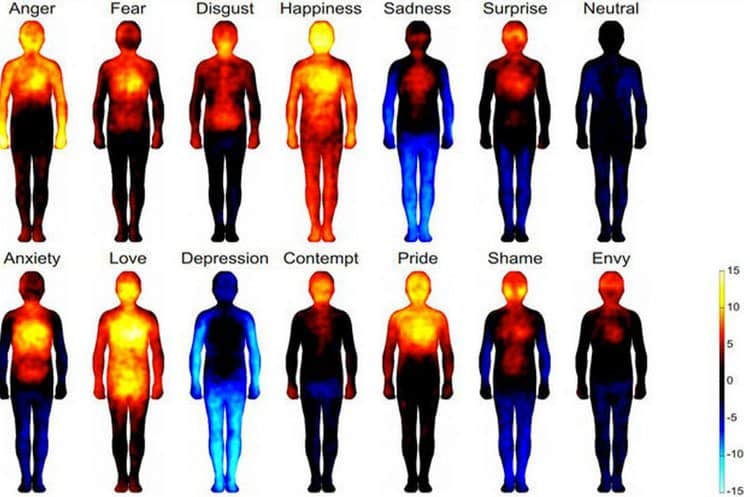
The study was published in the Proceedings of the National Academy of the Sciences and consisted of five experiments that included 701 participants. Researchers showed them two silhouettes of bodies on a screen and asked the volunteers to think about one of 14 different emotions, including love, anger, pride, sadness, etc.

Then, they asked the volunteers to paint areas of the body where they felt the emotions on the first silhouette, and on the second silhouette, shade in parts of the body where they felt the emotions become deactivated.

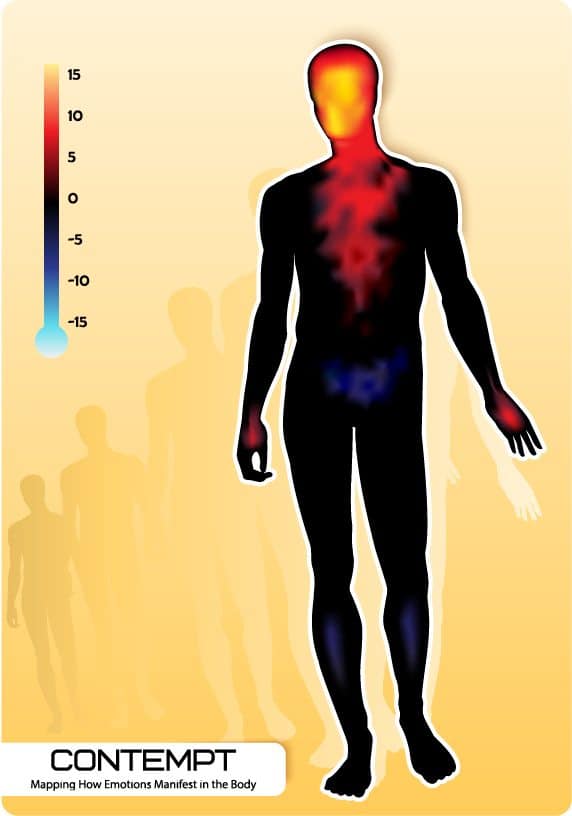
Here are what some of the emotional heatmaps look like:

Contempt

contempt

Contempt mostly activated areas of the head, neck, and chest, while the rest of the body remained neutral. We can speculate that since contempt means looking down upon someone or feeling that they’re beneath consideration, this boosts our own ego, which literally can get to our head if left unchecked.

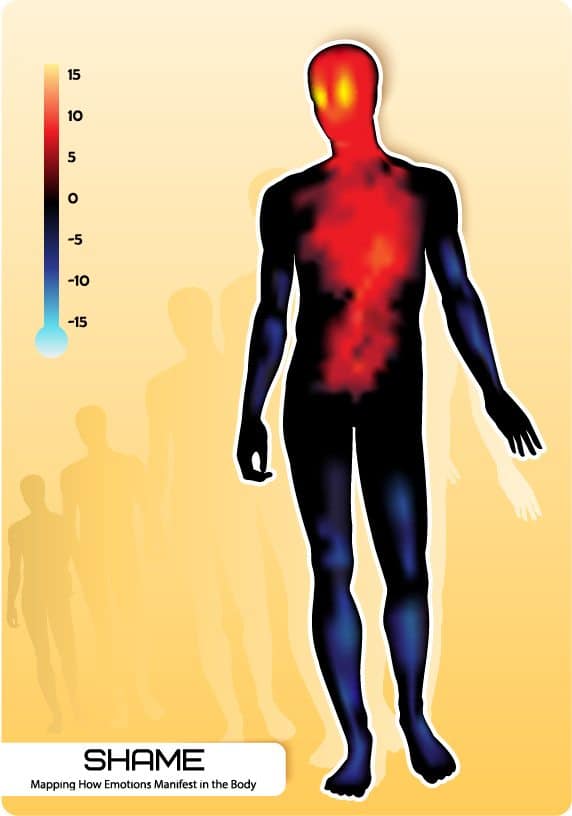
Shameshame

Shame caused much of the same areas to become activated as contempt, though emotions were felt a bit lower in the abdomen. Interestingly, people’s emotions became deactivated in the lower legs.

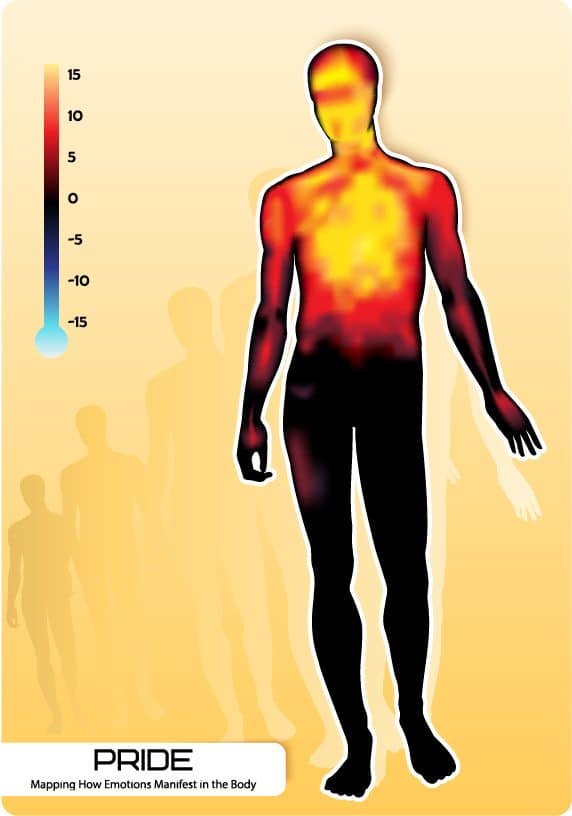
Pride

pride

It’s no surprise that people reported feeling pride in their upper body, specifically in their head and chest. Pride is a positive emotion and releases feel-good chemicals throughout the body.

Depression

depression

It’s also not a surprise that people reported decreased activity in the body when depression came to mind. Depression has a numbing effect on the body and looks virtually opposite of love and happiness on heatmaps.

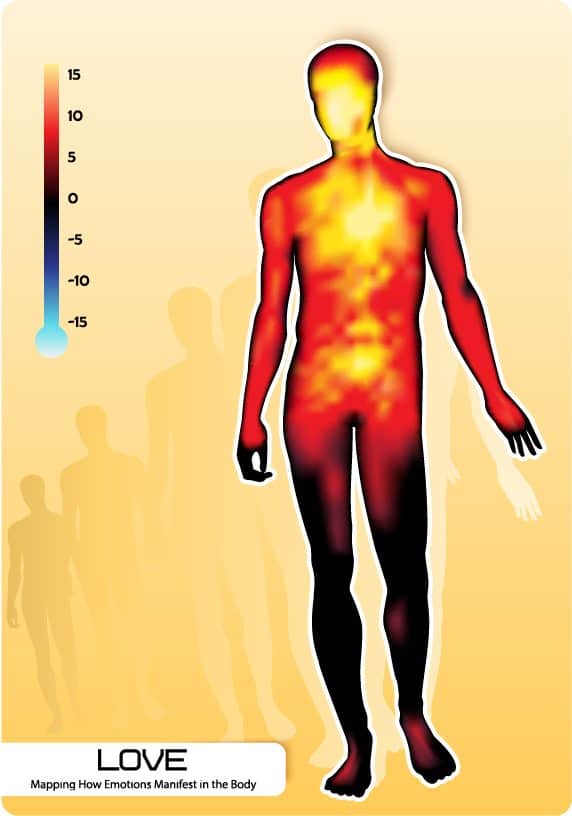
Love

love

As we said before, love causes the whole body to light up with positive emotions, because it’s such a powerful feeling. People reported the most activity in the head, chest, and lower abdomen (maybe this has to do with “butterflies!”)

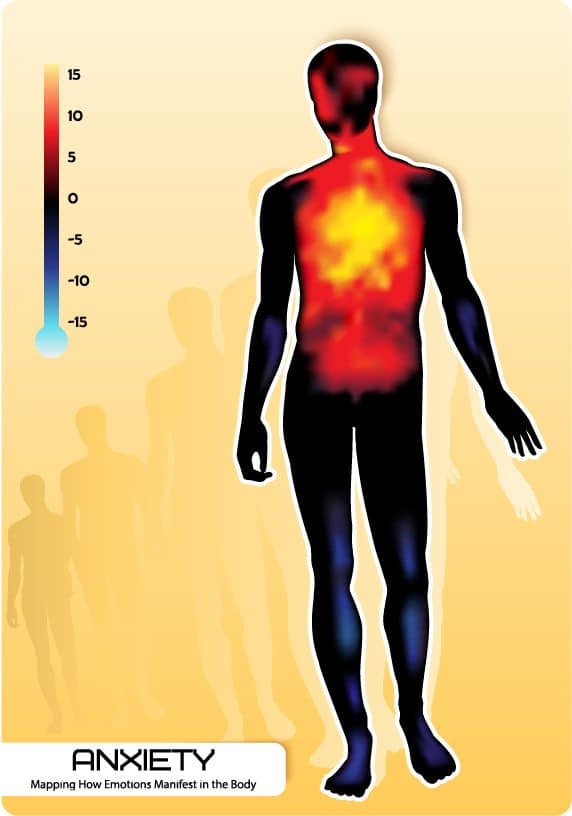
Anxiety

anxiety

We hate to end on a sour note, but anxiety is an important emotion to discuss. According to the heatmaps, anxiety was felt mostly in the chest. This makes sense because our hearts speed up greatly when we sense a threat, whether real or perceived.

For a quick recap, happiness and love increased activity across nearly the whole body, while depression decreased activity, especially in the arms, legs and head. Sadness also had a numbing effect, though not nearly as pronounced as depression. Danger and fear triggered strong reactions in the chest area, which makes sense because the fight-or-flight response speeds up our heartrate in response to a threat.

The authors stated that the results showed consistency across cultures, indicating that the heatmaps represent universal biological responses.

“Our data show bodily sensations associated with different emotions are so specific that, in fact, they could at least in theory contribute significantly to the conscious feeling of the corresponding emotion,” said Nummenmaa.

These results led authors to speculate that how we perceive these emotions within our bodies might have something to do with how experience them, as well.

So, this means that our awareness of our emotions as well as our conscious effort to feel certain emotions plays a role in how we feel them throughout our bodies. With that said, we have the ability to control our emotions to a certain extent.

Here are a few tips on doing just that:

heatmaps

Proceedings of the National Academy of Sciences of the United States of America PNAS, Proceedings of the National Academy of Sciences

Express your emotions; don’t bottle them up. Hiding your emotions can lead to things like depression, anxiety, anger, and other emotional problems.

Have an outlet for your emotions, whether that’s journaling, exercising, talking to a friend, etc.

Remember that emotions come and go. Don’t get so caught up in the moment. Instead, allow yourself to feel them and then let them pass. Remembering that feelings are temporary can help you transmute negative emotions into neutral or positive ones.

Practice mindfulness to help you get in better touch with your emotions and feel more grounded in your day-to-day life.

https://youtu.be/CU2LlJxEdJ4

Sources:
https://www.npr.org/sections/health-shots/2013/12/30/258313116/mapping-emotions-on-the-body-love-makes-us-warm-all-over
http://www.pnas.org/content/early/2013/12/26/1321664111
http://www.businessinsider.com/body-maps-show-of-emotions-2013-12
http://www.pnas.org/content/111/2/646
(C)Power of Positivity, LLC. All rights reserved

5 Behaviors That Reveal Someone Is Mentally Strong

Mentally strong people can relate to this quote:

“Nothing can stop the man with the right mental attitude from achieving his goal; nothing on earth can help the man with the wrong mental attitude.” – Thomas Jefferson

Let that sink in for a second. Everything we do or don’t do in life depends on our mental attitude. Sure, other circumstances can get in the way, but more or less, we have control over our lives, and our thoughts become our reality. Being mentally strong isn’t always easy, but anyone can learn how to balance their mind with practice.

Remaining mentally strong in life boils down to changing your attitude and outlook on life. Some of us have been through so many trials and tribulations with no choice but to become stronger. We’ll go over some everyday habits and behaviors of the mentally strong among us.

15 Signs of a Mentally Strong Person

(Note: Before we get into this article, we in no way are trying to understate or discredit the struggles of those with mental illnesses. We know that a mental disorder is challenging to manage, so keep this in mind as you read the article.)

mentally strong people

1.     They don’t complain much.

Mentally strong people try not to complain about their situation. Instead, they assess the problems and focus on solutions. They know that dwelling on problems will not make their situation any better; in fact, it usually magnifies the issues until they’re blown way out of proportion.

The toughest people know that the only constant in life changes, so they embrace that. Even if the changes are not necessarily positive, they go with the flow and don’t resist what life throws at them.

They change what they can and forget about what they can’t. Complaining about what they can’t change only creates chaos, and they steer clear of that thinking.

2. Mentally strong people take control of their lives.

Mentally strong people don’t blame others for their misfortunes or expect someone else to come and save them. While they might have a support system when things get tough, they don’t just sit around and wait for someone else to fix their life. They take charge and make the necessary changes so that their life feels good from the inside out.

In fact, they don’t procrastinate on what needs to get done for them to find fulfillment in their lives. They take responsibility for themselves and their lives and take action to create the life they desire.

3. They learn to dance in the rain.

Mentally strong people know that life doesn’t come with an instruction manual; they have to write it themselves. With that said, creating a life you love doesn’t come easily. You’ll face many obstacles, but in doing so, you’ll have a deeper appreciation for your life when you overcome them. Mentally strong people take the good with the bad and don’t let life rain on their parade. Where others see a roadblock, they see a detour.

4. They let go of bad habits.

Anything that doesn’t enhance their life must go. Mentally strong people know that creating your best self and ideal life can only happen when you let go of things that no longer serve you. Whether those bad habits are toxic relationships, drugs or alcohol, unhealthy foods, or something else, mentally strong people have learned to distance themselves from these temptations. They might indulge every once in a while, but they get right back on track and follow habits that add value to their lives.

5. Mentally strong people stand their ground.

This means saying “no” when something doesn’t feel right to them. They exert boundaries to maintain the integrity and don’t let others walk all over them. If they can’t fit something into their schedule, they have no problem letting someone know that. They respect themselves and don’t allow others to treat them like a doormat. Mentally strong people also don’t mind standing alone if it means standing up for what they believe in.

6. They embrace changes, whether good or bad.

Being mentally strong means remaining balanced at all times and not shying away from difficult situations. Whether they encounter positive or negative circumstances, a tough person will meet every situation with courage. You will never catch a strong person remaining stagnant in life or waiting for the right moment to take action. They jump headfirst into rough waters, knowing that they have what it takes to survive. This doesn’t mean they make foolish decisions, but they don’t allow fear to paralyze them either.

7. Mentally strong people avoid people-pleasing.

Mentally tough people won’t bend over backward to make someone else happy. They don’t purposely do things to upset people, but they also don’t go out of their way to please others. The mentally strong speak their mind in a discreet manner, knowing it isn’t their responsibility if someone gets upset with the truth. They don’t allow emotions to get in the way of reason; when something needs to get done, you can count on them to follow through.

mentally strong people

8. They believe in their abilities.

A mentally strong person doesn’t doubt themselves because they know everything in life occurs due to our thoughts. So, they cultivate positive thoughts about themselves and life in general to manifest a fulfilling reality. Because they have faith in their abilities, they often take jobs that challenge them and never hide from life.

9. Mentally strong people live a healthy lifestyle.

To have a balanced mind, you must have a strong body. Mentally tough people know this and choose their habits accordingly, so they have the energy to meet their goals. Exercise, a healthy diet, quality sleep, and a mindfulness practice like meditation are all part of their daily routine. Studies have proven that exercise helps ward off depression and anxiety and contributes to a positive mood, for example.

They also surround themselves with people who care about their health and motivate them to strive for greatness. Mentally strong individuals always want to improve somehow, so they want to associate with others who have similar goals.

10. They aren’t afraid of failure.

Some people tend to dwell on their mistakes and berate themselves for every little thing they do wrong. However, being a perfectionist usually doesn’t get you anywhere since you overthink every detail. Instead, mentally strong people keep trucking through life even if they fail at times. They see failure as a valuable learning experience and an opportunity for growth. For them, failure is a necessary step on the pathway toward success.

11. They don’t compare themselves to anyone.

Mentally strong people don’t see others as a threat or wish to trample people on the path to success. They only want to become better than the person they were yesterday, using only their progress as a measurement of success. As long as they see personal improvement, they feel satisfied and don’t need to compare themselves to others.

12. Mentally strong people cheer others on as well.

Mentally tough people don’t need to belittle anyone to raise themselves in life. They already have a positive self-image because they have done the necessary work to feel whole. So, they spread that magnetic energy with others and encourage them to reach their individual goals. They know that we only rise by lifting others, anyway, and they want to see everyone become their best selves.

13. They practice gratitude no matter how much they have on their plate.

Even if they have very little in life, mentally strong people always feel grateful for their family, job, home, and life. They realize that the littlest things in life, such as having the ability to walk, see or eat healthy food, shouldn’t be taken for granted. By saying a simple “thank you” to the universe each day, they infuse their minds with positive energy that they carry through the day.

14. They manage their time wisely.

Having mental fortitude means carefully using every second of the day, not wasting time idly or trying to accomplish too much. Mentally tough people follow a schedule and learn to delegate tasks, so they aren’t overwhelmed. They see time as a precious resource and treat every day as an opportunity to reach for the stars.

15. Mentally strong people lean on their support network when needed.

Even though tough people attempt to do most things alone, they know when to ask for help. Everyone has a breaking point, even the most mentally resilient among us. Studies show that having a support network during tough times can help reduce stress and increase mental wellbeing. So, mentally strong people call on their loved ones when they need help managing stress. It doesn’t make them weak, and they’re only human.

mentally strong people

Final Thoughts on Mentally Strong People

Becoming mentally strong doesn’t happen overnight; it gradually becomes a natural byproduct of healthy habits and mental control. Mentally strong people set boundaries, have respect for themselves, and don’t expect others to take the reigns in their life. They know that building a life they love is entirely up to them, so they rely only on themselves to create something out of nothing. This might seem overwhelming to some, but to a mentally strong person, it’s an opportunity to test their skills and develop a stronger relationship with themselves.

Marriage Therapists Explain 6 Habits That End Marriages

“It is not a lack of love, but a lack of friendship that makes unhappy marriages.” – Friedrich Nietzsche

The end of a marriage can creep up on you. Some people don’t even realize what went wrong until the marriage is already over.

Love and trust are vital components to the foundation of a solid marriage that endures.  But love and trust alone are not enough. When times get tough, and life being what it is, having skills to listen effectively (to yourself and your spouse), manage intense negative emotions well, and communicate in non-blaming or defensive ways, are the tools to navigate life’s tougher challenges,” says relationship expert Adrienne Levy, LMFT.

Relationship experts, and therapists who specialize in helping marriages stay strong, have compiled a list of reasons why marriages end. Recognizing the things that go wrong in a marriage will help everyone in the long run. Being aware of the top reasons that marriages end is the best way to make sure they don’t.

Here Are 6 Things That Can End Marriages

1. There’s no communication about the relationship

Many people think that once you get married, there’s no more need to sit down and talk about your relationship. This is false, and one of the main reasons that marriages end. Being able to sit down and discuss your relationship is vital, especially in marriage.

my one piece of advice is to keep communication open. In particular, be willing to validate your partner’s experience, listen, compromise, and attempt to foster empathy with your partner,” says couple’s therapist Dr. Rae Mazzei.

Being married is making a long-term commitment to your partner. You want to make sure that the channels of communication are open. Marriage doesn’t mean that the relationship is always going to work flawlessly. Communicate about your relationship to keep your marriage healthy and happy.

how to make relationship last

2. You have no relationships outside of the marriage

Having relationships and friendships outside of your relationship is key to keeping your marriage strong and healthy. You need to have a support system that isn’t just your spouse. This means that you have to have friends or strong relationships with your family members. Marriage therapists have pointed out that if your only strong friendship or relationship is your spouse, then your marriage might be in trouble. Having a support network and taking the stress of your partner is vital to a healthy and long-lasting marriage.

3. There are differences in values

When you get married to someone too quickly, you may not know that person inside and out yet. Marriage is supposed to be a time when you learn about the person you’re spending the rest of your life with. Sometimes, you find out that you don’t share the same values and morals.

Partners should be especially sure that their values match before getting into marriage. Although other differences can be accommodated and tolerated, a difference in values is particularly problematic if the goal is long-lasting love,” says associate professor of psychology Kelly Campbell, Ph.D.

Couples’ therapists explain that having a difference in values can be something big that ends a relationship. The key is to talk those differences out, respect them, and compromise on things in your new life together.

4. Keeping secrets from one another

While there are certain things that we often prefer to keep to ourselves, secret-keeping is a bad habit to have when you’re in a marriage. You don’t have to tell your spouse every thought that comes into your head, but consciously keeping secrets from them can quickly lead down a disastrous road. Marriage therapists don’t recommend keeping secrets from your spouse, no matter how big or small. Honesty is always the best policy and one that will nurture a healthy and long-lasting marriage.

5. Forgetting how important the little things are

After a while, the little things can start to get pushed away when you get married. You have kids, you have a mortgage, you have things that need to get done. Day in and day out, the “big things” start to take precedence over the “little things”. Marriages can end because people forget to compliment their spouse every day or thank them for the little things, like bringing them a cup of tea, or tidying up the living room.

When people feel recognized as special and appreciated, they’re happier in that relationship and more motivated to make the relationship better and stronger,” says Terri Orbuch, Ph.D., author and professor at Oakland University. Marriage should be built on a foundation. Forgetting all of the little things can make a marriage crumble. It’s important to always make time to nurture parts of the relationship that may be getting neglected.

6. Not knowing how to compromise

Compromise is truly key in marriages. Sometimes, things can’t always go our way. However, if you dig your heels in and refuse to compromise, there can be consequences. Namely, it can start to kill your relationship. Couples’ therapists see partners all the time that have trouble compromising, which can cause rifts in the relationship. Being flexible and having the ability to sacrifice a little bit for your partner is key to a long and happy marriage.

Final thoughts

Marriages end for all kinds of reasons. But, there are ways to turn it back around. Even if there’s something in your union that isn’t working, marriage therapists know that with enough devotion and patience, those problems can be fixed. Being open to learning and changing your behavior in a relationshipwill help you stay in love and keep your marriage long-lasting.

Researchers Reveal 3 Ways Your Relationship Changes Your Weight (And How It Helps You Lose It)

Losing weight can be a challenge for all kinds of people. There are hundreds of different diet and exercise tips for people who are trying to get healthy and lose a little extra weight. The problem, though, is that many of us don’t realize that the relationships that we’re in can actually affect our weight loss. On the flip side, though, relationships can also be extremely beneficial for weight loss.

How we change our eating and exercise habits can affect others in both positive and negative ways. On the positive side, spouses might emulate their partner’s behaviors and join them in counting calories, weighing themselves more often, and eating lower-fat foods,” says Professor Amy Gorin.

There are parts of relationships that can make weight loss difficult, but parts that can make it easier, too. Health experts and researchers have come to a few conclusions as to why this is. Here are the ways that your relationship can actually affect your weight loss.

Here Are 3 Ways Your Relationship Changes Your Weight (And How It Helps You Lose It)

“When one person changes their behavior, the people around them change.” – Prof. Amy Gorin

1. Stress

As we all know, stress can cause so much trouble in our lives. When your relationship isn’t going smoothly, stress is more likely to occur. Stress can cause us to skip our daily exercise routines. It can also cause us to overeat as a way to self-soothe. “This happens, in part, because the body releases chemicals in response to food that might have a direct calming effect,” says Jason Perry Block, MD.

If you’re having trouble with your weight loss, and you find that you’re actually gaining weight back, you might want to keep an eye on how much stress is going on in your relationship. Addressing the stress in your relationship might be just what you need to put your weight loss back on track.

2. Self-esteem

How much self-esteem do you have? If the answer is “not very high,” you might want to take a look at how much your self-esteem has contributed to your difficulty losing weight. Taking a long hard look at your relationship might be in order, as well. If your partner isn’t doing much for your self-esteem, they may be inadvertently causing problems with your weight loss.

Losing weight shouldn’t be based on shame or negative feelings. To lose weight, researchers often emphasize self-love and positivity over negativity. If your relationship is making you feel poorly about yourself, it may be one of the reasons you’re having trouble sticking with your weight loss goals.

good enough

3. Support

Are you getting the support you need in a relationship? If the answer is a reluctant “no”, you might notice that losing weight is a little more difficult than you anticipated. According to a study by a group of researchers, having a support system in place when you’re trying to lose weight is extremely important. Without a support system, you may find that your weight loss stagnates, or stops altogether. If you’re not getting the support you need from your partner, this may be why.

Of course, relationships aren’t always the cause of poor weight loss. In fact, relationships can be extremely beneficial for losing weight.

Here are some of the ways relationships affect your weight loss positively:

1. Brain signals to eat less

When you’re in a relationship that’s good, positive and supportive, you may find that you’re overeating or snacking less and less. This is because your brain releases a chemical called oxytocin. According to a group of scientists, “Oxytocin markedly reduced snack consumption, restraining, in particular, the intake of chocolate cookies by 25%.

This chemical is basically a happy pill for our brains and is often released when we are affectionate and intimate with our partners. An increased level of oxytocin also lowers our drive to snack, which can help you on your weight loss journey.

2. Your health matters more

If you weren’t particularly interested in eating healthy or exercising before you got into a relationship, you may find that those things suddenly seem to matter afterward. Researchers have found that once most people enter a healthy relationship, they care more about their health than they anticipated.

The research states, “For married couples, when one spouse participates in weight loss treatment, the untreated spouse can also experience weight loss.” Caring for your body is one of the quickest ways to put you on a path towards better eating and exercise.

3. Support

On the flip side of having no support in your relationship, healthy relationships often come with heaps of support. If your relationship is healthy and positive, you’ll find that your partner is supportive of your desires to eat better, exercise and generally take care of yourself. A supportive partner can make a world of difference when it comes to keeping the weight off. Researchers have found that weight loss is easier for those who are met with positivity and support for their choices.

Final thoughts

Weight loss is a challenge for anyone, whether they want to lose a few pounds or a significant amount. Relationships are one of the major things that can affect weight loss. However, these effects don’t always have to be negative. Relationships can positively affect our weight loss as well.

References:
https://www.medicalnewstoday.com/articles/320808.php
https://www.webmd.com/diet/features/stress-weight-gain#1
https://www.ncbi.nlm.nih.gov/pubmed/21164501/
https://www.ncbi.nlm.nih.gov/pmc/articles/PMC3781467/
http://onlinelibrary.wiley.com/doi/10.1002/oby.22098/full
Skip to content