Weekly tips, affirmations, and small actions to feel your best.

15 Things an Empathetic Person Does Without Realizing It

An empath is a person that is particularly good at tuning into the feelings of those around them. The feelings are so overwhelming that they may find it hard to be in large crowds due to their sensitive nature. Are you or someone you know an empathetic person?

One common simile that psychologists use to describe an empath is that they’re like a sponge. They can easily absorb both the pleasure and pain of others. These people don’t have filters to shield themselves from a bad situation, so it’s not uncommon for them to attract negative emotions.

They may not know why they are so upset at the end of the day, but they are no doubt channeling the emotional fields they’ve been around. Another common thing in this group is that they are sensitive to sounds. Hectic environments like the grocery store may cause significant stress and be too overwhelming.

Fifteen Key Behaviors Indicate You Are an Empathetic Person

The wonderful thing about these people is they bring a lot of heart and compassion to the world. If you tend to be empathetic, then here are 15 things that you might do without even realizing it.
empathetic person1. Your Care For Others Overshadows Your Care For Yourself

You can’t just feel bad for someone because your instincts require you to take it to the next level. You take on others’ emotions so profoundly that you often let that overshadow your need to take care of yourself. It’s not uncommon to become fatigued or burnout from all the energy used to help others, so there’s nothing left of you to pour into your own needs.

2. Intimacy Overwhelms You

Close contact with anyone can be problematic, but it can scare the empathetic person regarding intimacy in romantic relationships. You may become stressed and overwhelmed when you’re spending a lot of time with someone. Most of it stems from irrational fears of losing the one you love.

An empath often goes into sensory overload, which can be devastating during sexual encounters. Your “frayed nerves” keep you from some pleasurable life experiences. Often, people in relationships with an empath don’t understand their need for alone time and space.

Their requests for solitude come across as being hurtful, and then the empath absorbs those negative emotions. It’s common to see these people choose to remain single rather than attempt the roller coaster.

3. Can Pick Up On Subtle Cues and Provide Insight

An empathic person is known for having strong gut reactions. They use their instincts to pick up on dishonesty or other things that appear off. Empaths put a lot of faith in their instincts without noticing it.

Though some might say you’re a bit impulsive, you’re just using your gut to guide you. Those subtle clues that bypass others don’t get by you.

4. Nature Calls To You

There’s nothing wrong with spending time in nature, but the empath feels a calling to go to remote areas. Nature provides the serenity and calming that someone on sensory overload needs.

You can sit on the shore and watch the waves crash for hours or hike to a mountain peak for solitude. Empaths use nature to soothe an overstimulated mind, but you probably didn’t know why you felt such a closeness to the earth.

5. You Shop At Small Stores In Non-Peak Hours

Walking through the mall for a leisurely Saturday afternoon trip seems like fun to most folks. However, the empath is overwhelmed by the number of people, the noise, the lights, and the energy.

Since you can feel both positive and negative emotions, it’s too overwhelming to absorb all this racket, and your senses are on overdrive. Due to this tremendous feeling, you may choose to shop at smaller stores at non-peak times.

6. You Act Like a Therapist

Do you find that everyone tends to run to tell you their problems? Many friends and family members save time and money by coming to you instead of a psychologist.

An empathetic person may get so many people dumping on them that they feel drained at the end of the day. Considerate, empathic people are fantastic listeners, which is why you will never want for company.

7. You Avoid Perfumes, Candles, and Other Strong Scents

The increased sensitivity you feel isn’t just emotionally based on your overly sensitive to smells and sounds. Do you know that some empaths can’t take being around someone that wears perfume or cologne? Highly scented candles and air fresheners can also be overwhelming.

Loud sounds are an issue, so you probably prefer your technology volume to be friendly and low. Any loud noises can be physically jarring and can even cause panic.
empath8. You Need A Time Out To Restore Your Energy Reserves

It’s draining to be sensitive to others’ pain, so it’s easy for the empathetic person to become depleted both physically and emotionally. Even positive feelings can be overtaking. It would be best if you had time to rest and process all your emotions.

When the empath can’t escape all the feelings and rest, they can become burnout or even get physically sick. Some may feel that you’re an introvert, but that is not always the case. You’ve been energized till the point of exhaustion, and you need time to rebuild those reserves.

9. You Avoid Conflict At All Costs

Empaths dread any conflict because the higher sensitivity range makes you wear your emotions on your sleeve. You often walk away with your feelings hurt at even the slightest remark. You can’t help it, but you take criticism so personally that you avoid such altercations.

Any arguments will cause you more distress than the next person because your feelings and reactions are different than most. Since you have a habit of soaking up others’ emotions, you strive to address everyone’s hurt even when you don’t know-how. You don’t have the coping skills to deal with even the smallest fight.

10. You’re a Loner Because You Don’t Feel as Though You Fit In (even though you do!)

Even though people love to confide and be around you, you have a hard time relating to others on a personal level. Due to your sponge-like emotions and the fact that you become stressed so quickly, you feel like an outsider.

To avoid the feelings of being out of place, you keep your inner circle small. Empaths usually tend to be private people who prefer the company of a smaller crowd. It’s just less stressful.

11. You Isolate

Many people mistake empaths for hermits because they tend to isolate. It’s not that you don’t like to be around people, but those times of solitude are healing to you. You must be careful that you don’t isolate for too long because it can have a real impact on your mental health.

Many empaths get a pet as they can benefit from the bond, and it’s a relationship that isn’t as stressful.

12. You Look At Things Differently

Greater emotional knowledge drives your feelings, and you feel things others miss. Sadly, this connection can come with caveats. Spaces that don’t allow you to express yourself emotionally can put a lid on your creative side, and you will become detached and have problems thriving.

13. You Can’t Shut Off The Emotional “Noise.”

The emotional noise that comes from the world brings you much distress. Many empaths need help to manage the overstimulation they experience. Your quality of life can be affected when you don’t have self-care approaches and ways to protect yourself.

14. Music Isn’t Your Thing

Has anyone ever ridden in the car with you and commented why the radio wasn’t on? You like music, as long as it’s nice and low. However, when you’re trying to focus and pay attention to the other drivers on the roadway, you find the radio distracting.

15. You Don’t Set Appropriate Boundaries

All relationship requires firm boundaries. As an empath, you may struggle with the ability to know when to say no. You will give of yourself and resources until nothing is left.

Since others’ problems and emotions take such a toll on you, boundaries become even more critical. Even your words or actions must have limits so that you don’t cross a line that takes you a while to bounce back from. When firm boundaries aren’t in place, you may become unable to decipher your emotions from those around you.

empathetic personFinal Thoughts On An Empathetic Person

Many people often confuse having sympathy for being an empathetic person. The two personality types are vastly different. Anyone can sympathize with someone going through a hard time, but the empathetic takes it to another level by absorbing others’ emotions.

It’s essential to have coping skills in place to keep you from getting burned out. Also, take time to be in nature and have some solitude among the wind and trees. Find ways to recharge your batteries so that you don’t become so overwhelmed by others’ emotions that you can’t live your life to the fullest.

Study Finds Striking Similarities Between The Brain And The Cosmos

Scientists have recently discovered uncanny similarities between the neuronal structure of the brain and the patterns of the universe. This connection to the cosmos is striking.

Of course, many scholars and researchers have already noted that humans and nature share the same structure. For instance, our veins look much like the branches of lightning, and our fingerprints have similar patterns as tree rings. Nebulas in space have oddly similar structures as our irises, and the birth of a cell looks like the death of a star.

How do we explain all of this? It seems now that science is finally catching up with what the sages and saints in various religions have said for millennia. We are not only a part of the cosmos – we ARE the cosmos experiencing themselves. Therefore, since we come from stardust, our makeup bears a striking resemblance to nature and the cosmos.

A new study provides further proof that the human brain and the universe have more in common than we think. Of course, the similarities go much deeper than just appearances. In fact, the two have well-defined networks and organizational patterns. The findings were published in Frontiers in Physics on November 16, 2020.

How the study linking the cosmos to the human brain worked

pop memeFor the study, an astrophysicist and a neurosurgeon used quantitative analysis to compare the complexities of the brain and the Universe. In the brain, the neuronal network creates the structure, and in the universe, galaxies make up a complex system. You’ve probably seen the image online, which shows a side-by-side comparison of a neuron and galaxy cluster. The idea of our brains acting as a mini version of the universe doesn’t seem too farfetched after seeing the pictures.

However, the researchers wanted to dig deeper and uncover the similarities which don’t seem obvious at first glance. Astrophysicist Franco Vazza of the University of Bologna in Italy and neurosurgeon Alberto Feletti of the University of Verona collaborated on the study. They’ve dedicated the last few years of their lives to analyzing the similarities between the universe and the human brain.

Here’s what they discovered so far

The brain and universe have a size difference of 27 orders of magnitude (or a billion billion billion). Of course, the energetic processes which create the structure of the brain and universe differ greatly. However, the researchers say that they both have similar levels of intricacy and self-organization. They dedicated their study to find out more about these structural similarities.

For starters, they found that the human cerebellum contains about 69 billion neurons. The cosmos have about 100 billion galaxies. The team also discovered clearly defined networks running each one, with filaments connecting the nodes of both systems. Again, the neurons in the brain and galaxies in the Universe act as “networks.”

The information and energy that flows between nodes only amount to 25 percent of each system’s mass and energy. Furthermore, the composition of the brain and the universe have stark similarities. While the brain contains about 77 percent water, the universe comprises around 72 percent dark energy. These materials play a passive role in helping the systems function, but the structures couldn’t exist without them.

The study data

After determining the similarities, they compared the structures quantitatively based on side-by-side comparisons. They got samples of the human cerebellum and cortex at various magnifications and compared them to the cosmos’ simulations. They looked specifically for similarities in the matter density fluctuations of each. While the two operated on vastly different scales, the team found similar distribution patterns in the density fluctuations.

“We calculated the spectral density of both systems. This is a technique often employed in cosmology for studying the spatial distribution of galaxies,” Vazza said in a news release. “Our analysis showed that the distribution of the fluctuation within the cerebellum neuronal network on a scale from 1 micrometer to 0.1 millimeters follows the same progression of the distribution of matter in the cosmic web but, of course, on a larger scale that goes from 5 million to 500 million light-years.”

Fascinated by this discovery, the team dug even further and looked at the number of filaments connecting each node. They found the cosmic web, or galaxies, had about 3.8 to 4.1 connections per node on average. The human brain had about 4.6 to 5.4 connections per node. Furthermore, both structures seemed to have more connections around central nodes and have similar information capacities.

In a recent study, researchers found that the human brain can hold about 2.5 petabytes of memory. Another recent study by Vazza suggests that the Universe would need around 4.3 petabytes to hold the entirety of its memories.

cosmosPrevious studies linking the cosmos to the human brain

In a previous study back in 2017, the researchers wrote that:

“Roughly speaking, this similarity in memory capacity means that the entire body of information that is stored in a human brain (for instance, the entire life experience of a person) can also be encoded into the distribution of galaxies in our universe.”

This doesn’t necessarily mean that the Universe IS a brain or can have an awareness of itself. Although, some scientists and religions believe that the cosmos have intelligence just as we do. However, this study shows that the laws of the cosmos seem to create the universe and brain in the same fashion.

Studies in the past seem to confirm this. According to a 2012 paper about simulations, the causal network which makes up the universe greatly resembles that of the brain. Also, complex systems such as the Internet, and social and biological systems, share this structure. The recent study by Vazza and Feletti could help scientists understand these overarching laws and systems more intricately.

“Once again, structural parameters have identified unexpected agreement levels. Probably, the connectivity within the two networks evolves following similar physical principles, despite the striking and obvious difference between the physical powers regulating galaxies and neurons,” Feletti said.

“These two complex networks show more similarities than those shared between the cosmic web and a galaxy or a neuronal network and the inside of a neuronal body.”

 20 Signs That Reveal A Child May Have Tourette Syndrome

Tourette Syndrome (TS) is a neurological disorder that affects both children and adults. According to research, approximately 1 in every 162 children have Tourette Syndrome. Sadly, many kids who suffer from TS go undiagnosed. As a parent, it’s important to be aware of the signs that could indicate your child has this disorder. Here is a list of common TS symptoms in kids.

About Tourette Syndrome

This neurological disorder was named after Dr. Georges Gilles de la Tourette, a French neurologist who first discovered TS in 1885. It’s characterized by involuntary and often repetitive movements or vocalizations that are called tics. Tics can last for several seconds or several minutes. A common misunderstanding of TS is that patients yell out inappropriate or obscene words and display obscene gestures, but these are rare behaviors and only add to the stereotypical thoughts about TS.

Tourette SyndromeCommon symptoms

Signs of TS typically show up in kids between 7 to 10, but it’s possible for signs to show up as early as 2 years of age or younger.  Although it can show up as late as 18, tics that start after that age aren’t considered Tourette Syndrome. Surprisingly, approximately 1/3 of kids with TS have no tics when they get to adulthood.

There are many symptoms of Tourette syndrome. Here are some that are more common, according to the National Institute of Neurological Disorders and Stroke.

  • Humming
  • Hopping
  • Kicking
  • Eye blinking
  • Grimacing
  • Head jerks
  • Arm flapping
  • Shoulder shrugs
  • Stomping
  • Grunting
  • Constantly touching people or things
  • Barking
  • Throat clearing
  • Shouting out a word

Kids who have TS can also display these symptoms:

  • Trouble focusing and concentrating
  • Behavior problems: aggressiveness, irritability, or immature behavior.
  • Attention deficit hyperactivity (ADHD)
  • Obsessive-compulsive disorder (OCD)
  • Purposeful self-harm
  • Emotional upsets
  • Anxiety
  • Sleep problems: troubling falling asleep, talking during sleep, nightmares, restless while asleep

These signs could reveal your child has Tourette Syndrome.

1 – Social problems

One common sign of TS in children is a  lack of understanding of social skills at an age when they should begin to practice them. Your child may have a total disregard for age-appropriate social skills like greeting, smiling, or playing with other kids. At first, you may think they’re shy or need extra training, but as you notice other kids their age practicing social skills, it becomes clear that your child has social problems.

2 – Sudden, brief repetitive movements

Early signs of TS will be tics that are sudden and repetitive. Young kids like to move a  lot and mimic others, but TS tics are different. Neurologists describe them as quick and repetitive motions, beyond what’s usually seen in kids.

3 – Vocalizations

Tourette syndrome vocalizations vary depending upon the child. According to the Centers for Disease Control (CDC), these vocal expressions are common in TS. They include:

  • Barking
  • Hissing
  • Grunting
  • Throat clearing
  • Whistling

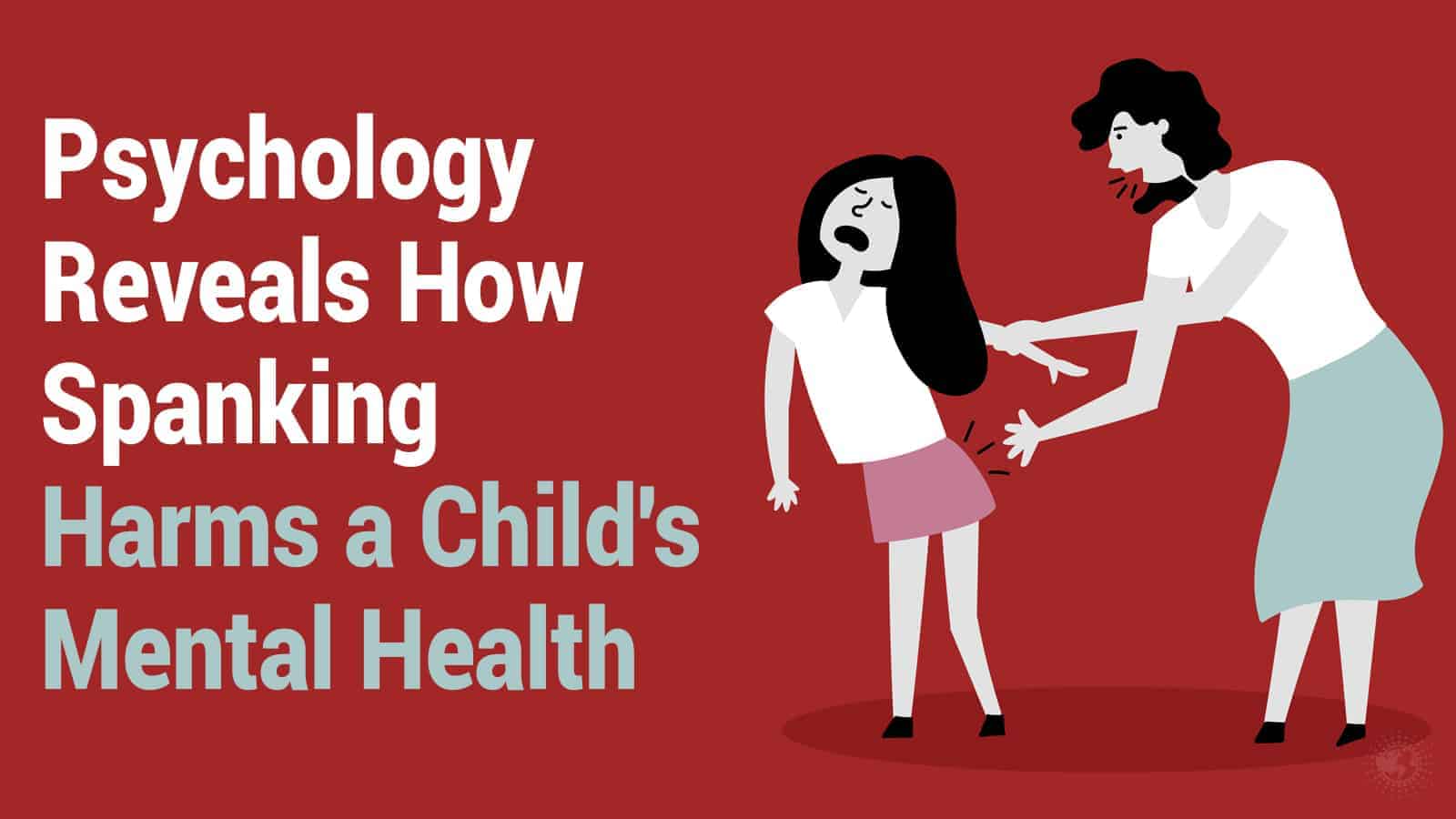
As a parent, you may feel irritable at your child’s incessant repetition. At first, you may think the child is doing these movements on purpose to irritate you or a sibling. Watch what the tics look like and when they show up. Don’t assume it’s behavioral. Never punish a child for these tics. This can make them worse and make your child feel like you don’t understand.

4 – Tics worse when excited

Your child’s tics may get more pronounced when they’re excited about an event or a special surprise. You may think the movements are a silly habit that your child does to show excitement, especially if they’re very young. Keep an eye on these movements and when they occur. You’ll see a pattern emerge over time.

5 – Feeling of being out of control

Kids who have TS say that they feel an urge or sensation right before the tics begin. This is similar to when you feel a sneeze coming on. They can feel like they need to complete the tic a certain number of times to fulfill this urge or make it go away.

6 – Clothes can trigger tic

Your child’s clothing may trigger tics. Your son may complain of tight collars or long sleeves and want to wear shorts or tee shirts when it’s cold outside. They may feel frustrated about this and embarrassed if other kids or adults mention their off-season clothing.

7 – Sounds can trigger tics

Certain sounds can trigger your child’s quick jerking movements like someone sniffing or clearing their throat. Television shows can also trigger tics if there is barking or some kind of repetitive behavior that your child mimics.

8 – Tics while asleep

A sign that your child has TS is that they will continue having tics even while they’re asleep. The tics may be less pronounced, but you’ll see them moving a lot and the same type of movements you notice during the day.

9 – The tics seem to be in the head or neck area

Some of the earliest signs of Tourette syndrome are jerking or repetitive movements of the head or in the neck area. Repetitive shrugging or head shaking is often the first thing a parent notices, especially in very young children. It can be misinterpreted as typically silly childish fun, but over time you’ll realize it’s not something your child can control.

10 – Subtle tics at first

Your child’s tics may be very subtle at first, almost like they’re having fun using their body in funny ways. But over time you’ll see more pronounced tics and that your child isn’t trying to do the movements. Eventually, the tics may begin to disrupt the child’s daily life.

11 – Other neurological conditions at the same time

If your child already has a neurological condition, they could develop TS along with it. The conditions that go hand in hand with Tourette syndrome include the following:

  • ADHD
  • OCD
  • Trouble processing and understanding information
  • Aggressiveness
  • Rage
  • Mood disorders: depression or extreme excitability
  • Anxiety: fearfulness, shyness, and separation anxiety.

12 – Early symptoms

The early TS signs are hard to read, but they generally start in your child’s head, neck, or arms. They may start as:

  • Blinking
  • Eye rolling
  • Jerking head from side to side
  • Head shaking
  • Arm flapping

spanking13 – Biological and genetic connections

Studies show that Tourette syndrome has genetic components. Recently researchers have found structural changes in two genes associated with TS. As these researchers move toward understand the disorder’s biology, they’ll be able to find treatments to help kids affected by TS.

14 – Boys affected more than girls

Early Tourette syndrome is 3 to 4 times more common in boys than in girls. It’s often more severe in boys, too. It’s not totally understood why this is the case.

15 – Tourette Syndrome could look like an allergy

It’s hard to tell whether your child has Tourette syndrome or an allergy that’s causing sniffing, blinking, coughing, and throat clearing. If you see these symptoms, take your child to the pediatrician to check for allergies. Many kids spend years going to allergists and pulmonologists only to find out that they have Tourette syndrome.

16 – Anxiety makes tics worse

Experts agree that stress and anxiety make TS symptoms worse. You may notice the tics are more pronounced on your daughter’s the first day of school or before your son’s basketball game.

17 – Repeating

Kids are notorious for asking for things over and over. You may attribute your child’s repeating and mimicking of you or family members as childish behavior, especially if they’re quite young. Kids with TS often ask to hear something over and over again and then repeat it again and again.

18 – Combination of several movements

Your child may have more than one or more tics that happen simultaneously or right after each other, such as blinking and then shrugging or humming and then yelling.

19 – Tourette Syndrome can show up in babies

You’ll notice behavior that appears like your child is doing them on purpose, such as

  • Kissing sounds
  • Pinching
  • Sticking out their tongue
  • Lip-smacking

20 – Tiredness makes it worse

Just like anxiety and excitement trigger tics, when your child is overly tired you may notice that they have more pronounced tics. This can be alarming for a parent to realize these movements are involuntary.

Can my child stop the tics?

Studies show that even though Tourette Syndrome is involuntary, sometimes patients can suppress or hide their tics to reduce the impact. That being said, the tics can be made worse from the stress of trying to suppress the tic. Never try to force your child to stop doing these behaviors.

What should you do?

If you notice your child has a tic, you should take them to the pediatrician. Some children grow out of tics. This means that not all tics are Tourette Syndrome. But if your child does have this disorder, the sooner you get a diagnosis, the sooner your child can get treatment.

What causes Tourette Syndrome?

Tourette Syndrome is still a mystery to doctors. Scientists think there are genetic considerations that could contribute to it, plus they think that these things could contribute to this disorder.

  • Environmental risks
  • Smoking during pregnancy
  • Pregnancy complications
  • Low birthweight
  • Infections: For some reason, tics can show up after your child has an infection.

Treatments for Tourette Syndrome

Relaxation techniques and behavioral treatments such as awareness training have been successful for TS patients. Recent studies found that training patients to move when they feel the urge of a tic coming on can help reduce the symptom. Biofeedback and counseling may also prove to help.

Tourette SyndromeFinal thoughts on a Tourette Syndrome diagnosis in your child

As a parent, you want your child to feel healthy and happy.  Because you know your child best, you are the best person to notice symptoms and advocate on their behalf.

If you suspect your child may have Tourette syndrome, arrange an appointment with your pediatrician right away. They can help give an accurate diagnosis and find the best treatment for your child. The sooner your child is diagnosed the better since there are many treatments that can give your child the normal, happy life that you want for them.

Psychologist Explains Why Doomscrolling Causes Anxiety and Depression

Have you ever heard of the term doomscrolling? What is this new mental health concern that has psychologists up in arms? Well, people who are continually scrolling and looking for updates to tragic events may be in danger by ingesting so much negativity daily.

The past few months have brought about challenging conditions that people worldwide must learn a new reality. Life isn’t as it was before, and people are struggling to stay sane while living with a new set of rules. Many folks work from home, isolated from family and friends, and trying to adapt to dealing with the current epidemic.

Your lying-in bed with your mind racing about all the happenings of the world. Your bored, scared, frustrated, and have an unsettling feeling you can’t shake. You check into a local app or favorite news source to see what’s going on.

You want statistics and the latest happenings to put your mind at ease. Once you’ve satisfied your curiosity for an update, you move onto something else. The only problem is that you find that you’re repeating the process all over again in a few minutes.

You’re obsessed with knowing what’s going on, and it’s a thought or feeling you can’t shake until you find out. From presidential election updates to virus happenstances, you want to know where you stand. You’re concerned if life as you know it will ever return to normal.

Before you know it, you’ve been scrolling and reading comments on social media for hours. This year has been monumentally unpleasant, and people on Twitter developed the term doomscrolling or doomsurfing to describe those obsessed with staying informed. Is it possible that 2020 is causing a new concern that goes far beyond the obvious?

Protective Mechanisms and Primal Instincts

anxietyFirst, you should know that it’s completely normal to want to stay informed. It’s human nature to gather as much information as possible when someone feels they’re in danger. The amygdala is a structure within your brain’s limbic system that controls your fight-flight-freeze mode.

When there is a danger in your environment, you’re constantly scanning for new threats. Your brain kicks into overdrive as it’s an instinct that saves lives. Imagine how the cavemen felt with all the dangers around them, yet they didn’t have social media or other technological advances to keep them informed.

They had to rely on gut instincts and their protective mechanisms to keep their families safe. With the pandemic being a genuine threat in today’s society, your brain is kicking into a hypervigilant state with ease. Psychologists confirm that fight or flight contributes to anxiety, depression, and even obsessive-compulsive disorder.

Why Doomscrolling is Bad For Your Mental Health?

You may feel that it’s harmless to scroll the internet trying to find out the latest news. However, this activity is a significant waste of time, but it’s filling your mind with so much negativity. Reading this stuff makes you panicked about life and your security, which can cause you to be hostile, aggressive and lead to stress, anxiety, and eventually, depression.

The New York Times did a study in July of 2020 when the pandemic was peaking for the second time this year. They found that people were devoting 50 percent more of their time to scrolling for updates. This is precious time that you could be using to do other more resourceful things.

The more you search through commentary, news articles, and other occurrences, the more you feel helpless. You can do nothing to change the situations around you, but you can protect your family by following local mandates. If you continue doomscrolling endlessly, then some severe side effects can be harmful to both your physical and mental health.

Side Effects of Doomsurfing

What happens to an apple when it gets a bad spot on it? The rotten area is full of bacteria, and it grows until it takes over the whole piece of fruit. Now, use that analogy when it comes to putting negative things into your mind.

Sure, initially, it’s just a bad news report here or a troubling specialist giving their spill there. However, soon you become so permeated with the rottenness of negativity that it affects your entire wellbeing. Listening to all the terrible things occurring in the world leaves you with a sense of helplessness and dread.

You cannot change the circumstances, but you must learn coping skills to live with them. While you would think that doomscrolling is limited to your mental health, it can also affect your physical health. The following things have been observed with this state of mental unrest:

•Upset Stomach/Nausea

•Chronic Headaches

•Muscles Tension

•Fatigue

•Insomnia

•Poor Sleep Quality

•Appetite Issues

Reducing Internet-Induced Anxiety

You don’t have to accept the mental and physical consequences that come from doomscrolling. Rather than looking at all these negative things, why not look for something positive that makes you smile? If you think you’re alone in your internet scrolling obsession, you would be mistaken.

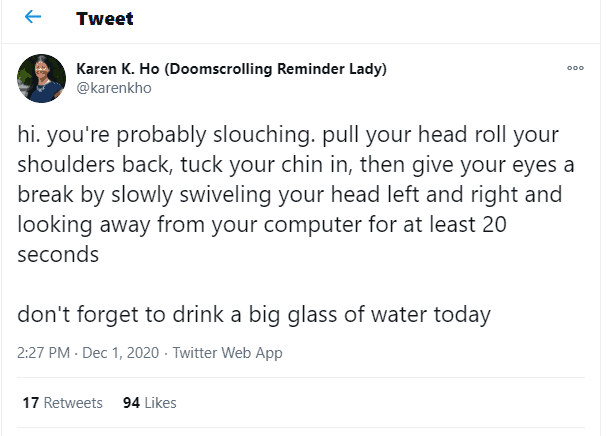
Doomscrolling is so pervasive these days that one Twitter user, journalist Karen K. Ho, now uses the handle Doomscrolling Reminder Lady. Each day, she sends our words of encouragement and advises people to put down the phone and appreciate the positive things in life. From the many positive comments on her feed, it appears that her followers are both welcome and respect her common-sense reminders.

doomscrolling

Clinical Psychologist Dr. Amelia Aldao warns that “doomscrolling traps us in a vicious cycle of negativity” that triggers those anxious feelings. Here are five easy ways to help you break this harmful habit.

1. Set A Limit on Your Consumption Time

Give yourself a timed limit of how long and when you can surf. Reward yourself for cutting down your internet usage. Set the alarm to alert you to check the news, and don’t surf news and world reports during any other period. A good 10-15 minutes is all you need to get the gest of what’s going on.

2. Focus on News Where You Live

While it’s easy to become engrossed with what’s going on nationally or in or another state, try to focus on the news that pertains to you. It doesn’t mean that you don’t need to be informed of happenings across the globe, but you need to pace yourself. Your depression or anxiety is your body is trying to tell you it’s on overload from all this negativity. So it would be best if you cut back.

3. Opt-Out of News Alerts

News alerts can be beneficial, but they can also give you a burst of anxiety when they alert you with the latest happenings. If you’re already suffering from depression and anxiety, the last thing you need is something alerting you always to negative things. Face it; nothing on the news is ever good.

4. Replace Scrolling with A Game Or E-Reader

One good way to divert your mind is to turn your attention to something else. Why not find a game on your play store that you love to play? Anytime you get the urge to scroll, you can play your game to release anxiety.

Additionally, an e-reader is an excellent choice so that you can brush up on your reading skills. Is there a new book you’ve wanted to read?

5. Don’t Keep Your Phone By Your Bedside

Most doomscrolling happens when you have idle time. So, rather than using your phone as an alarm clock or newspaper, please remove it from the side of your bed. Keep it close enough that you can hear if someone should call, but it should be out of your reach.

Most people find themselves surfing for hours on end when they cannot sleep, which will only acerbate the issue. Keeping the phone away from the bed will improve your sleep and help you to stay focused on getting some rest.

doomscrollingFinal Thoughts on Doomscrolling

If you’re continually scrolling your phone for the latest updates and breaking news, then you may find your brain is on overload. The bad-news-tracking impulse is something that is affecting millions across the globe because knowledge is power. Your primal instincts are kicking in as you want to protect you and your family.

Why do you think people are hoarding toilet paper, food, and doing other senseless things that are only making the situation worse? They hear of a toilet paper shortage and jump on the bandwagon. Fear is a tremendous motivator, and it’s time that you stop letting it have a foothold in your life.

Today, make an oath to yourself to slowly back away from the doomscrolling and start ingesting more positive things. You will be surprised by the difference it will make in your mental and physical health.

Cognitive Therapies Can Improve Schizophrenia, According to Research

Schizophrenia is a chronic and serious mental disorder that affects around 20 million people worldwide, according to the World Health Organization. Symptoms and characteristics include distorted thinking, emotions, and sense of self, auditory and visual hallucinations, and delusions. Most people with schizophrenia develop it in early adulthood, and men tend to show symptoms earlier than women. Annually, the new number of schizophrenia cases is 1.5 per 10,000 people.

Schizophrenia is in the top 15 leading causes of disability worldwide. In the U.S., around 1.5 million people get diagnosed with it every year. Risk factors for schizophrenia include genetic traits, chemical imbalances in the brain, and environmental stress in early life. People with this disorder are 2-3 times more likely to die early than the general population. This is mostly due to physical illnesses like cardiovascular disease or infections.

Common symptoms associated with schizophrenia, according to the World Health Organization (WHO):schizophrenia

  • hallucination: hearing, seeing, or feeling things that are not there;
  • delusion: fixed false beliefs or suspicions not shared by others in the person’s culture and that are firmly held even when there is evidence to the contrary;
  • abnormal behavior: disorganized behavior such as wandering, mumbling or laughing to self, strange appearance, self-neglect, or appearing unkempt;
  • disorganized speech: incoherent or irrelevant speech; and/or
  • disturbances of emotions: marked apathy or disconnect between reported emotion and what is observed, such as a facial expression or body language.

Other symptoms may include:

  • The poverty of speech: Minimal speech or giving short-responses to questions.
  • Anhedonia: Lack of pleasure from things they used to enjoy, decreasing interests. This leads to decreased involvement in a person’s community, affecting the quality of life.
  • Lack of motivation: A person may not have the internal motivation to follow through with tasks in everyday life, such as getting ready in the morning.

Despite the severity of this disorder, it’s highly treatable. Research suggests that Cognitive Behavioral Therapy (CBT) is most effective in treating schizophrenia. A study recently published in the Journal of Psychological Medicine found that antipsychotic medicines, along with therapy, led to significant improvements. Specifically, UCLA scientists and colleagues found that patients receiving both treatments showed better cognition and increased productivity.

Researchers also said that patients using this combined treatment approach saw dramatic improvements in work and school performance. This is partially due to memory, and problem-solving skills taught in therapy sessions. Since schizophrenia affects how a person thinks, feels, and behaves, cognitive treatments help them organize their thoughts better. This leads to improvements in all-around functioning, helping them integrate with society and have a chance at a normal life.

People with this disorder may appear to “be in their own world” or lose touch with reality, leading to permanent disability. Many sufferers don’t even recognize it as a problem at first because the hallucinations appear so real. It usually causes distress for friends and family, but therapies can help the patient reconnect with loved ones. Consistent treatment can help patients perform better in school or work settings and regain independence.

pop quoteThe schizophrenia study

For the research, the team put patients through a 12-month randomized controlled trial. 60 patients from the UCLA Aftercare Program who had recently experienced a schizophrenic episode for the first time took part in the study. They either received oral or long-acting injectable antipsychotic medication and either cognitive therapy or healthy behavior training.

Cognitive-behavioral therapy included training in attention, memory, and problem-solving skills to help patients handle complex, real-life situations. Healthy behavior training included proper nutrition, stress management, and exercise, with the same treatment time. All patients received help with employment and education to encourage them to re-enter work or school environments.

The study confirmed that cognitive training and consistent doses of long-acting antipsychotic medication significantly improved symptoms of schizophrenia. The therapies showed a separate positive impact on work and school functioning.

UCLA researchers included: Keith Nuechterlein, Joseph Ventura, Kenneth Subotnik, Denise Gretchen-Doorly, Luana Turner, Laurie Casaus, John Luo, Michael Boucher, and Jacqueline Hayata. Morris Bell of Yale University and Alice Medalia of Columbia University also contributed to the study.

The value of early detection and treatment

Early treatment can significantly improve the long-term outlook for patients with this disorder. Patients often experience the worst symptoms in the early stages of the illness, when the risk of suicide is highest. At the onset of schizophrenia, around 5% of people die by suicide. 20% of people with the disorder attempt suicide at least once.

The majority of people with schizophrenia get better over time with proper treatment. In fact, 20% of people improve within five years of showing symptoms. Since genetics is a huge risk factor, people with a family history of this disorder may want to seek mental health treatment. This way, treatment can begin early, increasing the chances of improvement.

Unfortunately, only around 31% of people with the disorder seek treatment. Usually, the stigma attached to the disorder and being low income prevents people from getting help. 90% of people with untreated schizophrenia live in low- and middle- income countries.

Racial inequities are evident in schizophrenia

Schizophrenia diagnosis by race/ethnicity

  • The lifetime prevalence of self-reported psychotic symptoms is highest in African Americans (21.1%), Latino Americans (19.9%), and white Americans (13.1%). (Psychiatric Services, 2013)
  • The lifetime prevalence of self-reported psychotic symptoms is lowest in Asian Americans (5.4%). (Psychiatric Services, 2013)
  • Research has found that Black Americans are three to four times more likely than white Americans to be diagnosed with schizophrenia. (World Journal of Psychiatry, 2014)

schizophreniaFinal thoughts on the study showing cognitive therapy can improve schizophrenia.

While schizophrenia is a severe, debilitating mental illness, studies show that cognitive therapies, along with medication, can lead to significant improvement. In fact, around 20% of people with the disorder improve within 5 years of first showing symptoms. As with any mental illness, early treatment and intervention significantly increase the chances of getting better. If you have a family history or show early symptoms of schizophrenia, you may consider seeking mental health treatment.

Research Connects Positive Thinking With Reduced Memory Loss

A new study reveals that positive thinking may help reduce memory loss as people age. It seems the people who look at life through rose-colored glasses may have the right idea after all. This study adds to mounting research about the role of a good attitude, or ‘positive effect,’ in healthy aging.

The study, published on October 22, 2020, in the journal Psychological Science, found that people with an optimistic attitude have better memory as they age. Most people want to retain good memories in life, but the ability to do so largely depends on emotional and physical health. While many factors come into play in regards to the strength of our memory, it turns out being cheerful can reduce memory loss.

The study

reduce memory lossFor the study, a team of researchers analyzed data from a 9-year longitudinal study involving 991 middle-aged and older U.S. adults. They all participated in a national study conducted at three separate times: between 1995 and 1996, 2004 and 2006, and 2013 and 2014. In the questionnaires, the participants reported on various positive emotions they’d experienced in the past 30 days.

In the last two assessments, the researchers also gave the participants tests to observe the strength of their memory. For these assessments, participants had to recall words right after they’d been said to them, and again after 15 minutes passed. The researchers analyzed how positive thinking could reduce memory loss, taking age, gender, education, depression, negative outlooks, and extroversion into account.

“Our findings showed that memory declined with age,” said Claudia Haase, senior author of the paper and an associate professor at Northwestern University.

“However, individuals with higher levels of positive affect had a less steep memory decline over the course of almost a decade,” added Emily Hittner, the paper’s lead author and a Ph.D. graduate of Northwestern University.

In the future, they hope to do further studies on what life factors may improve positive affect, and therefore reduce memory loss. For example, better physical health and stronger relationships may play a role in one’s overall happiness.

Other ways to reduce memory loss

 In addition to thinking positively, other lifestyle factors can help improve your memory:

1 – Get plenty of exercise.

pop memeExercise improves every aspect of health, not just our physical appearance and muscle-to-fat ratio. You will increase your endurance and strength, plus give your brain muscles a run for their money as well. Since the mind and body are inarguably linked, we must take care of them both.

Lack of exercise can lead to developing health problems such as obesity. A growing body of evidence links obesity and all the health complications that go along with it to increased memory loss. Furthermore, obesity heightens the risk of developing Alzheimer’s or dementia later in life.

Researchers believe this may occur because obesity negatively affects brain structure and volume. Overweight and obesity cause the hippocampus to shrink, which leads to cognitive decline. Also, the same proteins in the brain that lead to Alzheimer’s have been found in those with severe obesity.

Several studies show how regular exercise may help reduce memory loss. For example, studies have shown that regular aerobic exercise can result in a larger hippocampus. This area of the brain aids in learning and memory; therefore, a larger brain can support a stronger memory.

2 – Prioritize sleep.

Unfortunately, in our “24/7” society, many of us suffer from some level of sleep deprivation. When we run on little sleep, it starts to affect our cognitive function, including memory. Deep, quality sleep helps us consolidate and sort through memories, so without enough REM sleep, our memory suffers. No matter what your schedule looks like, aim for 7-8 hours of sleep each night, and make sure to keep it consistent.

3 – Eat a healthy diet.

What we put into our bodies not only affects our physical health, but our mental performance as well. Eating too many processed, high-calorie foods can lead to a feeling of brain fog, impairing our memory. Experts say that if you want to reduce memory loss, you should include these foods in your diet:

  • Fatty fish, such as salmon
  • Blueberries
  • Turmeric
  • Broccoli
  • Pumpkin seeds
  • Dark chocolate (near 100% cacao, little or no sugar added)
  • Nuts such as walnuts
  • Oranges
  • Green tea
  • Coffee

4 – Do brain games and puzzles.

Just like any other muscle in your body, your brain needs regular exercise to perform at its best. Do crossword puzzles or other brain games which require you to jog your memory. Instead of passing your time scrolling through social media or watching Netflix, take a few minutes a day to challenge your brain. Not only will you possibly learn something new, but you will reduce memory loss in the process.

5 – Watch your sugar consumption.

This tip will help both your physical health and your memory. Just like berries and nuts can improve your memory, unhealthy foods like sugar can hinder it. Studies show that people who eat a lot of sugar have difficulty remembering things and have a heightened risk of developing dementia. Even if the person doesn’t have diabetes, eating too much sugar can hinder memory and brain health.

Researchers believe that, once again, the hippocampus starts to malfunction with too much sugar intake. While it requires a certain amount of glucose to function, too much of it can cause the opposite effect.

reduce memory lossFinal thoughts on research that shows positive thinking can reduce memory loss

Positive thinking enhances many aspects of life, from our relationships to our physical health. Researchers have found that optimism may help reduce memory loss as well, perhaps due to stronger pathways in the brain. While more studies need to be done about the relationship between memory and positive thinking, this shows great promise for future research.

Since thoughts create our reality, it seems vitally important that we pay attention to what goes on inside our heads. Positive thoughts lead to better outcomes in life, so make sure to take care of your mental health.

7 Things That Happen To Your Body When You Don’t Eat Enough Protein

Protein is present in many different foods. Fortunately, some of the best options for protein content are also among the healthiest. It makes sense that protein isn’t just healthy but crucial to everyday life. Without it, the body cannot function.

It’s rare in this day and age for protein deficiencies to be significant enough to have hugely noticeable or dangerous effects. But that doesn’t mean that there aren’t some negative factors associated with a moderate or even mild lack of protein. Here are 7 things that happen to your body when you don’t eat enough.

1.    Muscle Mass Loss

The muscles are where most of the human body keeps its stores. A lack of protein consumption can force the body to use up those stores to provide the body with the nutrition it needs.

Protein is needed to preserve numerous bodily functions and crucial tissue. To continue supporting those functions when you don’t eat enough, skeletal muscles provide their protein reserves. Doctors call this issue, “muscle wasting.”

Unfortunately, even just a moderate level of insufficiency in protein consumption can lead to muscle wasting. In fact, research has confirmed many times that muscle loss occurs at a greater rate, the less protein you consume. It is also believed that eating more protein can reduce the rate of age-related muscle degeneration.

enough protein2.    Increased Caloric Intake

Lacking protein often means you’re making up for it with other kinds of foods that are more packed in calories. In mild deficiencies, you are likely to consume more calories. This happens for many reasons, as proven below:

·         The Body Fights To Restore Protein

A lack of protein means the body must find ways to compensate for the amount it uses from muscle storage. To achieve this, the body tries to push you into finding more food, hoping protein will be among the new consumed components. This leads to increased appetite, according to studies. Resisting the desire to eat is often very difficult, as the lack of sufficient food as perceived by the body drops positive thinking and concentration.

·         You Might Experience Increased Savory Cravings

For some, the body is more specific about the kinds of food it wants you to eat. Research has found that many people experience a craving geared toward savory meals instead of general hunger when they lack protein. Unfortunately, a lot of the most convenient ways to sate savory cravings involve junk food, packaged meals, and high-calories fare all around. Worse still, these empty calories have even less protein than healthier options, so it won’t aid the cravings!

·         You May Gain Unwanted Weight

Unfortunately, with the added consumption of excess food to make up for protein deficiency, you’d be subject to something that experts call the protein leverage hypothesis. The hypothesis states that humans will naturally prioritize protein over other foods and eat until those requirements are met. Supposedly, if they meet their protein requirements, their desire to eat other foods will be reduced, and they will eat less overall. Sadly, this means that if you don’t eat enough protein, your body will keep demanding more and more food to seek it out, even to the point of significant weight gain.

·         Protein Is More Filling

Protein is known to be more satisfying than fats and carbs, which is why it plays a big role in weight loss programs. This means that lacking protein means you’re less likely to feel full from the calories you do eat, leading to further consumption.

3.    Higher Fat Accumulation In Liver

The liver cells can accumulate fat over time, leading to a dangerous condition called fatty liver disease that may result in liver damage, inflammation, and failure. It’s most common among those who drink excess alcohol or the medically obese.

Surprisingly, this disease links in some ways to protein deficiency. Researchers believe this might be due to impaired proteins responsible for transporting fat throughout the body. These are lipoproteins. And a deficiency in their synthesis can lead to fat deposits being left in the liver.

So far, research is still working on better understanding these links. Still, current studies seem to support some form of impairment from protein deficiency as a risk factor for fatty liver disease.

4.    Higher Fracture Risk

Most of us don’t associate protein with bones, but the fact is that bones are also at risk from even a moderate deficiency. How? Here are some studies that explain and prove the concept:

  • “Low protein intake: the impact on calcium and bone homeostasis in humans,” published in The Journal of Nutrition (2003). This paper covers many of the basic factors and relationships between protein deficiency and bone weakness, specifically of the kind that worsens fracture risk. It indicates that these links are well-studied and understood.
  • “Protein supplements increase serum insulin-like growth factor-I levels and attenuate proximal femur bone loss in patients with recent hip fracture. A randomized, double-blind, placebo-controlled trial” published in Annals of Internal Medicine (1998). This study indicated that 20 grams of protein supplementation over the course of six months could reduce bone loss by an impressive 2.3%.
  • “Prospective study of dietary protein intake and risk of hip fracture in postmenopausal women” published in The American Journal of Clinical Nutrition (1999). This study indicated that is postmenopausal women, eating higher protein amounts, can reduce the risk of developing hip fractures. At the highest healthy intake, this caused a reduced risk of 69%, with animal proteins having the most positive.

woman with headache5.    Worsened Infection Severity

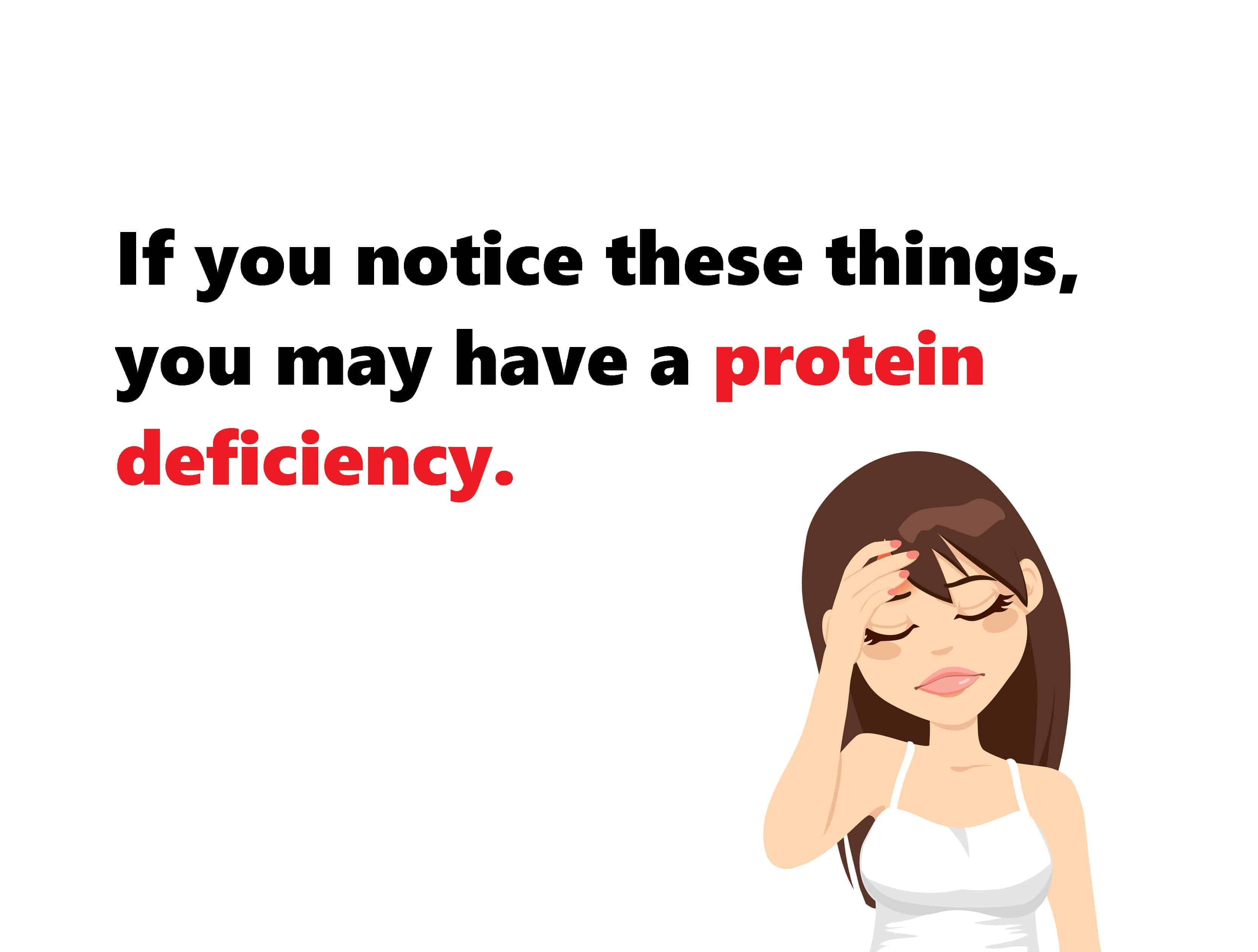
Did you know that a lack of protein can harm the immune system? If you don’t consume enough of the nutrient, you’ll be at greater risk for catching viruses and developing severities and complications from infections of any kind. Here are some studies that discuss this:

  • “Protein-energy malnutrition decreases immunity and increases susceptibility to influenza infection in mice,” published in The Journal of Infectious Diseases (2013). This study was conducted on mice and revealed that, when following a diet consisting of 2% protein, mice had a higher chance of developing severe infections from influenza than mice with an 18% protein diet.
  • “Amino acids and immune function,” published in British Journal of Nutrition (2007). This research identified strong links between deficiency and symptoms involving worsened infections and overall immune system function. So if you want positive health, you’d likely have to eat more protein.
  • “Elderly women accommodate a low-protein diet with losses of body cell mass, muscle function, and immune response” published in The American Journal of Clinical Nutrition (1995). This work of research was performed on older women who were asked to follow a diet that was low in protein. After nine weeks, they showed a notable reduction in immune system response.

6.    Hair, Nail, and Skin Issues

If you lack protein to a minor or moderate degree, then you’re unlikely to notice problems with the appearance of your:

But if you are severely deficient, you might start seeing the marks of that unmet nutritional needs. Many parts of your body are made of protein – and nails, hair, and skin are among them.

Here are some studies showing the links between a deficiency and the changing appearance of protein-based body parts:

  • “Nutritional factors and hair loss” published in Clinical and Experimental Dermatology (2002). This study discusses the clear links between nutrition and the premature loss of hair, positing that protein-energy malnutrition is among one of the many causes of the issue.
  • “Skin, hair, and nail in protein malnutrition,” published in World Review of Nutrition and Dietetics (1961). This extremely early study shows that researchers discovered malnutrition’s effects on hair, nails, and skin even back then. Low-protein diets would consistently result in discoloration, thinning, loss of hair, and increased nail brittleness.
  • “Skin in protein-energy malnutrition” published in Archives of Dermatological Research (1987). This study focused on children living with severe protein deficiency in countries with less positive economic standings. It revealed that skin in children with that deficiency could split, become flaky, develop depigmentation, and experience redness.

7.    Edema

Edema is a condition where the skin becomes puffy and swollen. In some cases, it’s at least mostly harmless. In others, it can be a symptom of something serious or even be dangerous. Most scientists think it is the result of low blood albumin levels in humans.

Serum albumin, aka blood albumin, is an incredibly abundant in the blood plasma. It is the most prevalent of all proteins within that liquid portion of the blood and has multiple functions. It works in many ways, with one of its most notable functions being oncotic pressure maintenance.

The oncotic pressure is a kind of force that brings fluid into the circulation system of the blood. This prevents the accumulation of any fluid in compartments of the body, like tissues. Thinking about how a deficiency can lead to edema can be complicated. So let’s break it down step by step:

  • 1: A deficiency in your consumption leads to a drop in serum albumin levels.
  • 2: Serum albumin, due to its insufficient quantity, cannot perform its duties accurately, causing unbalanced oncotic pressure.
  • 3: Oncotic pressure is too weak to pull fluids into the bloodstream and away from other places. This leads to swelling in those locations.

enough proteinFinal Thoughts On Some Things That Happen To Your Body When It Lacks Enough Protein

Protein deficiency, while rare, is something to be taken seriously. It can cause many different symptoms in the body that could have serious long-term effects.

Worried about your protein intake? Put on your positive thinking! It’s hard to be significantly deficient in nutrient. So make sure that you’re consuming 0.36 to 0.45 grams of the stuff per pound of your body weight. This is the daily recommended intake. If you’re still concerned, consult a doctor or nutritionist for advice!

Remember These 15 Quotes on Grief When It’s Time to Say Goodbye

Saying goodbye to a loved one is likely the hardest part of life. Many quotes on grief explain the pain and suffering involved with this. These quotes on grief can also help you find a way through the darkness and will help you smile again.

It can be easy to stay in the dark when you experience a loss, but it is important to find a way out. Through the wisdom and experience of others, these quotes on grief can help you get through it.

Saying goodbye doesn’t mean you are letting go of someone. You will always have your memories and feelings, and you can cherish these always. Instead, it means acknowledging that they will no longer be a part of your life.

Fifteen Quotes on Grief

When you have to say goodbye, remember these quotes on grief. While the quotes won’t take the pain away, they can give you hope for a brighter future. Plus, they will remind you that you aren’t alone and that you can get through this hard time.

quotes on grief1. “When someone you love becomes a memory, the memory becomes a treasure.” – Unknown

The memories of your loved ones are something that can never be taken from you. They will be with you always, and they are something you can treasure. These memories tie you to the person you have lost and that feeling can never be lost.

2. “The reality is that you will grieve forever. You will not ‘get over’ the loss of a loved one; you will learn to live with it. You will heal and you will rebuild yourself around the loss you have suffered. You will be whole again but you will never be the same. Nor should you be the same nor would you want to.” – Elisabeth Kübler-Ross

Grief doesn’t end, even when you work through it. Getting over the death of someone you loved will never happen, but you will learn to adjust. As you heal, you will build a new life, always missing the person but learning to live without them.

3. “Don’t cry because it’s over. Smile because it happened.” – Dr. Seuss

Grief comes at the end of something spectacular. Not everyone experiences something so amazing, so smile at the memories that were created. Remind yourself that you were lucky to have had the experience instead of being sorrowful.

4. “How lucky I am to have something that makes saying goodbye so hard.” – Winnie the Pooh

Similar to the previous quote, this one reminds you of how lucky you are to have loved someone so much. To love someone enough to grieve their loss means you had something truly amazing in your life. When you are grieving, make sure to spend time being thankful for having the person in your life.

5. “What we once enjoyed and deeply loved we can never lose, for all that we love deeply becomes part of us.” – Helen Keller

Everything precious to you becomes a part of you. The time spent with a loved one and the love you felt for them can never be taken away. Those memories will always be with you, and their contributions to your life will stay with you always.

6. “Those we love don’t go away, they walk beside us every day…unseen, unheard, but always near, still loved, still missed, and very dear.” – Unknown

Just because you can’t see someone doesn’t mean their presence isn’t there. They played a role in the person you are today, so they are always walking with you.

7. “Although it’s natural to forget your power after you lose a loved one, the truth is that after a breakup, divorce, or death, there remains an ability within you to create a new reality.” – Louise Hay and David Kessler

No matter how you have lost the person you love, it can take a toll on your sense of power. Oftentimes, losing someone will leave you feeling out of control of your life, but it doesn’t have to be that way.

Instead, work to create a new normal and build your life the way you want to do it. Then, you will be able to remember that you are in charge of your life. You have the power to create happiness for yourself, even if things seem unbearable right now.

8. “Deep grief sometimes is almost like a specific location, a coordinate on a map of time. When you are standing in that forest of sorrow, you cannot imagine that you could ever find your way to a better place. But if someone can assure you that they themselves have stood in that same place, and now have moved on, sometimes this will bring hope” – Elizabeth Gilbert

Grief can leave you feeling stranded, alone, and like there is no way out. You might feel like you can’t find a way to cope or move on, but you must find a way to do so.

One way to do this is to remind yourself that many others have been through the same thing before. They have lost people they love and still moved forward in life. You can do this too, so find your way out so that you can begin to heal.

depression meme9. “When you are sorrowful look again in your heart, and you shall see that in truth you are weeping for that which has been your delight.” – Kahlil Gibran


The thing you are grieving for is likely one of the things that made you happiest. When the grief becomes too much, look in your heart, as Gibran says, and see the happiness, instead. All of the happy memories you made together will be right there whenever you need a reminder.

10. “You will survive and you will find purpose in the chaos. Moving on doesn’t mean letting go.” – Mary VanHaute

While saying goodbye to someone you love is hard, you will get through it. You will learn to live again and to move on. Moving on doesn’t mean letting go, however, because you will always carry the love you feel with you.

11. “And when great souls die, after a period, peace blooms, slowly and always irregularly. Spaces fill with a kind of soothing electric vibration. Our senses, restored, never to be the same, whisper to us. They existed. We can be. Be and be better. For they existed.” – Maya Angelou

While it may seem impossible now, you will experience peace again. Life will become normal, although it will be a new idea of normal, and you will be happy. With this will come the realization that if the person you love existed, then you can get through life and become better.

12. “I learned that, with grief, you have to take it one day at a time and learn how to find the happiness amid the heartbreak.” – Adrienne C. Moore

When you lose someone you love, it is only expected that you will feel heartbroken. There is no magic way to get over it and stop grieving, so you have to keep working on it. Find happy moments whenever you can, and eventually, it will all get easier.

13. “Tears have a wisdom all their own. They come when a person has relaxed enough to let go and to work through his sorrow. They are the natural bleeding of an emotional wound, carrying the poison out of the system. Here lies the road to recovery.” – F. Alexander Magoun

You must allow yourself to grieve and cry when the time is right. This may not happen right away, but once you begin to accept the situation, it will begin. Crying is good, though, because it means that you are healing.

14. “Grief can be the garden of compassion. If you keep your heart open through everything, your pain can become your greatest ally in your life’s search for love and wisdom.” – Rumi

Good things can come from grief, even if that seems impossible right now. If you allow yourself to grieve, you will become wiser and find those who can help you through.

15. “This is not goodbye, my darling, this is a thank you. Thank you for coming into my life and giving me joy.” – Nicholas Sparks

Since it can be hard to say goodbye to someone you love, say thank you instead. You were blessed to have them in your life, and they left you with memories and love. For this, you should be thankful, and that will be easier to express than saying goodbye.

quotes on griefFinal Thoughts on Remember these Quotes on Grief When It’s Time to Say Goodbye

When you have to say goodbye to someone you love, you will inevitably experience deep grief. These quotes on grief can help you get through and will remind you of the good in your life. You have to allow yourself to grieve and grow in this situation.

Give yourself time and grace, and remember to take it one day at a time. Eventually, it will get easier, as these quotes on grief explained. Knowing you aren’t alone in this feeling can help, too, so try to find peace in the experiences of others.

Skip to content