Weekly tips, affirmations, and small actions to feel your best.

4 Ways of Getting Out of Your Comfort Zone

Expanding your comfort zone is where growth happens. The comfort zone is like a secure island of stagnant high ground. Life gently pushes us into the infinite waters of our potential.

We are so used to living in a bubble of security that we don’t realize how much we limit ourselves. Facing the unknown is never easy; fear appears- as an indicator of change- and change always boosts our expansion as human beings. Outgrowing our fears and insecurities brings liberation, joy, and trust.

Ten Reasons You Fear Growing Your Comfort Zone.

Before we dive into how to make these positive changes, let’s first look at why you prefer your cozy spot in the first place.

getting out of your comfort zone1. You’re Waiting for the Right Time

If you’re always waiting for the right time to step out of your comfort zone, you’ll never do it. The time is only suitable if you decide to do it. You don’t have to wait to perfect your skills or overcome your fear because you can move forward anytime.

By waiting until the time seems right, you will miss out on many opportunities and experiences. You will spend your life watching everyone else try new things and excel in life. Don’t be the person sitting back watching everyone else.

2. You Don’t Educate Yourself or Ask Questions

People that expand their comfort zone spend time asking questions and educating themselves. They strive to gain knowledge and glimpse other perspectives to understand the world around them. Even if you feel like an expert, seeking deeper insight is always beneficial.

If you struggle with getting out of your comfort zone, consider whether you are furthering your knowledge. While you can take courses or research a topic, you can also educate yourself by asking questions. Asking questions is one of the best ways to gather a deeper understanding.

3. You’re Afraid of the Unknown

People like knowing what will happen next, and you can’t do that unless you stay in the same place in life. When you don’t know what’s coming, you might worry about things you can’t predict. This mindset holds you back and prevents you from trying anything new or advancing your life.

4. You Want to Be in Control

If you always feel the need to be in control, it could be the reason you struggle with getting out of your comfort zone. When you become comfortable in life, you might feel like you control the rules and daily routines. You learn to enjoy the monotony of your current life because you always know what to expect.

If this sounds like you, then you must work on letting go of things. Craving excessive control hinders your ability to move forward and make progress toward your goals. Learn to enjoy unexpected situations and spontaneous experiences that are out of your control.

5. You Strive for Perfection and Experience Negative Self-Talk

No one is perfect, no matter how hard they try. If you are seeking perfection, you are likely holding yourself back. When you aren’t comfortable, you know that you can’t exhibit perfection in that area.

This mindset forces you to stay in your comfort zone, where you feel better equipped to handle things. You might think that stepping out of your comfort zone will lead to failure or feeling like you aren’t good enough. When you set the bar at perfection, you are creating an unattainable goal for yourself.

6. You Lack Will-Power

If you don’t do something because you don’t feel like it, you make it impossible to get out of your comfort zone. You will do the bare minimum because you have no drive to do more. If this sounds like your situation, learn to develop willpower even when you’re in a bad mood.

Force yourself to do new things even when you don’t feel like it. You can start with something simple like getting out of bed when your alarm wakes up rather than hitting snooze. Gradually increase the difficulty of your tasks to build your willpower as you go along.

7. Your Goals Are Undefined

If you don’t have definitive goals, you might not feel like getting out of your comfort zone. You might have a basic idea or concept of what you want but no clear vision or plan for achieving it.

If you want to step out of your comfort zone, start by creating a plan to guide you along the way. With a plan, you can do new things and make progress toward your life goals.

8. You Struggle to Make Decisions

An indecisive person will struggle with stepping out of their comfort zone. If you can’t make a decision or always want someone else to decide, it could be the reason you don’t want to move forward.

An inability to make decisions is a sure sign that you won’t step out of your comfort zone. It indicates an avoidance of conflict or a misunderstanding of your desires.

getting out of your comfort zone9. You Have Anxiety

Anxiety often holds people back from getting out of their comfort zone. It will make you feel like you can’t do more, or it will cause paralyzing fear. Learning to tolerate a little anxiety will help you overcome this, and you can gradually increase your stress factors over time.

10. You Struggle with Passive Behavior

If you exhibit passive behavior, it means that you avoid conflict, responsibility, and important decisions. You likely prefer to go with the flow of things and handle situations as they come along. Passive behavior could also cause you to reject change unless forced to conform to it.

When you struggle with passive behavior, you likely won’t feel like getting out of your comfort zone. Since you like to handle things as they come, you won’t want a new situation to mess up the flow of things.

Four Strategies of Getting Out of Your Comfort Zone

Here are 4 steps to break out of your comfort zone and conquer the fear that leaves you feeling stranded:

1 – Realize that everything is in your head

When put in difficult situations, the mental scenarios people create don’t always reflect exactly how things unfold in those situations. Things in our lives will turn out better or worse; the events may not develop exactly as imagined and played in our heads. Running the same negative mental film means worrying, and this is never an alternative.  Worrying is one of the most useless things one could use his imagination for. Life flows, and its paths are for sure mysterious.

2 – Be brave

Accept the hardness of the moment; accept you are vulnerable. Sometimes, when faced with a life-changing event (the death of a loved one, the departure of your partner, your kids leaving the nest, losing your business) or when you find yourself at a crossroad, you need to find the courage to take the next step. And this next step will burst the bubble of security that you created to nurture your sense of immutability. Well, as much as we want things to be different, we live in a world where everything ages, changes, alters, and at a certain level, disappears.

Being brave in this context means being aware of our wavy-like existence and integrating this truth. Being brave means being more loving towards our needs; this has nothing to do with adrenaline, but it has everything to do with being aware of what really serves us. We are alive to feel, explore, expand, and travel in places and spaces beyond our imagination. Our comfort zone doesn’t suit this noble purpose of existence.

3 – Be kind to yourself

When scared of change, you are out of balance, and basically, you are in pain. The easy way out most of the time is denial: dishonesty regarding your emotions. Avoiding suffering is a built-in bulletproof vest, but the result of using this system attracts, however, the outcome we wanted to escape. Psychological, spiritual, and emotional wounds exist in layers. Healing takes place by going deep into the source of the pain. Denying and avoiding the pain is no remedy, as the real cause of your problem continues to run in the background and affect your life.

When you find yourself in such a place of doubt, pain, fear, and lack of trust (we’ve all been there), be gentle with yourself. No amount of self-criticism will ever set you free. When in a place of change, find compassion for yourself; be patient, allowing, and kind. This is the start of a beautiful friendship between you and yourself.

4 – Have faith

Remember that all things pass; find that eternal essence deep in yourself and hang on to that. Trusting life with your experiences is the easiest way. Accept that some things will happen regardless of you holding on to some result you think it’s most favorable. Follow your intuition, even if the false mental scenarios attempt to lead you astray.

pray moreFinal Thoughts on Getting Out of Your Comfort Zone

In the comfort zone, nothing happens, and life is about everything; discovering your most significant potential starts outside the comfort zone by dissolving the boundaries of your identity. One of the most self-loving acts is the act of letting yourself drift away in the infinity of your potential. You are then alive, able to experience, discover and remember yourself! Let yourself be what you are.

11 Powerful Affirmations to Help Treat Depression and Anxiety

Affirmations are positive declarations and self-scripts that mold the subconscious into a more positive form. And lately, this new-age practice is approved by practitioners and their patients as potentially revolutionary practice in treating depression.

These individuals state that positive affirmations have the capability to heal the hurt done by negative talk that takes place both from within our own minds and from the mouths of others.

What about affirmations to help treat the two most common mental illnesses in the world – anxiety and depression?

Can the causes or symptoms of anxiety and depression be reduced, or even healed, through positive affirmations?

Promising Research on Affirmations

In a 2009 study done at Arizona State University, three expert ‘populations’ were studied: popular self-help literature, respected psychologists and psychotherapists, and individuals who were experiencing anxiety and/or depression.

In the research that was conducted it was determined that, at the very least, affirmations can be useful as a supplemental form of treatment for many depressed and/or anxious patients. For some patients, affirmations proved to be the most influential part of their recovery process.

Within the study, 17 therapists on a scale of 1-7, rated seven different affirmations on how effective they were in the treatment of those struggling with an anxiety disorder and/or clinical depression. The same affirmations were used for both disorders, as they often complement each other.

Interestingly, the three highest-rated affirmations were for anxiety. The top three affirmations had average scores of 5.43, 5.37, and 5.03, respectively. On the other hand, the top three affirmations for depression had scores of 4.83, 4.58, and 4.58.

Nearly all of the participants (including the therapists) agreed that affirmations can be a helpful practice when recovering from anxiety and depression! Individuality and the patients’ preferred method of treatment is thought to be the most important element in determining how effective a method of treatment is.

In other words, the willingness and belief of the individual to embrace positive affirmations increases the likelihood that these affirmations will make a positive impact!

The authors conclude with restating that treatments for anxiety and depression are highly individualized and customizable, and must be constructed as such. In the construction of an individualized treatment plan, all therapists and the authors of the study agree that affirmations should be deliberated – as they have been embraced by therapists and patients alike.

depression

11 Powerful Affirmations to Help Treat Depression and Anxiety

If you are new to affirmations, you’ll find our “How to Practice Affirmations” guide below very helpful.  Repeat these positive affirmations, begin to believe them and you’ll see results!

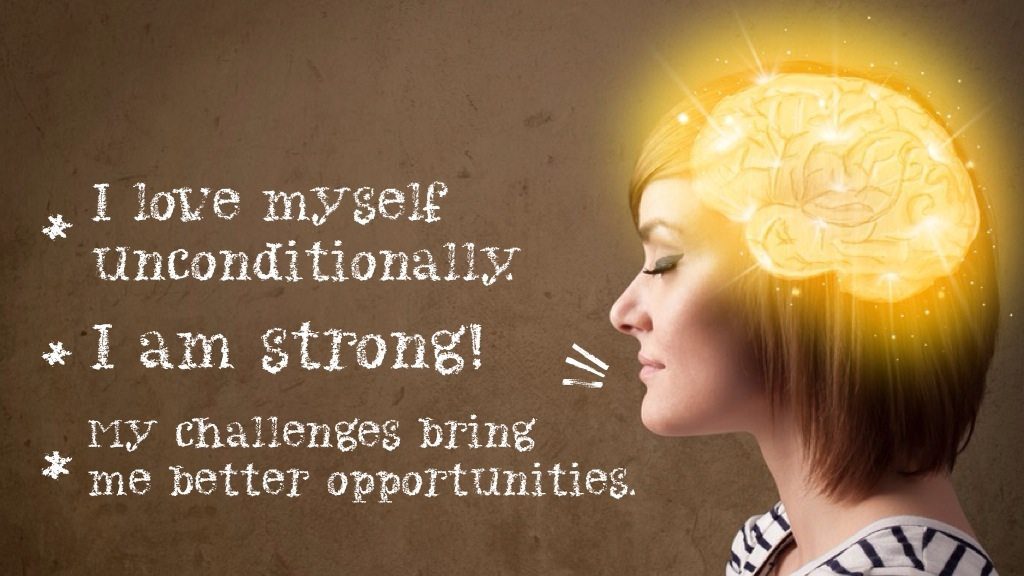
1. I love myself unconditionally.

 2. I am STRONG!

3. I allow only healthy and loving relationships into my life.

4. Life wants the best for me. I am OK with where I am right now.

5. I am connected and comfortable in all environments, with all people.

6. I find and enjoy the simple pleasures life is offering right now.

7. How I feel matters, therefore I concentrate on aspects of life that make me feel good!

8. My challenges bring me better opportunities.

9. My mood creates a physiological response in my body. I am peaceful and positive!

10. I am in control of my thoughts and my life.

11. I love myself and who I am.

How to Practice Your Affirmations

First, it’s important to understand that the effectiveness of affirmations depends on your commitment and dedication to practicing consistently. Therefore, the belief of the affirmation will get easier over time. If you talk every day, then you are already practicing affirmations.

Every word you speak is an affirmation.  And so, it’s just that sometimes our affirmations to ourselves, about others, or our situation is not positive. Affirmations help us to consciously flip the switch and begin speaking in the direction that we actually want to travel.

You will want to make affirmations a daily routine (or at least a few times a week) in order to achieve the maximum benefits and help relieve your anxiety/depression faster. Be gentle with yourself though and do them as often as you can. Like anything, it seems harder in the beginning and then gets easier and easier until it’s like second nature.

Positive Affirmations: Helpful tips

Contemplate your positive qualities.

As human beings, we more often think about what we’d rather change about ourselves than what we love. We are all unique creatures. And, we possess gifts that no one else in the world has! Write down the things that you know are special about you, and write them in the first person (“I am…”)

Consider the negative scripts that you wish to replace with positive ones.

What goes through your head when you’re down? Do you have negative perceptions about your looks, intelligence, accomplishments or abilities? Time to replace that negative chatter with those positive qualities you listed in step one!

Consider what positive goals you want to accomplish.

There are specific goals that you want to achieve, right? As you continue to feel better about yourself, you’ll be more and more motivated to work towards these. Write them down.

Order your list of goals and scripts.

You may find that your list of scripts and goals have grown rather large. That’s great! You will want to work on a few of these at a time. Choose what is the most urgent and work on these first. When you see measurable improvement in an area, move down the list!

Re-write and re-read your affirmations and goals daily.

Make a habit of writing your goals and scripts daily – to the point where they’re the last thing you think of when you fall asleep and the first thing when you wake up.

Combine your positive qualities (step 1) with your goals (step 3).

What positive qualities did you affirm in step one that can help you achieve the goals that you’ve set? If you resolve to lose weight and have great focus, then you can combine these two to give yourself some momentum. Choose two or three affirmations to support your goals.

Meditate on your affirmations.

Get in a meditative state, whatever is most comfortable for you, close your eyes, and think about your affirmations. Feel the emotions that arise as you repeat the words and think about the future.

Remind yourself of your affirmations.

Write down your affirmations on notecards, a whiteboard, scrap paper, or Post-Its. Then, place them around your home, work, and car. Of course, place them where you’ll see them!. Each time you see the affirmation, think about what it means to you.

Keep at it!

Finally, remember that practice makes perfect. As you continue with your affirmations and begin to see real evidence of your making small changes, feel gratitude and keep going. You will begin to see bigger and bigger changes in your mood, feelings about yourself and others, and your life.

Add to the Conversation:

Do you have a positive affirmation that has helped you? Please share in the comments below!

8 Ways To Compassionately Support Someone With Depression

Depression is an incredibly difficult thing for a person to go through. Feelings of worthlessness, hopelessness, sadness, anxiety, emptiness, loss of interest, and even physical aches and pains like headaches and cramps, are a constant reminder for someone with depression that they are afflicted.

If someone that you love has been diagnosed with depression, you may indeed be feeling some of these things yourself. Please understand that it is important for you to be there for your loved one, and that they need your support.

Here are 8 ways that you can compassionately support someone with depression.

depression

#1: Research and understand what depression is

This is very important; as it helps you understand what the body and mind actually experience during depression.

For example, many people do not know that there are at least nine major classes of depression. These classes all have various symptoms and some have different treatment measures.

Understanding depression, depression types, and treatment options will put you in a better position to understand the illness. With this understanding, you are far less likely to criticize, judge, or otherwise, offend the person.

#2: Be there for them

After understanding the illness, you should be there for them. Be aware that your loved one’s mood maybe not so good, and that they may also feel tired or irritable. It’s important not to take this personally, as these are just byproducts of the illness.

Again, be there for support – not for tough love, giving advice, or other ulterior motives.

Your presence is the most important thing here.

#3: Show them the good things in their lives

Here, don’t tell them how they should feel – like that they should be grateful, positive, enthusiastic, etc. Simply tell them they are loved or cared for, and that people are thinking about them.

If you are not a particularly emotional person – that’s okay! Simply send them a text message or send them a letter or card, or post to their Facebook page.

#4: Release judgement

This is very important and needs to be completely understood. Most people with depression are already ashamed and feel weakened; criticizing or judging them makes an unfortunate situation even worse, and could possibly isolate you from your loved one.

Judging and criticizing a chemical-based illness is pointless and potentially very damaging to the afflicted and the relationship. Remember, depression is not a personality flaw; it is a medical illness with years of scientific research.

Contrary to popular belief, they don’t pity themselves and many of them are strong people.

#5: Be gentle with yourself

When a very close family member or friend is going through depression, it can be very difficult to come to terms with the fact that there is only so much that one can do.

Depression is a battle, and it can be a very long one. In the heat of this battle, you are certainly going to feel helpless and perplexed at times. Remember, you can equip and support the troops as much as possible, but they are the ones that fight.

You cannot solve this problem or heal them of this disorder – this is for the doctor or the therapist to do. The best thing you can do is show unconditional love and support while lending a helping hand.

#6: Take care of yourself, too

Helping someone as they battle depression can be exhausting and trying, both mentally and physically.

If you are in a weakened or stressed state, how effective will you be for your loved one?

You should make sure that your own needs are being met and that you are taking care of yourself too. Make sure that you are getting ample sleep, good nutrition, and getting in some fun time for yourself.

#7: Encourage treatment

Some people with depression don’t even realize that they have it, much less seek any kind of treatment. Often, those that are affected often feel ashamed to admit that they are. Some feel that the ailment can be overcome with just willpower or with time.

The truth is that it’s rare for people to get better without some type of treatment.  This can be through a doctor/counsellor, nutrition therapy, positive inspiration, or a combination of all.

With your knowledge of depression, you are well equipped to recognize the signs and symptoms of depression. Further, you are able to encourage them and discuss their options for treatment.

#8: Educate them

Here are some things that you can do to help…

– Discuss with the person what you’ve noticed and your concerns.

– Explain that you are more than willing to lend an ear if they want or need to talk.

– Explain that depression is a medical condition, caused by chemical imbalances in the brain. It is not a sign of weakness or some kind of character flaw and usually gets better with treatment.

– Discuss the various treatment types, including counseling.

– Offer to help set up and get them ready to take the next positive step.

Depression is a serious condition and needs to be treated ASAP. If your loved one is opposing treatment or shows troubling signs or behaviors, you should contact a doctor or other mental health professional for advice.

By compassionately supporting someone with depression you are better equipped to help your loved one through this difficult time.  You may even save their life.

5 Things Successful People Do on Weekends

Have you ever wondered what Oprah does on the weekends? Even the most successful people in the world are, at the end of the day, only human. How they handle their downtime may give the rest of us a little insight into the way successful minds work.

“Successful people are simply those with successful habits.” – Brian Tracy

Here’s what successful people do on the weekends:

1. They unplug.

Even if only for a few hours, most of the uber-successful and wealthiest people in the United States take time off from being connected to their work life. Although their reasoning may be slightly different than ours, there’s a big takeaway in this for all of us.

Turning off your cell phone for 24 hours will force you to be more present and take more enjoyment from the activities that you do engage in on the weekends. I’ve mentioned this before, and if it seems like I keep harping on this point, it’s because it’s important. You must put the phone down.

2. They don’t turn into sloths.

Sometimes, after an extremely busy and overwhelming work week, the urge to bellyflop onto the couch and stay there until Sunday night can be tempting. This is a bad idea because it can lead to a feeling of apathy and depression, leading you back to work on Monday with a giant case of the Blahs. There’s nothing wrong with getting a little extra rest on the weekends, but be sure to temper it with some stimulating activities as well, like going to see a show, having lunch with friends, or having a backyard barbeque.

3. They connect with family.

Even our kids are now tethered 24/7 to some kind of digital device. It’s not life support, so get them into the

habit of unplugging along with you and teach them how to stay engaged in life. It’s an important skill that’s not being taught anymore.  Reconnect your kids with the world, and with you.

successful people

4. They don’t do housework.

Using weekends to catch up on cleaning and laundry will negate the unwinding that you need in order to thrive Monday through Friday. Instead, the most successful people are good at managing their time during the week, enabling them to fit chores into smaller time-slots on weekday

evenings. This frees up the entire weekend for pleasure.

5. They don’t let Monday scare them.

I have heard my sons complain on more than one occasion, “It’s Sunday; the weekend is almost over!” This type of thinking will put you in a foul mindset, and can take away from a potentially fun afternoon and evening. Instead of fretting about what is to come on Monday, enjoy the remainder of your free time by staying unplugged and focused on friends and family.

*BONUS*

6. Most importantly, successful people rarely work on the weekends.

“Instead of fretting about what is to come on Monday, enjoy the remainder of your free time…”

While this isn’t a hard and fast rule, more and more success stories are happening to those people who know how to balance their time wisely. Re-charging your batteries on the weekends is critical to your ability to make good decisions during the week. If toting your cell phone (even if you turn it off) causes you undue temptation to check in on work, simply leave it at home while you enjoy life.  Make it clear that during the weekends, you are off the clock and will be busy dedicating your time to unwinding, relaxing, and re-charging.

How do your weekend habits match up to those of some of the world’s most successful people? 

Let us know in the comments below!

4 Reasons Optimism is the Ultimate Success Formula

Optimism: an inclination to put the most favorable construction upon actions and events or to anticipate the best possible outcome. – Merriam-Webster Dictionary

There are three frames of mind where you’ll most often find yourself: optimistic, pessimistic, and apathetic.

Optimism is the feeling or belief allowing the ability to perceive and understand challenges as impermanent and surmountable. In short, optimistic people seek the best outcome in each and every situation.

Contrast this with pessimism. These individuals often perceive challenges as insurmountable roadblocks that make it either impossible or extremely difficult to move forward. Sadly, pessimism takes the prize as the leading cause of broken dreams.

Finally, there is apathy – a lack of interest, enthusiasm, or concern. Total, complete indifference is probably the only thing worse than pessimism. Why? Because there is no effort, passion, fight or struggle to be seen in apathetic people.

Now, if we are honest with ourselves, we can admit to feeling all three of these mindsets at some point in our lives. There’s a good chance that we are feeling one of these mindsets right now. The truth is we all need to feel more optimistic and a little more hopeful in our daily lives.

Here are some good reasons to be more optimistic. . .

4 Reasons Optimism is the Ultimate Success Formula

optimism

Reason #1: More people will trust and respect you. 

Co-workers, friends, family, and those you interact with will see your positivity and optimism and immediately respect and admire you for it. Trust and respect are two things that no amount of money or power can earn, and are huge factors in your quest for success and happiness.

Reason #2: People will be drawn to you.

When’s the last time you saw a Debbie Downer receiving admiration and praise? Not that you need constant approval from people, but you at least want to seem approachable and likeable. Right?

Optimists have magnetic energy, and people love that.

Reason #3: It is vital to success in anything.

Optimism is irreplaceable for success in business and in life, as optimists are incredibly resilient and strong individuals. They are seen as reliable, trustworthy, respectable, and confident individuals. Obviously, this has a tremendous impact both on what you believe you’re capable of and what others believe you are capable of. People want to know that you believe in yourself before they believe in you.

Reason #4: You are mentally and physically healthier.

When the Mayo Clinic, the top hospital in the United States, is publishing work on the health benefits of positive thinking and optimism, it’s a BIG deal.

Indeed, the organization has reported the following benefits to positive thinking and optimism: increased life span, lower rates of depression, lower rates of distress, greater resistance to illness, better coping with stress, lower risk of death from heart disease, and better overall mental and physical wellbeing.

In conclusion: be more optimistic! Granted, it can be very difficult at times – but it’s doable. It all starts with self-talk or the endless stream of thoughts running through your mind. There are many, many ways to induce more positive thinking into your thoughts– meditation, prayer, rest, exercise, and on and on.

Just find what works best in activating your optimistic brain and stick with it.

Stay optimistic, friends!

Join the Conversation: Why do you stay optimistic?

5 Ways to Bounce Back Better

We all stumble, trip, or fall at certain points in life.  Many people bounce back right away, but some grow depressed, angry, or have difficult times finding their way out of the hole altogether.  No matter how many falls one makes, each one teaches a lesson. How well we learn those lessons determines how well we can bounce back.  Not only does it measure our resilience, it ultimately serves as an integral part of our unique character.

“What defines us is how well we rise after falling.” – Unknown

Now is the time to turn the corner on conquest.  It is your time to rise. 

Here are 5 ways to help you create a better bounce back in life:

bounce backyes

1. “Just say no” to no

Sometimes, you may find yourself in an experience where you just don’t feel right.  When you’re experiencing this, don’t be afraid to say no.  This “no” can be delivered to the physical experiences in life where you don’t feel comfortable.  And just as in the physical, it can be to the non-physical, in the form of negative thoughts trying to creep in or find fault in your positive thinking.

Your intuition is guiding you toward your own personal best, not someone else’s.  You deserve to follow that inner guide, and grow into the best “you” that you can be.

2. Reinforce your desires

If you want what you actually want, instead of what you don’t want, it’s important to call in backup for the battle of your mind. The reinforcement you want can be brought about through positive affirmations (click here to read more about them, and how to use them), mirror work, and many other positive thinking practices. You can also find like-minded communities to help you.  No matter what, your goal is to ultimately get out of the funk, or avoid it in the first place altogether.

And if you have a hard time asking for help from others, remember that it’s ok to ask for help from those around you.  Everyone has a perspective on some experience that can provide value.

3. Just say yes to yes

As you reinforce your desires, you’ll find that opportunities for those desires to be attained will come into view.  When these opportunities come, seize them!  If you ordered a salad at dinner and they bring it to you, you wouldn’t normally ask for the soup instead, would you?  Carpe opportunitatem! (Seize the opportunity!)

4. Be grateful, not hateful

When the opportunity arises for you to express angst toward someone, or have a negative attitude, it’s time to press the gratitude button.  If someone cuts you off on the highway, instead of yelling at them and serving the “one figure salute”, take advantage of the current moment to express gratitude for your awareness, or for the function of your vehicle’s brakes.  Remember, no matter what the story, it could always be written worse.

5. Give yourself room to wiggle

If you don’t reach your desired bounce-back point, that’s ok – nobody’s perfect.  Be grateful for the progress you’ve made, any amount gives us growth.  Even if it’s a little bit of regress, it may just be giving you something more to learn before your next big bounce-back.


Here’s to overcoming every challenge life has to offer.   Let’s talk about how you’ve used these tips to your advantage in the discussion below!

11 Ways to Overcome Negative Energy

There are an ebb and flow that exists in life. It is part of our world and every day we have a choice on how we react to it. Some days we feel exhilarated and ready to take on the world, while other days our attitude may be more positive, peaceful, and calm.

Life is filled with doors of opportunity for the negative and positive. It is up to us which doors we pass by and which ones we enter. How long we stay in each room depends upon us and what we allow. Although, sometimes the illusion is that the door is shut, locked, and we are trapped.

Yes, negative energy exists, but it does not mean it needs to consume our lives and rob of us the abundance that is truly available to all of us.

For some, positive thinking may come easy. But, most people need to practice and cultivate it. It is possible for everyone.

“There is a little difference in people but that little difference makes a big difference. The little difference is attitude. The big difference is whether it is positive or negative. – W. Clement Stone

The current state of your mind and your life can improve simply by making small tweaks in your daily habits. Over time, practicing new, positive habits will become second nature to you and will allow for better opportunities and growth.

positive

Here are 11 Tips to Overcome Negative Energy & Be More Positive:

1. Bypass the Negative

“Turn your face to the sun and all of the shadows fall behind you.”  – Marori Proverb

If you truly want to turn a negative into a positive, skip the negative altogether and just be positive. You can override the negative with practice.  Look forward and focus on where you are going, not where you have been. Your soul yearns for growth and expansion for our highest good.

2. Realize you are stronger than you think.

Fear is a nasty negative emotion. It holds us in bondage and can rob us of our true potential and happiness. In addition, it tells us we are not good enough and that we are weak. It whispers lies in our ear and sometimes we believe them. The more we believe them, the farther away we travel from the life of our dreams.

To overcome the negative we MUST realize we are stronger than we believe. We can do more than we think. We are capable of so much more. Believing in ourselves is the first step. When we let go of limiting beliefs, we open doors of opportunity that we never once thought possible, and gain the courage and strength to enter those doors and do our best.

3. Practice changing your perspective.

There is always a positive perspective you can take from every situation. Yes, it’s not always easy but even the most negative and traumatic situations hold life lessons to move forward.

When you choose to habitually move forward from pain with a positive perspective your life will transform. You will release anger, blame and many other negative emotions, while opening your heart, mind and doors to new opportunities.

“See the positive side, the potential, and make an effort.” ~Dalai Lama

4. Smile more and walk with an uplifted disposition.

Have you ever looked at random pictures that someone has taken of you at an event or gathering? What does your normal demeanor and disposition look like? Do you look joyful or unhappy?  Are you smiling or do you appear stressed?

If you aren’t sure, consciously check in with yourself throughout the day. Be sure your face and body are relaxed and walk with a comfortable, upright posture. Smile as often as you like, even if for no apparent reason except for the fact that you are alive! 🙂

5. Focus on building the new.

“The secret to change is to focus all of your energy not on fighting the old, but on building the new.”
– Socrates

Switch to forward-thinking and release the held visions of the past. Learning from your past is helpful in building the new, but don’t keep your focus there or you will continue to repeat the same mistakes. Growth happens when we step out of our comfort zone in faith, explore new horizons, and begin to create a life of your dreams.

6. Make the best of what the day brings – dress up and show up.

A positive attitude won’t protect you from all of the negative, but it will help you better manage how long it stays around. When a challenge arises, make the best of it. React to negative situations with peace, patience, an open heart, and an open mind.

If you wake up feeling down, dress your best anyway. Actually, it’s when you need it the most. Show up for yourself and you’ll instantly feel happier and more confident. Life loves when you step into your power and transcend the negative.  😉

7. Enhance your self talk. Speak about your worthiness.

“Like food is to the body, self-talk is to the mind. Don’t let any junk thoughts repeat in your head.”
  -Maddy Malhotra

How you live your life is largely determined by that “eency-weency” voice inside your head.  If that voice speaks down to you, it’s important to hush it and start speaking words of worthiness. Love yourself the way you want others to love you.

Have you read our 24 Affirmations to Help you Build Positive Self Talk?

8. Keep in touch with positive people.

We can’t do everything by ourselves and thinking that way will keep us from our highest good. We all need each other and daily inspiration from others. Neurons that fire together wire together, so it is vastly important that you allow yourself to fuel on positive energy from those around you.

Take a moment to consider the people you keep in touch wight he most– are they helping you along on your journey or are they stressing you out?  Allow yourself to connect with more positive people every day!

9. Spend time alone, but not too much.

Spending time alone can be rejuvenating. During this time you can meditate, read, do yoga, take a bubble bath, or just be. It’s very important to take this time for yourself every day (or at least a few times a week).

The key is not to spend too much time alone. Often times too much time alone gives you too much time to over think things. We all need human interaction, especially with those that we truly love.

10. Live in Gratitude.

“Develop an attitude of gratitude, and give thanks for everything that happens to you, knowing that every step forward is a step toward achieving something bigger and better than your current situation.– Brian Tracy

If something isn’t going your way, one of the first things you can do is think of all the things going right. Turning on the gratitude switch will help begin to turn it all around. After some diligent practice, gratitude will be so ingrained in your life there will be no need for practice.

You will wake up every day living with a thankful heart. Your beautiful, radiant positive energy will be picked up by others and inspire them. Gratitude is surely the quickest way to overcome negative thinking and transform your life.

11.  Be active daily and eat raw, whole foods.

Movement is good for the mind, body, and soul. It allows everything to move whether it’s our blood, oxygen or tension and negative emotions. Exercise of any form allows your mind to stop and focus to be placed in the now and on your breath.

In addition, fuel your body with raw, plant-based foods that contain energy not found in processed or cooked food.  There is a much higher level of positive, light energy in these foods and your body will thank you.  You won’t feel sluggish, tired, or full – you’ll feel energetic, revitalized, and satisfied!

BONUS POSITIVE TIP

12. Read positive quotes and articles daily.

What are you watching and reading daily? Be sure that it’s positive. For instance, listening to the nightly news could be switched to watching an inspirational documentary, reading a self-help book or watching GaiamTV.  One great way to receive daily inspiration is to stay subscribed to Power of Positivity on Facebook. By becoming a fan and being part of this fast-growing, positive community you will receive daily quotes of inspiration and connect with like-minded people any time.

The “Like List” Challenge

Nearly every expert speaks highly of a daily “to-do” list.  This list is supposed to cure stress and make you more productive and successful, right? So, we propose the idea of a different kind of daily list to create success in life.  It’s called  The “Like List Challenge”

Every day you have two choices. You can focus on what you like or what you don’t like. Essentially, you create your life based on where you keep your focus.

With every thought and word, you either add to the “Like List” or the “Do Not Like List”.

Which list are you adding more to right now?

For the next 24 hours,  consciously monitor your thoughts and words. 

Here is how you can take the “Like List Challenge.”

Observe what happens throughout the day, record the daily summary of your thoughts and conversations on paper.

If you find yourself with a large majority on the “Like List”, congratulations! You are allowing positivity to flow through you freely, which will result in more happiness, gratitude, fulfillment, love, and success. Your focus is on the positive direction and you will continue to see more abundance.

If you find yourself adding many items to the opposite list, the “Do Not Like List”, you are creating more limitations on yourself.  The limitations in your life are there because of your focus on negative thoughts.

When you begin to release your limiting belief systems and stop adding to the do not like list, you create space for the things you do want.

It’s very important that through this process you are easy and gentle with yourself. You’re not perfect. You may add to the do not like list sometimes, but that happens. In fact,  to a degree, knowing what we do not want can lead us closer to what we do want. It can give us experience and knowledge so we can grow our “Like List Challenge” circle and ask friends to join in.

Ideally, you want to keep your focus mainly on the “Like List”. Keep your “Do Not Like List” at a minimum, only using it as a tool to understand more about your like list, and adding to it.

Overall, strive to have 75% of your thoughts, words, actions, and reactions positive.

Keeping this strong focus on the things you like, will bring you more of what you like. The same is true for the other list.

So, YES it is really that simple.

You have the ability to allow your mind to be a fresh sheet of paper – a new list. You can write whatever you want on it, whatever feels good to you and is for your highest good.

Take the Like List Challenge and let me know what you find in the comments. Better yet, tag us on Facebook<3

The Human Aura: What Is It and How Does it Work?

Did you know that you create your own energy field? It’s true. The abundance of electrical impulses (aura) from your brain to the nerve endings of your body creates an energy field.

Incredibly, we impact our energy field (or ‘aura‘) by our mental, emotional, physical, and spiritual states. The environment in which you surround yourself also affects your aura. Ever heard the phrase “you are a product of your environment”? Well, your aura may just be part of that.

Let’s’ explore ‘Aura’ a little more.

Aura = visible energy

“All phenomena- from the planet we inhabit to the oceans, clouds, forests and flowers that surround us, arise in dependence upon subtle patterns of energy.” – The Dalai Lama

Most of us cannot see energy without the assistance of scientific instruments. Bioelectrophotography captures these energy fields as a permeating light around the body.

Your aura will often radiate a colorful, brilliant glow when you’re feeling happy, feeling blessed, or just being in a positive state of mind. Additionally, your heart will actually emit a pink and gold-like glow in vibrant form when feeling any of these positive emotions.

When you’re feeling angry, sad, depressed, anxious, or any other negative state, your body minimizes your aura emission. Indeed. the color dulls. The vibrancy loses its glow and its allure, kind of how your state of mind becomes doom and gloom when feeling bad.

human-aura

Aura and consciousness

“We are developing the idea that our consciousness is part of the material world and that with our consciousness we can directly influence our world.” – Dr. Konstantin Korotkov

More amazing is the idea that you may just be able to change the world by using your own energy. While certainly not a new idea (Buddhists have believed this for thousands of years), the notion was sorely lacking any backing or legitimacy from the scientific community.

Meet Dr. Korotkov

Then, a Russian scientist by the name of Dr. Konstantin Korotkov, a professor of physics at St. Petersburg State Technical University in Russia, proclaimed that our energy and consciousness has an impact on our surrounding environment.

He also claimed that both human beings and elements found in nature have their own energy fields and that these energies can interact with one another (further examined in the Princeton study, below).

Dr. Korotkov developed the technique known as Gas Discharge Visualization (GDV). This is a collection of techniques enabling the capture of electrical energy fields. In doing so, Korotkov discovered ways to view the emotional, mental, physical, and spiritual energy radiated from human beings and other natural elements.

GDV facilitated the patenting of Electrophotonics, Korotkov’s technology line that captures energy emanating from humans, inanimate objects, liquids, plants, and powders, and convert these images into a digitized model.

Korotkov and his researchers state that this technology can detect abnormal energy fields, and can facilitate the diagnosis of various ailments and other physical and emotional imbalances.

In addition to diagnosis, Korotkov and his fellow scientists are researching how GDV and electrophonic can assist with potentially life-saving treatments for cancer. Besides medicine, technology is utilized in fields such as agriculture, biophysics, ecology, genetics, forensic science, and psychology.

Take note that Dr. Korotkov is not alone in proclaiming that our mind and energy can alter our material world.

Princeton’s PEAR program

Princeton University (yes, that Princeton) created a division known as the Princeton Engineering Anomalies Research (PEAR) program.

The PEAR program focuses on “studying the interaction of human consciousness with sensitive physical devices, systems, and processes, and developing complementary theoretical models to enable better understanding of the role of consciousness in the establishment of physical reality.”

They also established a non-profit research organization and a company that provides devices specifically designed to be used for research.

In other words, one of the world’s top research institutions thinks there’s enough to Dr. Korotkov’s “consciousness can directly influence our world” thing to invest millions of dollars into a program dedicated to its study, a non-profit research organization, and a company that manufactures devices to be used for the study.

The Princeton “Coin Flip” Experiment

Princeton scientists in the PEAR program use devices called random event generators (REG) in many of their experiments. These devices randomly generate a string of numbers, which are then stored in computer files.

One of these REG machines replicates coin flips. So, when left alone, the machine flips at about a 50/50 clip of heads and tails, as expected. However, when researchers placed a human being near the machine and told them to focus intently on heads or tails, the results changed to more heads or tails!

Here is an outcome that’s even more interesting. When two people in a relationship, such as a married couple, focused on the same heads/tails outcome, the results were intensified. Indeed, even more heads or tails occurred. According to researchers, this happened in virtually every experiment.

Everything is Energy

“Now I realize that it isn’t the miracle that creates the believer. Instead, we are all believers. We believe that the illusion of the material world is completely real. That belief is our only prison. It prevents us from making the journey into the unknown.” – Deepak Chopra

This phenomenal quote by Dr. Deepak Chopra summarizes the common person’s thought process in five sentences. Almost all of us unconsciously default to this frame of mind when going about our daily lives.

Einstein wrote the revolutionary formula of E=mc2 in 1905. Of course, this theory demonstrates that the mass of an object and its energy are the same. Yet, we took almost 120 years to begin making the connection between humans, our energy, and our universe!

The fact is that everything we see, hear, touch, smell, and taste consists of energy. Scientists all over the world are beginning to discover the interconnectivity of seemingly unrelated elements. Of course, all this happens through the study of electrical and magnetic fields.

The future of human energy fields, our consciousness, and how it can influence the world is truly exciting and potentially revolutionary.


Resources:

Dr. Konstantin Korotkov

The Human Aura: http://www.heartscenter.org/TeachingsBlogs/FoundationalTeachings/UnderstandingtheHumanAura/tabid/368/Default.aspx

Princeton/Korotkov experiment: http://www.collective-evolution.com/2013/09/05/mind-over-matter-princeton-russian-scientist-reveal-the-secrets-of-human-aura-intentions/

Princeton’s PEAR program: http://www.princeton.edu/~pear/

Skip to content