Weekly tips, affirmations, and small actions to feel your best.

5 Ways to Think Outside the Box

To think outside the box means to think creatively, free from any constraints of societal or “accepted” norms.  It’s become almost cliche in society, but is so much more than that.  Throughout history, “radical” ideas from outside the box have changed the way people learn, form ideas, and construct civilization as a whole.  But why is such a common phrase today put into practice so little?  

With an expanded positive thinking mindset, it becomes very possible avoid the cyclical ills of society that cause problem after problem.  Solutions are often waiting for you to simply peel back the curtain of your current awareness.

Here are 5 Ways to Help You Think Outside the Box:

1. Release limiting beliefs

The first thing you’ve got to be willing to do to regularly think outside the box is realizing what’s holding you in it in the first place and why you’re in it.

Society has molded a “structure” that people are expected to follow.  In many cases, people pursue academia, followed by a career to work your way to the top…  But when you realize that many of the world’s biggest successes never made it out of high school, following a traditional path may seem fruitless.  Don’t be afraid to blaze your own path to creating a positive and prosperous lifestyle.

Anyone can release limiting beliefs.  You’ve probably done so and don’t even realize it.  Just ask yourself “are there beliefs I’ve held 5 years ago that I do not hold today?”.  That question alone shows you the possibility to release limiting beliefs think outside the box

2. Practice responsibility

Thinking outside the box is like exploring uncharted territory.  You’re opening yourself up to new perspectives, beliefs, and paradigms.  The potential energy that awaits you outside the box is limitless and must be handled with responsibility.

As new people and possibilities enter your realm, maintaining a level head will help you stay focused on what you want.  The possibility of losing your vision for stepping outside the box altogether is there — if you allow it to be.  No matter how far in or out of the box you may be, your actions still create your future.  Create responsibly.

3. Release judgment

Once you’re opened up to new ways of thinking, you may come to a new level of understanding a person’s power of choice.  So long as it’s not destructive or hurtful toward anyone, a positive practice is to release judgment and understand that we all have an equal amount of power to create in this world.

Releasing judgment will not only make room for more abundance in your own life but may also even restore a little bit of your faith in humanity!

4. Remember how small you really are.

Many people are thinking inside the box (and sometimes a very small one) without even realizing it.  They think that this space is all there is, with nothing behind the walls of their current reality.

Your life is a perfectly unique piece of the entire cosmos but is only that – a piece.  Stepping outside and away from “you” for a moment opens up a whole new perspective on how small you really are, and how big the world around you really is.  Like sand, a beach is not formed from a single grain, but each grain still plays an equal part in creating the beach.

5. Be confident

Make no doubt, many thought leaders have paid the price for thinking outside the box.  But those people knew the positive effect their discoveries would make and showed resolve to prove a new truth to the world.  If you’re ever afraid of what “the box people” think of the new ideas you’re bringing to the table, remember that if they don’t accept it – it may be because your idea is too big for the box itself.

As you continue to think outside the box, you’ll find yourself asking new questions. Dare to continue asking and seeking answers – be an agent of progress. The “rabbit hole” you’re traveling down goes as far as you want it to.  Could you be thinking outside one box, then realize that you’re only in another?  Life is limited only by the limitations you set on it.


Take this article outside the box – In what ways have you discovered newness in your life?  What new ways of thought, speech, action, and reaction have you discovered?  How have they changed your life overall?

What happened when I pretended my marriage was the best ever (and how it got there)

“What if I just pretend we have the best marriage ever?”  I asked my husband one day. We’ve had our ups and downs, but it was a most serious question.

And then I had this weird realization that we might already be, but we were pretending that we didn’t. Like maybe we were letting silly human challenges (like growth, learning, and parenting) take the focus instead of a great marriage that’s waiting to bloom.

What could it hurt to think in a different way?

I was DONE with fighting over stupid stuff. I was DONE with feeling like the man who was supposed to be my partner didn’t even like me. And I was DONE with feeling like a complete failure. I was DONE with looking with regret at my wedding ring.

I’m typing now with a smile as I remember when I ended up secretly experimenting with this. I was close to giving up hope, but I was SURE there must be a way to love this seemingly difficult man. There HAD to be because we made this sweet little baby together, and I was determined to stay together! Assuming we could somehow transform our marriage into one I enjoyed.

My Secret Marriage Experiment

My secret experiment was founded on the hope that I could act “as if” our marriage was amazing until reality changed. So I pretended our marriage was already there. (One that’s strong, loving, faithful, quite pleasant, and dare I say even delicious. With two equals happily cohabitating and sharing life. Who would renew those vows any day of the year.)

Many times a day, I asked myself, “What would I do if we had the best marriage ever?”

I asked myself before he came home from work to greet him. This was a stretch for me. I’d stop working before he arrived, freshen up a bit, and greet him with a yummy kiss and my full attention.

I asked myself when planning dinner. I’d think about us both, what he loved AND what I loved.

Also, I asked myself when deciding if I wanted sex. And what that would look like.

I asked myself when deciding what to tell him. Did I really need to vent to him about anything? Nope. Did it really matter if he put the toilet lid down? Not really. Did it really matter if he left a mess in the kitchen? Nah. It turns out not that much really matters in the day-to-day stuff.

I will never forget how surprised he looked when I was happy to see him.

I will never forget how many times he apologized for being a “back seat driver” because he was scared it would annoy me. Then the surprise that I never got annoyed. (Not anymore, not in “the best marriage ever”! I just smiled and adjusted my driving per his requests. Slowed down. Then sped up. It then slowed down. Then sped up. I’m not even joking. I just shrugged and went with it. Because, really, who cares?)

I will never forget how the spot between his eyebrows suddenly softened, and so did the way he looked at me.

I will never forget how it felt to suddenly fantasize about my husband again.

The results from my secret experiment are in, and I can only laugh. This is better than I ever could have hoped for.

It took exactly one day to move from nearly ready to divorce, to feeling like we might just be building the best marriage ever.

That’s what I hoped for when I married him. I just didn’t know it could be so simple.

Also, I didn’t know that there was a particular way to make it happen or that I needed to take 100% responsibility in our two-person marriage. I want to share with you exactly what is making this one-day experiment a long-term success. Not because I know how to make your relationship better, but because I am seeing a pattern here that I can’t deny. I’m a bit startled at how simple this might be.

CONDUCT YOUR OWN MARRIAGE EXPERIMENT!

These are the pieces that I see now were key in this and in pretty much everything else I’ve ever really wanted.

1. How IMPORTANT is this to you?

If what’s happening now is not in alignment with your desire for life, what’s the potential difference in making the effort to effect change?

2. Get crystal CLARITY

That is, about exactly what it is you’re hoping to resolve or do as a result of your experiment.

3. Move forward under the full and gutsy ASSUMPTION that you can have whatever you want.

And then act like you already do.

4. Practice PERSEVERANCE

Start by committing yourself full-on for whatever period of time you think is worth it. (This won’t stick for me either if I don’t keep it up!)

5. Finally, RELEASE attachment

Get rid of old emotional attachments, and know that however it works out can be for your highest good.

This isn’t just some story I wanted to share with you. I realize now that this can apply to nearly anything in life. We are the ones choosing our beliefs and actions!

Do you want to be an amazing mom? Let THAT be the barometer for how you make parenting choices. You want to have a thriving business? Let THAT be the barometer for how you spend your working hours. You want to feel good in your skin? Let THAT be the barometer for what is worthy of your attention, plate, and activity. ETC.

marriage

I cannot stress this enough… If this resonates… If you’re having a challenge… Why not try it out for yourself? You have nothing to lose, but you know what you have to gain!

7 Ways to Show More Compassion to Others

“Our human compassion binds us to one another – not in pity or patronizingly, but as human beings who have learnt how to turn our common suffering into hope for the future.” – Nelson Mandela

After watching the news recently, two starkly different images came to mind. The first images were of physicians, nurses, and other healthcare professionals diligently and lovingly providing care to sick, contagious patients in West Africa. The next set of images were of a violent, extremist group – holding their assault rifles in the air while waving their flags, celebrating the epitome of hate and violence.

How can a single human race be so divided, with people fervently racing toward each end of the spectrum?

The answer is quite simple – human beings have a choice whether or not to show compassion and understanding toward others. When we show true compassion, we can make tremendously positive differences in the world. Where compassion and willingness to understand and others is absent, there is a sense of hurt and a longing for love and acceptance.  This ultimately appears in a physical form of negativity, including hatred and violence.

As Gandhi once stated, we must be the change we wish to see in the world.  If you’re going to start, start here and now with you…

Here are 7 ways that you can show more compassion toward others…

1. Accept disagreements and differing opinions.

The intricate diversity and differing beliefs of individuals is part of what makes our world a remarkable and interesting place. It’s almost comical to see two people argue over a simple difference of opinion. Debating viewpoints on a particular topic is intellectually healthy and can be quite enjoyable. However, there is a difference between becoming combative (verbally, sometimes physically) and debating.

As thinking creatures, we form opinions on a variety of issues. These opinions are a product of various factors – our environment, home life, upbringing, and intellectual and emotional experiences. Where there are people, there are different opinions. It’s an interesting thing that should be appreciated, not demonized.

2. Listen.

Truly listening to others is a seemingly lost skill for many people today. When in a meeting sometime, notice how many people are swiping and typing away on their phones, looking out the window, or talking to someone else. It is incredibly disrespectful, not to mention discouraging to the person trying to convey their message.

To be compassionate means to not just hear, but to listen to others. Making it a point to look someone in their eyes and provide feedback throughout the conversation shows active listening, a tremendous skill to have and one that can show compassion.

 3. Empathize with others.

“Put yourself in their shoes, look at the world through their eyes.” President Barack Obama made this statement in a speech regarding the continuing conflict between Israelis and Palestinians, encouraging them to show empathy towards one another.

To empathize with someone does not necessarily mean to sympathize with them. It’s not quite as simple as “taking to heart” someone else’s circumstances. To empathize means to make the conscious attempt to trade places with the person (or people) in order to gain perspective. Often times, we can show true compassion by just being empathetic.

4. Volunteer for a greater purpose.

The biggest differences in our world are often made through groups of determined volunteers. Advocating and volunteering through the giving of yourself and your time is a special kind of compassion.

We can verbalize how much we support this cause or that cause, but it’s through our actions that real change materializes. In many ways, time is more precious than money. Regardless of our financial situation, we can make a determined effort to give back through donating our time and efforts towards a greater purpose.

5. Demonstrate acceptance.

To demonstrate acceptance doesn’t necessarily mean that you agree with someone, rather you accept someone out of respect for the dignity of that individual’s humanity. It means the simple recognition and appreciation for our differences.

One of the beautiful things about the United States, for instance, is the diversity of the population itself. Even today, the U.S. is the primary destination of immigrant citizens from around the world. In fact, most natural born citizens can trace their roots directly to a vast wave of immigration that happened between 1890 and 1919.

How was this possible? We were accepting of other people and welcomed them with open hearts and minds. We should continue to do the same as individuals.

“Our task must be to free ourselves by widening our circle of compassion to embrace all living creatures.” – Albert Einstein

6. Practice acts of kindness.

Practice doing something small each and every day to make someone else’s life better. These acts of kindness don’t require anything besides a willingness to act for the benefit of someone else.

If a daily practice is made of showing kindness, it will eventually become something that is done without much thought and effort. In fact, the satisfaction created by demonstrating these acts of kindness will encourage us to do so more often.

7. Commit to a morning ritual of gratitude.

Taking a small amount of time in the morning to appreciate life and what you’ve been given is a great springboard into practicing compassion throughout the day.

Here is a quote by the Dalai Lama on affirming gratitude and appreciation in the morning. Notice in his quote how he first emphasizes the importance of gratitude and appreciation for life and self-growth before using our energies and abilities to benefit others. In other words, compassion starts with appreciation, gratitude and self-love.

“Today I am fortunate to have woken up, I am alive, I have a precious human life, I am not going to waste it. I am going to use all my energies to develop myself, to expand my heart out to others, to achieve enlightenment for the benefit of all beings, I am going to have kind thoughts towards others, I am not going to get angry or think badly about others. I am going to benefit others as much as I can.”

What additional ways do you demonstrate compassion toward others? Add to the discussion below!

compassion

11 Powerful Beliefs to Free You from Negativity

“That’s my gift: I let negativity roll off me like water off a duck’s back. If it’s not positive, I didn’t hear it. It you can overcome that, fights are easy.” – George Foreman

This is a wonderful quote by George Foreman and how he deals with negativity in his life. Much like George’s boxing matches, one must train in order to be free from negativity.  In this case, it’s consciously training your mind to form positive, supportive, and uplifting beliefs. Once you take control and build a positive belief system, your life ultimately follows suit, creating more positive results and diminishing the negative.

Here are 11 powerful thoughts to remember to free yourself from negativity.

 1. I am free to be myself.

Trying to become someone else when around other people is both unnatural and unnecessary. Not only that, but it also causes a lot of undue stress that you don’t need. Anyways, why would you need to pretend to be someone else for people to like you? Who cares if they think badly about you anyways?

Bottom line: if someone can’t love and appreciate you for who you are, they aren’t worth having around in your life.

 2. My past is not my future.

Ralph Waldo Emerson once said: “What lies behind us and what lies before us are tiny matters compared to what lies within us.”

This is Emerson’s beautiful way of saying that your character is what matters – not what you’ve done before and not even what you’ll do in the future. While people may know about your past and even judge you on it, your strength of character will ultimately win out. If you have this inner strength, it doesn’t matter what situation comes your way.

 3. Each experience is a lesson learned.

When something bad happens to you, consider it a lesson learned, as that is exactly what it is. When faced with an adverse situation, there are only two outcomes: you win or you don’t win.

Now, while you may technically “lose”, there is still something to be gained from the experience – the strength of character. Throughout each and every difficulty that you’ve faced in your lifetime, you’ve become a stronger individual as a result.

Think back some years to a time where you felt “defeated”. Try to remember what it felt like and what your thought process was. Unless it was a sincerely traumatic event, it’s probably very difficult to recreate these thoughts and feelings. That’s because we move on…and become stronger people.

4. Appreciation and gratitude are the keys to happiness.

There is nothing quite as powerful as “an attitude of gratitude” in determining how happy your life is (or isn’t). Not being appreciative and grateful is often the result of comparing yourself to others, not considering your blessings in life, or having a sense of entitlement.

Instead, consider what you already have. Take some time to write five things that you are grateful for, and repeat this list to yourself when the situation arises. You’ll find that your perspective begins to change for the better!

 5. “Roll with the punches – tomorrow is another day.”

Does anyone out there remember this quote? It’s from a character named Dicky Fox in the movie “Jerry Maguire,” and it stuck with me ever since…I know, kind of an odd way to remember a quote.

Just as you should not let our past dictate our future, you shouldn’t let your today influence your tomorrow. Take the punches as they come, keep building that inner strength and just drive on.

6. What people say or think about me is not my problem.

The negative things that people say or think about you are often a reflection of themselves. Allowing this negativity to affect you is a tremendous waste of your energy, time and attention.

You must remember that our brain’s resources are finite – where you set your attention matters. Don’t waste your mental resources on some ignorant person’s negativity towards you. If possible, spend some time with a friend or just take yourself out of the situation.

 7. My happiness comes from what I choose to think.

As with most other realizations in our lifetime, happiness is in your mind. I love this quote from Buddha: “The mind is everything. What you think, you become.” Happiness and most other emotions are a product of your thoughts.

remove negativity

You can choose to focus on what you’re grateful and appreciative for or you can choose to focus on the negativity presently in your life. The choice is yours and yours alone. Make the attempt to produce positive thoughts and disregard the negative ones.

8. How I spend my time matters.

Your time is valuable for a couple of reasons: there is not enough of it (for anyone), and the way in which you spend it has an impact on your frame of mind.

Focus on spending your time being productive, having fun, relaxing, and enjoying life as opposed to putting yourself in negative situations. Remember the fact that your time on this Earth is limited, and that you’ll never get a day of your life back…so make every day count.

9. I work joyfully.

“If you want to have the perks, you have to put in the work.” we disagree with that quote – the perks should be the work.

If you desire work that makes you truly happy, whether it’s being your own boss, managing a store, becoming CEO, becoming an author or anything else…you need to find a way to make the work joyful.

It’s become almost universally accepted that work is a tedious, but necessary, a requirement to live. This misguided, unfortunate mindset has been accepted by most people as a reality. Don’t buy into it. Find something you can work towards that will bring you happiness.  Even if it’s unpaid right now, it will pay off to live out your passion.

10. I make a difference each day.

Yes, you can make a difference each day. Someone somewhere can be positively impacted by how you choose to conduct yourself. Whether it’s at the workplace, at home or somewhere else, you can have a positive influence on someone.

Surround yourself with positive people, be mindful and deliberate in your words and actions, and make a conscious effort to be genuine, thoughtful, and caring towards other people. If you do these things, you’ll find that making a difference each day was easier than previously thought.

11. I release drama from my life.

Americans have become addicted to the dramatic…and much of it isn’t their own fault. Flip on the T.V. and attempt to stomach one of the latest “reality” shows…that’s drama at its worst.

Sadly, this infatuation with the dramatic has trickled into our own personal lives. People have misconstrued drama as excitement…in the movies, maybe. In reality, dramatic people are draining, obsessive, and often irrational. Don’t allow these types of individuals or situations into your life.

Add to the discussion below.  What beliefs have you allowed into your life to free yourself from negativity? 

5 Ways to Feel More Secure in your Relationships

When you are in a relationship – intimate or friendly – you are taking a chance on someone else. The better you get to know someone and the more chemistry you have, the better the chances are that the relationship will be a positive one. However, despite the longevity and chemistry factors, there is always going to be a chance that the relationship doesn’t work out. As such, there will be an element of the unknown in most relationships.

Regardless of the unknown, there are ways you can feel more secure in your relationships, notwithstanding the vulnerability that you may or may not feel.

Here are 5 ways that you can feel more secure in your relationships.

 1. Release insecurity

Ask yourself this question: how often do you feel worried, lonely or jealous when in a relationship? If you are honest, chances are that you’ve felt one or more of these feelings at one time or another. As human beings, we fear rejection and isolation from other people because we value acceptance.

That being as it may, being infatuated with insecure thoughts and feelings can irreparably harm a relationship. Your imagination is not your reality and nothing is certain in any relationship. Therefore, you should just ‘let it be’ and let the chips fall where they may.

 2. Give the person a chance

When you’ve been emotionally hurt in a relationship, it can be very difficult to start anew with someone else. Emotional hurt can manifest itself in judging a person simply because they ‘remind’ you of someone else.

Perception is not reality – however, your perception can become your reality if you let it. Carrying excess emotional baggage and handing it off to someone else because of what you perceive to be true is not fair – plain and simple. If you ever find yourself doing this, gently remind yourself that no two people are the same. Everyone at least deserves a chance until they show otherwise.

3. Remind yourself that imperfection is OK

Everyone is perfectly imperfect. Have you ever met someone who is perfect in every way, inside and out? Of course not, that is because perfection in a human being doesn’t exist.

Having impossibly high standards for people that you meet in life, hoping that they will meet these standards will almost assuredly result in emptiness and disappointment. There are no perfect people or relationships – only imperfect ones that happen to work for you.

4. Trust until there’s a reason not to

Trust is the foundation to any meaningful relationship. For someone to share their life with you or depend on you in any way demands a sense of trust.

Trust is not easy to give because it makes you vulnerable. However, despite any initial difficulty that you may have giving trust, it helps to know that the majority of people are well-intentioned. You’ll find that people value the trust you place in them and your relationship will be strengthened.

relationship

5. Take care of yourself first

Having good, long-lasting relationships is a great thing. Knowing your fellow human beings in an intimate way is one of the many blessings of your time on this planet. That being said, you should care for yourself first before directing your care towards someone else.

If you lovingly and gently care for yourself, not only will your relationships with others flourish, so will the relationship that takes place within your own heart and mind. Be at peace with yourself and watch your relationships blossom into something truly special.

11 Habits that Create Positive Relationships

A habit is: “a settled or regular tendency or practice, especially one that is hard to give up.” Once formed and ingrained into your being, habits are very difficult to break. This includes habits that are practiced in your relationships – positive or negative.

Upon closer examination, it becomes evident that positive habits are a foundation of positive relationships. When bad habits are present, the relationship is challenged. Conversely, good habits create and maintain strong, healthy relationships.

Here are 11 habits that help create positive relationships…

relationships

 1. Being respectful to each other

Respect is one of the essential habits of positive relationships because it builds trust and shows acceptance. Showing disrespect towards your partner slowly weakens trust and creates barriers to connection.

Disagreements often lead to arguments, and arguments often lead to insults. Watch your tongue and think before allowing something to come out that could lead to negative consequences.

 2. Eliminating distractions when with your partner

Between work and other obligations, we don’t have enough time with each other as it is. Allowing distractions to interrupt your time alone damages your relationship and affects intimacy with your partner. Preoccupation with work is one of the biggest distractions, often arising when couples are trying to get closer.

You can do some simple things: turn off the T.V. when having dinner, leave your phones off when spending time alone, and ensure that your work is completed before heading home.

 3. Responding to each other

Are you ready for an eye-opening statistic? 86 percent of happily married couples respond to their partner’s bid for attention, while only 30 percent of unhappy couples do the same.

You can show your attention by doing very simple things: responding to your partner when they ask a question or bringing something on your way home when asked. It’s really as simple as showing your attentiveness and responsiveness when something arises.

4. Recognizing and appreciating qualities

Create the habit of conveying positive qualities toward your partner. This deepens the emotional connection between couples and makes the other person feel genuinely good about being them.

Showing admiration and appreciation of your partner’s positive attributes will strengthen your bond, while continuously bringing up the person’s shortcomings ultimately damages the relationship…sometimes irreparably.

5. Staying connected throughout the day

Nearly all of our lives are busy from the moment we wake up. You are probably no different. However, part of having a long, happy relationship is showing love and affection when apart from each other.

When you commit to another person, you essentially make that person the number one priority in your life. Nothing should allow that commitment to wane, even a hectic work schedule.

Connect with each other through the day by texting on your break or calling your partner on the way home.

6. Taking some time apart

You may be thinking: “Wait…so how am I supposed to stay connected to my partner while being told to take time apart?” Good question. When frustrations occur in a relationship (and they will), time apart can be both healthy and productive.

The truth is that healthy couples recognize the importance of taking time apart. They recognize that this time deepens the appreciation and love for each other, while giving them some much-needed quiet time. This can be in the form of going to a movie alone, having dinner with friends, or simply reading a book or watching television alone.

relationships

7. Forgiving shortcomings

Personal flaws are part of being human. It’s not about finding someone that is perfect, but about finding someone who is perfect for you.

You will continually realize that the person you fell in love with has some quirks that push your buttons. To be in a healthy relationship means accepting these shortcomings, forgiving them, and loving the person anyways.

8.Frequent affection

Research shows that people in healthy relationships are abundantly affectionate toward each other.

Affection and being close to each other are important because it fosters connection and trust. A healthy frequency of affection strengthens your bond, ultimately creating a stronger connection with each other.

9. Surprising your partner

When you reach a certain time-frame in your relationship, the feelings of infatuation and intrigue with the other can start to weaken – this is natural. The thing that you are trying to avoid is complacency and feelings of routineness.

Spontaneity in a relationship is healthy, fun, and creates feelings of appreciation and love. These spontaneous gestures can be small or large, but should always show that you made the effort to do something special.

If you are not the most creative type (and that’s okay!) there are plenty of great ideas circulating around in cyberspace.

10. Working together on goals

Healthy relationships focus on having both short and long-term goals. Complacency and a lack of progress in your relationship and lives together can lead to unhappiness and regret.

Instead, sit down and figure out where you want to be in the next 5, 10 or 20 years…what do you want your lives together to look like?

One important thing to remember: don’t base your goals on what others think your relationship should look like. Forget about “success” as society defines it…instead, focus on what will make you and your partner truly happy and fulfilled.

relationship

11. Finding humor in each other’s mistakes

Relationships are serious, but that doesn’t mean it has to be serious all the time…even when mistakes are made. You went into a relationship with someone knowing that they will probably do something dumb once in a while…so find some ways to laugh about it together.

Just anticipate that when you do something dumb, they will probably laugh in return…hey, it will eventually be funny.

A Tribute: Dr. Masaru Emoto

“Life is love which is a gift from God and parents, and death is gratitude for going to a new dimension.” – Dr. Masaru Emoto

Dr. Masaru Emoto passed away Friday in Japan.  He was 71. The scientist famously proved how human consciousness affects the molecular structure of water.

As a man, he dedicated his entire life teaching and serving others in his work. And, he never forgot who he was doing it for, even in death. According to those close to him, his last word was “Arigato” – “Thank You” in Japanese. His close friends believe he was thanking his entire community of supporters whose lives have been changed by his teachings.

Born in Yokohama, Japan on July 22, 1943, Dr. Emoto wore many different caps – businessman, scientist, philanthropist, author, and entrepreneur. His accomplishments, especially his studies in alternative medicine, are impressive. He founded his company in Tokyo at the age of 43. Then, he began to rigorously study the structure and foundations of water in the mid-1990s.

It was from these studies that resulted in Emoto eventually becoming the renowned, alternative scientist who used his advanced photographic techniques to demonstrate the molecular changes in water that resulted from human interaction. In doing so, Dr. Emoto impacted many people’s views on the power and effects of consciousness on our environment.

Dr. Emoto’s Early Work

Dr. Emoto once stated: “Water is the mirror that has the ability to show us what we cannot see. It is a blueprint for our reality, one which can change with a single, positive thought. All it takes is faith, if you’re open to it.” Emoto expanded on the traditional view of energy to include the energy that is created through our thoughts – specifically how these thoughts can alter the physical reality of the universe.

Emoto called this phenomenon ‘Hado’ – meaning “wave” and “move”. Hado is defined as “the intrinsic vibrational pattern at the atomic level in all matter. The smallest unit of energy.” Emoto further postulated that this energy is based on human thought and consciousness.

Hado goes further, stating that all phenomena are based on resonating energy. By changing the vibrations – which we create through our thoughts – we can change the substance. Emoto then set out to substantiate his theories on Hado and to teach the theories to others.

The 1990’s

Through the 1990s, Dr. Emoto performed a number of experiments focusing on the effects of human interaction, such as the environment, music, prayers, and words on the crystalline structure of water. For his experiments, Emoto hired photographers to snap pictures of the structure both before and after being exposed to the interaction.

His experiments included the difference in the crystalline structure of water before and after prayer, from a polluted and clean lake, and from negative (i.e. “You make me sick” and “Adolf Hitler” and positive phrases (i.e. “Thank you” and “Love and appreciation”). When viewing the images, the differences in aesthetics and symmetry of the water’s structure is clear – the “before” images portray dark and almost bacterial-like constituency, while the “after” pictures show a beautiful, snowflake-like image – nearly perfect and without blemish of any kind.

Lake Biwa Experiment

In another experiment on July 25, 1999, Dr. Emoto held a gathering of around 350 Japanese citizens who had all offered their prayers for Lake Biwa – the largest freshwater lake in Japan. At the time of the gathering, Lake Biwa was a polluted and putrid-smelling mass of water. Citizens often complained of the horrendous smell – the by-product of a genus of algae called ‘kokanada’ which also covered the once-beautiful lake.

The Japanese believed that this water needed to be purified, and the people gathered on the shores of Lake Biwa with the full intention to use the power of Hado and Kotodama (the spirit of words) to do so. The words offered on that day included the “Great Declaration,” which “(utilizes) the limitless energy filling the universe…a powerful statement to actualize world peace.” In Japanese culture, these words are thought to spread to penetrate the surrounding elements with fulfillment and happiness.

About a month after the prayers were offered, a major newspaper in Japan – The Kyoto Shinbun – declared that complaints about the lake had drastically decreased, with notable improvement in the water’s condition and the disappearing of the foul odor.

Dr. Emoto was the first one to realize that the conventional scientific community would likely not accept the results of neither his theories nor his experiments. Emoto fully expected this and was prepared when accused of manipulating his water images to coincide with his theories. When asked about these accusations,

Emoto stated:

“This is one of the more difficult areas to clarify. However, from continuing these experiments we have come to the conclusion that the water is reacting the actual words. For example, for our trip to Europe, we tried using the words “thank you” and “you fool” in German. The people on our team who took the actual photographs of the water crystals  did not understand the German for “you fool”, and yet we were able to obtain exactly the same kind of results in the different crystal formations based on the words used.”

When asked to further elaborate on what kinds of words created clear, large clusters in the water’s structure, Emoto replied:

“Slang words like “you fool” destroy clusters. You would not see any crystals in these cases. Negative phrases and words create large clusters or will not form clusters, and positive, beautiful words and phrases create small, tight clusters.”

The Famous Rice Experiment

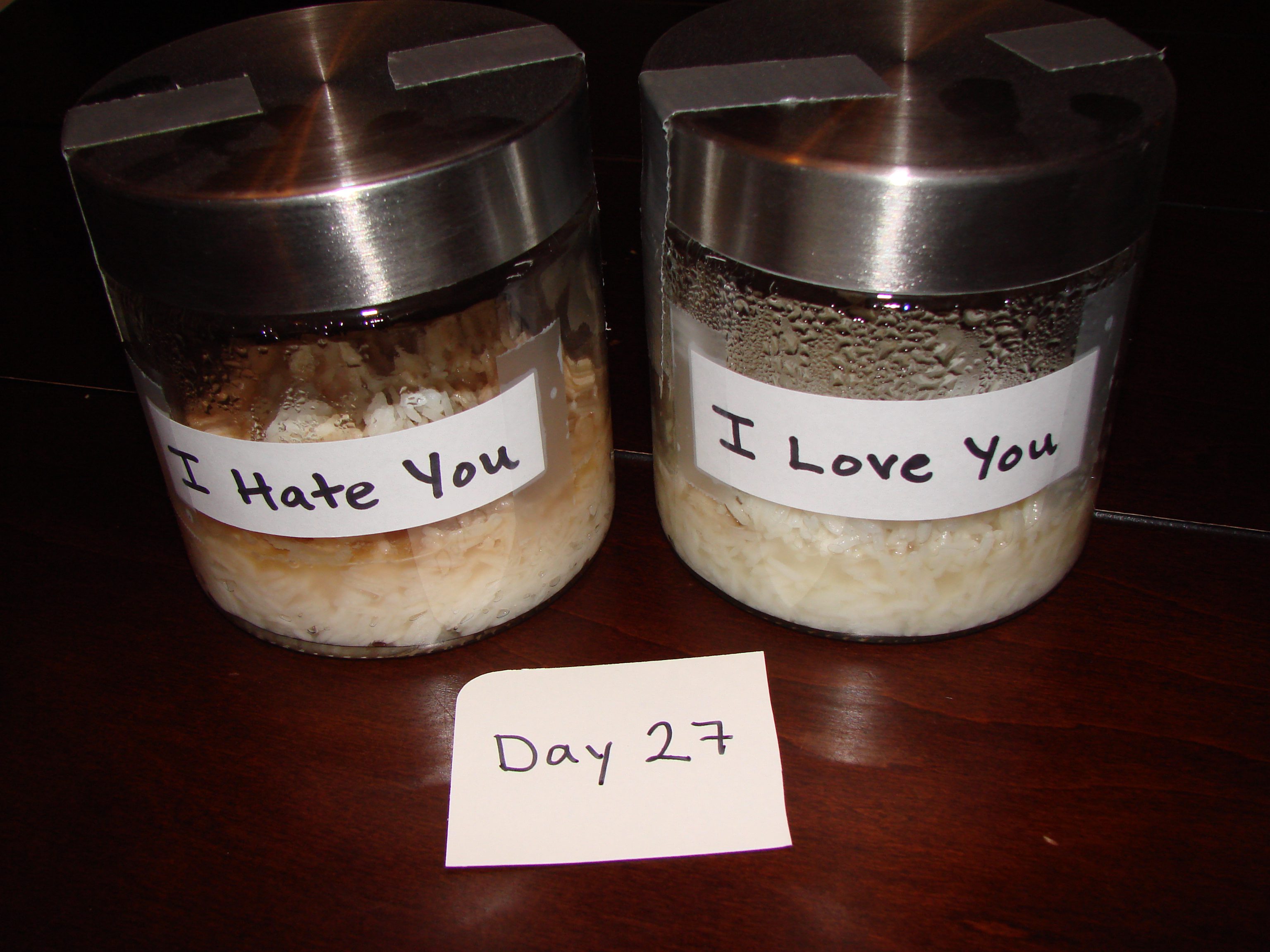
Despite the opposition, Dr. Emoto persevered and created many more experiments, including the infamous “rice experiment,” in which two jars containing cooked grains of rice were submerged in water and then subjected to both positive and negative phases.

dr-emoto

In one of these experiments, schoolchildren, not associated with Dr. Emoto in any way, were asked to repeat positive and negative phrases to the jars every time they passed by. After 30 days, the jar with the positive phrases showed little physical change while the jar with negative comments contained mold and was clearly rotting. One person, curious if they could achieve the results independently, conducted their own experiment with similar results.

Throughout his life, Dr. Emoto gave as much (if not more) credence to the power of positive thinking and faith in our relationship to the physical universe than anyone else before him. He never sought acclaim or recognition for his studies, humbly continuing his work while graciously accepting and responding to any criticism.

Dr. Emoto was as insightful as he was prominent and as humble as he was successful. He produced a body of work that changed many people’s thinking on the power of our consciousness and the importance of thinking positively, despite any difficulties that we may face. His friends and colleagues attest to his honest and kind-hearted nature while fervently defending his integrity and good intentions.

This tribute to Dr. Emoto is well-deserved. Our world has lost a truly great man, and it seems fitting to end the tribute with more insightful words from Dr. Emoto himself. Arigato, Dr. Emoto.

“What you really know is possible in your hearts is possible. We make it possibly by our will. What we imagine in our minds becomes our world. That’s just one of the many things I’ve learned about water.”

Is Anxiety Actually Good for You?

Having been diagnosed with a very severe form of Obsessive-Compulsive Disorder (OCD) at the age of 12, I had grown up thinking that anxiety was only present in my life to hurt me. But once fully recovering from OCD, anxiety, and clinical depression I started to study the mind, brain, and the real role of anxiety.

In studying what anxiety was I quickly realized that there are three main myths associated with it.

Here are the 3 top myths associated with anxiety:

anxiety

Myth #1 – Anxiety is bad

Anxiety is actually not bad at all. I am not suggesting that when you are going through an anxiety attack that it feels good. It does not. But anxiety is actually a defence mechanism created by the brain to tell you that you have to take action in some way. Anxiety is like physical pain. No one enjoys experiencing physical pain but it is created as a defence mechanism to protect us.

Imagine if you broke your leg but did not have the ability to feel the pain associated with the broken leg. You would continue to walk on your leg until you permanently damaged it. Pain is a warning signal sent at lighting fast speed from your brain to the troubled area as an alert to tell you that something is wrong and that you have to take action. Anxiety is identical. Anxiety is the brain’s way of sending your body a signal that you have to take action. Thus, anxiety will not make your leg hurt because it’s not broken. So it has to find other ways to tell you that something is wrong. It makes your heart beat faster, makes your hands sweat, makes you tremble, etc. In other words, it gives you the “fight” or “flight” response.

What is actually happening is that the hypothalamus (a part of your brain) is triggering the release of the “stress hormone” cortisol from your adrenal glands in your kidneys. Cortisol is then distributed throughout your body via the bloodstream and causes you to experience the above effects.

An Example of Fight or Flight in Action

Imagine that you were going for a walk and a huge alligator starts to slowly creep towards you but you did not have the ability to feel anxiety. You would just stay there until you become alligator food. Anxiety gives you that “fight” or “flight” response by giving you an extra burst of energy (adrenaline rush), elevates your heartbeat, provides you with extra strength, and an overall urgency that you have to take action (get the heck out of the way!). It’s a good thing. It’s a defense mechanism that was created to keep us alive.
But you may be saying, “but Jeremy, I take anxiety attacks when I am completely safe”. Yes, and that’s the second kind of anxiety. Many people believe that the anxiety attack that occurs when they are completely safe is “needless” and that it’s only there to hurt them and that they are cursed with anxiety.
But this is simply not the case.
It is still present as a warning sign to tell you that you are doing things day by day, month by month, year by year that is actually abusing your mind and body. This is the way that it tells you that you have to take action which leads me into Myth #2.

Myth #2 – Situations cause anxiety

Situations cannot cause anxiety. You may be surprised to hear me say that your kids, job, spouse, or finances cannot stress you out. But it’s true. It’s never the situation. It’s actually your psychological reaction to the situation. What is your psychological reaction? I am referring to your thoughts.
Researchers are telling us that we have on average approximately 60 000 thoughts a day. And not only are the vast majority the same thoughts we had yesterday but they are thoughts either dwelling on something negative in the past or fearing something that could happen in the future.  And because the brain cannot tell the difference between something that is actually happening and when you think of something, the brain reacts as if it is happening by triggering the “stress hormone” (cortisol) to give you that “fight” or “flight” (anxiety) response.
If situations caused anxiety, everyone would react to the same situation in the same way. But we know that’s not the case. How can one person love to ride roller coasters and one person fear it? Thoughts about situations cause anxiety, not the situations themselves.
Until we take full responsibility for what we cause ourselves we cannot equip ourselves to overcome it.

Myth #3 – The one, big traumatic experience in our past is causing your anxiety today

 
It’s actually not the one big, traumatic experience in your past that is causing you to experience anxiety today. It’s the dozens and dozens of little things you are doing every single day that is actually causing you to experience stress and anxiety. I am not suggesting that nothing traumatic happened in your past.  I am saying that it is not what happened in your past that is causing your stress and anxiety. It’s your thoughts about what happened that is causing you to experience stress and anxiety.
There are so many things that we do on a regular basis that actually contributes to anxiety. Every time that you complain, gossip, judge, ridicule, or hold vengeful thoughts you hold negative thoughts in your mind and your brain interprets those thoughts as a reality happening right now and triggers the release of cortisol (the stress hormone) from the adrenal gland in your kidneys. This elevates your heartbeat, makes your hands sweat, increases blood pressure, and makes you experience stress and anxiety. These are only a few things that we do that contributes to stress and anxiety.

Final Thoughts on Fight or Flight as a Coping Tool

We need to realize that we are the creators of what we feel, attract, and experience. Because we create the stress and anxiety that we experience we can also take it away. We have the amazing ability to create exactly the life that we want to live. We have the ability to experience bliss, happiness, and a life full of joy. And, finally, we have the ability to attract the people, situations, and experiences that we only thought was possible in our dreams. But first, we have to realize that we are the creators of our everything because of the thoughts we hold in our minds.
You are exactly what you attract. Choose your thoughts wisely.

7 Tiny Habits That Can Steal Your Happiness

The founder of positive psychology, Martin Seligman, proposes that around 60 percent of your happiness is determined by your genetics and environment while the remaining 40 percent is up to you. Considering that you also have some control over your environment, you have a big say in whether or not you lead a happy life.

Your habits are something within your control and play a large part in determining whether or not you experience happiness. An important aspect of controlling your habits is being mindful as to which ones are taking happiness away and replacing it with something less pleasant.

“Our happiness depends on the habit of mind we cultivate. So practice happy thinking every day. Cultivate the merry heart, develop the happiness habit, and life will become a continual feast.” ­–Norman Vincent Peale

Here are 7 habits that can steal your happiness away from you (if you let them)

1. Comparing yourself to others

President Theodore Roosevelt once said, “Comparison is the thief of joy.”

Oh, how true, and yet unfortunate this is. Whether it’s someone else’s physical appearance, job title, income level, house size or something else, comparing yourself to someone else is a bad habit that brings a heavy dose of unhappiness.

As with many other human emotions, our tendency to compare ourselves to others is as natural as it is damaging. It’s also something that you can learn to be mindful of and defend against. One great way of doing this is to become mindfully aware of your own successes and remind yourself of them often throughout the day.

2. Working a joyless job

As Americans, we are some of the most overworked people in the world. We also have the dubious honor of being the unhappiest with our jobs. Gallup conducted a study in which 70% of 150,000 polled were either “disengaged” or “actively disengaged” at work.

Chances are, you have been taught that work is not supposed to be fun. Well, shouldn’t it at least be engaging? It should be… if you are trying to live a happy life anyways. Working a joyless job for no other reason than a paycheck will almost certainly result in discontent and unhappiness.

If you are in this situation (and many are), don’t consider it acceptable. Find work that is personally fulfilling.

3. Allowing worry to control you

“Worry is like a rocking chair; it gives you something to do but never gets you anywhere.” This is a great quote that we all should commit to memory. Going one step further, worry not only gets you nowhere, it can also extinguish the flame of your ambitions.

Worry is often a by-product of holding onto something that has caused you hurt and disappointment in the past. Do yourself a favor and let it go. There is nothing that can be done about it now. You have a present to be experienced, not a past to be relived.

Strip away all of the worry, anxiety, and uncertainty about your life. It’s pointless and often harmful. Instead, focus on your dreams and allow life to unfold as it may…this is where you’ll discover true happiness.

4. Thinking that pursing pleasures brings happiness

The pursuit of pleasure cannot provide you with enduring fulfillment – this includes material possessions.

In a TED talk conducted by Dr. Martin Seligman, he discusses three different kinds of happy lives: a pleasant life, in which you pursue as many pleasures as you can; a life of engagement, in which your find a life in your work, love, parenting and leisure and a meaningful life, which “consists of knowing what your highest strengths are, and using them in the service of something larger than your are.”

Throughout his research, Dr. Seligman has concluded that pursuing pleasure alone will not provide any sort of lasting fulfillment. Instead, a person must also pursue a life of engagement and meaning. Short-lived pleasures, if constantly pursued, will often lead to emotional letdowns and feelings of emptiness.

5. Taking your unwelcome thoughts too seriously

Possessing more brainpower than the world’s most advanced supercomputer is both a blessing and a curse. Your advanced thought processes are great for productivity, complex problem solving and meeting the demands of life. On the other hand, human beings have the innate tendency to overthink things, which can lead to negative thoughts that constantly replay themselves.

Remember this: you are not the sum of all your thoughts. Negative thoughts are tabloid material for your mind – unreliable and misleading. This includes thinking you are not good enough, smart enough, successful enough…you are exactly the person you were meant to be and you can do great things. Don’t read the tabloids.

 6. Neglecting your passions

When you neglect your passions, you neglect one of life’s greatest gifts: doing what you love. Neglecting the things you love doing can be attributed to the constant stressors placed on your life: work, money, bills, and other things that come with living in an “always on” society.

If you can’t for some reason do what you love for a living, try to at least make it a part of your life. Follow your heart, your intuition, and your purpose. You don’t need to make money to pursue your passions in life; you just need to make the effort. Your happiness and passion is something that money can never replace.

7. Putting things off

Having to do something that you aren’t fond of instead of doing something enjoyable can be mentally taxing. Ironically, tacking these boring tasks can actually boost your happiness (please, keep reading).

Don’t just take our word for it – in a survey done by the Procrastination Research Group (there is such a group, by the way) 94 percent of the 10,000 respondents reported that procrastination has negative effects on their happiness, with 19 percent saying that the effect is extremely negative. The reason for this is mostly due to regret. In the long-term, you regret what you don’t do or have put off.

To kick the procrastination habit while boosting your happiness, practice temptation control. For example, if losing weight is a major area of procrastination, go to the grocery store with a detailed list of what to get. If you find yourself checking your e-mail instead of writing your paper, disable the notifications for incoming mail.

If you’re a chronic procrastinator, check out this site created by Piers Steel, author of “The Procrastination Equation”.

Skip to content