Weekly tips, affirmations, and small actions to feel your best.

How to Make Savory Snowflake Bread Recipe (Two Ways)

These savory snowflake bread recipes will become your latest obsession once you try them (trust us). Yes, they take a little elbow grease, but you’ll thank yourself once you bite into their fluffy goodness. First, we’ll make olive oil and scallion bread, and next up is garlic butter, herb & cheese bread. Ready to get baking? Read on for the recipes!

Snowflake bread supplies you need:

  • 2 large bowls (1 should be an extra-large, deep bowl)
  • 2 small bowls
  • Spoon
  • Measuring cups/spoons
  • Whisk
  • Kitchen towel
  • Spatula
  • Baker’s table or large cutting board
  • Knife
  • Rolling pin
  • Baking sheet
  • Parchment paper
  • Pastry brush
  • Pastry cutter
  • Circle cookie cutter mold
  • Plastic wrap

Ingredients for olive oil & green onion snowflake bread:

Here are the ingredients that you will need to get started.

snowflake breadDough ingredients

  • 4 cups all-purpose flour
  • 1/2 cup tapioca flour
  • 1/2 tsp granulated sugar
  • 1 tsp salt
  • 2 tsp instant yeast
  • 2 cups lukewarm milk
  • 1/2 cup softened butter
  • Olive oil

Filling ingredients

  • 1/2 cup scallions
  • One tbsp flour
  • 1 tsp salt
  • 1 tbsp olive oil

Extras

  • Egg wash
  • Sesame seeds

How to make olive oil & green onion snowflake bread:

Let’s bake!

Creating the dough

  1. Combine all ingredients in a large bowl and whisk until combined. Next, begin kneading the dough until the flour is no longer visible and forms a ball shape. Set aside.
  2. Grab your extra-large, deep bowl and drizzle olive oil in the bottom.
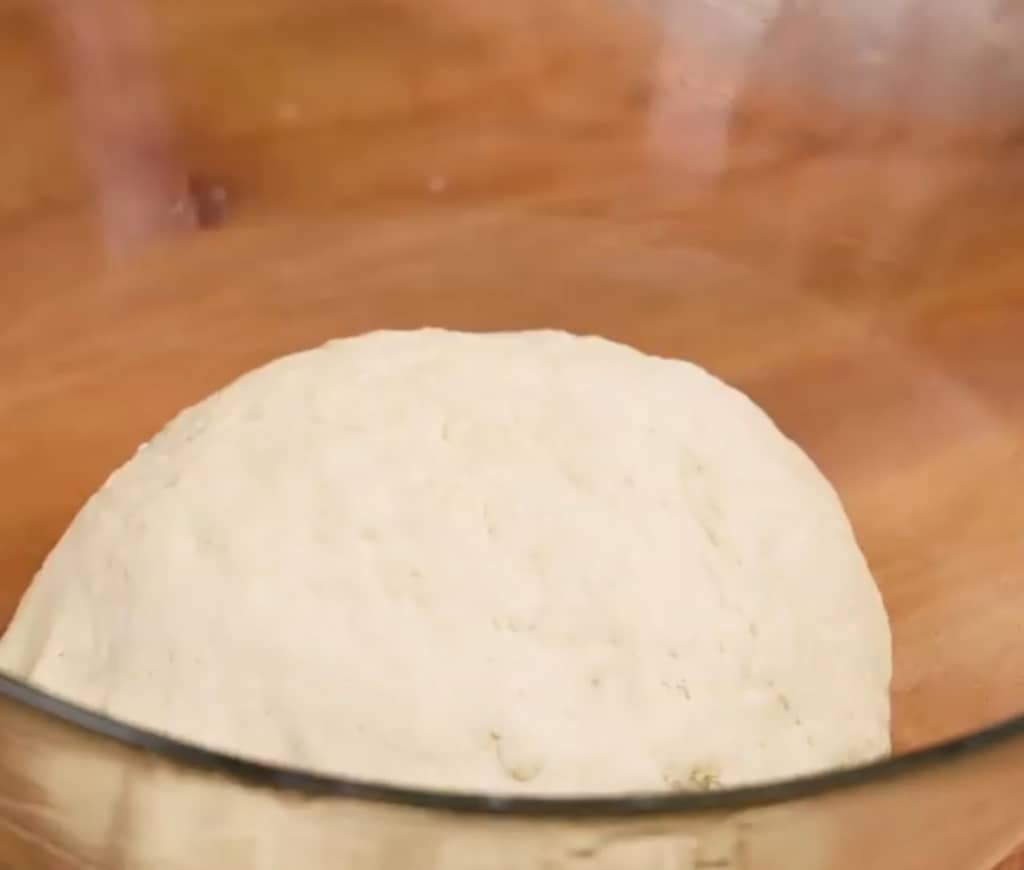
  3. Spread it around the bowl with your hand, and place the dough inside. Cover with a kitchen towel and let it rise for one hour.
  4. While the dough rises, combine the scallions, tbsp of flour, and salt in a small bowl. Mix the ingredients with a spoon, then add the tbsp of olive oil. Mix the oil with the other ingredients until fully combined.
  5. In another small bowl, combine 1/2 cup softened butter, 1 tbsp dried thyme, 1 tbsp dried rosemary, and 1/2 tsp garlic powder. Mix with a small spoon or spatula and set aside.
  6. Now, back to your snowflake bread. Before taking it out of the bowl, you’ll want to “punch” it several times to prevent over-proofing. Form a fist and press firmly into the dough. This removes some of the gas bubbles formed from yeast while rising.
  7. Once that’s done, sprinkle some flour on a large cutting board or baker’s table. Set your dough down, and use your hands to shape it into a loaf shape.
  8. Next, use your knife to cut it in half lengthwise. Please take one of the halves and shape it into a square, then cut the dough into fourths.
  9. Ball up each piece with your hands. Now, take one of the fourths and sprinkle flour on top.
  10. Grab your rolling pin and roll out the dough until it forms a flat circle.
snowflake breadAdding the filling

Set it on a baking sheet lined with parchment paper, and brush the beaten egg wash on the dough. Make sure to coat it thoroughly.

  1. Next, spoon the scallion and olive oil mix from one of the bowls onto the dough. Use a spoon to spread it evenly on the surface.
  2. Now, take another one of the smaller pieces of dough that you cut in step 8. Repeat step 10, then place the flattened dough on top of the other.
  3. Brush the egg wash and scallions on top of this piece as well. Add another piece of dough and repeat the process.
  4. Place a final piece of dough on top, but don’t add the egg wash or scallion mix this time. Instead, place a medium-sized plate face down on top.
  5. Now, use a pastry cutter to cut off the excess dough around the edges of the plate. Remove the plate and extra dough.
  6. Next, use a circular cookie cutter mold to press lightly in the middle of the dough. Make sure not to press too hard, just enough to create a circle imprint.
  7. Then use the pastry wheel to cut the dough into fourths, starting from the outside of the circle. Make more cuts until you have sixteen evenly cut pieces. Now the snowflake bread is starting to take shape!
  8. Finally, take two pieces and twist them in opposite directions (one clockwise, one counterclockwise), connecting them at the ends. Press them firmly together, so there’s no space in between.
  9. For the last step, rub the snowflake bread thoroughly with egg wash, and sprinkle sesame seeds on top. Cover with saran wrap and let it rest for fifteen minutes.

Ingredients for garlic butter, herb & cheese bread:

See the first recipe for dough ingredients.

Fillings

  • 1/2 cup softened butter
  • 1 tbsp dried thyme
  • 1 tbsp dried rosemary
  • 1/2 tsp garlic powder

Extras

  • Egg wash
  • Pecorino cheese

snowflake breadHow to make garlic butter, herb & cheese snowflake bread:

  1. Repeat the process for cutting the other half of the dough. (Cut this piece into fourths, and roll the balls into flat circles).
  2. Now, lay the first piece of dough on another baking sheet lined with parchment paper.
  3. Rub egg wash and the garlic butter & herb spread on top. Next, sprinkle the dough with a bit of pecorino cheese.
  4. Add another dough layer on top, repeating this process two more times. After adding the fourth and final piece of dough, lay the plate on top.
  5. Cut the excess dough with a pastry cutter, and then remove the plate and extra dough.
  6. Use your cookie cutter to press down on the middle of the dough and create a circular imprint.
  7. Cut this snowflake bread just as you did with the first recipe. After twisting the pieces together and forming the edges, brush the dough with egg wash.
  8. Sprinkle dried rosemary, thyme, and a bit of extra cheese on top. Cover with saran wrap and let it rest for fifteen minutes.
  9. Bake both snowflake bread at 400 degrees F for twenty minutes. When it’s done, tear off a snowflake piece and enjoy!

After all your hard work in the kitchen, you’ve definitely earned your slice of snowflake bread! Aren’t these loaves of bread just beautiful? They’re almost too beautiful to eat, in our opinion. However, the aroma of freshly baked bread will probably tempt your taste buds too much to have any leftovers. Let us know what you think if you try it!

15 Toxic Beliefs That Sabotage Your Relationships

Having a relationship that maintains a healthy balance is challenging. Sadly, many toxic beliefs can stand in the way and cause issues between you and the one you love. Do you and your partner have problems because one or both of you have toxic views?

Sadly, you’re not alone, as relationships take hard work. According to Psych Central, dynamics, practices, beliefs, feelings, suppressed memories, and emotions come together. Sorting through all the past baggage and the current issues can be overwhelming, but it can be done by changing your mindset.

Fifteen Common Toxic Beliefs That Ruin Relationships

If some toxic beliefs are between you and your spouse, then it can cause significant trouble. Here are some of the beliefs and thoughts in a relationship that can become lethal to your union.

1. It’s Your Way Or The Highway

In a perfect world, everything would always go your way. However, one of the toxic beliefs that can ruin your relationship is thinking that your opinion is the only one that counts. Having a partner means learning to give and take, and you’re not always right.

A black and white mindset is a recipe for disaster. You must understand that there is sometimes a gray area that you must explore. Being one-sided will cause issues in your relationship.

toxic beliefs2. Time Together Isn’t Important

If you feel that dating is done once you get married or move in together, you may have some issues. To keep your union strong, you must carve out time for each other. No matter how hectic your days and nights are, nurturing your relationship should take top priority.

3. Work Comes First

Yes, your job is essential as it gives you money to live. However, don’t ever put a career over those you love. Your job will replace you in a heartbeat should things go south, but it’s your family that will remain when the going gets tough.

It’s a toxic belief that work takes the top spot in your life. If you elevate your career over people, then you will likely end up alone.

4. White Lies Are Acceptable

It’s never okay to tell your partner something that isn’t true. Even if you think that the truth is too hard to handle, it’s always best to be upfront and honest from the start.

5. Trust Cannot Be Re-Established

When you’ve been together for any length of time, you will learn that the person you idolize is a human being, and humans are fallible. Your partner will fail you many times, but it’s learning to rebuild that trust that makes or breaks your relationship. Some people believe that cheating is the ultimate sin in a partnership, but the American Psychological Association states that only 20-40 percent of those relationships end in divorce.

Even if your spouse does the unthinkable, you need to learn how to forgive and build trust. Forgiveness does just as much for you as it does for them.

6. Your Needs Are Superior

Do you come first, no matter what? This toxic belief will send you to divorce court quicker than anything. When you elevate your needs and wants above that of your family, then you’re acting selfishly. Some might even say these are the actions of a narcissist, yet it isn’t always the case.

Your desires are essential, but you must consider the needs of your spouse too. If you’re genuinely in love, you will put their needs above yours in many instances. Say your partner wants to go out for burgers, but you like Mexican food. You might give in because you know that you want to make them happy too.

7. Your Happiness Is The Responsibility of Others

Wow, why do people always think that their happiness is the responsibility of others? If you’re not happy, then it’s time for you to do a self-inventory. Granted, there are situations where you can feel like your partner is making you miserable, but ultimately your happiness falls on you.

toxic beliefs8. Relationships Should Be Struggle Free

In a perfect world, the sun would shine every day, there would be no stormy skies, and rainbows would be commonplace. However, life doesn’t always go the way you plan. For every sunny day comes one that’s filled with thunder and lightning and torrential downpours.

It’s an unrealistic thought that there won’t be any struggles in your relationship. The rough patches are what bind you and teach you to work better as a couple. Additionally, if things were sunshine and roses all the time, would you be able to enjoy the beautiful fragrance that wafts through the air after a spring rain?

Life is about embracing the good and the bad times, and in a relationship, there will be plenty of both. Having realistic expectations is essential to ensure that things stay on even kilter between you and your partner.

9. Communication Isn’t Important

When you first fell in love, you would text, call, or message on social media throughout the day. Why would you think that this should change just because you make things official? When you don’t have proper communication or a shift in communication, you must be aware that it will change your relationship.

Also, if you once texted ten times a day and now you don’t text at all, it’s going to cause suspicions to grow from your partner. They may think you’re cheating, or something is wrong since you’re aloof.

10. Finances Shouldn’t Be Discussed

The old method of budgeting, where one person handles all the finances, is out. According to MadameNoire, both parties need to have a hand in the bills. Imagine never seeing a statement, not knowing how much the outgoing expenses are, and not knowing what’s coming in versus what’s going out.

Both parties need to be in the loop, even if just one person is paying the bills. Whether you put your checks together or not, you need to ensure that you both have a general idea of what’s going on in the finance department.

11. The Past Is Irrelevant

If you believe the past doesn’t count, you would be mistaken. The best predictor of future behavior is relevant past actions. Each person carries a certain amount of baggage with them that they need to unload.

Some folks have experienced horrible things like abuse, while others have gone through a broken heart that nearly destroyed them. The toxic belief that your past is irrelevant is sadly untrue. Your history helps mold you into who you are, but you don’t have to let it dictate your tomorrow by learning to get beyond those events.

12. Keeping Secrets

No, you cannot keep secrets from your partner. Well, you can, but if you choose not to disclose certain parts of your life, then you can rest assured it will cause trouble down the line. The open dialogue between you and your spouse needs to be honest and constant.

Before you keep something from the one you love, ask yourself why you feel uncomfortable telling them. Will they be mad if they find out what you’re hiding? Chances are they will be angrier that you didn’t tell them in the first place.

13. There Doesn’t Need To Be Friends or Family Time

It can’t be just you two and no one else. You need to allow your partner to have time with their family and friends, just like you need time away from your spouse too. Many people help mold and make you into the person you are today, but you can’t just isolate these folks because you’ve found love.

14. Self-Care Isn’t Important

Your self-care is essential to your overall well-being. There’s no way that you can nurture and care for your spouse, children, and others without first taking care of yourself. It would help if you had that time where you can collect your thoughts and recharge your batteries.

15. Intimacy Can Be Put On The Back Burner

The personal needs of a person are of vital importance. You cannot ignore the physical needs of your spouse, and if you don’t make this a matter of priority, they may look outside the relationship to have their needs met. This fact sounds unfair, but we all know the stories. Even when the whole world is crashing in around you, an embrace, kiss, or some affection is warranted.

toxic beliefsFinal Thoughts On Toxic Beliefs In A Relationship

Did you see anything on this list that you find as a significant issue in your relationship? Toxic beliefs can destroy the good thing you have going, but this will only happen if you allow it. Remember, you have the power to change your destiny.

Even if you’ve had toxic beliefs that harmed your relationships in the past, they do not have to dictate your future. You can make changes and work on things to ensure that the one you love today will still be with you tomorrow. Changing your mindset and alleviating toxic thoughts and beliefs can change everything.

Scientists Create Speech Neuroprosthesis, Helping Paralyzed People Communicate

Scientists have successfully developed a speech neuroprosthesis for the first time to help a man with severe paralysis communicate. The researchers at UC San Francisco created a technology that allows him to communicate in complete sentences. The system translates signals from his brain to the vocal tract into words that appear on a screen.

Over a decade of research by UCSF neurosurgeon Edward Chang, MD, led to this groundbreaking discovery. His work created a technology that would allow people with paralysis to communicate in alternative ways. The study appeared July 15, 2021, in the New England Journal of Medicine.

Dr. Chang, the Joan and Sanford Weill Chair of Neurological Surgery at UCSF, Jeanne Robertson Distinguished Professor, and senior author on the study said this:

“To our knowledge, this is the first successful demonstration of direct decoding of full words from the brain activity of someone who is paralyzed and cannot speak. It shows strong promise to restore communication by tapping into the brain’s natural speech machinery.”

Strokes, neurodegenerative diseases, and accidents cause anarthria – the loss of ability to speak – in thousands of people annually. However, researchers believe their technology could help these people communicate more naturally and efficiently in the future.

How communication neuroprosthesis helps seizure patients

speech neuroprosthesisPrior research in communication neuroprosthetics aimed to help patients communicate with spelling only. These approaches involved typing out letters one at a time in text, relying on signals to move the arm for typing. On the other hand, Chang’s study focuses on translating signals that control vocal tract muscles for speaking words. Chang says this method allows for more natural, fluid communication.

Dr. Chang noted that spelling-based approaches using typing, writing, and controlling a cursor are considerably slower and more laborious.

“With speech, we normally communicate information at a very high rate, up to 150 or 200 words per minute. Going straight to words, as we’re doing here, has great advantages because it’s closer to how we normally speak.”

Over the past ten years, Chang’s research involved seizure patients with normal speech at the UCSF Epilepsy Center. They underwent neurosurgery so doctors could understand the cause of their seizures. The patients had electrode arrays placed on their brains to track electrical activity. Before surgery, they volunteered to have these recordings analyzed for speech-related activity.

Next, Chang and colleagues in the UCSF Weill Institute for Neurosciences mapped the brain patterns associated with vocal tract movements responsible for speech. The team then worked on translating the brain activity into speech recognition of full words. This responsibility fell on David Moses, Ph.D., a postdoctoral engineer in the Chang lab and one of the lead authors of the new study. He created new techniques to decode the patterns in real-time along with statistical language models to increase accuracy.

This study proved fruitful, so Chang wanted to replicate it in people with paralysis. However, the team realized they faced more difficult challenges this time around. The technology worked well before, but they weren’t sure how it would perform in a person with vocal cord paralysis.

Dr. Moses said this:

“Our models needed to learn the mapping between complex brain activity patterns and intended speech. That poses a major challenge when the participant can’t speak.”

Not to mention, the researchers didn’t know the condition of the brain signals controlling the vocal tracts of the patients. Would they still function in people who haven’t been able to use their vocal muscles for years?

“The best way to find out whether this could work was to try it,” said Moses.

The study showing how speech neuroprosthesis helps paralyzed people communicate

For the study, Chang collaborated with colleague Karunesh Ganguly, MD, PhD., an associate professor of neurology. Together, they launched “BRAVO” (Brain-Computer Interface Restoration of Arm and Voice). The first volunteer for the study, referred to as BRAVO1, is a man in his late 30s. Over 15 years ago, he suffered a severe brainstem stroke that caused massive damage to his brain, vocal tract, and limbs.

Since his stroke, he’s had minimal mobility of his head, neck, and limbs. He communicates using only a pointer that presses letters on a screen.

For this study, the participant worked alongside researchers to formulate a 50-word vocabulary. Chan’s team would monitor and recognize the words from brain activity utilizing advanced computer algorithms. The vocabulary includes simple words such as “good,” “water,” and “family.” The algorithms can then use these words to create hundreds of sentences to help BRAVO1 express his thoughts.

After that, Chang surgically implanted a high-density electrode array over BRAVO1’s speech motor cortex. After BRAVO1 fully recovered, the team recorded 22 hours of brain activity over the course of 48 sessions. The recording sessions lasted several months. In each session, BRAVO1 made several attempts to say each vocabulary word. At the same time, the electrodes recorded the signals from his speech motor cortex.

How the speech neuroprosthesis converts words from brain signals

Other lead authors of the study employed custom neural network models to translate the attempted speech into text. Forms of artificial intelligence, the networks helped record subtle brain patterns to detect speech attempts. Then, the system identified which words BRAVO1 was trying to say.

To test the models, the team gave BRAVO1 short sentences comprised of the 50 vocabulary word bank. Then, they asked him to attempt saying them a few times. When he attempted to speak, the words decoded from his brain activity got recorded on a screen.

Next, the team began asking him questions like “How are you today?” or “Would you like some water?” BRAVO1’s responses then appeared on the screen. He said, “I am very good,” and “No, I am not thirsty.”

The speech neuroprosthesis decoded words from brain activity at a rate of around 18 words per minute. Impressively, it had a 93 percent accuracy (75 percent median). The language model Moses created also played a role in its success. The system had an autocorrect function similar to modern smartphones and speech recognition software, which increased accuracy.

“We were thrilled to see the accurate decoding of a variety of meaningful sentences,” Moses said. “We’ve shown that it is actually possible to facilitate communication in this way and that it has potential for use in conversational settings.”

speech neuroprosthesisFinal thoughts on the speech neuroprosthesis that improves communication in paralyzed people

In the future, Chang and Moses will perform a follow-up trial to include more volunteers with severe paralysis. However, the team is working on expanding the words in the vocabulary and improving the rate of speech for now.

While the study only included one participant and a 50-word vocabulary, both scientists called it a huge success. Finally, Moses said, “This is an important technological milestone for a person who cannot communicate naturally and it demonstrates the potential for this approach to give a voice to people with severe paralysis and speech loss.”

3 Ways Reconnecting With Old Friends Can Help You Grow

Have you ever felt like it was only yesterday that you were running around with your old friends from childhood? Or that you’ve just closed your eyes for a moment, and now your siblings have their own families? When is the last time you saw your parents? Sometimes, we get so focused on our plans and dreams that we don’t realize that we’ve let meaningful relationships slip through our fingers.

As you become an adult, learn to be independent. It’s normal to let go of some people and lose relationships that once felt like the most essential things in the world. As time passed, not only did you grow up, but you grew apart. In letting go of some people, we can risk letting go of our personal development.

So, can people from our past help better our future? Read on to find out three ways in which reconnecting with old friends and family helps you with inner growth.

What Is Inner Growth, And Why Is It Important to Connect with Old Friends?

Inner growth is most easily described as the process through which you get to know, understand and express all aspects of your humanity and experiences. It can be perceived as personal development, the personal change in behaviors, thoughts, and feelings. It’s the journey you embark on to develop who you are on the inside by letting go of meaningless self-criticism, being kinder to yourself, and strengthening your ethical framework.

But why is it essential in someone’s life? Studies prove that inner growth and personal development are the bedrock of one’s way of being, thus being crucial for achieving happiness. In addition to that, self-improvement tends to make you kinder and less worried, thus helping you be in a safer space of mind from which you can learn to treat others better. Therefore, bettering yourself doesn’t only benefit you but also the people around you.

old friendsWhy Did You Lose Touch With Old Friends And Can You Do Something To Change That?

We will have dozens of friends throughout our lives, and we will drift apart from most of them. This is usually just an ordinary sign of growing up. According to Lauren Millman, a marriage and family counselor, as people grow, their views and interests change, thus making relationships less stable as people begin to have less and less in common.

But while this is true in some cases, sometimes the fact is that people don’t always have an actual reason for drifting apart. Sometimes we forget to put enough effort into a meaningful relationship because we’re too busy with our problems, and, before we know it, we’ve lost sight of what’s important: people and socialization.

The good news is that no matter how estranged you have become from a particular family member or friend, you can always do something to fix that.

Reestablishing a connection is easy. Indeed, the best way to start reconnecting is to reach out to those people. Don’t be passive, don’t expect others always to make an effort. You have to be willing to take that first step. Apologize for not keeping in touch and try to make plans to meet up and have an actual conversation. Not only that, but your oldest friends and your family are the ones most likely to be forgiving, empathize, and give your relationship a new chance.

Five Ways Rekindling Relationships Can Help You With Inner Growth

But you might be wondering, why would I ever want to reconnect? What’s in it for me? And how do old friends fuel inner growth?

1.      Reconnecting With Old Friends Triggers Nostalgia

Imagine you’re walking down the street on an average day, and you bump into your oldest friend that you have not seen in years. Or that you’re at a family reunion, and you see the person who was once your favorite cousin. What would be the feeling those meetings evoked? Well, nostalgia, of course.

We all like to feel a little bit of nostalgia. It reminds us of simpler times, happier moments. But can nostalgia be a feeling attributed to inner growth?

Nostalgia is not about retreating into the past but rather exploring the contents of our mind and seeing how our “inner time capsule” can propel us into the future with a sense of hope.

Studies Support This Line of Thinking:

Studies confirm that, when measured as an individual difference, the people prone to nostalgia report greater meaning in life than others. Nostalgia has also been found to increase self-esteem, optimism, and self-connectedness.

Interestingly, research has shown that when people experience negative states, such as loneliness or meaninglessness, they use nostalgia to regulate distress.

According to Dr. Clay Routledge, Social Psychologist and Associate Professor of Psychology at North Dakota State University, nostalgia motivates people to cultivate and maintain meaningful relationships and pursue important life goals. Moreover, as people get older, it can help them feel more youthful and energetic.

All the positive factors correlated to nostalgia are integral to inner growth. The possibility of exploring the past again, meditating, considering how you were compared to how you are now, the feeling of hope and meaning that can be extrapolated from nostalgia, can be used for self-development. Moreover, old friends and family will always remind you of the person you once were and will give you their honest opinion on the change you’ve been through, allowing you to better judge who you have become.

When you choose to embark on an exploration of the past, you allow yourself to realize who you’ve been, what you’ve been through, who you are now, and who you want to be. And what better way to evoke nostalgia than to invite an old friend out for coffee and reminisce on simpler times?

old friends2.    Reconnecting With Old Friends Builds And Strengthens A Support System

Who was there with you when you broke up with your first love? Or when you got into the school of your dreams? Whether it was your parents, your best friend, whoever it might have been, they are people who have been a shoulder for you to cry on in times of need and also the first ones to jump with joy at your achievements. Over time, the people who used to know you best have become strangers. Wouldn’t it be better to change that?

For humans, it is vital to have a support system, a network of family and friends that you can turn to in times of need. Whether you’re looking for emotional, informational, or practical support, reconnecting with people can get you precisely what you are looking for. You will get to socialize with people who know different parts of who you are and what you have been through. Thus each being able to aid you in different ways. Combined, all that support can make for a comprehensive system that can keep you from going to dark places when facing a problem.

In one study, it was found that middle-aged men with a support system were likely to live longer than those who lacked this support. This supports the idea that aid is integral to our vitality and well-being.

The Studies That Prove This:

Support systems bring positive influence. Your present relationships will be catered to present you. Thus, they will not object to any of your flaws because they are used to them or don’t see them as a flaw. If you are an avid drinker, you most likely have friends who also drink a lot. While surrounded by people who think like you, you will never have a strong checks-and-balances mechanism. By reconnecting, you will get new perspectives on life. So you will not be able to stay stuck in your echo chamber.

Studies suggest that reconnecting with people leads to lower rates of substance abuse, depression, or suicide. Moreover, reviving old relationships makes you better cope with trauma. Think divorce, loss of a loved one, mental health issues. And reconnecting only helps because it allows more people who know you and care about you to be by your side.

A robust support system is integral to inner growth. You won’t be able to better yourself if you’re stuck holding the weight of the world on your shoulders. So, don’t be scared. Reach out to people you used to know, and you will find that they will be your shoulder to cry on in times of need, just like they used to be in the past.

3.      Reconnecting With Old Friends Improves Your Self-Worth

Reaching out to someone you haven’t talked to in ages and seeing that they’re willing to reconnect can immediately boost your confidence. It will make you see that you are worth talking to, even after all this time, and even though you and that person have drifted apart, there’s still compassion between the two of you.

Research shows that relationships can help boost your confidence by reducing stress. Knowing you have a person who will listen to you and validate your feelings is vital in combating feelings of anxiety and doubt you might feel.

The sense of belonging you feel whenever you reconnect to people can make you understand your true worth by demonstrating that you are worth taking the time to strengthen the relationship again.

So, on your path to personal development, remember: you have to feel worthy to have the incentive to start working on yourself, and reconnecting with people you used to love can make you see just how special you are.

old friendsFinal Thoughts On How Rekindling Old Relationships Can Help With Inner Growth


We tend to feel scared when we think about reaching out to an old acquaintance, and that’s perfectly normal. People are afraid of rejection, but sometimes you have to take a chance. Old friends and family members are most probably people who still care deeply about you but are just as scared to reach out as you are.

By taking that first step towards reconnecting, you get to rekindle a relationship and get to live through those fantastic feelings of nostalgia that can make you introspect. You can build a support system that will be there in times of pain and boost your confidence. People can always help you become a better you and can help you embark on the road towards inner growth.

So, next time you log into your favorite social media platform, maybe look up your old friends, message them, and invite them to get a coffee. You never know what that relationship can do for you in the future.

8 Benefits of Hemp Milk Never to Overlook

Got hemp milk?

For at least 10,000 years, humans have been consuming milk from cows. According to an article published by Homestead, early humans also drew milk from sheep, goats, horses, camels, and yaks. Now, people have a choice to enjoy several plant-based products that animal-free, such as hemp milk.

Conversely, most dairy products in America come from cows. The dairy industry went from home delivery to supermarket shelves. In the past, most of these products would be from cows or the occasional products from goats.

Now, you’ll find a wide array of milk products to suit your taste and needs. While you probably won’t see any yak butter or camel milk, you’re bound to find delicious dairy products from goats and sheep.

Brief History of Animal Milk Consumption

In his article published for the BBC, Michael Marshall explains the irony of humans consuming animal milk. While anthropologists and historians don’t know how ancient humans got the idea, it stands to reason that they observed mammal mothers breastfeeding their young.

So, they may have assumed the animal milk would be good for them, too. Marshall states that adult humans started drinking milk before it was biologically feasible for them. As babies are weaned, their bodies stop producing lactase, an enzyme that allows them to digest lactic acid in their mother’s milk.

Ancient adult bodies didn’t produce lactase, so they would have battled digestion problems after drinking animal milk. Fortunately, explains Marshall, evolution kicked in, and most adult humans retained the ability to produce lactase.

It wasn’t long until our ancestors discovered how to make butter and fermented products such as cheese, yogurt, and kefir. Dairy products became a staple for households across the world. When new mothers couldn’t nurse or their babies weren’t satisfied with breast milk, cow milk became the ideal substitution.

Infants who couldn’t tolerate the traditional type were often introduced to goat’s milk, which can be easier to digest.

hemp milkWill Hemp Milk Do a Body Good?

Yes, milk and other dairy products are loaded with beneficial vitamins and minerals. Guidelines published by the USDA state that dairy is a rich source of calcium, Vitamin D, Vitamin A, magnesium, and protein. It helps build strong bones and teeth and reduces brittle bone disease and osteoporosis in seniors.

What do you do if your body can’t tolerate milk? At least 30 to 50 million people in America are lactose intolerant, says an article published by the National Institutes of Health. This intolerance may vary according to your ethnic background, with Caucasians being the lowest at two percent and Native Americans at the highest, at eighty percent.

You can have one of four types of lactose intolerance, states the article. The most common form is primary lactose intolerance, which is a sudden onset without gastric diseases. If you are intolerant due to a gastric illness, it’s called secondary.

The third type, congenital lactose intolerance, is rare and is a total inability to produce lactase.

Plant-Based Milk

Perhaps you are lactose intolerant, or you don’t consume dairy for ethical reasons. Does that mean the end of all the delicious, healthy dairy products for you? The good news is that the plant world supplies a tasty milk alternative.

Plant-based milk goes beyond the commonly recognized soy varieties. It’s been a popular ingredient for infant formula for years. Soy milk has also been a staple in health food stores.

However, plant-based milk alternatives are not a recent discovery. An article published by IFT mentions non-dairy alternative milk from coconuts, almonds, rice, oats, and peanuts. One of the earliest ones the article discusses is coconut milk, which dates to Ancient India and China. Today, approximately 9.3 percent of milk consumption in the US is plant-based.

Although experts aren’t sure when humans began cultivating and using hemp, they know it’s from antiquity. An article published by MIT says that using hemp for textiles, medicine, and food possibly dates to 8,000 BCE in Mesopotamia. Ancient Chinese medicine included hemp fiber.

Hemp vs. Marijuana

If you’re looking to get a “high” from drinking hemp milk, you’ll be disappointed. Even though hemp and marijuana are the same plant species, hemp doesn’t have the hallucinogenic properties as its weed sister does. You needn’t worry that consuming hemp milk will show up on a drug test, either.

Hemp: Cannabis sativa

An article published by Matt Shipman of North Carolina University explains the crucial difference between these plants. They are both cannabis but have different levels of THC, the compound that produces a high. Cannabis sativa is hemp, and its fibers are used for textiles. It has less than .3 percent of THC.

Marijuana: Cannabis Indicus

Cannabis Indicus, the classic marijuana plant, has mild to high doses of THC and is used for recreational highs or medicinal purposes. It’s regulated by local and federal law. According to an article published by the NCSL, hemp is now an agricultural product regulated by the USDA.

The Production Of Hemp Seed Milk

Hemp milk, also called hemp seed milk, is made by simply soaking the seeds in water and pulverizing them. Like other plant-based milk, it has a creamy consistency that makes it an ideal dairy substitute. Plus, fans adore the sweet, nutty flavor it lends to their dishes or by itself.

You can prepare your own hemp milk at home, or you can find it in specialty stores or online. While some brands have additional flavors and sweeteners, many prefer it unadorned. Unopened, it can last in your refrigerator up to a month (sealed) or seven to ten days after you open it.

Another positive aspect of using hemp seed milk is its versatility. Today’s market has tasty non-dairy options such as creamer, cheese, and even ice cream made from hemp seed milk. It may be a tad more expensive than other plant-based milk, but it’s still affordable on almost any budget.

plant basedEight Possible Benefits of Consuming Hemp Milk

Although many people sing the praises of hemp seed milk, scientists continue to research and confirm the benefits. They can say for sure that it won’t give you a buzz and is safe for most adults, children, and pregnant or nursing mothers. Here are eight possible benefits you may receive by consuming milk made from hemp seed.

1. May Be Heart-Healthy

You’ve probably read about the health benefits of omega-3 acids. Fortunately, research reveals that hemp seed milk is a delicious source of this essential acid, and it may boost your heart health. It can be part of your prescribed plan of a healthy diet and exercise routine.

2. May Reduce Inflammation

One of the ways you can gradually develop diseases is by chronic inflammation in your body. When you consume hemp seed milk, you’re getting a vital dose of omega fatty acids such as linoleic and alpha-linoleic. Studies show that both these acids work as anti-inflammatories and may reduce your risks of certain skin irritations and diseases.

3. It’s Ideal if You Have Allergies

Do you have allergies to nuts, soy, or gluten? If so, you can’t use most of the popular plant-based milk. However, you have a new alternative to try–creamy hemp seed milk without any issues.

4. It’s Great if You’re Lactose Intolerant

If you miss the creamy deliciousness of cow milk because you’re lactose intolerant, hemp seed milk may be your answer. It is naturally lactose-free and can be used in many recipes that call for traditional milk.

5. Hemp Seed Milk has Complete Protein

Perhaps you are one of the many people in America who are following a vegetarian or vegan lifestyle. Then, you’ll need to replace animal-sourced protein with plant-based protein. According to a chart published by Nutrition Value, three tablespoons of hemp seed contain 9.5 grams of complete protein, which means it also contains essential amino acids.

6. May Benefit Your Skin

The same essential fatty acids in hemp seed milk that are anti-inflammatories can also benefit your skin. Some skin disorders like eczema are caused by inflammation. If you enjoy a cold glass of this natural non-dairy milk, you may reduce inflammation and have a healthier, more radiant complexion.

7. Boost Your Brain Health

Your brain needs optimal nutrition, just like the rest of your body’s organs. Amino acids are excellent for a healthy brain, according to science. Consuming these and other brain booster nutrients may reduce your risk of neurological disorders.

8. Lower In Calories

Another possible benefit of this tasty plant-based milk is that it has fewer calories than cow’s milk. It also has fewer carbohydrates, which means it may be helpful in a low-carb diet plan. Hemp seed milk is one of the few plant-based kinds of milk that combine the benefits of protein and essential fatty acids.

hemp milkFinal Thoughts on Consuming Hemp Milk

Replacing cow’s milk with hemp seed milk may be a smart option, whether for lactose intolerance or ethical reasons. Plus, you’ll be pleasantly surprised when you taste its creamy goodness. When you consider the possible benefits and delicious flavor, you may not miss cow’s milk at all.

Motherhood May Cause Premature Aging, According to UCLA Study 

Most new mothers expect to lose sleep caring for their newborns. But, unfortunately, this can lead to premature aging. A new UCLA study reveals that sleep deprivation during motherhood may actually shave a few years off their life.

Scientists studied 33 women between the ages of 23 and 45 during their pregnancies and their first year of motherhood. They analyzed the women’s DNA using blood samples to determine their “biological age.”

This can number differ from chronological age because it takes into account other factors than just your birthday. For example, genetics, lifestyle, diet, and diseases or illnesses contribute to one’s biological age.

After compiling this data, scientists determined the women’s biological age one year after giving birth. The mothers who got less than seven hours of sleep per night at the six-month mark showed signs of premature aging. They had a biological age of three to seven years older than those who slept for seven or more hours per night. The results of the UCLA research were published this summer in the journal Sleep Health.

What’s more, the researchers discovered that mothers who slept less than seven hours had shorter telomeres in their white blood cells. Telomeres are tiny pieces of DNA at the ends of chromosomes and resemble the plastic tips on shoelaces. They help protect DNA molecules, preventing the ends of chromosomes from fraying or sticking together. When telomeres shorten, it can heighten cancer and cardiovascular disease risk along with earlier death.

“The early months of postpartum sleep deprivation could have a lasting effect on physical health,” said the study’s first author, Judith Carroll, UCLA’s George F. Solomon Professor of Psychobiology. “We know from a large body of research that sleeping less than seven hours a night is detrimental to health and increases the risk of age-related diseases.”

Motherhood links to premature aging, according to a new study

premature agingThroughout the study period, participants slept anywhere from five to nine hours per night. However, over half of the women got less than seven hours at the six-month and one-year marker.

“We found that with every hour of additional sleep, the mother’s biological age was younger,” said Carroll, a member of the Cousins Center for Psychoneuroimmunology at UCLA’s Jane and Terry Semel Institute for Neuroscience and Human Behavior. “I, and many other sleep scientists, consider sleep health to be just as vital to overall health as diet and exercise.”

How to lessen these impacts of premature aging:

So, by attempting to get a little more shuteye each night, new mothers can slow down premature aging. Carroll encouraged new mothers to take advantage of any opportunities to catch up on sleep, including:

  • taking daytime naps while their baby sleeps
  • reaching out to friends and/or family for assistance
  • asking their partner to help with the baby during the night or early morning

“Taking care of your sleep needs will help you and your baby in the long run,” she said.

Co-author Christine Dunkel Schetter, a distinguished professor of psychology and psychiatry at UCLA, said this research “and other findings on maternal postpartum mental health provide impetus for better supporting mothers of young infants so that they can get sufficient sleep — possibly through parental leave so that both parents can bear some of the burden of care, and through programs for families and fathers.”

However, she added that new mothers shouldn’t worry too much about premature aging from sleep loss. Accelerated biological aging may pose some health risks, but it doesn’t cause immediate harm to their bodies.

“We don’t want the message to be that mothers are permanently damaged by infant care and loss of sleep,” she emphasized. “We don’t know if these effects are long-lasting.”

Premature aging stems from damage to codes in DNA

The study’s authors utilized the most current scientific methods of observing alterations in DNA to determine biological age. Also known as epigenetic aging, this occurs when specific regions of the codes within DNA become inaccessible. DNA provides codes for making proteins, which carry out vital functions in the body.

“You can think of DNA as a grocery store,” Carroll said, “with lots of basic ingredients to build a meal. If there is a spill in one aisle, it may be closed, and you can’t get an item from that aisle, which might prevent you from making a recipe. When access to DNA code is ‘closed,’ then those genes that code for specific proteins cannot be expressed and are therefore turned off.”

Since premature aging causes certain areas within the DNA to “turn off,” Carroll says this process acts as a sort of clock. This helps scientists estimate individuals’ biological age; the greater the epigenetic age, the higher their disease and early mortality risk.

Since the study’s cohort involved a small sample of women, the authors suggest additional studies to draw definite conclusions. Future studies using a large representative sample may uncover more information about the long-term ramifications of sleep loss during motherhood. They may also assess other factors contributing to sleep loss and whether premature aging effects can be reversed.

In a prior study, Carroll and Dunkel Schetter reported that a mother’s pre-birth stress might accelerate her child’s premature aging. This constitutes a type of “intergenerational transfer of health risk,” Dunkel Schetter said.

Other ways to slow down premature aging besides getting more sleep

  • Engage in strength training and endurance exercises at least a few times per week
  • Maintain a healthy diet including whole foods like lean meats, dairy, nuts, grains, fruits, and veggies
  • Keep your stress low by exercising and performing relaxation techniques like yoga or meditation

premature agingFinal thoughts on a study linking sleep loss during motherhood to premature aging

Most mothers out there can attest to the exhaustion that comes with raising a child. While having a baby brings great joy as well, it requires immense sacrifice. Many new mothers lose hours of sleep a night caring for their child, accelerating premature aging. However, the UCLA study says that long-term effects of sleep loss during motherhood have yet to be determined. By taking naps or asking for help with the baby, mothers can get extra sleep, perhaps offsetting the negative effects of nighttime sleep loss.

Man Takes His Dog on a Motorcycle Adventure Across the USA

Michael and his beautiful husky pup Sox have been traveling across the US on a motorcycle adventure of a lifetime. They’ve been to national parks all over the country and have no plans to settle down anytime soon. It’s clear they’re best friends who have a thirst for adventure and love exploring nature together. If you’ve been looking for a heartwarming story during these difficult times, we hope this one makes you smile!

Many people dream of traveling their home country or the world, but Michael made this dream a reality. We only have a short time on this planet, so why not color outside the box and make it amazing? That’s what Michael and Sox have been doing, and they inspire people every day to follow their hearts. Not only does Michael get to do what he loves, but it also seems Sox is living his best life, too!

“Riding on the motorcycle and just looking back at my best friend enjoying the wind in his hair, there’s no way to describe it,” Michael says.

Sporting goggles and a helmet for safety, Sox rides on the back of the motorcycle like he was born to do it! He looks like a champ riding with his dad, and people can’t believe how well he took to it.

“Sox is almost 10 years old; I’ve had him for about 9.5 years. When I first got Sox, I had no idea the journey that we were about to start on.”

They’ve driven over 75,000 miles now, and it all began in the beautiful state of Hawaii. Michael’s always wanted to live there, so he took a big leap of faith and decided to go. He didn’t have a job, car, or even a house before flying there, but he did have the most important thing – his best friend.

The Aloha State, where dreams really do come true

“When we moved off to Hawaii, I knew I wouldn’t be able to bring my car. I was just planning on bringing my motorcycle. I needed to sell my car in order to have money to actually move there and try to get settled. That was pretty much the deciding factor where I was like, ‘Okay, I’ve got to teach my dog how to ride a motorcycle,’” Michael explained.

View this post on Instagram


A post shared by Sox & Michael (@the_bike_dog)


Michael says that to make Sox feel comfortable on the bike, he started training him slowly. First, they spent a lot of time in the driveway, just allowing Sox to sit on the bike while the engine ran. This helped him get used to the noise and feel of the bike. Michael also shifted the bike back and forth to mimic the motion of driving it.

Next, Michael sat on the motorcycle, putting it in neutral and letting it roll down the driveway. That way, Sox could get a feel for the whole motorcycle riding experience. They spent hours each day repeating these simple steps. Once Sox showed Michael that he felt ready, they started riding around the neighborhood together.

“So, that was a very slow process; truth be told, it was probably over three months before I was actually feeling comfortable riding around the neighborhood with him.”

People often say they can’t believe he hops right on, but of course, it took a little training to get him there. Now, he seems like a natural – he’ll even run to the motorcycle and hop on when he wants to ride!

“We started driving all over the Big Island. There was no place we wouldn’t go. We went to the most beautiful waterfalls. We drove to these incredible valleys. Every adventure that I did, I had Sox. In fact, when people would see me if I ever didn’t have him with me, their first question was, ‘Where is Sox?’” Michael said.

The motorcycle adventure continues.

They spent five years traveling in Hawaii on their motorcycle adventure. After a while, though, Michael longed to explore other parts of the US. He’d always dreamed of seeing all 50 states, so he started planning their next destination.

Wanting to explore the desert, he decided on Southern California, Arizona, and New Mexico. They eventually made it to Utah and Nevada, and oftentimes, they were the only vehicle on the horizon! It’s so sparse and desolate there, so that’s not too surprising. When they took breaks, Michael would let Sox just run free and be a Husky for a while. For both of them, it was quite a liberating experience.

View this post on Instagram


A post shared by Sox & Michael (@the_bike_dog)

They’ve explored the west coast also, driving all the way to Washington. There, Sox got to see the ocean and run through the vast wilderness. The adorable duo eventually made it to Big Bend National Park in Texas and saw a deer run right in front of them! When Michael reviewed footage later from Sox’s helmet camera, he could tell the dog was following the deer’s movements across the field. It made the adventure even more special to know his best friend was taking it all in with him.

“We’ve done 42 states and 41 out of the 62 national parks. When people ask, ‘When are you going to go home,’ I can’t give them an answer anymore. Because at this point, I can see us doing this for the foreseeable future. There’s a big world out there, and I’d love to explore all of it with Sox.”

Michael says that what started as an ordinary friendship between man and dog turned into something incredible. They’re sharing a motorcycle adventure of a lifetime, crossing off their bucket list for two together.

Final thoughts on the man taking his dog on a cross-country motorcycle adventure

It’s not every day you see a man driving his motorcycle with a dog in tow, but that’s just how these two roll. For them, every day is a chance for a new adventure and another national park waiting to be explored. We can’t wait to see where their travels take them next!

Would you go on a motorcycle adventure with your dog? We definitely would!

3 Ways Repetitive Thinking Can Hold You Back In Life

Have you ever found yourself stuck in a cycle continuous, repetitive thinking? Do the same worries and fears repeat over and again in your mind, no matter how much time you already pondered them? Is your head mostly filled with the exact string of thoughts or feelings that never seem to go away?

This repetitive thinking is also known as rumination, which is a negative thought pattern. The thoughts involved are often inherently negative, dark, or sad. Besides that, they can play a significant role in the decline of your mental health. Worse still, repetitive thinking is hard to break out from and forms a downward spiral. The more you ruminate, the worse your mental health gets, and that makes you ruminate more!

The American Psychological Association states that rumination occurs for many different reasons. You might think that repetitive thinking will grant you better insight or solutions for your problems. You may feel overwhelmed by the stressors in life that you’re facing. Or perhaps you’re struggling with remnants of physical or emotional trauma that you can’t stop thinking about. It’s also a common trait of individuals who consider themselves perfectionists or focus on what other people think of them.

Whatever the reasons for your repetitive thinking, the fact remains that it’s draining your positive thinking and doing a lot of harm to your psychological state. It may even be affecting your life so severely that you’re missing out on opportunities for success and happiness! Here are three ways repetitive thinking can hold you back in life.

1.    Repetitive Thinking Affects Emotional Processing

Avoiding repetitive thinking doesn’t mean avoiding emotional processing. Without emotional processing, you can’t:

  • Solve problems that you’re facing
  • Learn and grow from the mistakes and experiences of the past
  • Address unpleasant or negative thoughts that need to be faced
  • Escape cycles of toxic positivity

repetitive thinkingThe problem is that many people believe that their rumination is a form of healthy emotional processing, but that’s not the case at all. Studies have shown that many people get stuck in repetitive thinking when they try to process emotions because of negative patterns that lead to their continual “replaying” of pain and past problems.

The correct goal of emotional processing is to seek solutions and find resolution. But that doesn’t happen when rumination is central to those attempts. This means you’ll need to be able to find a good balance between completely ignoring or avoiding your issues and getting stuck by constantly ruminating on them. Differences between these two extremes are as follows.

  • Emotional processing allows for the generation of new ideas, ways of thinking, and behaviors. Rumination keeps you stuck on the same thoughts and actions again and again.
  • Emotional processing involves positive thinking for forward movement and a growth mindset. Rumination maintains negative thinking that only wallows and catastrophizes.
  • Emotional processing gives you the chance to be productive in bad times by finding solutions and brainstorming ways to resolve a problem. Rumination offers none of that, leaving you to dwell on the same issues with no innovation.

When you don’t positively process your emotions, you wind up being held back from big and important moments of growth. The sources of powerful and complex emotions are often also sources of enormous lessons, and you’re missing out if you don’t take those opportunities to develop and become a better person.

2.    Repetitive Thinking Prevents You From Having Confidence

Confidence is an important part of forward momentum in life. While it does you no good to be arrogant, it also does you no good to have zero faith in yourself and your abilities. Some degree of positive thinking for your self-esteem is necessary. But when you use a lot of repetitive thinking, that confidence can be sapped away.

Studies show that rumination can increase the risks of depression and worsen self-esteem and confidence. This lack of confidence holds you back in life by affecting you in the following ways:

·         You Don’t Follow Things Through

When you lack self-confidence and self-esteem, you tend to give up when the going gets tough. You see all those challenges ahead of you and become overwhelmed with fear that you’re not capable of handling them, so you “quit while you’re ahead.” In reality, you would have been able to jump those hurdles, so you missed out on an ample opportunity due to that lack of confidence! Rumination makes this even worse by making you overthink the things that lie ahead.

·         You Don’t Go For What You Want

Many of the desires and aspirations you have in life are likely not ones that are easy to get to. Pretty much everyone will face many difficulties on their way to achieving their goals – that’s a normal part of life! But when you don’t have confidence, you’re not willing to go through those difficulties. And you know what they say – you miss 100% of the chances that you don’t take. So you won’t take any chances when you don’t have the self-esteem for them. Repetitive thinking adds to this by catastrophizing the challenges you may face.

repetitive thinking·         You Care Too Much About What Others Think

It’s good to be kind to others and listen to their feedback and opinions, but ultimately your life is up to you. Unfortunately, a rumination that harms self-confidence can make you overly reliant on the validation of others. You worry so much about what others think about you that your self-esteem becomes dependent on them. This stops you from pursuing what matters to you in life, leaving you stuck defining yourself by the thoughts of others.

·         You Never Take Risks

You don’t have to be a daredevil to move forward in life, but taking risks now and then is often necessary. Risks can pay off when they’re well-measured, and the risks that don’t pay off still serve as valuable lessons. Without confidence, though, you’re unlikely to feel comfortable taking risks due to a fear of failure, and rumination worsens this by paralyzing you in that fear.

·         You’re A Perfectionist

Repetitive thinking can make you overanalyze every single step of what you do to the point that you find something wrong with everything! This can harm your self-confidence and turn you into a “perfectionist.” But perfection isn’t possible, and trying to achieve that is just an unrealistic expectation and a tactic for avoidance that will ultimately hold you back.

3.    Repetitive Thinking Keeps You Living In An Inaccurate Past

Repetitive thinking means always looking back at things that have already happened, leaving you stuck in the past. It’s quite obvious how that affects your ability to move on. When you live in the past, your mind and body don’t have the resources to step forward in life. Therefore, you stay held back by that past.

But, worse still, repetitive thinking doesn’t even form accurate memories for you to think about! So it’s not just counterproductive. It’s also totally fake. This makes it even harder to break free from those thoughts, as you’ve already created circumstances in your head that are more negative than reality. This happens in the following ways:

·         You Form Overgeneral Memories

Overgeneral memories are a form of memory that summarize several incidents wrapped up into a single mosaic of a thought. This means that instead of seeing multiple different events that had nuance, context, and unique features. So you’ll remember all vaguely similar incidents as one single block. It’s easy to understand just how wrong this kind of memory can be, and it’s incredibly unproductive to think of your life with these chunks of haphazard bits and pieces. Studies show that ruminators and repetitive thinkers tend to form blurry memories instead of accurate ones.

·         You’re More Likely To Remember Negative Things

Memories are filled with a mix of positive and negative factors, but when you ruminate, your concentration will lie on the negative things more, says research. You’ll be unable to see the good things that lie in your experiences instead of getting stuck in all the mistakes you’ve made or the bad times you’ve endured. This forms an inaccurate picture of what the past looks like and makes you forget about the positive things you’ve brought to the table, leaving you unable to move forward with those things.

·         You Define Yourself By That Inaccurate Past

When repetitive thinking traps you in the past, it can shape your view of your world, life, and self. You begin to define yourself by that past, believing that the negative things you’ve done or faced are what define you as a person. And since people attract what they think they deserve, if you believe you’re not worthy of positive things in life. In fact, you’re unlikely to get any positive things.

repetitive thinkingFinal Thoughts On Some Ways Repetitive Thinking Can Hold You Back In Life

If you’re a victim of your repetitive thinking, you’re probably horrified by how much that rumination has been affecting your life and holding you back. But don’t worry – it’s something that can be solved! You can address repetitive thinking and change your thought processes to move away from this bad habit.

One way to break the cycle of repetitive thinking is by being aware of when the cycle begins. Being able to detect the start of rumination allows you to take action to prevent its spiral by seeking positive distractions. This awareness challenges your negative thoughts with logic, or better understanding your triggers.

In the background, working on your self-esteem and confidence can also be a great way to combat repetitive thinking. Understanding how to learn from past experiences and overcome current challenges is a powerful way to break the negative thought spiral with your positivity. Adjusting your expectations and goals as you go will help you to keep everything in line, too.

If you’re struggling a lot with repetitive thinking and can’t seem to negate its severity, remember that there’s no shame in reaching out to a professional for help. Mental health professionals, such as therapists, are expertly trained to provide assistance and unbiased aid to those in need. It’s always okay to ask for help when you need it, and that help can make a huge difference in your life!

Neurologists Link Motion Sickness to an Increased Risk for Migraines

A new study reveals that people who suffer from migraines also report more motion sickness. During a virtual rollercoaster ride, people who got migraine headaches suffered from dizziness and motion sickness more than others.

During the virtual rollercoaster ride, researchers also discovered that migraine sufferers had abnormal nerve cell activity in specific brain regions. Certain areas had increased nerve cell activity, while others had less activity. Researchers believe this dysfunctional processing of visual motion stimuli contributes to migraines and susceptibility to motion sickness. The new study was published in Neurology, the medical journal of the American Academy of Neurology, on July 7, 2021.

“Millions of people regularly experience painful and debilitating migraine headaches that can reduce their quality of life,” said study author Arne May, MD, Ph.D., of the University of Hamburg in Germany.

“People with migraine often complain of dizziness, balance problems, and misperception of their body’s place in space during migraine. By simulating a virtual roller coaster ride, our study found that some of these problems are not only magnified in people who experience migraines but are also associated with changes in various areas of the brain. By identifying and pinpointing these changes, our research could lead to a better understanding of migraine, which could, in turn, lead to the development of better treatments.”

Neurologists link motion sickness to increased migraine risk

motion sicknessThe study included twenty people who suffered from migraines and 20 who did not. The average age of participants was thirty, and over 80% were women. The people with migraines had an average of four migraines per month.

Using functional magnetic resonance imaging (fMRI), researchers took brain scans while watching videos to experience a virtual rollercoaster ride. No participants reported having a migraine while watching the videos. After the virtual experience, researchers asked participants about their levels of dizziness, motion sickness, or other symptoms.

They found that 65% of migraine sufferers experienced dizziness compared with 30% from the other group. Researchers also gave the study groups a questionnaire on motion sickness, scoring symptom intensity from 1-180.

Those with migraines had an average score of 47 compared to 24 in people with no migraines. Migraine sufferers also experienced unpleasant symptoms longer, with an average of 1 minute and 19 seconds. The other group’s symptoms lasted an average of 27 seconds. Not surprisingly, the migraine group reported more intense symptoms than the second group.

Abnormal processing of visual motion stimuli in the brain is to blame

After analyzing the brain scans, researchers pinpointed changes in nerve cell activity by observing blood flow in the brain. Those with migraines had more activity in five areas of the brain:

  • two areas in the occipital gyrus (superior and inferior)
  • pontine nuclei
  • cerebellar lobules V/VI

They observed decreased brain activity in the cerebellar lobule VIIb and middle frontal gyrus. Researchers found that these changes in visual processing areas of the brain correlated with migraine and motion sickness symptom scores.

“One other area of the brain where we found pronounced nerve cell activity in people with migraine was within the pontine nuclei, which helps regulate movement and other motor activity,” said May. “This increased activity could relate to abnormal transmission of visual, auditory, and sensory information within the brain. Future research should now look at larger groups of people with migraine to see if our findings can be confirmed.”

The German Research Foundation funded this study.

It’s clear that more research is needed to understand the links between motion sickness and migraines better. However, scientists believed they found the culprit behind both of these conditions.

The Serotonin Factor

Another study published in Neurology in 2005 discovered that low serotonin levels might contribute to migraines and motion sickness. Many drugs that treat migraines lead to elevated serotonin levels. We know that people with migraines report more motion sickness episodes, suggesting that low serotonin is the common denominator.

For the study, investigators recruited 39 people with migraine headaches and 37 people without the condition. They gave both groups tryptophan, a key ingredient involved in making serotonin. The researchers gave half of each group capsules and a protein drink without tryptophan. The other half received capsules and a balanced protein drink containing tryptophan.

Next, the researchers attempted to induce motion sickness in the participants. They had them sit in a chair with their head inside a rotating drum painted with vertical black and white stripes. When the drum rotated, it created the illusion of spinning. Researchers rotated the drum 10 times per minute for 15 minutes or until the subject felt nauseous. Participants rated their nausea, dizziness, and headache on a scale of 1 to 10 before the experiment and every 3 minutes while the drum rotated.

Study results

Migraine sufferers who received a protein drink with tryptophan asked to stop the experiment three minutes earlier than people without migraines who got this drink. They also had higher nausea, motion sickness, and headache rates than non-migraine sufferers both before and during the experiment. This held regardless of which drink they got.

However, the tryptophan-free drink caused similar motion sickness intensity in both groups. This suggests that a lack of serotonin increases motion sickness symptoms. Because people with migraines already have lower serotonin, this suggests that lowering them further with the tryptophan-free drink had no effect. So, the suppressed serotonin levels may contribute to both motion sickness and headaches in migraine sufferers.

motion sicknessFinal thoughts on a study linking motion sickness to increased risk for migraines

A new study by the American Academy of Neurology found that people who suffer from migraines report more motion sickness. Abnormal activity in nerve cells within the brain may explain this phenomenon. During a virtual rollercoaster ride, participants had increased or decreased activity in five areas of the brain. These regions are responsible for processing visual motion stimuli.

Researchers hope that by pinpointing these changes in the brain, better treatments will emerge for migraine sufferers in the future. A related study also suggests that low serotonin levels could exacerbate motion sickness in people with migraines.

Skip to content