Weekly tips, affirmations, and small actions to feel your best.

How Coffee Affects Your Body (And Brain) In Just 6 Hours

Besides water, people around the world drink coffee more than any other beverage. Plants from which coffee beans are derived are refined in more than 70 countries. Drank as a morning “eye-opener” or burn the midnight oil lamp, billions of people around the world enjoy this dark and tasty beverage.

Ever wondered what happens to the body after drinking coffee? Well, we know it provides a much-needed jolt in the early hours – but why? Well, this article will provide these answers and more.

We’ll take a look at coffee’s effect on the brain and body, the time window of its effects, and the proven health benefits.

So grab a fresh cup of Joe and let’s go!

How Coffee affects the Brain

The main reasons people drink coffee are for its alertness, focus, and mood-boosting properties. Here’s the science behind these properties:

  • Certain chemicals within the coffee cross the blood-brain barrier.
  • Chemicals effectively block the activity of adenosine, the neurotransmitter that makes us drowsy.
  • The transmission of dopamine increases, which elevates and improves our mood, and increases alertness.
  • The levels of acetylcholine increase as well, which increases muscle activity.
  • It raises serotonin levels, creating an energetic yet relaxed feeling.

Researchers continue to study the potential long-term benefits of coffee on the brain, including improved memory, protection against age and disease-related brain degeneration, and the reduced risk of depression.

How Coffee Affects the Body

Most people consume java for its neurological benefits. However, the drink also possesses certain properties that improve other functions of the body. Here are some of those benefits:

  • Coffee boosts our metabolic rate, which accelerates the burning of fat.
  • Chemicals within coffee can significantly improve physical performance and strength.
  • Coffee is the single-largest source of antioxidants (disease-fighting compounds) in the world.
  • One cup of coffee contains 11%, 2%, and 6% of the recommended daily allowance (RDA) of vitamins B2, B3, and B5, respectively.
  • Properties within coffee appear to have a protective effect on the liver.
  • Coffee helps to support blood vessel health.

The Time Window of Coffee’s Effects

Let’s put all of this information together and explain what happens from the moment you take your first sip of coffee to the time it exits the body:

  • Within 10 minutes: The caffeine from coffee enters your bloodstream, causing your blood pressure and heart rate to rise.
  • Within 20 minutes: Two of the above-described neurochemical reactions take place. First, caffeine binds to the brain’s chemical adenosine, which neutralizes fatigue while increasing our energy. Dopamine levels then increase, which provides an alert and focused feeling.
  • Within 30 minutes: The adrenal glands kick into high gear and produce more hormones. As a result, our pupils dilate and may sharpen vision for a short time.
  • Within 40 minutes: The body produces more serotonin, which improves the functioning of neurons within the spinal cord called motoneurons. This leads to improved muscle strength and coordination.
  • Within 4 hours: Cellular metabolism increases. Thus, it initiates the expedited burning of energy. The body will break down stored fats as a result. Levels of acid within the stomach increase.
  • Within 6 hours: Caffeine produces a diuretic effect, promoting the act of urination. During this time, approximately half of the caffeine consumed earlier leaves the body. (This is called a drug’s half-life – or the amount of time needed for its chemical presence in the blood to drop to 50%.)

Final Thoughts on the Impact of Coffee

As you can see, coffee possesses many powerful health benefits. Effectively, it improves our mood and relieves boredom. Cognitively, it enhances alertness and focus, and helps with decision-making. Physically, coffee promotes fat-burning and improves muscle coordination and strength.

Perhaps more exciting than the short-term benefits of coffee are the potential benefits in the long run. Accumulating amounts of research continue to demonstrate and espouse the benefits of coffee against cancer, depression, cardiovascular disease, stroke, and other serious ailments.

Furthermore, it’s important to understand that the properties of coffee beans provide most of the abovementioned benefits. Energy drinks, energy “shots,” and many other caffeine-laden products on the market come with high levels of sugar, unnatural chemicals, and preservatives. Additionally, the same applies to canned or bottled coffee.

The Food and Drug Administration recommends limiting caffeine intake to four hundred milligrams (mg) or less per day, or the equivalent of about 4 cups (the average adult consumes about 200 mg.) Also, make sure to supplement your java with plenty of water and a healthy diet to mitigate the notorious side effects (e.g. jitters, crashing out, or heartburn.)

Let’s get brewin’!
5 Critical Sentences To Avoid If You Want to Lose Weight

As you might already know by now, losing weight is mostly a mental game. Our minds give out much faster than our bodies ever will, so we must be mindful of our self-talk so that we don’t sabotage our own weight loss efforts before we even begin. With that said, there are certain things you should never tell yourself on your weight loss journey, simply because you’ll psyche yourself out before you have even tried to lose weight.

Here are 5 things to never tell yourself if you want to lose weight:

1. I’ll never be able to get down to my ideal weight

If you want to lose weight, never say never. This sentence is so easy to say, because if you are still struggling to lose weight, then it feels true. However, this sentence is only true, because you believe it is true. Restate this sentence more positively instead – for example ‘Even though I haven’t yet achieved my ideal weight of ____ pounds, I know that I am capable of anything that I really put my heart and mind to.’

In other words, if losing weight was the most important thing in the world to you, you’d be doing it. It is possible that in the future you will achieve your ideal weight, so if you want to lose weight, never say that you’ll never get there.

2. I don’t have time to exercise.

This sentence is about a failure to prioritize your time more than it is about not being able to exercise. Again, if you make it a priority and discipline yourself, you will make the time to exercise. Find the optimal time to do it, or add it to your routine. Do glute squeezes while commuting. Do leg lifts while brushing your teeth.

3. My slow metabolism is what keeps me from losing weight

Be totally honest with yourself now, is this sentence helping you lose weight? Challenge this belief by saying this sentence as a question: “What is keeping me from losing weight?” Blaming your body, or a diagnosis that you or a medical ‘professional’ gave you might be keeping you from losing weight.

In other words, a diagnosis of ‘slow metabolism,’ no matter where it came from, is the excuse that you can use to assign blame for not losing weight. Ask yourself if you are using this as an excuse. Do you regularly eat healthy, nourishing, organic foods in balanced nutrition and exercise regularly and long enough to increase your heart rate and oxygen consumption? If not, then metabolism is not your problem.

believe in yourself

4. Other people are sabotaging my weight loss efforts.

No one is forcing you to eat the Doritos that they bought in bulk. No one put your hand in the bag and put it in your mouth. Yes, the fact that you, and you alone, are the only person responsible for your weight gain or loss is a hard fact to swallow, but it is true.

Researchers studying the role of social support or sabotage for weight loss found that the perception of support is helpful for weight loss. Blaming another person for your inability to lose weight doesn’t help your situation at all. Likely, it also makes someone else resent that you blame them for your inability to control yourself around foods that you crave. Assume that your friends have the best intentions, which is to help you lose weight.


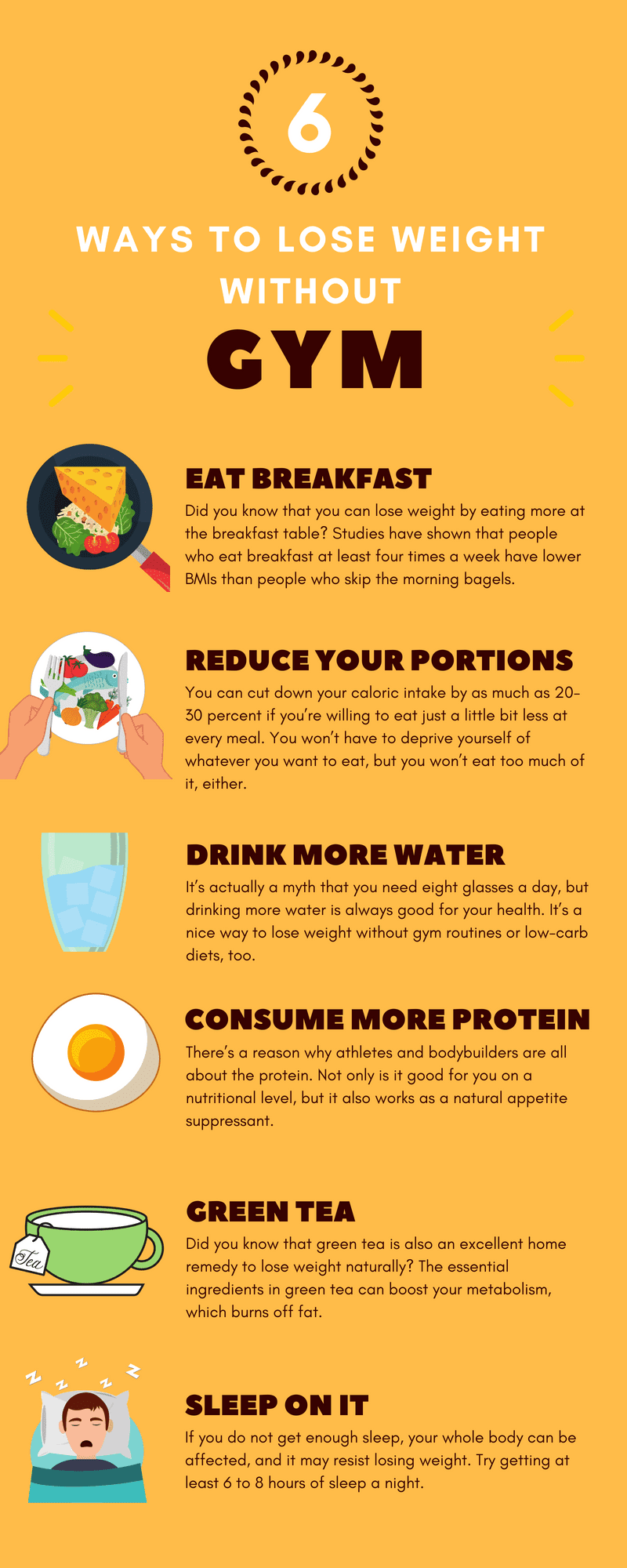
lose weight without gym

5. I don’t have the energy to exercise.

It is definitely possible to feel this way after a long day of work or your average running-around. However, people who are successful at losing weight know that they have to know themselves first. For example, the author knows that her energy is highest in the morning up to 10:00am. Know your own ‘best’ time of day and plan your exercise around that.

Get plenty of sleep to avoid exhaustion if you want to lose weight. Research shows that sleep deprivation can lead us to make poor choices about food and our health, which can lead to weight gain. A study published by the National Academy of Sciences found “that increased food intake during insufficient sleep is a physiological adaptation to provide energy needed to sustain additional wakefulness; yet when food is easily accessible, intake surpasses that needed.” Researchers also found that when people were able to get a good night’s sleep, they reduced intake of fat and carbohydrates and lost weight.

Sources:
National Academy of Sciences http://www.pnas.org/content/110/14/5695.full
http://link.springer.com/chapter/10.1007/978-3-319-42536-8_15

How To Tell If Someone Is Being Authentic

It’s probably accurate to state the majority of us value the quality of authenticity in people. It’s also accurate to state the majority of us disapprove of people who obscure their true nature by putting up a façade. How do we tell the difference? Who determines if a person is “authentic” or, well, “fake?” We’ll get to that later on.

Let’s try a quick two-part experiment. First, try to think of the most authentic person you’ve ever met. Take as much time as needed. Ready? Okay, let’s continue.

What do you value about this person? In other words, what makes them authentic in your eyes? Okay, let’s continue.

Psychologists correlate the attractiveness of authenticity to three things:

(1) We believe that people who are authentic are more trustworthy; in part because they’re truer to themselves.

(2) Genuine people often possess a sense of individualism and firmness, which we admire.

(3) Remaining true to oneself requires courage, strength and tenacity – all qualities that we find appealing.

How does the person you thought of measure up the above three observations? Probably quite well.

“Authenticity is the daily practice of letting go of who we think we’re supposed to be and embracing who we are.” – Brené Brown

The truth about authenticity

Not one person in the history of mankind has ever been 100 percent authentic, genuine, real – whichever term you prefer. We’re all fallible – and there is nothing wrong with this.

But there are some people who’ve exemplified authenticity much more often than not. Odds are that the person you thought of in the “experiment” above is one such person.

The “answer” lies in self-discovery, continued self-improvement, and self-discipline – a journey made possible through the acquisition and application of knowledge. Fortunately, we possess plenty of the latter.

With that in mind, here are ten signs of authentic people:

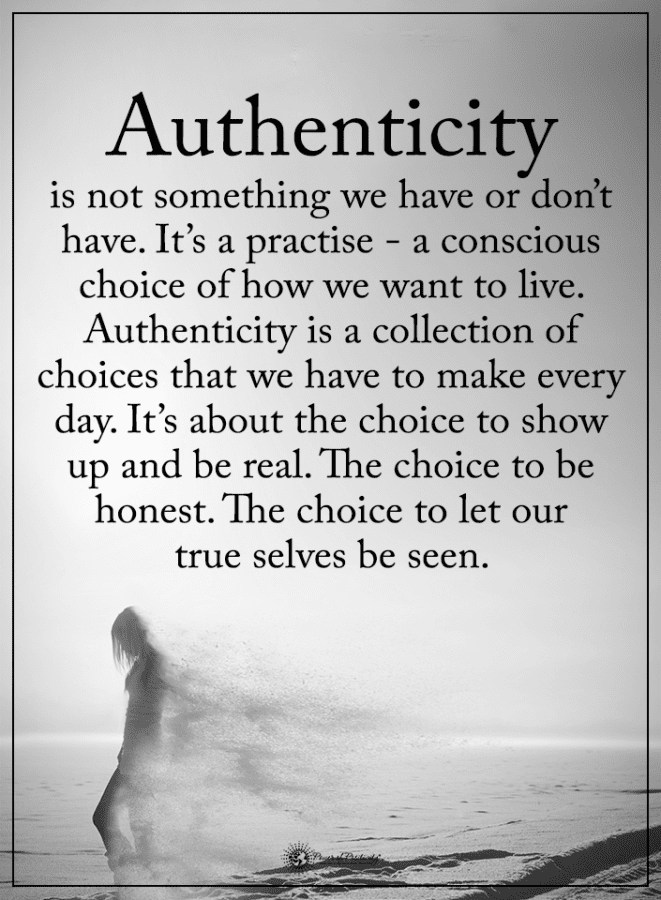
authenticity

1. They Speak Their Mind

Authentic people are confident about their opinions and perspectives – and share them with confidence. Their thoughts are also well-constructed and, when prompted, are conveyed with both firmness and civility.

2. They Realize the Unimportance of Material Things

While authentic people may enjoy certain things, they certain do not base their happiness off of them. Furthermore, they do not judge an individual by what they have and do not have. Authentic people focus on a person’s character, not their bank account.

3. They Relish in Experiences

Genuine people realize the impermanence of life and try to live it fully. This means experiencing what people and the world has to offer – and they make every attempt to do so.

4. They Set Their Own Expectations

As apparent by now, authentic people are highly individualistic; they do not seek the “approval of others” and never will. Their beliefs, ideals, morals, and value are self-acquired and applied.

5. They Are Active Listeners

Genuine people exemplify the “two ears, one mouth” axiom. Active listening is listening without anticipating one’s response. 100 percent of their focus is on the speaker and nothing else. (Was the person you thought of earlier an active listener? Please share!)

6. They Acknowledge Their Faults and Mistakes

It takes tremendous fortitude to admit to your failures – and authentic people have plenty in reserve. They know their weaknesses and mistakes; but what really differentiates a genuine person is they take necessary action to correct them.

7. They Take Personal Responsibility

This one really doesn’t need to be said, but here it is. Authentic people are hold themselves accountable to what they do and don’t do. They are very responsible for many reasons, including the self-empowerment and pride that comes from being answerable to themselves.

8. They Make Their Own Way

Genuine people are not a “sit back and wait” group. They find a way to make things happen, regardless of the sweat, blood and tears required. Further, the path they set for is their own – something that requires grit, determination, and…

9. They Aren’t Scared of Failure

people change

How many of us would love to say, “I’m not scared to fail”? (Raises hand and nods head.) Part of being a truly authentic person is acknowledging the possibility of failure, looking it in the face and not blinking. Whew…easier said than done.

10. They Aren’t At All Judgmental

Perhaps of all the wonderful traits listed, this last one may be the most admirable. Genuine people can wholeheartedly and honestly accept individuality precisely because they are different. Authentic people are often very smart – and are able to see right through the pointlessness of preconceived expectations and human stereotyping.

References:
Twardowski, J. (2016, March 16). 11 Signs of a Truly Authentic Person. Retrieved May 27, 2017, from http://www.huffingtonpost.com/jennifer-twardowski/11-signs-of-a-truly-authentic-person_b_9462220.html
Winch, G., Ph.D. (2015, March 18). The 7 Habits of Truly Genuine People. Retrieved May 27, 2017, from https://www.psychologytoday.com/blog/the-squeaky-wheel/201503/the-7-habits-truly-genuine-people
https://tinybuddha.com/wisdom-quotes/authenticity-daily-practice-letting-go-think-supposed-embracing/

How To Love Your Partner When They Have A Guarded Heart

Regarding relationships, we’ve all been hurt at some point. And that can cause a guarded heart. It’s likely, knowingly or unknowingly, that your actions have resulted in someone else’s pain. When it comes to dating and relationships, most of us don’t point fingers and curse the world – it’s simply part of the “process” of finding a life partner.

Then, there are those “other cases.”

Some folks find it easy to dust themselves off and move on, and some don’t. Those in the latter group have often experienced hurt – in some form – at the hands of someone who promised the world only to deliver nothing.

As such, the main difference between those who “dust off and carry on,” and those who guard themselves comes down to trust. The ability to trust someone else and confidence in their self-trust.

Here is an analogy. If your computer was hacked, what would you do? You’d install a more robust security system. In the same (albeit more humanistic) way, those whose trust has been violated secure and safeguard their emotions. Similarly, someone whose trust has been abused instinctively begins to fortify a defensive position. Eventually, the person will slowly let their guard down. But while their “security system” has been downgraded, their defensive mechanisms remain on alert (a byproduct of evolution, by the way.)

Still, many will find a person to believe in despite their understandable reservations. But two parts do not make a whole. That other “someone” must often contend with the remnants of the guarded person’s past. Whether or not such contention is acceptable is up to the individual. However, if you genuinely love the person, you will – at the very least – try and find a way to make the relationship work.

6 Signs of Someone With a Guarded Heart

What are the signs that reveal a person with their guard up?

guarded heart

1. Emotional Detachment

Individuals with guarded hearts often exhibit emotional detachment. They may have difficulty expressing their feelings or connecting deeply with others. They tend to keep their emotions to themselves and may appear aloof or distant.

2. Fear of Vulnerability

A guarded heart often stems from a fear of vulnerability. People who have experienced past emotional pain or trauma may build walls to protect themselves from getting hurt again. They may find it challenging to trust others and open up emotionally.

3. Defensive Behavior

Individuals with guarded hearts tend to exhibit defensive behavior. They may react strongly to perceived threats or criticism, even unintentionally. They may become guarded and defensive when others try to get close to them or ask probing questions about their emotions.

4. Reluctance to Share Personal Information

Someone with a guarded heart may be hesitant to share personal information. They may keep their past experiences, thoughts, and feelings private, limiting the depth of their relationships. This guardedness can make it challenging for others to understand them truly.

5. Difficulty in Trusting Others

Trust is vital to any relationship, but individuals with guarded hearts find it difficult to trust others fully. They may have been betrayed or hurt in the past, making them skeptical of other people’s intentions. They may require significant time and consistent actions to develop trust in someone.

6. Fear of Intimacy

Intimacy involves emotional closeness and vulnerability. Someone with a guarded heart may struggle with fear of intimacy. They may avoid deep emotional connections and prefer to keep relationships on a superficial level. This fear can hinder the development of intimate and fulfilling relationships.

How to Love Your Partner When They Have A Guarded Heart

This brings us to the central meaning of this article: how to love someone with a guarded heart. Here are the main points that someone in this situation must understand.

difficult

“Don’t ever miss out on a woman with a guarded heart. She’s usually protecting the deepest most caring soul you’ll ever know.” -Sylvester McNutt

1. Loving a person with a guarded heart will not be easy

When the person you care for has been emotionally and/or physically abused, it’s essential to have appropriate expectations. Should the courtship last two or three dates, it’s probable that his or her past will reveal itself.

If necessary, research the psychological impacts of abuse and its intelligent impact on the person subject to it. Equipped with this knowledge, you’ve already conquered half of the battle.

2. Words are inconsequential

Someone whose heart is guarded has heard the “sweet talk” before. Ask anyone that has been in a relationship with a narcissist or sociopath. Words are almost meaningless.

Does this mean you should censor every word uttered? NO! But you should consider whether or not such words are spoken with sincerity and truth.

3. Actions are everything

Ralph Waldo Emerson once wrote:

“Don’t say things. What you are stands over you the while, and thunders so that I cannot heart what you say to the contrary.” (This is Emerson’s original quote, which is now promulgated as “Your actions speak so loudly, I cannot hear what you say,” or some other variant.)

Digression aside, how you choose to act overwhelmingly triumphs over any words you speak. Act like a man. Act like a woman. If you love someone with a guarded heart, demonstrate your love through your actions.

Speak from the heart. Any other words should be considered meaningless.

4. Don’t give up on your winning your beloved’s guarded heart

Someone with a guarded heart expects another to give up on them. Such is the insidious result of abandonment, abuse, and neglect. If you truly (truly) love the person, you must find the wherewithal to see things through.

For others, it’s essential to be realistic about the nature of your relationship (e.g., you’re not in love, or the situation is too stressful.) Numerous unforeseen challenges will test your determination, patience, and, yes, your love.

Should you feel guilty about exiting such a relationship? Absolutely not. To love someone with a guarded heart can be overwhelming. Just do not contribute to their pain. Be caring, honest, empathetic, and straightforward.

Tell them you care about them – and that they’re worthy of the best life offers.

5. Be honest

Upon uncovering that the person you care for has a guarded heart, honesty in everything you do is the most responsible and noble act. No white lies. No “sleight of hand.”

This applies to situations when you think what you say may hurt them. Hiding or manipulating the truth is worse than being honest, even if said honesty results in someone you love experiencing hurt.

In a way, this “hurtful honesty” will help to lower the barriers around the person’s heart. They may experience a mourning period before the nobility of your actions is realized – but you did the right thing.

And doing the right thing for someone subject to emotional trauma will, sooner or later, reinforce their faith in humanity.

difficult relationship

Final Thoughts on Loving a Person With a Guarded Heart

It’s important to remember that people with guarded hearts may have valid reasons for their behavior. Patience, understanding, and open communication can help create an environment where they feel safe to gradually let their guard down and develop more meaningful connections with others.

5 Behaviors Selfish People Display In A Relationship

Recognizing if and when someone is being selfish in a relationship can be difficult, especially when it’s someone that’s close to you. Most people are good at heart, and we’ll give others the benefit of the doubt. People known to use others for personal gain are leeches, and they don’t care who it is they hurt.

Nobody deserves to be taken advantage of (unless you’re a leech, of course. It’s called karma.) Now, what sort of subhuman sycophant would intentionally mooch off of their partner? Not out of need, but out of greed; not out of inability, but out of laziness; indeed, it takes a *ahem* “rare” type of individual.

It certainly may just be love and devotion that makes you vulnerable to such a person. Additionally, these same feelings could make it difficult to discern your partner’s trickery; hence the reason for this article.

Here, we discuss five probable signs that your partner is taking advantage of you. Should you relate to one or more of these signs of a selfish partner, it’s past time to reconsider your relationship.

The Five Signs of Selfish People

pop meme1. Everything happens on their terms

If you’re with someone who rarely lets you make plans, you’re probably being taken advantage of; if you’re with someone who doesn’t value your time, effort, or emotional needs, you’re likely being used. A relationship without sacrifice or compromise is not a real relationship.

Do you notice any of the following selfish behaviors?

– Time spent with your partner almost always requires their “approval”

– Decisions regarding places you go, people you see, and things you do are too frequently theirs

– Your ideas are quickly rebuffed or blatantly ignored

You get the idea by now. Can you relate to one or more of these examples? If you can, the odds are that your partner is taking advantage of you. And probably in more ways than one.

2. Most communication from your partner is negative or neutral

Many relationship experts (e.g. scholars, therapists, counselors) have conclusively cited individual or mutual contempt as the best predictor of relationship failure.

Dictionary.com defines the term contempt as:

  1. “the feeling with which a person regards anything considered mean, vile, or worthless; disdain; scorn.”
  2. “the state of being despised; honor; disgrace.”

In other words, contempt is the opposite of respect. In a relationship, contempt reveals itself through “negative judgment, criticism, or sarcasm regarding the worth of the individual.”

As you assuredly know, communication is everything in a relationship. Now ask yourself, how does your partners communication make you feel?

3. You put forth most of the effort

In a relationship, a lack of effort is often a sign of disinterest or disengagement. If you’re pouring a disproportionate amount of time, money, and energy into the relationship, something is wrong. Monetary expenditures are much less important than the emotional investments you’ve made. Money comes and goes; but if your partner isn’t willing to put the effort and time into making a relationship work then, why would you?

Abdicating responsibility in a relationship is immature, careless and selfish. No reasonable person would do that to someone who they love. It just may be time to exit stage right.

4. They don’t “label” your relationship

They’re uncomfortable with the word “girlfriend,” “boyfriend,” or any other terminology that describes your relationship as anything but casual.

When you attempt to initiate a conversation about the relation (e.g. making it official or exclusive) they quickly tense up or go speechless. The simple reason for this reaction is that they are not ready to make your relationship a priority. In fact, they may not want a relationship at all.

Time to muster up some fortitude, stand your ground, and consider your other options.

5. You’ve caught them (non-humorously) flirting with other people

take responsibility for actions

We won’t spend too much time explaining the problem with flirting. Why? Well, we don’t want to insult your intelligence.

Some people use flirtation as a means of making people laugh – the person dating them usually knows this and is fine with it. This is the sole exception regarding flirting with other people. Otherwise, flirting is a behavior that stems from infidelity.

Unsurprisingly, pathological flirters are not particularly keen on self-awareness. (Got to sit back and cackle at someone who flirts with their partner’s friend and not expect to hear it.)

(C)Power of Positivity, LLC. All rights reserved

10 Questions That Help Reveal Your Authentic Self

“One of the greatest tragedies in life is to lose your authentic self and accept the version of you that is expected by everyone else.” – K.L Toth

Everybody possesses an ‘authentic self’ – or personal identity. Actually, most people have multiple perspectives on themselves; they possess different self-identities. No, this doesn’t indicate Multiple Personality Disorder – it merely implicates that you’re human.

The deeply entrenched foundations of what constitutes our sense-of-self/selves in thought to be based on nine variables:

Abilities/disabilities (e.g., funny, smart, shy, introverted, extroverted, disabled, etc.)

– Affiliations (e.g., football fan, club/society membership, etc.)

Family relationships (e.g., mother/father, brother/sister, son/daughter, etc.)

– Hobbies (e.g., athlete, collector, gamer, musician, singing, etc.)

Occupation(s) (e.g. doctor, lawyer, plumber, electrician, white collar, blue collar, etc.)

– Quasi-occupation(s) (e.g., helper, volunteer, part-time teacher, etc.)

Salient attributes (e.g. reliable, hard-working, good-looking, dishonest, lazy, etc.)

– Social relationships (e.g. colleague, friend, husband/wife, mentor, etc.)

Spirituality (e.g., Buddhist, Catholic/Christian, Mind-body, Religious Humanism, etc.)

Self-identity is dynamic and malleable, even into adulthood and middle-age. The dynamism of self-identity sharply declines into the later years, though it may still fluctuate. For example, a person who is 60 years old may experience a shift in their spiritual perspectives or quasi-occupational interests.

Sharon Martin, a Licensed Clinical Social Worker (LCSW) explains the evolving process of self-identity:

“Developmentally, we wrestle with ‘finding ourselves’ as teens and young adults. Then we often revisit these questions in middle age. It’s both normal and essential to seek self-understanding. In order to accept ourselves and establish a sense of belonging, we need to understand who we are. A strong sense of self helps us navigate life and brings meaning to our experiences. Without it, we feel ‘lost.’”

Martin lists the four reasons why people experience a loss of identity:

  1. Putting other people’s needs before ours. This behavior can lead to self-neglect and diminished self-worth.
  2. Detachment from our thoughts and feelings. A myriad of distractions exists that may be used to disconnect us from “the world”: alcohol, drugs, food, and even electronics.
  3. Experiencing a life-changing event or transition. Trauma is one example – the death of a loved one, job loss, divorce – these and other circumstances can derail us from our true selves.
  4. Repressing and subsequently “burying” our real selves out of shame, embarrassment, fear, or having been subject to bullying and criticism. We make a conscious or unconscious decision to hide our true selves after such treatment.

Asking Yourself These Questions Every Morning Can Help You Discover Your Authentic Self

If you have a “gut feeling” that some part of you is lost, there is hope. No matter what you’ve gone through, you can still rediscover and reembrace the real you.

With that in mind, we’ve come up with a list of ten questions that may assist you on your path to rediscovery.

1. What is my biggest strength? My biggest weakness?

This may sound like a terrible job interview question, but it’s important to know our abilities and inabilities. Answering these two questions honestly gives us confidence while giving us something on which to improve.

2. What is my proudest achievement? Biggest failure?

Is there something in your life that you can be proud of? For almost everyone, there’s a “yes” answer to this question – even if you have to look a little harder.

What is your biggest failure? More importantly, what have you learned from it? If nothing’s learned, it is not failure but foolishness. Thomas Edison, arguably the greatest inventor in history, once said: “Never say I failed 99 times, say I discovered 99 ways which cause failure!” Be an Edison.

know yourself

3. What am I worried about?

Many people have worrisome thoughts; some allow such worries to dictate their lives. Whatever you’re worried about, write them down. If there’s something that can be done, do it. If it’s something outside of your control, breathe (deeply) – everything will be okay.

4. What do I like to do for fun? Am I making time for fun?

Having fun must be taken seriously – and we’re serious. (Sorry).

Joking aside, Dr. Marc Bekhoff, a renowned evolutionary biologist, states that play is “a banquet for the brain, a smorgasbord for the senses, providing nourishment for body and spirit: sad then that as a society we seem to be starving ourselves of it.”

5. What do I believe in? What are my values?

We’re not talking about religion necessarily, or even spirituality, although most American’s define themselves as either “religious” or “spiritual, but not religious.”

Values and beliefs can be a certain view on politics, God, the Universe, humanity, and so on. Clearly defining your values and beliefs is necessary for a healthy sense of self.

6. What am I interested in but haven’t tried?

Continuous learning and new experiences are two essentials for a happy life. Having hobbies, as mentioned in the initial parts of the article, is also a key element to self-understanding.

7. How are my relationships?

Think about the relationships that you feel are important. How are your social and familial relationships? Is there someone you’ve lost touch with who may want to hear from you? Who do you want to speak with?

Understanding and nurturing your relationships is inseparable from your sense of self.

8. What do I like and dislike about my job?

If you love your job, a sincere “good for you” is in order. The hard work and determination to follow your passions has paid off.

If you dislike your job, you aren’t alone. It’s estimated that 80 percent of Americans “don’t enjoy” or “hate” their jobs. That said, try to think of things you consider good about your job. What do you like about it? Keep these things in mind as you go throughout the day. Also, keep your options in mind.

9. What does my inner critic tell me?

Is your inner monologue more critical than not?

Here’s an experiment: whenever possible, write down self-reflecting thoughts as they surface. At the end of the day, take a look at what you wrote.

Now (honestly) ask yourself if there’s something that can or cannot be done about what’s on that piece of paper. If not, be mindful of this fact the next time this same thought surfaces.

10. I know when I’m stressed when I __________

The World Health Organization (WHO) has dubbed stress the “Health Epidemic of the 21st Century.” Work, relationships, life changes, environmental, and self-inflicted causes are the five leading causes of stress.

Question: What do all five of these things have in common?

Answer: For the most part, they’re controllable.

Building on this answer, it’s important to recognize our behavioral and thought patterns under stress. It’s more important that we do something about it – which leads us to mindfulness.

Mindfulness – a state of active, open, present attention without judgment (i.e. “good” or “bad” thoughts) may be the one and only answer we need. Mindfulness – through deep breathing, meditation, or task-orientation – is linked to numerous mental, psychological, and physical health benefits.

Don’t make the mistake of thinking mindfulness is easy; it is not. It takes patience and practice. But the rewards are extraordinary.


References:
Bekhoff, M., Ph.D. (2014, May 02). The Importance of Play: Having Fun Must be Taken Seriously. Retrieved May 25, 2017, from https://www.psychologytoday.com/blog/animal-emotions/201405/the-importance-play-having-fun-must-be-taken-seriously

Martin, S. (2016). 26 Questions To Help You Know Yourself Better. Retrieved on May 25, 2017, from https://blogs.psychcentral.com/imperfect/2016/04/26-question-to-help-you-know-yourself-better/
Masci, D., & Lipka, M. (2016, January 21). Americans may be getting less religious, but feelings of spirituality are on the rise. Retrieved May 25, 2017, from http://www.pewresearch.org/fact-tank/2016/01/21/americans-spirituality/
Soleil, G. (2016, January 07). Workplace Stress: The Health Epidemic of the 21st Century. Retrieved May 25, 2017, from http://www.huffingtonpost.com/gina-soleil-/workplace-stress-the-heal_b_8923678.html
Stannard, L. (2015, June 29). Five Major Causes of Stress. Retrieved May 25, 2017, from www.livestrong.com/article/92809-five-major-causes-stress/
Ylvisaker, M., Ph.D. (2006). What Is Sense Of Self? Retrieved May 25, 2017, from http://www.projectlearnet.org/tutorials/sense_of_self_personal_identity.html

10 Ways to Tell If You’re In a ‘Fake’ Relationship

Being trapped in an unauthentic, fake relationship can easily take a toll on your mental health after a while. Even if your heart cries out for you to leave, it’s not always easy to walk away from a significant other.

If you’ve been with them for a substantial amount of time, you probably have fond memories. This makes it difficult to call it quits on your partner, even if your gut instinct urges you to.

However, no matter how much you love someone, you can’t stay in a one-sided relationship. If they’re not giving you their whole heart, it’s time to move on to greener pastures. You deserve to feel fulfilled and secure with your partner and not second-guess the relationship all the time. If you’re on the fence about leaving your SO, these tips can help you decide once and for all.

10 Warning Signs of a Fake Relationship

wrong relationship

1.     They’re Emotionally Distant or Unavailable.

Your partner will seem emotionally closed off or guarded in a fake relationship. Of course, they may have a wall up due to past trauma or breakups, which isn’t your fault.

However, if they genuinely love and care about you, they will attempt to move past their issues and work toward a healthy relationship. If they show no interest in opening up or getting closer to you, they may not want to take things further.

It’s your call if you want to wait things out and see if they improve. If they still haven’t made any progress after a few months, it’s probably time to end the relationship.

2.     They Seem Uninterested In the Relationship.

If you’re in a fake relationship, your partner will keep you at arm’s length and avoid letting things get too serious. Perhaps they don’t want to fully commit to you because they’re seeing other people or just not interested in settling down yet.

They want to keep their options open and only invest in casual relationships. These partners will never satisfy you because they’ll always have one foot in the door and the other waiting for the next opportunity to present itself.

In a fake relationship, your partner may view you as a trophy, someone to show off to friends in social situations. However, when the two of you get alone time, they give you the cold shoulder.

3.     In a Fake Relationship, Your Partner Won’t Try to Resolve Conflicts.

Conflicts occur in every relationship, even between people who deeply love one another. If you never disagree about anything, it could mean your partner isn’t interested in taking things to the next level. A certain amount of arguing in relationships is healthy because it means you’re communicating and trying to resolve. A partnership without conflicts may appear smooth-sailing on the surface, but it’s a sign of trouble in paradise.

4.     Your SO Never Meets You Halfway.

A partner who won’t compromise or make sacrifices isn’t ready for a committed, authentic relationship. If your SO only looks out for themselves, they probably aren’t mature enough to handle a long-term partnership. Relationships require a certain amount of care and concern from both parties. So, if you feel like you’re the only one putting in the effort, it could signal a fake relationship.

5.     They Don’t Care About Your Thoughts or Feelings.

If your partner isn’t interested in your inner world, it’s a surefire sign of a fake relationship. Two people in a healthy, happy partnership have no problem investing in each other’s emotional health. After all, to form any connection with someone, you have to allow yourself to become vulnerable.

Sharing thoughts and feelings with one another forms the foundation of a thriving relationship. If they can’t even ask how your day went, you should have a talk with them about their true intentions.

relationship

6.     If They Avoid Talking About the Future, It Might Be a Fake Relationship.

Most people in a committed relationship want to settle down eventually, perhaps starting a family or buying their first home. If your partner continually dodges your attempts at conversation about the future, they may have other ideas in mind. In this situation, it’s best to break things off now before investing any further in the relationship.

7.     You Don’t Feel At Ease or Comfortable With Them.

You should feel comfortable being your authentic self around your significant other, the person who’s supposed to know you best. If you feel uneasy around your partner, that’s your gut trying to warn you of their underlying intentions. A fake relationship wouldn’t make you feel insecure or unconfident about where you stand with your partner.

8.     They’re Withdrawn, Cold or Aloof.

A partner who isn’t emotionally available can’t give you their whole heart, only a fake relationship. They only know how to take but can never reciprocate the energy and emotions you share. Do you pour your heart and soul into the relationship, only to feel drained at the end of the day? If so, this means your partner only cares about you regarding what you can offer them. Unfortunately, they’re not ready or able to return the favor.

9.     They Never Let You Meet Friends or Family.

A fake relationship isn’t too difficult to identify from the outside looking in. Aside from the signs listed above, your partner may also keep you from their friends and family. They don’t want to give you the wrong idea that there’s a future in the cards. So, they will always make excuses when you ask to meet the critical people in their life.

10.  Something Feels Off.

If all else fails, listen to your intuition about the relationship because your gut will never lie. If you’ve tried your hardest to make it work and are still unsatisfied with your partner, it’s best to break things off. Maybe you’re just not right for each other, and there’s no shame in admitting that. According to multiple studies, you’ll both have improved well-being by moving on rather than staying in an unhappy relationship.

relationship

Final Thoughts on Signs of a Fake Relationship

Nothing hurts more than being in a fake relationship with someone you envisioned a future with. Perhaps you hit it off initially, but their interest gradually waned, becoming distant. No matter what happens throughout the partnership, you’ll be better off leaving a dead-end relationship behind. It hurts you more to stay with someone who only offers half their heart, anyway.

10 Habits To Develop If You Want To Be Your Authentic Self

“When you are authentic, you create a certain energy… people want to be around you because you are unique.” – Andie MacDowell

There’s a unique and unmistakable power in knowing, becoming, and being your real self. Those who are truly happy in life understand this power and vehemently stick to their authentic selves.

To be authentic is not to allow a situation or person to change you, unless for the better. Personal authenticity is firmly in place, regardless of who is in your company. Sure, your style of communication and how you present yourself (e.g. formal or informal speech) may change, but not your actual core.

There is undoubtedly an authenticity problem in society, as many of you have likely seen and experienced. For example, one survey found that nearly half of all people feel they need to “fake it” at work (a belief that only adds to an already stressful working environment.) When we walk into a place of business to purchase something, it’s commonplace to experience a sense of doubt about the person doing the selling. “What’s in it for them?” we ask ourselves.

While we may not be able to change someone else’s authenticity, we can certainly change ours. Feeling the need to “put on a mask” is exhausting, stressful, and (often) deceitful. It’s also risky – when people feel uncertain about you, they’re more likely to start distrusting anything you do or say.

To be your authentic self requires honesty, vulnerability, and courage – and it’s also incredibly rewarding. What does it mean to be an authentic person? And how do you find your true self? Here are some tips for how to discover yourself.

HOW DO YOU CONNECT WITH YOUR AUTHENTIC SELF? HERE ARE TEN WAYS:

1. WRITE IT DOWN

Jot down what you appreciate and love about yourself, along with what you may need to improve on. Write the names of people you want to spend your time with, and what you’re joyful and passionate about. Breathe this information in, meditate on it, and resolve to be this person. This is the authentic you.

2. LEARN TO FEEL COMFORTABLE IN YOUR OWN SKIN

Once you understand and accept your real self, get comfortable with it. Allow self-critical thoughts to naturally dissipate. Forget about comparing yourself to others, including what they may think.

3. LET GO

Release any guilt or self-limiting thoughts. The past is the past – it’s over, done. Be in the moment, present, and at peace with your identity. This process may be gradual, and that’s okay. Breathe, be patient, and your real self will eventually surface.

4. IGNORE THE CYNICS

As you begin to make positive changes in your life, people will start to take notice. Most will look at you with admiration and respect – a few may not. Should you become aware of this cynicism, be mindful, and their pessimism, along with any discomfort you may feel, will inevitably disappear.

being yourself

5. KEEP A JOURNAL

Write down times and places when you felt your authenticity begin to wane – the actions and behaviors (yours and theirs), the situation, your observations, and the outcome. Keep this journal up to date – it will provide valuable insight into certain patterns of thoughts and behavior you may wish to change.

6. PAY ATTENTION TO EVERYONE

It’s too easy to become lazy and overlook other people – don’t make this mistake. Many people have a valuable lesson to teach if we’d only let them. Don’t underestimate the power of observation. Some of the best lessons may come without a word being uttered.

7. PRACTICE ACTIVE LISTENING

Giving your full attention to someone else is a remarkably powerful skill. Active listening is a sign of respect and of your true interest in others, which is a gift in itself. However, it also provides: (1) a stronger bond and level of trust with others, and (2) a fantastic opportunity to learn and grow from their knowledge and experiences.

8. BE KIND

Being your authentic self and living up to your ideals means demonstrating kindness to everyone. Say hello, ask them how they’re doing, and make good eye contact while displaying a genuine smile.

9. ACCEPT CHANGE

In order to be authentic, it also means being comfortable with change. Regardless of the circumstances, remain true to your inner core. Be open to self-improvement as well, as there is nothing more authentic than changing for the better.

10. ALIGN YOUR HEART AND PATH

You have one precious life to live. Spend it following your passions and your heart. Remember, the only expectations that truly matter are the ones that you set forth. Follow your real expectations by allowing you heart and life’s journey to walk step-in-step.

Now that you have a better idea of how to discover yourself, all that is left is to work on it and, most importantly of all, be authentic. Once you have figured out how to do this, and started living it, you may be surprised at how much your life and your relationships improve.

https://youtu.be/ii0G1Cbpk20

(C)Power of Positivity, LLC. All rights reserved
References:
O’Brien, K. (2012, March 30). 5 Ways to Become Your Authentic Self Today. Retrieved May 26, 2017, from https://www.mindbodygreen.com/0-4378/5-Ways-to-Become-Your-Authentic-Self-Today.html

Stillman, J. (2014, October 15). 5 Steps to Train Yourself to Be Your Authentic Self With Everyone. Retrieved May 26, 2017, from https://www.inc.com/jessica-stillman/5-steps-to-train-yourself-to-be-your-authentic-self-with-everyone.html
Andie MacDowell. (n.d.). BrainyQuote.com. Retrieved May 25, 2017, from https://www.brainyquote.com/quotes/quotes/a/andiemacdo673396.html

20 Foods That Cause Acid Reflux

Many people struggle with the agony of acid reflux. The regurgitation of sour food and burning sensation travels from your chest, through the throat, and into your mouth. IBS treatments are often sought by those experiencing similar digestive discomfort, helping to manage symptoms like bloating, cramping, and irregular bowel movements.

Like most people, you’ve probably asked yourself why this uncomfortable feeling occurs.

First, we will review the science behind acid reflux. At the inlet of your stomach is a ring of muscle, the lower esophageal sphincter, or LES. Most of the time, when we eat, this valve closes as soon as food moves through it. When the LES doesn’t close completely or if it opens too often, the acid produced by your stomach can move upwards to the esophagus. This “trespassing” of acid is what causes heartburn.

The common risk factors for acid reflux disease – a chronic condition called gastroesophageal reflux disease (GERD), are:

  • Consuming large meals
  • Being overweight or obese
  • Certain drinks, such as alcohol, coffee, tea, or carbonated drinks
  • Smoking
  • OTC and prescription medications, including aspirin, ibuprofen, blood pressure medications, or muscle relaxers
  • Eating certain foods

It is this last risk factor that we focus on in this article.

20 Foods to Avoid if You Experience Acid Reflux Regularly

Here are seven foods (and drinks) that cause acid reflux.

acid reflux

1 – Chocolate and acid reflux

Don’t kill the messenger, chocolate lovers: this delicious treat may cause more reflux than any other food. Here’s why:

  • Common ingredients in chocolate, including stimulants, caffeine, and theobromine, may induce reflex.
  • It is high in fat.
  • Chocolate contains cocoa, a bean known to produce a reflux response.

Dark chocolate doesn’t produce the same amount of reflux episodes, but the difference is marginal.

2 – Carbonated Drinks

Yep, you knew this one was coming. Carbonated beverages – including our beloved Coke and Pepsi – are among the leading causes of acid reflux.

Here’s why carbonated beverages are harmful to acid reflux:

  • Carbonated bubbles (culprits of that “burp” reflex) expand inside of the stomach, which can stimulate a reflux response.
  • Almost all sodas are acidic, and acidic ingredients contribute to reflux.

The worst offenders? Diet Pepsi, Coca-Cola, and Tab.

3 – Alcohol

Booze may not be too acidic, but nearly every form – beer, liquor, and wine – can bring about acid reflux.

Alcohol can produce an acid reflux response by relaxing the pathway that adjoins the esophagus and stomach. Of course, this isn’t the type of “relaxing” we envision when imbibing – and it can produce some nasty reflux.

4 – High-fat Dairy

Let’s get this out of the way: all high-fat foods are among the main culprits of reflux. This little factoid includes any kind of high-fat dairy product: cheese, milk, butter, yogurt, and ice cream.

Low-fat is a better alternative but can still instigate reflux. The best advice is to consume dairy on a seldom basis.

5 – Caffeine

Medical professionals claim that up to three 8-ounce cups of coffee is fine for health. Not bad, right? But if you’re a fiend for the java – you are sending reflux an RSVP.

Chamomile tea is a healthier option than a cup or two of green tea per day.

Or you can do what most of us coffee lovers will probably do and roll the dice.

6 – Fried Foods

Fried foods are (gasp!) high in fat! French fries, fried chicken, and fried fish – basically anything that is both fried and delicious – are among the common culprits of reflux.

The high-fat content in fried foods makes them among the top causes of heartburn; the chest pain that results from acid reflux.

7 – Meats

Like fried foods and dairy products, the high-fat content in meats makes them an instigator of acid reflux. Meats such as beef, lamb, and pork also take longer to pass through the stomach during digestion – and increase the risk of a reflux response.

The better alternative is to choose lean cuts of meat – chicken, turkey, tenderloin beef and pork, extra-lean ground beef, and Canadian bacon, for example – and limit meat as an entrée to once per week.

8 – Chili powder, cayenne, black and white pepper

Spices make your food taste great, but too much of something good can come back to haunt you as acid reflux. These spices have a reputation for causing uncomfortable heartburn. This is because they raise the acid levels in your stomach. Try reducing how much you put in your foods when you cook if you like spices. Other seasonings that can cause acid reflux include:

  • Crushed red pepper
  • Tabasco sauce
  • Curry spices
  • Cinnamon
  • Hot paprika
  • Ginger
  • Cloves

9 – Pizza creates a perfect acid reflux storm

Pizza is the public enemy number one when it comes to acid reflux. The gooey cheese, garlicky tomato sauce, and spicy pepperoni all add to a lot of heartburn. Pizza is also high in fat, a natural trigger for GERD (gastroesophageal reflux disease). If you suffer from acid reflux, pizza is one food you need to skip.

10 – Fatty foods that can cause acid reflux

Fatty foods naturally slow you down. Your body digests them slower than other food, causing them to sit in your stomach longer. Because they stay in your stomach so long, your body makes more acid. Fatty foods also cause your esophageal sphincter to open, which causes acid reflux. Rich foods that cause heartburn include:

  • Processed baked goods
  • Bacon
  • French fries
  • Saturated and trans fats
  • Fatty sauces or gravies
  • Creamy salad dressings
  • Potato chips
  • Buttered popcorn

acid reflux

11 – Acid reflux and peppermint

Peppermint can be soothing to your tummy, but it can have the opposite effect on individuals who suffer from acid reflux. Peppermint relaxes muscles in your gut that affect digestion. It also relaxes the sphincter muscle, which separates your stomach from your esophagus. All of this combined triggers painful acid reflux.

Even sipping on peppermint tea or chewing peppermint gum may set off a bout of heartburn.

12 – Garlic

Garlic, especially when it’s raw, causes heartburn even in people who don’t usually suffer from acid reflux. This pungent vegetable has many attractive benefits, but garlic is high on the list of acid producers. You may love garlic, but it won’t love you back. It’s best to skip this flavorful vegetable to avoid the pain of acid reflux.

13 – Onions

Onions and garlic are members of the Allium family. They’re related to shallots and leeks. Raw onions are acid producers that cause heartburn for many people. Even dried onions stir up this painful condition.  Onions are probably one of the best vegetables to add extra flavor to your cooking, but if you suffer from heartburn, it’s best to skip these pungent veggies.

14 – Tomatoes

Juicy and sweet tomatoes are super high in acid. Eating tomatoes in any form can lead to heartburn. Tomatoey foods like ketchup, salsa, spaghetti sauce, or even a sliced raw tomato will give you acid reflux. Replace the tomatoes on your pasta with other toppings such as fresh herbs and parmesan cheese.

15 – Pineapple

It may be sweet and juicy, but pineapple isn’t for those with a sensitive stomach. It’s highly acidic, so it’s high on the food list to avoid if you suffer from acid reflux. If you must eat pineapple, stick with a small amount. Some people suggest eating small amounts of dried pineapple because it’s less acidic than fresh.

16 – Oranges or grapefruits

Most citrus fruits are high in acid. If you love citrus fruits, you can avoid experiencing acid reflux by eating a small amount of this fruit in the morning. Avoid eating near bedtime. When you eat food close to your bedtime, you’ll get heartburn. As you lay down, gravity works against the food traveling through your digestive tract, forcing bile and acids into your esophagus. This position causes acid reflux. You can skip the citrus fruits and eat other fruits that don’t cause acid reflux, including:

  • Apples
  • Bananas
  • Melon
  • Berries

17 – Salt causes acid reflux

Salt is a prime culprit for acid reflux. It’s not fully understood how salt triggers acid reflux symptoms, but individuals with a diet higher in salt usually end up with acid reflux. Be sure to read your food labels to check for the sodium amounts each food contains. Steer clear of overly-processed foods.  Choose fresh foods.  Also, find other ways to give flavor to your food, such as herbs or broths.

18 – Butter

Fatty foods like butter trigger heartburn. Fat makes food taste good, but it’s hard on your gut. Try finding alternative healthier fats in your cooking, such as olive oil or grapeseed oil. Steam, grill, or broil your foods instead of frying or roasting them in fat. Add herbs to your food for extra flavor.

19 – Acid reflux and mashed potatoes

Mashed potatoes seem harmless enough, but this food is a well-known trigger for painful acid reflux. The potatoes aren’t to blame, but the butter and dairy products you add to create the creamy mashed potatoes are the problem. If you love mashed potatoes, you can make a lower-fat version with skim milk and imitation butter to avoid acid reflux.

20 – Candy

Candy is sweet, but if you suffer from acid reflux, its sweet taste can quickly lead to painful heartburn. Sugar is the culprit that leads to heartburn. Plus, many candies contain Vitamin C for flavoring. This vitamin triggers painful heartburn. Skip the candy. If you have a sweet tooth, try eating blueberries or raspberries. They will satisfy your desire for sweets without giving you painful heartburn.

acid reflux

Final Thoughts On Avoiding The Foods That Cause Acid Reflux

Acid reflux is a painful reminder your body isn’t happy with something you ate. You get it from spicy foods, fatty foods, sweet foods high in acid like tomatoes, and even some fresh fruits like oranges and grapefruits. The bile in your esophagus and the painful burning sensation in your chest often flare up at night. Blame it on gravity because your food can’t travel through your digestive tract when you’re lying down. Hopefully, if you suffer from acid reflux, this list of food to avoid will help ease the pain you experience. Your good health is worth giving up a few foods.

Skip to content