Weekly tips, affirmations, and small actions to feel your best.

5 Differences Between A Relationship Partner and A Life Mate

Many people go through different kinds of relationships in an effort to find the one person that they truly want to be with for the rest of their lives. It can be hard to tell who is supposed to be your life mate, and who is simply supposed to be a relationship partner. Sometimes, we confuse the two and spend longer than we need to in a relationship that isn’t meant to last forever.

There are key differences between a simple relationship and a relationship with your life mate.

Once you know the difference, finding that special someone to spend your whole life with will be a much easier. Not only that, but you will be able to pinpoint relationships that aren’t working much more effortless.

Here Are 5 Differences Between A Relationship Mate And A Life Partner

relationship

1. You feel like you’ve known them forever

When your life mate walks into your life, it can suddenly feel like you’ve known them your entire life. While you may find out new things about them every day, they don’t feel like a stranger to you. You’re immediately comfortable around them and feel you can tell them anything.

Soulmates often feel a sense of the familiar and a sense of comfort around each other. Many people say it’s easier to relax into that person and allow themselves to be vulnerable,” says wedding officiant and author Rev. Laurie Sue Brockway.

With relationship partners, it can take a while to start to trust them and get to know them. But your life mate will feel like you’ve known each other from the moment you were born. It’s an amazing feeling.

2. Your attraction is physical, spiritual and emotional

When you meet your life partner, everything about them is attractive to you. Not only will you be physically attracted to what they look like, but you’re also going to be spiritually and emotionally attracted to them. When it comes to simple relationship partners, you may find them attractive, but not everything else lives up to the idea of a life mate. You may get along well, and have a good time together, but it’s not quite the same as being spiritually and emotionally attracted to someone.

3. They know you intuitively

When you’re with your life mate, it’ll almost feel like they can read your mind. While that’s not actually possible, they will be much more highly attuned with your emotions and your personality to feel like they’re able to read your mind. Relationships can often falter with communication because we’re not actually mind readers.

“It seems like your senses and perceptions are feeding off of each other so much so that one or both of you often say, “I was just thinking that”, “You read my mind”, or?”How did you know?” They see you on a deeper level and can sometimes do it early on in your relationship,” adds speaker and presenter Lori Peters.

The deep spiritual and emotional connection you share with your life partner, vs. just a relationship partner, will make communication flow much easier. This isn’t to say you won’t have your moments, but you’ll be able to work them out much quicker.

4. You keep falling in love

With relationships, people can sometimes feel their love plateau – or worse, they can feel themselves falling back out of love with the person that they were with. When you find your life mate, you don’t have that problem. In fact, you keep falling deeper and deeper in love with them. It doesn’t seem to end. There’s a never-ending well of love inside your heart for this person. All of their flaws and quirks are just a part of them and they make you love them even more. Every day you find something new about your life mate that makes you love them more than you already did – even if you didn’t think it was possible.

signs of soulmate

5. You feel secure and protected by the relationship

In a normal relationship, you might feel comfortable and happy. This is good and normal. You should feel relaxed in a relationship. However, these feelings seem to compound when you’re with your life partner. You feel secure and physically and emotionally protected from all of the stressors in the world. You know that your partner has your back through anything.

Author, clinical psychologist, and relationship expert Dr. Carmen Harra says, “Regardless of the gender of your partner, he or she should always make you feel secure and protected. Your soulmate will make you feel like you have a guardian angel by your side. A person who plays on your insecurities, whether consciously or subconsciously, is not your soulmate.”

No matter what comes up, they will instinctively have your back and be on your side – even if you’re in the wrong. But they’ll be there to help you through anything, and you’ll never have to worry about not having someone in your corner.

Final thoughts on knowing the difference in your relationships

Relationship partners and life mates are two different types of emotional and physical relationships. We have many relationship partners, but only one life mate. You may not realize you’ve found your life mate until you’re already caught up in their love. However you find them, they will be by your side through everything, loving you in ways you never knew were possible.


5 Signs Your Partner Is Ghosting You

What is “ghosting?” This is a term that’s risen to popular usage in recent years to describe a phenomenon of when a potential partner suddenly stops speaking to you. No more texts, no more messages, no more calls – and they suddenly seem to always be busy when you’re trying to get them to hang out with you.

“Silent treatment is nothing unusual when it comes to long-term relationships – ‘ghosting’ can happen after just the first date or sometimes many dates,” says relationship counsellor and Gestalt therapist Clinton Power.

Some people are ghosted by their partners, which is a way for one person to try and end a relationship without doing any of the hard, emotional work. If you’re worried that your partner is starting to ghost you, have no fear. There are some telltale signs that your partner is ghosting you. Once you know the signs you’ll be able to confront them, or end the relationship on your own terms.

Here Are Five Telltale Signs Your Partner Is Ghosting You

“When you get ghosted, be happy they’re on a one-way ticket with no return address.” – Julie Spira

1. They cancel plans and don’t reschedule

A big sign that your partner is going ghost is when they suddenly start cancelling your plans to hang out together. It can be anything from planning to go to the movies together, to hanging out at your apartment. Whatever the plan, big or small, it seems like they always have a reason to cancel.

“Men who are checking out on you and on the verge of disappearing for good tend to be unable to simply tell the truth: ‘I’m just not that into you.’” But if you try to bring it up with them, they’ll probably give you excuses they think sound “good”: Work is so busy now. Traveling nonstop with work. Pressure from my family to come visit more often. Watch for these lame excuses. They usually are a harbinger of things to come,” says dating expert and author of Smoke Drink F*#k, Esme Oliver.

They’re always busy, or working, or have something else important that they need to be doing. And they never seem to be able to offer a definite reschedule date. In fact, sometimes they won’t even offer vague dates like “next week”. This leaves you left feeling like they don’t really want to hang out with you all that much.

2. They go silent on social media

Social media is a great way to stay connected with everyone in our lives, even our significant others. It’s also a good measure on whether or not you’re being ghosted by your partner. A major red flag to potential ghosting is when your partner stops interacting with you on social media altogether. Either they unfriend you or soft block you (blocking and then immediately unblocking so you no longer follow them), and you’re left wondering where they disappeared to. This is usually coupled with them still texting you and stringing you along in other ways. If their social media goes dark, this is probably a red flag that you’re about to be ghosted.

3. You don’t have any friends in common

Someone who plans on ghosting their significant other sometime in the future is probably not going to invest in introducing that person to their friends. If for whatever reason, you two don’t seem to have any friends in common whatsoever, it’s probably because they’re not that invested in your relationship. It also means that they’re probably preparing to ghost you so that you don’t have any contact with their friends to find out what happened. If they’re adamant that you don’t need to meet their friends, this is a red flag to someone who isn’t going to treat you the way you deserve.

4. They take forever to get back to you

In the beginning, things are great – you’re messaging all the time, seeing each other a lot, and enjoying being together. But now, it seems like the conversations lag and drag on.

“A good indicator of a classic ghost would be when someone is ALWAYS on their phone, yet when you’re not with them it seems like you’re rarely getting that text or phone call,” says Melissa Rogers, a professional matchmaker.

You can’t seem to get a quick text out of them, and they take forever to get back to you about plans, or just in general. People can get busy, but we usually make time for our significant others. Even on our busiest days, sending a message telling your partner you’re thinking of them only takes a minute. When it seems like they no longer want to take the time to get back to you, it’s probably a sign that they’re getting ready to disappear like a ghost.

“They don’t feel obligated to answer you until they ‘feel’ like it, which can be hours or days,” adds author and sex therapist Dr. Gloria Brame.

5. They don’t have anything to say

When you finally get ahold of them after days of not speaking, are they bursting to tell you everything that’s been happening? Or do they seem like they haven’t got anything new to tell you? Usually, when you’re being ghosted, your partner isn’t going to put that much effort into the conversation that you do have.

“He is no longer engaged in conversation or previously shared interests. And while his behavior is noticeably different, if he is confronted, he denies that anything is wrong,” says Teresa Solomita, a psychoanalyst and relationship Therapist.

This is a red flag that they’re not really all that invested in you anymore. Where you used talk for hours on end, it may now seem like getting them to talk is like pulling teeth.

Final thoughts

Getting ghosted isn’t fun! Knowing the signs can prepare you for when it happens. Taking control of the end of a relationship can be a powerful thing. If your partner seems to be ghosting you, it might just be time to take control and end it before they disappear into smoke. You’ll be able to find someone who appreciates you when you’re not hung up waiting on them.

(C)Power of Positivity, LLC. All rights reserved
References:
https://clintonpower.com.au/2015/07/ghosting-ultimate-silent-treatment/
http://bestlifeonline.com/ghost-signs/
https://www.glamour.com/story/7-signs-of-a-toxic-relationship-with-your-so

10 Things to Remember Before You Discipline A Child

(***Acknowledgement…) Being a parent is hard work. If you’re a parent, you know this. It’s hard. Unfortunately, parents sometimes let their emotions get the better of them and dish out discipline that is neither in the parent’s or the child’s best interest.

Be the parent TODAY that you want your kids to remember TOMORROW.

To all current and future parents, please go back and re-read the above quote again. In fact, do yourself a favor and memorize it. The quote isn’t long, so it shouldn’t be too hard. Most importantly, understand that these words are 100 percent true.

What kind of parent is your child going to remember? What kind of influence are you going to leave with them? And what will you teach them? Parents are a huge influence on a child’s personality.

Parents help determine what kind of person that child will become.

Enter discipline.

The word ‘discipline’ stems from the Latin word disciplina ‘instruction, knowledge’ from discipulus ‘learner’, from discere ‘learn.’

While many of us attach a certain degree of harshness to the word ‘discipline,’ the word was born from the ideas of instruction, knowledge, and learning.

This isn’t to say that firmness in the application of discipline isn’t necessary; sometimes it is. In the military, firm discipline can save lives. In the classroom, steady discipline maintains order. And in our daily lives, self-discipline can lead to achievement, financial freedom, and happiness.

Discipline can make us better people.

Discipline can make our children better people.

Child Discipline: 10 Things To Know

“Discipline isn’t just about giving kids consequences. Instead, it ensures children are gaining the skills they need to become responsible adults.”

The above is a quote by Amy Morin, a renowned life coach and discipline expert. In one of her posts, Morin describes four ways in which proper discipline benefits children:

1. Discipline helps kids manage anxiety.

Morin states that kids test the patience level of caregivers to ensure they’re able to keep them safe. When positive and negative consequences are offered, children learn and grow. On the flip side, overly-permissive parents convey a lack of guidance and leadership, which is a source of anxiety for youngsters.

2. Discipline teaches kids to make good choices.

child discipline

Morin states that temporary suspension of a child’s privileges, or “play time,” provides the child with the incentive to make better choices. Healthy discipline helps children learn impulse control, self-control skills, and problem-solving skills.

3. Discipline teaches kids to manage emotions properly.

Morin uses the discipline of “time-out” to illustrate this next point. “When a child receives a time-out after hitting his brother, he learns skills that will help him manage his anger better in the future.”

Morin also describes the benefits of positive discipline strategies, such as praise: “When you say ‘You are working so hard (even) though it is really hard to do. Keep up the good work,’ your child learns the importance of tolerating frustration.

4. Discipline keeps kids safe.

Teaching children to look before they cross the road – and administering positive discipline if they fail to do so – can ultimately save a child’s life. While children will inevitably get hurt, a necessary foundation of self-control, achieved through discipline, benefits the child in both the short and long-term.

5. Positive discipline is paramount.

Dr. Jane Nelsen, a distinguished educator, psychologist, and mother of seven states “The key to positive discipline is not punishment, (but) mutual respect.” While the specifics of Nelsen’s discipline framework is beyond this article’s scope, positive discipline teaches rather than punishes; encourages rather than praises; focuses on identifying and correcting the behaviors rather than the child.

6. ‘Negative Discipline’ is real – and it’s pointless

Negative discipline is counterproductive and potentially harmful psychologically. Striking, admonishing, or otherwise mismanaging one’s emotions while issuing discipline has been shown – in study after study – to be ineffective and possibly damaging to the child.

7. ‘Logical Discipline’ is real, too – and it’s effective

WebMD explains ‘logical consequences’: “The consequence is directly linked to the behavior. For example, you tell your child that if he doesn’t pick up his toys, then those toys will be removed for a week.”

8. Taking away privileges is another way

Temporarily removing privileges is another effective means of discipline. If the child doesn’t do their homework on time, for example, taking away their television privileges provides an incentive for them to act responsibly. Timeouts are another means of removing privileges.

9. Natural conseqences may prove more effective

When your child does something wrong, and you let them experience the consequences of that behavior, there’s little need for your intervention. For example, if you’ve told them the importance caring for their toys and they break one, they simply don’t have that toy anymore.

Experience is sometimes the best teacher.

10. Setting the right example beats discipline

As mentioned, children learn from what they see and hear. Parents who set a good example often find that they needn’t frequently discipline their child. After all, the child doesn’t do many things wrong.

They’ve been taught the right way.

Does this mean the child is perfectly behaved? Of course not! All children will get into mischief – that’s part of being a kid! But you can bet that your words and actions directly affect the child’s behavior – and the need for discipline.

Sources:
https://www.oxfordlearnersdictionaries.com/definition/english/discipline_1
https://www.positivediscipline.org/about-positive-discipline
https://www.verywell.com/why-it-is-important-to-discipline-your-child-1094790
https://www.webmd.com/parenting/guide/discipline-tactics#2

5 Signs of Stroke That People Ignore

Just 15 years ago, stroke was the third-leading cause of the death in the United States. Rapid advances in neuroimaging technologies and pharmaceuticals have significantly reduced the number of deaths from cerebrovascular causes.

Today, people are 4.5 times more likely to die from heart disease than stroke – one of the widest discrepancies between the two conditions in history.

Time is of the essence. For each minute that a stroke goes untreated, a person loses about two million brain cells. In another hour, that same person’s brain will age nearly four years.

Stroke conditions worsen rapidly. That’s the bad news.

Denial or ignorance?

silent stroke

The good news – great news – is that strokes are both preventable and treatable.

But far too many people delay treatment, according to Carolyn Brockington, MD, director of the Mount Sinai Stroke Center in New York City.

“Stroke is scary. (For that reason) Denial is the biggest factor in delaying treatment. When I ask stroke patients in the ER why they waited to call 911, the most common response is that they wanted to see if it would go away.”

But most people aren’t idiots – nor are most people crazy. So why would someone see if a stroke would go away?

The only plausible answer is that the person thought their symptoms arose for some other reason.

Masquerading Symptoms

“Silent strokes are real. They’re caused when blood flow to a part of the brain is cut off. But you may not notice anything out of the ordinary. Typically, you learn when you had one when permanent damage is found on a brain scan that you may have for some other reason.” ~ WebMD

Let’s discuss five symptoms of stroke that people commonly mistake for a different condition (which are in parentheses.)

Signs of stroke most people ignore

1. A vicious headache (migraines)

For people diagnosed with migraines, this makes sense. However, if you’re not prone to these particular type headaches, it’s entirely possible that something else is going on.

Ralph Sacco, MD, professor of neurology at the University of Miami North School of Medicine, says “Migraine headaches can masquerade a stroke because they have the same neurological symptoms. I tell people to treat it like a stroke and call for help; let us figure it out.”

Symptoms of a migraine, along with their frequency, include:

Throbbing, pulsating pain – 85 percent.
Light sensitivity – 80 percent.
Sound sensitivity – 76 percent.
Nausea – 73 percent.
Pain on one side – 59 percent.
Vision changes, blurred vision – 44 percent.
Aura – 36 percent.
Vomiting – 29 percent

2. Abrupt thinking problems (fatigue or exhaustion)

Sudden cognitive deficits are common in today’s fast-paced society. We’re working longer hours, commuting more, and taking on additional responsibilities.

In other words, we’re tired.

And fatigue begets thinking problems. However, overtly noticeable cognitive impairment – such as having “tip of the tongue” moments over and over – isn’t the norm.

Dr. Brockington adds, “You might struggle to think of a word every once in awhile, but there shouldn’t be a long period where you can’t think of anything to say or be unable to speak.”

3. Slurred speech (medications)

As you’re probably aware, America (and many other countries) is contending with an anxiety epidemic. Perhaps not so coincidentally, we’re also battling a widespread opioid problem.

Oh, and we’ve got a massive problem with doctors overprescribing the hell out of prescription drugs.

Slurred speech is a side effect of many medications, including some that fall into the categories listed above. And many people chalk up speech problems with prescription drugs.

But if slurred speech isn’t usually a problem after taking medication, it’s best to be safe and seek immediate help – especially if joined by other stroke-related symptoms.

4. Numbness (compressed nerve)

After waking up, it’s not unusual to have a limb or two that’s “fallen asleep,” also known as a compressed nerve. However, Dr. Sacco says, “Don’t feel like a hypochondriac. If your arm is suddenly numb or weak, and it doesn’t go away in a few minutes, call 911.”

If you’re experiencing prolonged numbness or weakness on one side of the body, and want to avoid overreacting, the Mayo Clinic provides the following advice: “Try to raise your arms over your head at the same time, if one arm begins to fall, you may be having a stroke. Similarly, one side of your mouth may droop when you try to smile.”

5. Vision problems (exhaustion, old age)

Yes, exhaustion can cause distortions to our vision.

Old age? Perhaps, if you’re not wearing your prescription eyewear.

But vision problems that include haziness, double vision, or loss of sight can be a sign of stroke. Dr. Brockington says “Seeing two images is very unusual for just being tired…”

An obstructed blood vessel leading to the brain can cause visual distortions.

Preventing stroke

stroke

As always, prevention is the best medicine. Harvard Medical School recommends seven preventative measures for diabetes:

– lower your blood pressure
– lose weight
– exercise more
– drink in moderation
– treat arterial fibrillation (a form of irregular heartbeat)
– treat diabetes
– stop smoking

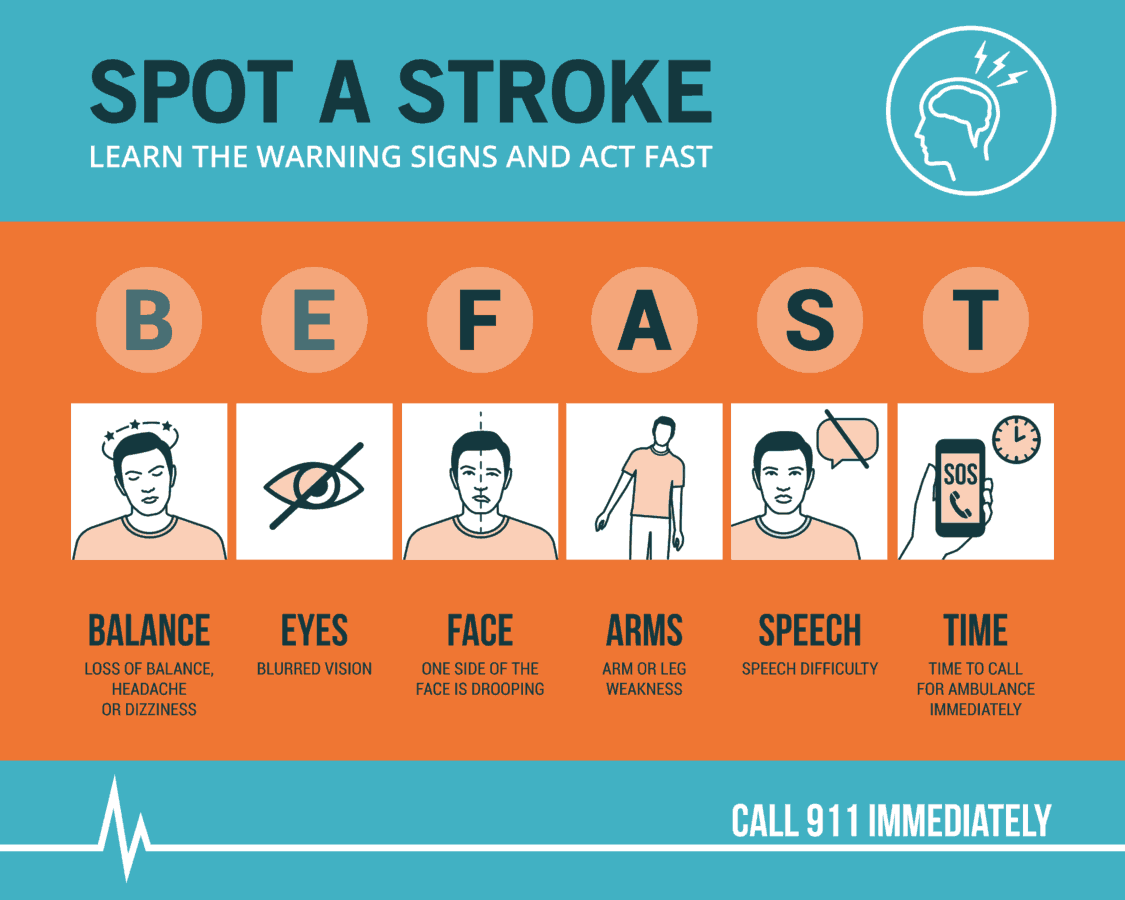
The National Stroke Association recommends the F-A-S-T technique for identifying a possible stroke.

– (F)ace: “Does one side of your face droop when you smile?”
– (A)rms: “When you lift both arms, does one arm drift back down?”
– (S)peech: “Is your speech slurred or does it sound odd?”
– (T)ime: “If you see any of these signs in yourself or someone else, call 911 right away.”

Sources:
https://migraine.com/migraine-symptoms/
https://www.cdc.gov/nchs/fastats/leading-causes-of-death.htm
https://www.health.harvard.edu/womens-health/8-things-you-can-do-to-prevent-a-stroke
https://www.mayoclinic.org/diseases-conditions/stroke/symptoms-causes/syc-20350113
Avoid A Heart Attack Or Stroke: 8 Habits to Never Ignore
https://www.webmd.com/stroke

Psychologist Explains 10 Habits of The Most Intimate Couples

Being intimate with your partner is one of the most important habits of a successful relationship

“Intimacy refers to feelings of closeness, connectedness, and bondness in loving relationships. It thus includes those feelings that give rise, essentially, to the experience of warmth in a loving relationship.” ~ Robert J. Sternberg, Professor of Human Development, Cornell University

Robert J. Sternberg has been studying relationships for decades and is one of the most sought-after experts on long-term intimate relationships.

Part of what makes Dr. Sternberg celebrated is his development of the ‘Triangular Theory of Love.’ Sternberg’s theory consists of three parts: intimacy, passion, and decision/commitment.

Intimacy is the feeling of closeness, connectedness, and bondedness in loving relationships. It is used to describe the loving warmth that’s so critical to relationships.

Passion, as Sternberg describes it, are the drives that allow physical attraction, sustained sexual desirability, and psychological manifestations of romance and seduction.

Decision/commitment refers to the decision that a person makes when they love a person, and decide to maintain that love via a long-term, intimate relationship.

Decision and commitment are not necessarily mutually-inclusive; one can feel, acknowledge, and make the decision to love someone without desiring to sustain a long-term commitment.

While all three parts of the love triangle are crucial to an intimate relationship, no such thing would be possible without the foundational feeling of warmth. Intimacy is what stimulates and maintains the other two corners of the triangle.

Enhancing intimacy

But intimacy, as anyone who has been in a long-term partnership, can attest, may ebb and flow.

Not to fear! Here are ten proven ways to boost intimacy, according to psychologists.

1. Commit to emotional openness

Some couples are mismatched, in that one craves deeply open communication while the other does not. The fact is the latter will likely never be entirely at ease with expressing poignant verbal niceties.

The good news is that as long as the topics of communication are emotionally ‘safe’ – as in no digging for emotional ‘skeletons’ – then your partner will eventually become a bit more warm and free with their dialogue.

2. Give credit when it’s deserved

Sometimes it’s easy to take our partner for granted. The little things they do for us are often overlooked after a certain period of cohabitation. But it doesn’t mean that these things are not necessary.

Make it a point to tell him or her how much you appreciate them. It feels really, really good – and it’ll add some positivity to your relationship.

3. Embrace the humdrum

It is only natural that our partner becomes more predictable. At first, there’s all this new stuff to learn – and it’s really exciting! Then, a little maneuvering around each person’s routine before it becomes, well, routine. But intimacy is all about enjoying the humdrum. The monotonous creates the intimacy, and the routine sustains it.

4. …and then shake things up!

Few things are more intimate than the unexpected. While it’s true that routine weaves with intimacy, novelty provides the spark. Sometimes, all that’s needed to jumpstart the intimacy engine is to find a new path for the current to flow.

5. Avoid the hasty retreat

If you absolutely must walk away from someone, you’ll know it. But if the thought comes and goes, be aware of the risks of a hasty retreat. Communication is often the bugaboo of relationships. Coincidentally, walking away is too often the result. Do what’s necessary, but do yourself a favor and avoid taking the easy way out.

If that means sitting in a room for hours brainstorming a resolution, then so be it.

6. Keep discovering

If you – like so many – have embraced the comfort of relationship silence, try and get the conversation flowing again! Continued intimacy may hinge on the willingness to disclose more and welcome new topics of discussion with open arms.

7. Share your thoughts

Yes, this one’s another communication-related pointer. As mentioned, intimacy is the process of discovery with one another. (Don’t worry, it’s the last one!)

Sharing your thoughts is what intimacy is all about. Sit down at the end of the day, hold each other’s hand and just share.

8. Cuddle everyday

Holding each other for 15 minutes everyday floods the body and brain with feel-good hormones, including the “love hormone” oxytocin.

According to one study, 94 percent of couples that went to bed together holding each other reported feeling happy; compared to just 68 percent for those who did not.

cuddle

9. Get sweaty

According to a study published in the Journal of Personality and Social Psychology, researchers found that couples who mutually engage in an exciting physical activity or challenge report feeling more satisfied with their relationships and were more in love with their partner.

10. Keep laughing together

We’ve all heard the axiom “Laughter is the best medicine.” If you peek inside what happens in the brain when we enjoy a hearty giggle, you’ll understand why.

The physical act of laughing triggers the release of endorphins – the brain’s natural opioid. The chemical changes that occur in the brain while laughing – and even afterward – strengthens a couple’s emotional bond!

(C)Power of Positivity, LLC. All rights reserved
Sources
http://www.medicaldaily.com/6-scientifically-proven-ways-boost-intimacy-relationship-without-sex-395181
http://www.robertjsternberg.com/love/
http://www.nytimes.com/2011/09/14/science/14laughter.html
https://www.psychologytoday.com/blog/creating-in-flow/201602/10-proven-ways-you-can-increase-intimacy

5 Signs Your Anger Is Because of Your Hormones

Hormones are potent chemicals; they help keep our bodies’ working correctly and profoundly influence our mood. They are produced in glands located in the adrenals, ovaries, pancreas, pituitary, testes, and thyroid.

Our brain continually interacts with hormones via the neurotransmitters serotonin, norepinephrine, dopamine, and GABA. Hormones – including hormonal production and maintenance – are directly affected by brain activity and vice-versa. As a result, an imbalance in either the brain or hormonal systems can throw us for a loop.

“When we get angry, the heart rate, arterial tension and testosterone production increases, cortisol (the stress hormone) decreases, and the left hemisphere of the brain becomes more stimulated.” ~ Neus Herrero, researcher at the University of Valencia

Although the topic isn’t addressed as much, hormones play an important role in regulating mood. More emphasis is given to the brain’s neurotransmitters than to the body’s hormonal balance. Still, both are equally likely because of the intricate relationship between our endocrine (hormonal) and nervous system.

Anger, anxiety, and depression are the three more frequently-cited complaints of anyone experiencing a hormonal or neurochemical imbalance.

Here we’re going to focus on potential signs of hormonal anger, its causes, and how we can naturally rebalance our hormone levels.

Here are five signs of anger coming from hormones (and how to balance them):

stress hormones

1. Insomni: Progesterone Imbalance

Progesterone is the yin to estrogen’s yang; progesterone has the opposite effect on mood. Brain scientists use the word ‘inhibitor’ to describe the chemical’s function, which is just a fancy way of saying it slows the brain down. Estrogen, on the other hand, speeds the brain up.

If excitatory chemicals are not checked by inhibitory, we’re more prone to impulsiveness and anger.

Restful sleep becomes difficult when there is an imbalance between the two chemicals, particularly when progesterone levels are deficient. There is about 20 times more of the hormone in the brain than the body.

2. Anxiety: Low estrogen

Estrogen, one of the major sex hormones in women, assists the brain and body produce beta-endorphins and serotonin – both of which are vital to a positive state of mind. Estrogen also assists in balancing the levels of dopamine and norepinephrine.

Not only are bursts of anger more likely when estrogen-deficient, anxiety, and stress are too.

3. Decreased Libido: Low testosterone

While excess testosterone is associated with higher aggression, testosterone lack can contribute to ‘irritable male syndrome.’ Low testosterone levels are tied to higher amounts of cortisol – the body’s stress hormone.

‘Resulting behaviors include anger, sarcasm, frustration, sadness, depression, being withdrawn, hostile, and/or anxious, and dissatisfaction,” says Richard Giannoto, MD, a metabolic wellness physician.

Low sex drive often accompanies testosterone deficiency as well.

4. Depression: Hypothyroidism

Hypothyroidism is the slowing of thyroid hormone production. While hyperthyroidism can cause anxiety, irritability, and mood swings, hypothyroidism can cause depression (along with brain fog and memory symptoms.)

Abnormal thyroid hormone levels can cause anxiety, irritability, and mood swings. Fortunately, hypothyroid patients who treat their condition usually see the depressive side effects dissipate.

5. Weight gain: Excess Cortisol

As mentioned, cortisol is the body’s “stress hormone.” And it turns out that too much of it is a double-edged whammy to our mood and waistline.

Regarding the latter, rises in cortisol levels stimulate the conversion of blood sugar into fat, often evidenced by the little extra pudge in the tummy area.

It’s also worth mentioning that excess caffeine dramatically raises cortisol levels. In other words, too much junk food chased with a cup of Joe isn’t a very good idea.

hormone

Naturally Balancing Your Hormones

Dr. Josh Axe recommends seven natural ways to balance our hormones:

1. Swap ‘bad’ carbs for healthy fats: Eating foods rich in healthy fatty acids are essential to keeping hormone levels in check. Healthy fats efficiently counteract the inflammatory and hormone-altering properties of refined carbs.

2. Use adaptogen herbs: Adaptogen herbs are healing plants that combat stress and boost immune function. Axe recommends the herbs ashwagandha and holy basil.

3. Address emotional imbalances: Despite all of the statistics that point to stress as the number one killer today, far too many of us fail to address external factors and lifestyle choices that contribute to stress. Meditation, acupuncture, exercise, and natural options to rebalance emotional states.

4. Use essential oils: To naturally balance hormones requires the elimination of toxins in the body. Be wary of body care products that contain DEA and parabens. Try using natural products such as coconut oils, essential oils, and shea butter.

5. Use supplements: Our world is more fast-paced than ever in history. Eating on the go has become the norm for many of us, which isn’t good for our health. Natural supplements can help bridge this nutrient gap in our diets. Try some organic, plant-based nutrients or natural multi-vitamins.

6. Watch your meds: Side effects of certain medications can disrupt hormone balance. Changes in appetite, trouble sleeping, fatigue, low libido, and even depression may indicate something is amiss.

7. Get enough sleep: Continuously getting less than 7-8 hours of sleep per night disrupts the body’s natural circadian rhythm and is one of the worst things for maintaining hormonal equilibrium.

Sources
http://www.btf-thyroid.org/information/leaflets/37-psychological-symptoms-guide
https://draxe.com/10-ways-balance-hormones-naturally/
https://www.everydayhealth.com/mens-health/low-testosterone-can-make-men-grumpy.aspx
https://www.prevention.com/weight-loss/hormone-reset-diet
https://www.sciencedaily.com/releases/2010/05/100531082603.htm
https://www.webmd.com/a-to-z-guides/hypopituitary#1

Scientist Explains How the Universe ‘Talks to Us’

Life as we know it can be traced all the way back to some four billion years ago – in which time some single-cell organism, not much more conscious than a rock, evolved into miraculous and various life forms.

First, let’s discuss the two predominant viewpoints about existence minus the nuance and religious dogma:

(1) Human beings evolved from another living being – often referred to as “God,” “The Universe,” “The Great Spirit,” all of which involve a Greater Intelligence.

(2) Both simple and complex organisms, including humans, evolved via a random series of countless events through billions of years of natural selection.

One view is based on some form of greater intelligence; the other is based entirely on a materialistic (“Newtonian”) reality.

“If we could see before the first single-celled organism, and after the last man and woman, only you would remain – you, the Great Face behind, that consciousness whose mode of thinking contains that of the world.” ~ Robert Lanza, “Biocentrism.”

(Please note!):

This point of this article IS NOT to convince anyone one way or another – but to present a view from the perspective of a scientific minority.

(Phew! … ‘Conversion’ articles are the worst, aren’t they?)

Now that we’ve touched on the point of the article, let’s discuss the viewpoint of a ‘consciousness scientist.’ Further, we do not discuss much of the research-related elements.

“Life is essentially cognitive and conscious.”

Few of us would argue with the above quote from Dr. Bhakti Shanta. The minority who do take issue face a Kilimanjaro-sized mountain of scientific evidence and research verifying the claim.

However, certain scientists – including the brilliant Steven Hawking – maintain that science leaves no room for the subjective aspect of consciousness in its attempt to know the world as relationships among atoms, forces, and molecules.

What does “subjective consciousness” mean? Let’s take the two words apart and then put them back together.

Consciousness is the existential principle that allows us to have an “experience” – unlike unconsciousness, which does not.

Subjective is the word for something being “influenced by personal feelings, tastes, or opinions.”

Subjective consciousness, by definition, involves an individualistic experience of reality. On the surface, there doesn’t appear to be much to debate about; yet much debate takes place.

“The Universe speaks to us all the time.”

The Vedic view of the Universe, which these scientists ascribe to, is based on a subset of Hinduism; though it places more emphasis on the experimental and logical interpretation of reality via the scientific method.

According to the Vedic view of existence, the Universe is continuously trying to communicate with us. As a side note, Vedic wisdom is similar to Buddhist tenets regarding the nature of the Universe. (The Dalai Lama, for example, has debated known materialist scientists about consciousness and cognition – and given some beautiful presentations on the subjects.)

Okay, then how come we don’t hear anything?

Good question!

The answer, according to Vedic (and in many respects, Buddhist) tradition, is that the Universe possesses its own language. More specifically, the Universe speaks to us through a spiritual connection.

Another barrier to communication with the Universe is the “monkey mind” – or busy mind – of people. We’re also somewhat limited when compared to the collective intelligence that comprises the Universe. (Example: the enormous intelligence required to “push” existence through billions of years of evolution.)

To “hear” the Universe requires stillness of mind – something that many have trouble achieving without disciplined practice. We discuss methods of disciplined, deliberate, mindful practices below.

Here is how to do communicate with the Universe, per Vedic tradition:

#1 Be willing to receive

If we’re apprehensive about listening to someone, we will never truly “hear” them. The same is true of the Universe.

So, you must foster a general desire to hear from the Universe. No, it doesn’t require some Superhuman effort, contrary to what other woo-woo schools of thought may tell you.

#2 Pay attention to experiences

The Universe doesn’t communicate with its creation via Q&A sessions. You won’t hear words; instead, you’ll see patterns and witness transformative thoughts. (We’ll delve into the latter shortly.)

How would someone or something with limitless intellect and ability communicate? Well, they wouldn’t speak because they don’t need to – and you don’t need require the spoken word to interpret meaning.

The Universe communicates through mental, physical, emotional, spiritual and intuitional experience.

#3 Meditation

meditatedAs mentioned, it’s challenging to interact with the Universe with a monkey mind. Without a doubt, the best way to still the mind – and communicate with the Universe – is through meditation.

Meditation and mindful living are often prerequisites for communication with the Universe because both heighten intuitional and spiritual sensitivities. The Universe communicates on a different frequency – one which is foreign to human beings in our natural state.

#4 Believe

Millions of people have had transformative experiences with the Universe – awakenings, rebirths, transformations, etc. – only to allow overanalysis of rendering them non-believers.

Rigorous analysis and spiritual experience are mostly non-compatible. The former relies on measurement and observation, while the latter relies on impression of the soul and belief.

#5 Don’t overcomplicate things

Related to the fourth item, overcomplicating a spiritual experience often breeds individual mistrust. This mistrust hardens our hearts and suppresses the truth.

While the Universe’s intelligence is infinite, ours is not. Hence, why some of the most brilliant people to have ever lived can not accept the non-material nature of existence.

The Universe will speak to us. But we must be willing to know its language and – perhaps more importantly – open our hearts to the experience.

Sources:
http://www.robertlanzabiocentrism.com/are-we-part-of-a-single-living-organism/
https://chopra.com/articles/how-to-recognize-signs-from-the-universe#sm.00001i70uzcmb7duuqogxr93kfoam
https://en.wikipedia.org/wiki/Vedic_religion
https://www.dalailama.com/news/2017/the-nature-of-consciousness-dialogue-between-russian-and-buddhist-scholars
https://www.ncbi.nlm.nih.gov/pmc/articles/PMC4802748/

5 Subtle Behaviors That Make People Trust You

Trust is key to every relationship. From the relationships that we have with our family, to our friends, to our coworkers and our romantic relationships, trust is paramount. Gaining someone’s trust can be difficult, even if we tend to be generally trustworthy people.

On the flip side, we all know how hard it is to extend our trust to people that we don’t know very well, like acquaintances, coworkers and even strangers. By simply changing our behavior, we can nonverbally prove how trustworthy we are on the inside.

Understanding Behaviors That Make People To Trust You

“Trust is the glue of life. It’s the most essential ingredient in effective communication. It’s the foundational principle that holds all relationships.” – Stephen Covey

1. EXPRESSING EMPATHY THROUGH APOLOGIES

Apologizing for things that are beyond our control, like a rainy day or a crowded train, can show that you empathize with someone else’s situation, even if you’re not the one causing the problem. These are called “superfluous apologies,” which basically means “unnecessary,” with an added emphasis on being “more than enough”. If someone is having a bad day, or grieving a loss, saying, “I’m so sorry,” can express both concern and empathy, as well as increase the other person’s trust. A study done with a stranger asking to borrow another person’s cell phone was more likely to be a success when the stranger offered a superfluous apology.

2. MIRRORING BODY LANGUAGE

If you find yourself mimicking a person’s body language when you have a conversation, this is a good sign that you’re already well on your way to gaining that person’s trust. Studies show that subtly mirroring another person’s body language can help increase that person’s feeling of trust, without the other person being aware that you mirror them. This is especially good for negotiations and resolving interpersonal disputes.

However, make sure to do this subtly. If you copy every single move a person makes, it may seem a bit strange! Simply allow your body to follow their lead naturally. Indeed, you will see how much more open and trusting they become.

3. ACCEPTING A LITTLE EMBARRASSMENT

Being able to ride out the embarrassment with grace, and being able to accept it, is shown to be an acceptable trait when determining if someone is trustworthy. A study done showed a man reacting to a perfect test score first with embarrassment, then pride, made people who saw him react with embarrassment more likely to trust him.

Embarrassment is said to show that someone is more likely to be sociable, which inevitably leads to others wanting to associate themselves with that person. Everyone gets a little embarrassed, and being unafraid to show it can make others more likely to follow your lead, making them more relaxed around you and thus, more trusting.

4. WELCOMING SMELLS

What smells good to some people may smell neutral to others. However, science has shown that the way we smell may be a big influence on whether or not other people are likely to trust us. Lavender is a scent that is more likely to be considered welcoming than other scents, because it has a calming effect when we smell it. Other smells, like peppermint, can be more stimulating, which can put people on alert rather than relaxing them. If you want to seem more trusting, a switching to lavender scented shampoo or clothing wash may help you achieve that goal.

5. HAVING MUTUAL FRIENDS

People are more likely to trust the people that their friends are friends with. This is a phenomenon called “triadic closure.” This term means that two people who have a third person in common are much more likely to become close. In a study done with social media, people were much more likely to accept friend requests from people on Facebook if they had mutual friends in common. Much more likely, in fact! 80% of people accepted a friend request if they saw that they had 11 or more friends in common.

While being trustworthy is hugely about showing that trait through actions and words, it can also be affected by these subtle behaviors. Science has proven that there are several behaviors and habits that can help us gain the trust of the people around us, which makes for a longer-lasting and happier relationship. These are simple, daily things that can be done to help express our inner trustworthiness to the people around us.

10 Things That Make Kids Less Anxious

Being anxious affects one in eight children. Studies show that children with untreated anxiety are more likely to engage in substance abuse, under-perform academically, and remove themselves from important social development experiences.

“Anxiety is a normal part of childhood, and every child goes through phases. A phase is temporary and usually harmless. But children who suffer from an anxiety disorder experience fear, nervousness, and shyness, and they start to avoid places and activities.” ~ Anxiety and Depression Association of America

According to the Anxiety and Depression Association of America (ADAA), 80 percent of children with a diagnosable anxiety disorder are not getting treatment. This is particularly troublesome considering that the brain undergoes tremendous growth during childhood; thus, increasing the chances that the anxiety becomes hardwired.

In this article, we’re going to discuss signs of childhood anxiety, how to reduce a child’s anxiety, and other possible treatment options.

Signs of Childhood Anxiety

Parents of a young girl named Ella share their story:

“Ella was a worrier. Every morning, she worried that she wouldn’t make the bus on time, even though she hadn’t missed it once all year. And every afternoon, she worried that she wouldn’t get her favorite spot at the lunch table, or that she might have a pop quiz in science class and wouldn’t be prepared. At night, she worried about getting her homework done and whether her clothes would look right at school the next day.”

As you can gather from these parents’ story, child anxiety is quite apparent provided adequate attention is being given. Anxious kids display their anxiety in many ways – at home, school, and in social settings.

Per kidshealth.org, kids suffering from anxiety will have one or more of the following signs:

– excessive worry most days of the week, for weeks on end
– trouble sleeping at night or sleepiness during the day
– restlessness or fatigue during waking hours
– trouble concentrating
– irritability

Things that reduce childhood anxiety

When children experience chronic anxiety, it’s easy for parents to fall into the trap of trying to protect their child. However, overprotection is counterproductive to relieving anxiety – and exacerbates many of the symptoms.

Per the Child Mind Institute, here are 10 pointers for helping children escape the cycle of anxiety

before kids

1. Understand that eliminating anxiety isn’t the goal – but managing it.

It can be discouraging to see your kid deal with anxiety. It’s painful for us. But as much as we would like to get rid of everything that causes anxiety, it’s just not possible.

Instead, it’s all about teaching the child to tolerate their anxiety as best they can, even when they’re anxious.
Eventually, the anxiety will subside.

2. Allow the child to confront their anxiety.

While helping children avoid the things they’re afraid of may help in the short-term, it exacerbates the problem in the long run.

It’s important for parents to understand that pulling their child out of every anxiety-provoking situation reinforces avoidance – a poor coping mechanism for anxiety and stress.

3. Set positive and realistic expectations.

Setting positive and realistic expectations is all about instilling a sense of self-confidence. Often, expressing confidence that your child will be okay allows them to manage their anxiety well enough to see things through.

4. Respect, but don’t empower, thoughts and feelings.

You don’t want to belittle your child’s anxiety, but you don’t want to amplify it either. If your child is fearful about going to the doctor, address (don’t ignore) her concerns.

Listen and be empathetic, and say something along the lines of “I know you’re scared now, and that’s okay. We’ll get through this together.”

5. Don’t ask anticipatory questions.

If you have a vague feeling that something may be bothering your child, make sure to ask open-ended questions – and not leading them.

For example, the question “How is studying going for your exams?” encourages your child to express themselves more than “Are you anxious about your mid-terms?”

6. Don’t reinforce their fears.

In other words, don’t give your child a reason to be afraid. If your child has a negative experience with a bully, for example, the last thing you want to do is give him or her a reason to fear the big, strong kid in class.

Again, empathize and listen. If you don’t know how to respond, do some research and come back to the discussion. Whatever you do, don’t say “there’s a good reason for your fear” unless there is.

7. Motivate the child to tolerate her anxiety.

It’s important to let your child know how proud you are of them enduring anxiety. Anxiety and fear aren’t easy things for anyone to contend with, much less a young child.

We should know that we all possess what is called the “habitation curve.” As we are exposed to the thing(s) that we fear, we slowly but surely get over them; which is precisely what a child – and all of us, for that matter – needs to do.

8. Make sure to reach a conclusion.

We all live busy lives and may leave things unfinished from time to time. However, adequately addressing your child’s anxiety issues isn’t something to put off.

Commit to finding a resolution and resolve to keep that commitment no matter how long it may take.

9. Set a good example.

If your child is dealing with stress and anxiety issues, the best thing you can do is keep a stiff upper lip about your problems.

Again, stress and anxiety hit all of us. If you must release some pent-up tension, do it away from the child. Certainly, do not involve the child in such scenarios.

10. Listen with full intent.

When we’re dealing with a child who is obviously anxious, we’d be wise to lend an attentive ear. Not only is this part of being an adult, but attentively listening to a troubled child both sets a good example and helps to reach a solution earlier.

Skip to content