Weekly tips, affirmations, and small actions to feel your best.

11 Signs of A True Friendship

With the days of having hundreds of Facebook “friends” upon us, real friendships built on respect, a common bond, and shared memories seem to be few and far between in the modern world. We can instantly connect with anyone online, but does that make them a tried and true friend?

On the other hand, the friends you thought you could count on in real life can turn out to be just as distant, flaky, and unreliable as people you’ve connected within the cyber world. Studies show that even if people have thousands of Facebook friends, they usually only maintain close relationships with a few people in real life.

So, how can you ensure that these friendships you have invested so much in emotionally are authentic?

Here are 11 telltale signs of your true friendships:

authentic friendships

1. They accept everything about you, including your flaws.

They don’t want to change you. In fact, true friendships mean they embrace everything about you, from your quirks and flaws to your best personality traits. That doesn’t mean they must like or agree with everything you say and do mainly, but they don’t bash you or try to alter your personality. You feel like you can breathe a big sigh of relief around them. That’s because in a sea of billions of people, you’ve found one who sees the positive things about you even when you don’t see them yourself.

2. They stick with you through both the good and bad times.

This one probably best distinguishes a fake friend from a real one; in hard times, a true friend would never dream of leaving you in the shadows alone. Instead, they offer to help you however they can and bring you back into the light again. Fake friends often bail on you because they only wanted to stick around when things went well for you, and felt like helping you through your problems was a burden for them.

3. They are happy about your successes and congratulate you when you reach a new goal.

Fake friends feel jealous and contemptuous when you achieve something exciting, but true friends will celebrate your accomplishments with you. To know if you’re dealing with an authentic friendship or not, notice who sticks around when you reach new heights in your life. Some people will try to tear you down, but the real friends in your life will feel happy for you.

4. You feel totally comfortable around them, and they probably know things about you that many others don’t.

They know your best-kept secrets, wildest dreams, and the unique quirks you only share with people you feel most comfortable around. Plus, they know all the details about your love life, your most cherished childhood memories, and all those embarrassing stories that you wouldn’t share with just anyone. They want to know you to your core, not just on the surface. This separates a true friend from a fake one in many ways.

5. True friendships meet you halfway – they don’t expect you always to be the one to reach out to them.

You don’t have to call or text whenever you want to meet. They also show interest in hanging out with you and will contact you often to catch up. You don’t feel like you must chase them to keep them in your life – they put equal effort into your friendship, and make time to see you. They don’t only talk to you when it’s convenient; they reach out to you because they genuinely care about you as a friend and want you in their life.

friendship

6. They make you feel happier and more alive, not drained and stressed.

After seeing them, you feel more rejuvenated, vibrant, and excited about life, not the opposite. Authentic friendships will be a perfect energetic match between two people; otherwise, one person will be giving the other one energy, which means that you have an energy vampire on your hands. To know if you have a true friendship with someone, pay attention to how you feel after meeting up with them. A real friend will make you feel good about yourself and life, not depressed and uninspired.

7. They tell you the truth about things, even if you may not want to hear it.

Authentic friends tell you what you want to hear; they never sugarcoat anything just to appease you. They tell you the truth, even if it may hurt. And, you’ve learned to appreciate this, because not many other people in your life will cut to the chase and tell it like it is. They tell you the truth not to cut you down, but to help you make the right choices and become a better person.

8. They forgive you and don’t blow things out of proportion when you make a mistake.

Don’t expect perfection from true friendships; they won’t expect it from you. Plus, you don’t feel like you have to walk on eggshells around them to gain their approval. They know that you will slip up from time to time, and you don’t have to give a long apology. They just put it behind them and know that you have good intentions despite your mistakes.

9. Real friendships mean they don’t talk about you behind your back.

Real friends NEVER gossip about you when you leave the room. Indeed, they act like adults and confront you personally if they need to talk to you. They respect you enough to not spread rumors and tarnish your reputation behind your back; they would instead smooth things over with you and have a rational discussion face-to-face.

10. They allow you to have other friendships without getting jealous and possessive.

Real friends feel confident enough in your friendship that they don’t have to resort to jealousy and trying to control your life. They give you the freedom to pursue other friendships and activities because they know your friendship is rock solid. They realize you don’t have to be in their company 24/7 to validate the friendship.

11. You have so many inside jokes and funny memories with them that you’ve lost count.

You have such a close friendship with them that you’ve spent countless hours together just being silly and laughing about nothing, and in turn, you’ve created so many unforgettable memories that will last a lifetime.

friendships

Final Thoughts on Fostering True Friendships

Like any relationship, friendships take an investment of your time and care. However, the real sign that tells you that you have a friend for life is when you find that you actually enjoy that time spent and look forward to the next time you connect.

5 Positive Thinking Tales You Should Never Believe

Positive thought can be credited with reshaping our society and our lives. Unfortunately for those that don’t understand it, there is a lot of misinformation out there. It isn’t easy to buy into the fact that positive thought creates better lives when your thoughts keep returning to a place of negativity.

“There is a magnificent, beautiful, wonderful painting in front of you! It is intricate, detailed, a painstaking labor of devotion and love! The colors are like no other, they swim and leap, they trickle and embellish! And yet you choose to fixate your eyes on the small fly which has landed on it! Why do you do such a thing?”  ~C. JoyBell

Someone who doesn’t have a true understanding of positive thought will either believe wholeheartedly in it or discount it altogether. Like most things, the truth lies somewhere in between. Positive thinking doesn’t make everything better; it helps you to know you can make things better by taking action and making better choices.

Shunning the idea of how powerful positive thought is usually from people who are afraid of the unknown. They want to feel like they are in control and believe that somehow they will be required to give up that control and just blindly believe.

The contrary is true. Positive thinking helps you center your focus and action on things you can change while learning to accept and let go of the things you can’t. It prevents you from dwelling in a space where you can’t affect positive change giving you more time to do the important things.

With so many myths about positive thinking, it is important to understand that it isn’t about looking at the world through rose-colored glasses. Positive thinkers are realistic and have a thorough understanding of what is going on around them. They just choose to look at things differently.

To help see things from the perspective of those who practice a lifestyle around positive thinking, here are five positive thinking myths that you should never believe.

5 positive thinking myths you should never believe:

beat negativity

1. Positive thinking encourages big dreams that aren’t achievable.

Positive people are more in tune with their goals and the steps needed to get there. They might dream big, but they know how to put in the work to achieve their ultimate goals. Positive people are also able to change course as needed, knowing it is part of life.

2. Positive thinkers close their eyes to the world’s suffering.

On the contrary, positive thinkers work to address the world’s suffering whether on a local or global scale. There is no argument that there are some terrible things happening in the world, but living in a state of misery in an attempt to relate to it doesn’t help anyone. Remaining positive and focusing on solving problems is how positive thinkers address the world’s suffering.

3. Positivity holds victims responsible for their situation.

Acknowledging that limitations and illness exist doesn’t mean the fault lies with the patients and victims of such circumstances. In fact, it is the power of our brains to handle adversity and move forward that is at the heart of positive thinking. It isn’t about blaming the victim, it’s knowing you have the power to give them a helping hand.

4. Positive thinking is just a nicety.

Understanding the influence of our thoughts on our lives has been explored for centuries. There have been hundreds of studies on the effect of positive thinking, and there is substantial proof that positive thinking can potentially change lives for the better. Positive thinking isn’t just something that people do, it has the power to change your view on life, and therefore, life itself.

5. Positive thinking does not shape our reality.

For the past century-and-a-half, roughly since the dawn of what we know to be modern clinical study, our conceptions of the mind have always expanded, and never receded. Our thoughts are far from the only influence on our lives, but we may be just at the beginning of understanding their power.

Being positive all the time might be nice but it isn’t necessarily reality. Like so much in life, attaining goals and showing empathy requires a balanced and moderate approach with a constant positive perspective behind it that neither dwells on the downsides or forces a jump for joy.

“Man often becomes what he believes himself to be. If I keep on saying to myself that I cannot do a certain thing, it is possible that I may end by really becoming incapable of doing it. On the contrary, if I have the belief that I can do it, I shall surely acquire the capacity to do it even if I may not have it at the beginning.” – Mahatma Gandhi

Positive thinking gives you the power of believing things can change. Even if the face of adversity, suffering, and general discontent, positive thinkers know they can affect change around them and in turn change lives. They aren’t disappointed because they can’t “change the world” because they are content to change their world, knowing that it will ultimately change the world around them.

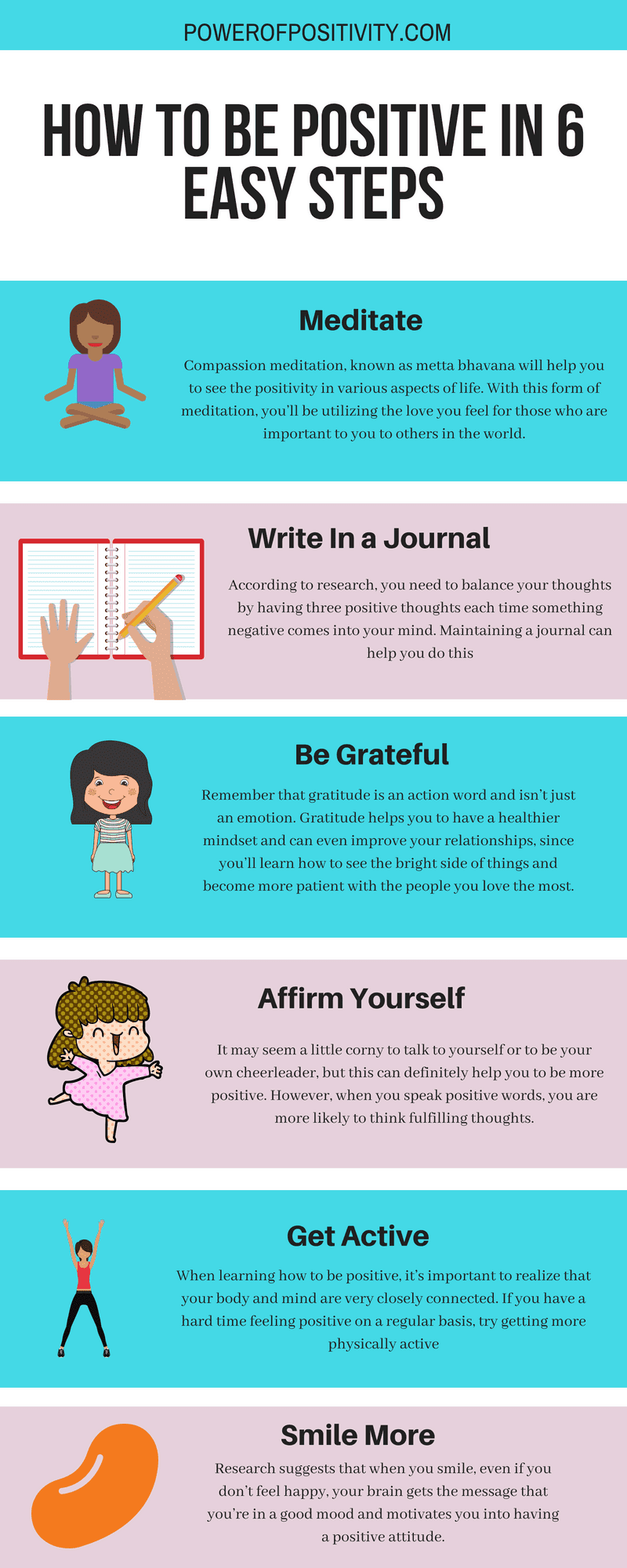
How to be positive

Share this Image On Your Site

5 Ways to Help Overcome Social Anxiety

According to the Anxiety and Depression Association of America, social anxiety disorder affects 6.8% of the U.S. population. That total equals out to a staggering 15 million people. Social anxiety goes beyond just a tendency to act shy around others. Indeed, it can completely debilitate the sufferer. The disease makes it almost impossible to enjoy social situations. People with social anxiety have an extreme fear of being judged or ridiculed by others. Moreover, everyday life can become a constant battle.

Many people who suffer from social anxiety feel powerless against their emotions and symptoms. However, the following simple practices can make a world of difference when you start feeling anxious in social situations.

Here are 5 Ways to Help Overcome Social Anxiety:

1. Try not to have an “all or nothing” mindset.

Justin Weeks, Ph.D, an assistant professor of psychology and director of the Center for Evaluation and Treatment of Anxiety at Ohio University, said “Dispute both bleak thoughts that undermine your performance and fuel your anxiety, and equally unrealistic thoughts that are irrationally positive.”

What does this mean? Basically, you should practice retraining your brain to not automatically think of the worst-case scenario, but also not get your hopes up too high. Having the mindset of a “realistic optimist” can make life exponentially easier. That’s because you won’t have unrealistic expectations. However, you also won’t dwell on every little thing that might go wrong.

2. Gradually increase your exposure to social situations.

This is what therapists call cognitive-behavioral therapy. And if you do choose to see a therapist, he or she can help you through the necessary steps of feeling more comfortable in public.

Dr. Weeks said it best: “We avoid what frightens us, and in turn, are frightened by what we avoid.”

The longer you evade social encounters, the more the fear will build up in your mind. Of course, gradual exposure will ease you into the situation so you don’t become overwhelmed, so try to first imagine yourself conquering your fear. Picture yourself assuredly delivering a speech in front of your class, or confidently walking up to a group of people at a party, or even just having a relaxed conversation at your home with friends.

While you imagine this scenario, don’t focus on how others might perceive you. Just picture what you would ideally look, feel, and sound like if you felt totally comfortable in this social situation that you fear. Then, just go from there. Talk to your barista at the local coffee shop when you stop by. Or go out with a trusted family member or friend to somewhere that makes you feel anxious, like a grocery store or mall.

It might feel uncomfortable or scary at first, but conquering the fears that you have implanted in your brain is a very necessary step on the path to recovery. Make sure to practice positive affirmations along your journey, because a positive mindset is a key to overcoming any challenge, no matter how big or small.

3. Practice deep breathing and meditation exercises.

An emerging body of research continues to prove that mindfulness can ease symptoms, or even completely reverse, social anxiety disorders. People who suffer from any form of anxiety focus their attention entirely on the future – how people will react to what they say, what people will think of them, if people will notice their blushing face or shaky hands in a group setting, etc. However, meditation and deep breathing exercises teach them to bring their attention back to the present moment and think of nothing else but their own breath.

After practicing this for a few weeks or months, it becomes second nature, and they can use these valuable tools when talking to people, giving a speech, or anything else that requires interaction with people.

4. Join a support group for social anxiety.

Oftentimes, people who suffer from mental disorders feel isolated, misunderstood, and abandoned. However, social groups catered to people with similar issues or backgrounds can make sufferers feel like they belong somewhere, and that people do understand what they’re going through. Research local support groups on Facebook or maybe even your area’s Chamber of Commerce website for more information.

5. Avoid focusing your attention inward as often.

As you may have heard before, we are our own worst critics. We analyze ourselves more than other people ever will. Thus, we create a lot of anxiety in our heads about how we appear to others. Some might call this “hyper-analyzing,” and it can become a very toxic practice if you make it a habit. To free yourself from these incessant thoughts, try to instead shift your focus to your current environment.

Listen to others fully when they speak to you, instead of wondering what you will say or fearing how you look or sound to others. Notice the color of the paint on the walls. Or observe how the smiles on others’ faces brighten up the room. Taking the attention off yourself for a while doesn’t mean that you don’t matter. Instead, it just gives you a chance to take in the entirety of a situation, rather than just your role in that situation.

These practices allow you to embrace the full experience of life instead of just a fraction of it spent inside your mind. Enjoy the life awaiting you with open, loving arms. You are valuable and deserve to live it!

How to Make A Vision Board

You may have wondered a time or two if vision boards work. Well they do, and the reason is simple – your brain will work to expand what is in your subconscious. Meaning if you glance at your vision board throughout the day, it will remain in your subconscious and, as a result, your brain will go to work in order to make it a reality.

A vision board is your image of the future. It represents your hopes, dreams, and goals for your life. The saying, “A picture is worth a thousand words” support the fact our mind responds most strongly to visual stimulation. Pictures along with your emotions are powerful motivators to achieving your dream life.

Ready to create a vision board? Here’s how:

vision board

1. Determine Your Vision Board Format.

Vision boards don’t always have to be a physical board; it might be your computer’s screensaver, background on your phone or pages in your planner. Observe your actions throughout the day and determine the best place for this board to be in your view frequently.

Some vision board formats to consider:

– A poster

A Pinterest board

– An art journal

– Planner pages

– String and clothespins

– An inspiration wall

– A deck of cards

– A screensaver

2. Establish Your Goals

Your vision board can represent the dreams for your future life, or it may focus on just one area. Understand what you want to achieve and highlight the specifics. Be selective as you begin to craft your vision, avoiding clutter and chaos by moving forward with a sense of clarity.

3. Gather Images

Use images from your photo albums, magazines, the internet, artwork – anything that speaks to you. Make copies of original photographs and artwork to preserve them.

As you begin to gather images, use images that best represent not only the ultimate goal but the emotions and feelings around the goal.

Make sure and include pictures of yourself from a happy time on your board and include words, affirmations or inspirational quotes that resonate with you and support your goals.

Collect freely. It is better to have too many images than not enough.

4. Create Your Layout

Start creating some structure for your board. You can physically draw spaces on your board or digitally mark the space on your visual image. Write each goal in the sections you created.

Make sure the amount of space and placement of each goal is relative to the importance of your goal. For instance, your most important goal might have more space and be centered in comparison to less important goals.

5. Sort and Arrange Your Images

Go through your images, quotes, words and decide what belongs where. You should have way more than you will ever use, and that is okay. A few clear and concise images will serve you better than too many images that are distracting. You could save them for later use.

6. Create Your Collage

Be very selective on the images you are using. Make sure they adequately represent your goal and your feelings about the goal. You may still find yourself eliminating images as you work through this stage.

Trim your images and begin to layer your words and quotes with corresponding images. As you are arranging the images, trim to make them fit better or bring something into focus. Continue moving and trimming your images until you have a board you love.

7. Personalize It

Glue down your images or save the digital version. Add some doodles, hand-written text or other personal touches. You can even make a physical version and then take a picture of it to use digitally.

8. Display It

Find a place to display your new vision board where you will see it regularly. Creating it is an important part of the process because it clarifies your goals but seeing it regularly is just as important. So make sure it is front and center and share it with your friends so they can support your vision.

9. Review It Daily

Seeing the board every day is great but take it one step further by reviewing it every day. Feel the emotion of the achievement, pause and think about what actions you are taking to support your goals and what you can do next. Keeping your vision in the forefront of your mind will help you do the things that will propel you forward towards your goals.

As your dreams begin to manifest, recognize your achievements and acknowledge that it’s working. When you are ready for a new set of goals, create a new board leaving this one intact. Don’t tear down all the good work you have done.

While we have provided guidelines for creating your vision board, there is only one rule to remember: create a visual reminder that makes your heart smile and makes you feel good. In the end, that is the only thing you need to remember.

7 Negative Thought Patterns You Should Never Tolerate

At the root of our overwhelmed life and often the cause of our unhappiness, unhealthy and negative thought patterns can be found. It’s common knowledge that negative thinking creates a reality based on negativity. What might surprise you, though is there’s a core group of unhealthy, negative thought patterns that contribute to that reality.

Barbara Fredrickson, a positive psychology researcher at the University of North Carolina, recently published an article on the effects of positive thoughts on the actions we take and the skills we develop. What she found was that negative thoughts and unhealthy thinking patterns can prevent your brain from seeing solutions and other choices when solving a problem. The bottom line is negative thought patterns can impair our survival instinct.

The good news is these unhealthy negative thought patterns can be overcome, and the first step is becoming aware of them. Here are seven common unhealthy thought patterns and how to fix them.

7 Common Negative Thought Patterns (and How to Fix Them)

1. All-or-Nothing Thinking

Any thought pattern that you base on extremes can signify trouble. Statements like, “it must be perfect,” or “I can’t do anything right,” only serve to prevent you from compromise and success. The more we believe the all-or-nothing thoughts, the more unhappy our reality becomes.

The Fix

Recognize and extreme statements and reframe them into a statement based on fact. For instance, the common phrase, “I can’t do anything right” is better reframed as “I do not understand what I am doing and I need to find help so I can learn to do it better next time.”

2. Jumping to Conclusions

Assuming the worst without the facts is a classic example of being in a negative thought pattern. These assumptions are a great example of why questioning your thoughts is necessary to interrupt the pattern. In most cases, your worries and fears are unfounded, and you end up worrying about nothing.

The Fix

It’s important to stop jumping to the end of the story and instead allow the story to play out. When you stay in the present, the situation always ends up being less dire.

3. Emotional Reasoning

According to your mind, feelings are facts, rather than subjective perceptions that change over time. For example, feelings of guilt might mean you’re a terrible, selfish person and being afraid of something means you’re in real danger. That is why it’s important to understand and work through your feelings.

The Fix

It’s necessary to question our thoughts to determine if they are real or perceived. Once we have gathered the facts, then we can create a plan of action to deal with them using both logic and feelings to guide us.

4. Should Statements

You feel disappointed, guilty, frustrated or angry when things don’t go the way you had hoped or expected. Self-talk commonly includes words such as should, must, have to and ought to. It also contributes to having unrealistic expectations for ourselves, we demand a lot and get upset when falling short. “I should have done” … will get you nowhere.

The Fix

Try avoiding the use of the words: “should,” “what if,” and “have to.” Instead, focus on changing and improving the things we can change and learning to accept the rest. You don’t owe explanations to others for most of your actions.

5. Personalization

We personalize matters when we blame ourselves for results that are out of our control. We make the lack of results about us instead of about the action that caused the results.

The Fix

We should focus on actions and behaviors and what we can change, instead of focusing on ourselves, or any person for that matter.

6. Playing the Victim

When we play the victim, we blame others for the bad things that happen in our life. Nobody can do anything right, and if it weren’t for them we would be more successful, wealthier, happier, in a better relationship, or you name it. It is easier to place blame on someone or something else than to accept responsibility for our part.

The Fix

We can start looking at our role in challenging situations so we can grow from the experience.

7. Future-Focused

We are future-focused when we feel everything will be better someday in the future when the conditions are perfect. We convince ourselves we will be happier when we are healthier, skinnier, richer, in a job we love, or out of school. It can be anything that is a condition for our future happiness.

The Fix

Change our focus to what we can do today to be happier tomorrow.

When we begin to recognize and change your unhealthy thought patterns, by default we are choosing to seek joy, be optimistic and move forward. When we do that, our brain starts to adapt and will build on those positive patterns.

Finding ways to reframe our thoughts from an unhealthy negative perspective to a positive influence will help us bring the lessons of the past into the present and will move us into living a happier life.

20 Things You Don’t Owe Anyone

How many things in your day do you do because you feel you should? Well, honestly, the word “should” should be eliminated from our vocabulary. The things we “should” do take us away from the things that matter, the things we must do to live our best and happiest life. Add to that the word “owe.” You don’t owe certain things to others.

When we stop doing things because we feel we should and start defining the boundaries around what will add value to our lives, we can get on with living our lives.

The biggest thing we need to stop doing is explaining our decisions to others in hopes of their support. We should be confident enough that someone else’s opinion doesn’t matter.

In fact, we all judge even when we try our hardest not to. That occurs because we watch people, form opinions, and make assumptions based entirely on their observations. So it’s no surprise that we assume other people are judging us. Knowing judgment is happening all around us; we must explain ourselves to make sure people see us as we want to be seen constantly.

Fine is not always really fine

“Never explain – your friends do not need it and your enemies will not believe you anyway.” – Elbert Hubbard

How often have you pretended to feel fine and tried to convince someone of this fact even though it is clear you don’t feel fine at all? We’ve all done it. Instead of faking fine, try being real without apologizing or explaining. Give yourself the freedom to … Just. Be. Human. Everyone has imperfections, why bother to hide it?

Explaining takes your power and gives it to the other person. The best decisions come when we listen to our feelings and gut instinct. But those sources aren’t usually well received in an explanation, so we make up an explanation the other person can relate to.

Unfortunately, many of us need to explain even though we know we shouldn’t. An explainer is waiting for someone else’s approval, and there is a lot of wasted energy in the waiting. During this waiting period, doubt creeps in; depression begins to expand, and unhappiness takes root. Waiting is wasted time.

When we explain, we move away from our greatest source of wisdom – our inner guide. We stop honoring ourselves and start placing more importance on the other person.

It’s hard to overcome the tendency to explain, but it can be done with focus and intention. Awareness is the key.

To help you become more aware, here are 20 things you don’t owe anyone an explanation for.

owe

  1. Justification for your values and your priorities.
  2. A yes when you want to say no.
  3. An explanation for your relationships, whether lovers or friends.
  4. Assistance with their happiness journey at the cost of your own.
  5. A debate around your political views, especially when the other person’s mind is made up.
  6. An apology when you are not sorry, and you would make the same decision again.
  7. A rationalization about why investing in yourself is important
  8. The meaning of what you believe in.
  9. A change in your appearance to please them.
  10. Friendship, especially when they do not share your values.
  11. A negative mindset so that you can commiserate with them.
  12. The access granted to information about your life that makes you uncomfortable
  13. Gossip material or unkind comments about other people just to fit in.
  14. Your time for their projects or for things that matter to them unless they matter to you too.
  15. The commitment to try something “new” just because you were asked.
  16. A safe place for constant complaining and dwelling in their poor choices.
  17. An answer other than the truth to prevent them from being uncomfortable.
  18. Your services as a crisis counselor unless you are actually a crisis counselor.
  19. False or undeserved compliments to make them feel better.
  20. Anything that doesn’t make you feel good and goes against your gut instinct.

Just remember this when you’re unsure if you owe someone:

“What other people think of me is none of my business.” – Wayne Dyer

and then remember this:

“You alone are enough. You have nothing to prove.”  – Maya Angelou

The next time you are tempted to justify something, remember that you can’t control what other people think. You can only control what you think and how you feel. If you are confident with your decisions then an explanation isn’t really necessary.

5 Things Grateful People Don’t Do

[dropcap]I[/dropcap]t’s easy to be grateful when things are going great, but the happiest and most grateful people are the way they are because their happiness and gratitude are not tied to circumstances. They remain happy and grateful in difficult times by avoiding things they know will erode the quality of their life.

Here are 5 things grateful people avoid doing to keep living their best life.

1 – They Don’t Complain Or Listen to Complainers

“What you’re supposed to do when you don’t like a thing is change it. If you can’t change it, change the way you think about it. Don’t complain.” – Maya Angelou

Complaining and listening to complainers takes us out of the positive space of gratitude. What’s worse? It can impair the brain. Research shows that just 30-minutes of exposure to complaining and negativity can affect your ability to make good decisions.

It’s impossible to fathom a life without a little complaining from time to time because life can be tough, and there are plenty of frustrations along the way. A complaint or expression of frustration isn’t what hurts your practice of gratitude; it’s remaining in the negative space of constant complaining or listening to a complaint that is detrimental.

What We Can Do

Express your frustration and then take a small action to move yourself out of the negativity and into a positive and more grateful space.

2 – They Don’t Take The Little Things For Granted

“It’s human nature to start taking things for granted again when danger isn’t banging loudly on the door.” – David Hackworth

You know what they say, “it’s the little things that make life big.” Well, this is entirely true with the practice of gratitude. Gratitude isn’t just about focusing on the big things in our life. Instead, the most grateful people spend time focusing on the little things that bring a smile to their hearts.

Small things like a beautiful flower, a smile from a stranger or someone holding the door open have the power to elevate our gratitude practice when we appreciate it at that moment. Being mindful of all the tiny miracles that happen in our day, is truly at the center of gratitude.

What We Can Do

Spend time every day looking for moments in which to express gratitude. It has the power to change an average day into a spectacular one.

3 – They Don’t Expect a Perfect Life

“Life is either a daring adventure or nothing at all.” – Helen Keller

We all know life isn’t perfect, and regardless of how grateful or happy we are, life can sometimes suck the joy right out of us. While we don’t expect a perfect life per se, why are we thrown for a loop when something unexpected happens? It always seems to catch us off guard.

Treating a challenge as if it were a problem takes us away from gratitude and puts us in a defensive position. When we spend time defending our grateful and happy life, we are moving further away from it by focusing on the problem. Be prepared for challenges to happen knowing you can handle it, because they will happen.

What We Can Do:

Stay in the present and become more proactive. Expect a challenge to test your gratitude and happiness. When it happens work through it focusing on all that there is to be grateful for knowing you will be a bit happier when you’re done.

4 – They Don’t Underestimate the Importance of Sleep

“Sleep is the best meditation.” – Dalai Lama

Sleep is probably the most undervalued and underutilized tool of living a more grateful life. We are a society that is sleep deprived. When we are tired, we become more emotional, more attached to drama and more prone to overreaction.

It is hard to be a truly grateful person when your emotional and physical health is not where it should be. Sleep heals and prepares our bodies to handle challenges, and it’s how we handle those challenges that affect our gratitude practice.

What We Can Do

Sleep. Establish a bedtime routine and honor sleep as a way of making gratitude a focus of your day. Sleep nourishes the soul, so you will awaken feeling refreshed and ready to tackle the day. And that is something to be grateful for.

5 – They Don’t Neglect the People That Matter – Including Themselves

“The quality of your life is the quality of your relationships.” – Anthony Robbins

Taking for granted the relationships we have with the people matter most, including ourselves, is detrimental to our gratitude practice. Think about it? Our relationships play an important role in who we are, where we are going and how we live our lives. If we neglect our relationships, we are neglecting our life.

It’s when we shift our focus from people onto things that we leave a grateful space for one that is not serving our authentic self. People should always be the focus.

What We Can Do

Pay attention to people, not things. Make people a priority by fostering the relationships that matter through regular communication and expressions of love and gratitude.

Elevating our gratitude practice only requires a commitment and constant focus on being grateful. It’s not rocket science, but it does take an effort to be present at the moment and to recognize these moments and their contribution to our day and your life.

10 Tips to Help You Attract Your Soulmate

The idea of the “soulmate” has been the subject of much mystery, confusion, and heartache throughout history, and today, people still wonder if their soulmate exists, and if so, how to make them a part of their life.

No matter your stance on soulmates, you can take the advice below and apply it to many different aspects of your life, including meeting a potential new partner, or even your one and only.

Here are 10 Tips to Help You Find Your Soulmate:

soulmate

1. Make a list of all the qualities you want in a potential life partner.

You might think, “How does making a silly list help attract my soul mate?” Well, making a list might seem like a waste of time and energy at first, but the Law of Attraction works in mysterious ways. Thoughts always manifest into form eventually, and writing those thoughts down on paper can help speed up the process. Putting your thoughts into written words will also allow you to visually observe the traits you desire in a partner and can help you envision what your ideal partner would look, sound, and act like.

2. Put yourself out there more.

This seems like a no-brainer, but you’d be surprised how many people just expect their life partner to waltz into their life without any effort on their part. To attract and meet your soulmate, you have to be willing to show your true colors, remain authentic to your highest self, and unabashedly present yourself to the world without fearing the consequences. You never know who you might meet in the most unexpected places, but the first step is to put yourself in situations that are favorable to bumping into your life partner.

3. Love yourself first.

You can’t possibly attract love if it doesn’t have a home within your heart first, so make sure to love yourself now, as you are. How do you do this? It’s simple: just accept yourself, be kind to yourself, and honor yourself. Loving yourself isn’t conceited or arrogant; it just means that you respect yourself enough to have confidence in your own unique cosmic energy. To manifest more love in your life, it’s essential that you first cultivate it within yourself, and send out that energy into the universe.

4. Make a commitment to understanding yourself fully.

Just as with loving yourself, you can’t understand others or expect them to understand you if you haven’t done some deep reflection. You have to dig deep and uncover all those secrets that even you might not have known about yourself before. To attract your soulmate, you have to appreciate and realize what kind of person you have been, who you are now, and the type of person you wish to become. Knowing yourself will also attract others who have taken that journey within and understand their strengths, weaknesses, likes, dislikes, and personalities.

5. Start saying “yes” to life.

It will be difficult to meet your partner if you always say “no” to new situations or opportunities. If you find yourself doing this often, practice opening yourself up to life more. This doesn’t mean to say yes when your instincts inform you that you shouldn’t, it just means to take a little more risk. Join that dance class you have been dreaming about, move to another state or country if you feel it in your bones, or even just meet up with a new friend for lunch. Life is meant to be enjoyed and lived without abandon, so start living!

6. Honor your gut feelings.

You will meet people in the most bizarre and surprising ways sometimes, and that’s usually because you listened to your intuition. Following your gut feelings just means doing what feels right to you, even if you can’t explain it. Maybe you feel compelled to go to a certain place or get in touch with an old flame for no reason other than your intuition telling you to do so. Tune into your intuition often, because it wants to help direct you on your path in life.

7. Pay attention to subtle signs sent from the Universe specifically for you.

We have mentioned this many times before, but the universe communicates to us through earthly methods, such as playing a song on the radio every time we get in the car, or directing our attention to a certain time on the clock, or even making us aware of an upcoming circumstance in our dreams. Pay attention to these signs and messages, because they could very well point the arrow toward an exciting new person in your life.

8. Open up your heart to love.

Obviously, to attract a partner into your life, you need to accept the love you offer yourself, and equally accept the love others give as well. Even if you have been hurt in the past (haven’t we all?), don’t close yourself off to love. Just learn from your past experiences, and transmute that pain into passion and love for life. Accept and acknowledge your pain, but don’t attach yourself to it; commit yourself to a path of love and compassion instead.

9. Have faith that your soulmate is coming your way.

For positive things to happen in your life, you have to first believe that you deserve it, and have faith that good things will start to manifest. The universe may not send you what you desire right away, but just believe that things are looking up, and that will slowly become your new reality and frequency you operate from.

fall in love

10. Don’t fight your current reality; just go with the flow.

Even if you haven’t met anyone you feel spiritually or emotionally connected to yet, that doesn’t mean that the future doesn’t have these things in store for you. Just enjoy the present moment as much as possible, and don’t get too caught up in what the future holds. Live in the now, and you will start learning to enjoy life from your current vantage point; you will see that your grass is already green where you stand, not just on the other side of the fence. 🙂

3 Types Of People to Keep In Your Life

We all encounter certain people during our lives that guide us along our paths back home to what we like to call source energy. No matter the duration or significance of your relationships with people, they all serve a vital purpose and can help you grow into your highest form of existence.

Even if some of those people appear to hinder your personal growth, they have an underlying purpose of redirecting you to new people or places that will better match up with what you need on your personal spiritual journey. Some people you meet will inevitably stick around for only a short time, but make sure to keep the following types of people around for the long haul.

3 Types Of People to Keep In Your Life

1. The Mentor.

This person could manifest in a variety of forms, such as a family member, teacher at school, life coach, or friend. You look up to this person because they have wisdom about the universe that they invariably pass along to you. Your mentor will likely be older than you since they will have more life experience to share with you, but this isn’t always the case. The universe will send you this person in order to encourage, support, and inspire you in your journey.

This particular relationship will embody that of the student and teacher. In fact, it will mostly benefit the student (yourself). However, the teacher may also learn new things from his or her younger companion. Also, the roles may have been reversed in a past incarnation, where you taught your mentor important lessons about life. You have likely met this person before in some manner in order to feel comfortable sharing details of your life and attaining wisdom and advice from them.

If you haven’t met them yet, keep on working on your own self-development, and the universe will send him or her along when it’s time.

Remember: “When the student is ready, the teacher will appear.”

2. Soul Mates.

people

Throughout your life, you will meet people that you feel you have known for lifetimes before. Some call these “soulmates,” others may resonate more with the term “soul family,” while others may call them their Soul Tribe. All of these terms essentially mean the same thing: people you encounter along your journey that you resonate with on a deep soul level. A soulmate doesn’t always show up as the opposite sex; a friend, brother, parent, or really anyone with a similar vibration as yours can manifest as part of your soul family.

Soul tribes are said to come from the same star system, and therefore reincarnate together throughout many lifetimes. You choose these people before you make the journey to Earth as the ones you wish to accomplish an important mission with or teach you valuable lessons. Upon meeting them, you will likely feel an uncanny sense of comfort and familiarity, and may even have past life memories with them. You literally feel as though you’ve reunited with a long lost soul brother or sister, and just click with them on almost every level.

You mirror many aspects of one another and share a part of the same soul. Immediately, you’ll connect with members of your soul tribe. Furthermore, you will likely meet them in unexpected places, so keep your eyes and heart open for connections to form.

people-quote

3. The opposite.

While opposites can encounter a lot of energetic discordances, this person will show up to inform you of what you need to work on in your path here on Earth. They won’t sugarcoat anything, as that will only distract from the message you need to hear at the moment. Some may call this person your “counterbalance,” or a force that seeks to balance you out so that you may grow into your highest self. They will show strength where you may have weaknesses, and vice-versa.

You may have arguments or disagreements with this person often, but don’t take it too personally. Indeed, they just want to see you transform into the best version of yourself. For you to accomplish this, they will point out any time in which you act out of alignment with your true nature. Plus, they will provide honest insight into how you can improve. Oddly enough, many of these relationships manifest in the form of twin flames, as this relationship perfectly embodies the yin/yang, light and dark, and feminine and masculine energies.

Skip to content