Weekly tips, affirmations, and small actions to feel your best.

Silence Negative Self-Talk With This ONE Easy Trick

We all deal with negative thoughts and judgmental voices in our heads from time to time, but what if you could learn to silence that negative self-talk with one easy trick?

The exercise we will share with you in this article can help you to achieve a peaceful state of mind, while also balancing your emotional health. Our minds often run on autopilot, and we don’t really tune into the thoughts playing over and over again until they become self-destructive. This exercise can help you to pinpoint the negative thoughts as they happen, and deal with them directly.

Silence Negative Self-Talk With This ONE Easy Trick

NLP, or Neuro-Linguistic Programming, can help you to manage those negative thoughts, and even reform them into more positive ones. It helps you to change the way you look at the world by first dealing with HOW you interpret it through your mind. Developed in the mid-1970s by Richard Bandler and John Grinder, it’s used in many different fields, such as trauma recovery and sports coaching. By utilizing the foundations of the exercise, Bandler and Grinder believe that anyone can achieve personal excellence and heal from a variety of conditions or phobias.

How does NLP work?

Basically, it involves connecting neurological processes, behavior, and language in order to change certain aspects of your life through reprogramming pathways in the brain. The founders believe that this set of techniques can work for anyone, as it simply involves removing processes that don’t help you achieve your goals, modifying existing programs, and installing new ones if necessary.

If you think of your brain like a computer, you will understand why this exercise works so well. Just like a computer, you can reprogram your mind based on the software that you put into it. Of course, the software is simply what thought patters you replay in your head each day. We either knowingly or unknowingly program our minds every day based on what we think, so you can easily reprogram your brain in order for it to function at its best.

A computer program helps us to do certain things, such as use Microsoft Word to type a document. So, think of the computer program as helping us to achieve a goal of typing, editing, and saving a document. In the same way, the thought processes we “install” in our brains can help us to achieve a goal as well, or they can actually hinder us from reaching the goal.

Basically, NLP involves having the perfect programs running in the brain in order to achieve maximum results, so if something doesn’t produce the desired result, we can simply “uninstall” it from our minds. Today, we’ll talk about modifying an existing program, however, to give you an idea of how you can transform negative thoughts into positive ones.

NLP Technique for Transforming Negative Self-Talk

1. Picture someone you love talking to you in a compassionate, understanding voice. How does that make you feel?

2. As you think about this, notice everything about how the voice sounds – the pitch, tone, rhythm, and volume. Become aware of all the qualities of this voice.

3. Now, put that on the back burner, and turn your thoughts towards the negative self-talk you sometimes notice in your mind. How does this voice sound, and how does it make you feel? Simply listen to it without judgement for a second…

4. Now, as you replay this voice in your mind, try to imagine these things being said in the compassionate voice of a loved one.

5. Now, replaying the destructive words again, imagine them being said in a silly voice, like that of a cartoon character.

6. Notice that just the tone of the voice in your mind can change your perspective, even if the WORDS themselves still seem negative.

7. Keep on adjusting the voice in your mind so that you can try out different perspectives.

You could switch from celebrities to cartoon characters to a loved one to anything else that you want – just keep in mind that you must play with the qualities of the voice in order to achieve the desired results.

8. Once you feel yourself having a positive breakthrough, you can then listen to the voice and see if it seems as negative as before.

Final Thoughts on Decreasing Negative Self-Talk

Chances are that your thoughts will have at least slightly transformed just because you repeated them so many times in different voices, and you know now that the voice plays just as important a role as the words being said.

This type of exercise can allow for the release of toxic thought patterns and emotions, as it draws awareness back to our minds and bodies. Once you recall the negative voice, try to see if you remember it the same way. Since you changed the voice so often, you probably won’t remember the original voice, which means your perspective changed since the beginning of the exercise. If you feel less upset than the first time you heard the negative self-talk, then that means you have made progress in transforming your negative thoughts to positive ones.

Related article: 7 Negative Thought Patterns You Should Never Tolerate
5 Ways to Protect Yourself From Negative Emotions

You can protect yourself from the negative health effects of emotions like fear, anger and emotional pain, just as easily as you protect yourself from sunburn with sunscreen. Negative emotions are just one part of what makes us human. Yet experiencing too many of them can be overwhelming to our physical and psychological health.

In this article, we will look at some of the ways that negative emotions impact your health. Also, we will discuss how you can learn to protect yourself.

5 Ways to Protect Yourself From Negative Emotions

1. Create a protective psychic shield

In his book Psychic Development For Beginners, William W. Hewitt explains the Law of Being by saying that whatever is in your consciousness must be brought into being and ‘nothing can happen for you or to you if it is not programmed into your mind. Therefore, it makes sense to program yourself with good, beneficial goals and thoughts’

By focusing on the positive, not negative thoughts, we can create a psychic shield that can protect us from negative emotions. Creating a psychic shield is as easy as visualizing it during your meditative practice.

Hewitt suggests that as you relax and you are in a meditative state, picture your body surrounded by a glowing light and say:

  • ‘This powerful, positive light is my psychic shield.’
  • ‘This light will repel all negative energies from programming my mind’
  • ‘The shield will allow only positive thoughts and emotions to pass through it.’
  • ‘This protective shield will be with me always, even when I am not focusing on it.’

2. Focus on the positive emotions of self-control

Some negative emotions, like guilt, arise from our lack of self-control. For example, if you overeat and you know that it is unhealthy for you, you may feel guilt about it later. When you are able to successfully resist temptation, that action helps you build your personal defenses against negative emotions.

13512176_10153584864132371_9183655721986806681_n

You know that you can avoid undesirable activities, like drinking too much, because you have avoided it in the past. Rather than the guilt associated with the ‘bad’ behavior, focus on the positive emotions you will feel when you successfully resist. Pride, a sense of accomplishment, and reassurance in your abilities are the positive ways to look at resisting a negative behavior.

3. Use awareness training

Meditation, yoga, and awareness of the physical sensations of negative emotions are all ways to use awareness of the present moment to learn to protect yourself from negative emotions. Researchers studying the role of awareness of bodily sensations in the experience of emotion found that Vipassana meditation, a type of meditation focusing on bodily sensations, helped people to learn the relationship between mentally feeling an emotion as a response to something negative in the environment and how the body responded to the emotion.

Once you can feel the negative emotion in your body, you can understand that your body’s response does not have to have a label associated with it. These are just sensations of heart rate, breathing, and perspiration, which you can then control by relaxing. Naming the emotion ‘fear’ only negatively affects what your body is experiencing.

4. Learn to comfort yourself in healthy ways

Psychologists believe that our ability to self-comfort is something we learn early in childhood, as we become separate people from our parents. A healthy person is able to comfort him or herself when they feel sad, scared or frustrated.

Related article: 5 Signs Of Emotional Suffering

Self-soothing behavior starts out as thumb-sucking or other repetitive, relaxing behavior in childhood, but as adults, we can identify that a walk on a sunny day helps us to release negative emotions just the same way. Think about a few things that you know are healthy for you and that give you a positive emotional boost. Keep this list of suggestions available the next time you need to protect yourself from negative emotions.

5. Detach from negative emotions

Your negative emotions are not you and you are not your negative emotions. Do not blame yourself for feeling negative emotions. Instead, act as an impartial observer and see yourself as another person would see you. Say to yourself ‘It looks like I am experiencing anxiety right now. Although that might usually bother me, I choose to not be affected by it.’

Related article: How To Train Your Brain To Stay Stress Free

You can also choose to physically detach yourself from the situation that brought on your negative emotions rather than stay and continue to feel negatively. For example, at a social gathering where you feel anxious, make a choice to leave if you are not able to switch to a positive emotional mindset.

Leaving a bad situation so that you can avoid negative emotions should not be something you feel defeated about. Instead, see it as you making a healthy emotional choice for yourself to focus on your well-being.

9 Comebacks For Dealing With Arrogant People

You know them when you see them, and arrogant people with their snotty attitude can negatively affect your day unless you’re armed with one or more of these 9 comebacks.

An arrogant person has decided to believe that they are somehow superior to you. However, we are all equal human beings with differences that are no more or less valuable.. How you respond or react to these people when you encounter them can affect your peace of mind. Your response to an arrogant person is also a reflection of your integrity as a person. So will you be a person who stands up for him or herself?

9 Comebacks For Dealing With Arrogant People

Arrogant people share the following traits with narcissistic personality disorder according to the Diagnostic and Statistical Manual IV, which is used to diagnose psychological problems:

  • Believes that he or she is ‘special’ and unique and can only be understood by, or should associate with, other special or high-status people (or institutions).
  • Requires excessive admiration.
  • Has a sense of entitlement, i.e., unreasonable expectations of especially favorable treatment or automatic compliance with his or her expectations.
  • Is interpersonally exploitative, i.e., takes advantage of others to achieve his or her own ends.
  • Lacks empathy: is unwilling to recognize or identify with the feelings and needs of others.
  • Shows arrogant, haughty behaviors or attitudes.

1. ‘Now what makes you say that?’

This comeback is intended to help the arrogant person identify the rationale behind the generalization, stereotype, or put down that they just used. We hope that they can realize that they made a negative statement that is being called into question, and will stop once they have been called out on their behavior.

13615167_10153623279332371_2053907921644560717_n

2. ‘Ouch.’

Well, if they’re hurting feelings, be they yours or someone else’s, call it like you see it. This is hurtful language that the arrogant person is using and this comeback can help them to realize the harm that they are doing.

3. ‘You know my mother is ___, right?’

An arrogant person is more likely to single out a group of people by race, sexual orientation, education, etc. and talk about negative stereotypes. The reason for this is that by putting others down, the arrogant person is attempting to elevate himself by comparison.

You can quickly put a stop to the negative talk by implying that someone close to you is a member of the group that the arrogant person is belittling. This shocks them into the realization that their negative talk is not going to be tolerated, but is insulting to you personally as well. A quick apology and exit by the rude person is likely to follow.

4. ‘Are you aware that there are other points of view?’

You and everyone else is entitled to their opinion, but the arrogant person needs to realize that their negative opinion of others does not hold true for other people.

5. ‘Tell me again why you are superior to ____?’

Arrogant people believe themselves to be better than another person, so let’s have them explain why we should treat them differently. This could result in some interesting answers, but more likely you’ve made them squirm uncomfortably since you pretty much said ‘You are not superior to that other person.’

6. ‘I would appreciate it if those were the final words you say on this topic.’

Let’s end that conversation as rudely as the arrogant person started it. This comeback is intended to put an end to their hateful words, but then again, arrogant people like to hear themselves talk so you might need to be more obvious about it with this next one.

Related article: 5 Comebacks For Dealing With Toxic People

7. ‘You need to stop talking now.’

Ending the conversation with an arrogant person could be as easy as leaving. But leave them with something to think about before you go. It is entirely possible that you will have no impact whatsoever on the arrogant person though. That’s because they obviously think highly of themselves in spite of the evidence of their meanness.

8. ‘I’m sure you didn’t mean for that to sound so arrogant, right?’

This comeback assumes good intentions, even if you have no evidence that they have good intentions. This language actually allows the arrogant person a way out, by saying that no of course they did not mean to sound rude. But it also makes it clear that you refuse to play their game of belittling others.

Related article: 5 Comebacks For Dealing With Closed-Minded People

overconfident

Read about the behaviors that reveal someone is overly confident.

9. ‘Do you realize how arrogant you sound when you say things like that?’

Call them out on their arrogant behavior and let them know that you find it completely unacceptable. Psychologists who study personality traits say ‘Modest people are not preoccupied with themselves; arrogant people have an inflated view of themselves.’

In one scale of personality traits, arrogance is associated with being calculating or manipulative toward others in a social situation.

(C)Power of Positivity, LLC. All rights reserved

Science Explains How Much Sleep You Need According To Your Age

Without a doubt, getting enough sleep to function is one of the most important aspects of health for humans.

Unfortunately, many of us suffer from a chronic lack of sleep – 35% of the population state that they get less than the recommended minimum of 7 hours of sleep per night. Consequently, we now have a sleep epidemic on our hands. The Centers for Disease Control called our lack of sleep a public health epidemic, and for good reason.

About 40 percent of adults suffer from insomnia, according to the National Sleep Foundation. This shouldn’t come as a surprise, however, when you think about how many people in the world have stress on their minds and hearts almost constantly.

When night falls, getting to sleep and allowing the mind to relax comes as quite a challenge for many people out there.

However, despite our increasingly fast-paced society and more demands being put on us than ever before, we can still adopt better sleeping habits and learn to reprogram our minds for sleep.

Think about it – as a child, you probably got to sleep without even thinking twice about it; however, as adults, we have so much going on that we often don’t prioritize sleep like we should.

With that being said, adults need a different amount of sleep than children, but just how much should we be getting per night?

We will give more insight into how much sleep you need below.

How Much Sleep Do You Need According To Your Age?

Obviously, growing children and teens will require more sleep than grown adults; however, with the overuse of technology we see today, many people of all ages suffer from a lack of sleep. The chart below will show how much sleep you need according to your age.

How-Much-Sleep

As you can see from the data presented by the National Sleep Foundation, both young adults and adults need 7-9 hours of sleep per night. School-age children need 9-11 hours, and teens require 8-10.

Many of us put off sleep in any way we can, staying up late doing work, watching Netflix, texting, or other activities that take away from our ability to easily fall asleep.

Below, we will discuss developing better sleeping habits so that you can get the quality sleep your body needs and deserves.

Four Sleep Habits To Avoid

To get proper sleep, you need to know what activities to avoid before bed to fall asleep quickly and easily. We will list some of the most common and destructive habits to avoid and give you some better habits to adopt for a good night’s rest.

1. Getting on your phone or computer before bed

Countless studies have shown that the bright lights emitted from phones and computers can delay sleep for hours past your bedtime. The bright blue lights from tablets, phones, and computers tell our brains that we need to stay awake, not go to sleep. Think about it: out in nature, the sun would tell our bodies to wake up and start our day. So, with all these artificial lights today, we stay awake longer and longer because our brains don’t know the difference between natural and unnatural light.

Better habit: Turn off electronics a few hours before bed and keep them off during the night so they don’t awaken you with notifications.

2. Drinking caffeine or alcohol too late in the day

Caffeine sends a jolt of energy through our bodies that helps us to stay awake and feel refreshed. Drinking a few cups in the morning to help us get our day started won’t do much harm; however, downing a cup or two close to bedtime will keep you awake well into the night. Alcohol might make you sleepy initially, and many people rely on it to fall asleep. However, alcohol spikes your insulin levels after consumption, which can wake you in the middle of the night.

Better habit: If you do drink caffeine or alcohol, make sure to avoid drinking it five or six hours before bed, as it will stay in the bloodstream for hours after consumption, forcing sleep to evade you once again.

3. Thinking/worrying while trying to fall asleep

We have a problem with overthinking and worrying; many of us do it without even realizing it! Overthinking before bed will make you feel stressed, which isn’t conducive to falling asleep. Worrying will produce more cortisol, and sleep won’t come for a while.

Better habit: If you find your mind wandering, try meditating or doing light yoga before bed. If this doesn’t help, fall asleep listening to relaxing music or nature sounds.

sleep

4. Not having a regular sleep schedule

Finally, our bodies were meant to perform tasks during set hours of the day. Out in nature, we would wake up with the sun and fall asleep just after it set each night. Therefore, not going to bed at the same time and waking up at different hours each day can cause your body to become confused and exhausted.

Better habit: Go to sleep at the same time each night and wake up at the same time each morning. If you have trouble with this, set a bedtime and try to go to bed within five to ten minutes of this time each night.

(C)Power of Positivity, LLC. All rights reserved

7 Signs of A Psychic Attack

People who experience a psychic attack are often afraid to come forward. That’s because they fear nobody will believe them. However, some victims know that there is nothing physically wrong with them and that are feeling one or more of these seven signs of attack.

Unfortunately, there are some malicious people with the knowledge of how to psychically attack others. So let’s look at some ways that you can defend yourself from a psychic attack.

7 Signs of A Psychic Attack (And How You Can Defend Yourself)

Beliefs about the psychic attack can be found in many cultures, from Russia to China, from India to those who study the Jewish tradition of Kabbalah. One Chinese study of colorectal cancer and the risk factors associated with it concluded that psychic attack was a factor that should be considered as a potential cause of poor health in patients.

A psychic attack is used to harm another person by manipulating and controlling them, by sending negative energy toward them. This mental manipulation occurs without your knowledge. Furthermore, it can cause physical symptoms similar to an illness, It can also cause a depressed mood, anxiety, and suicidal thoughts.

If you have concerns about feeling any of these symptoms, seek a medical professional to rule out a physical illness, but also seek a psychological consultation to rule out mental problems as well. Once you know that these are not factors in your condition, seek to safely remove yourself from the person you suspect of psychic attack.

13528888_10153607670337371_9121089323139513999_n

1. Exhaustion followed by deep sleep

Dion Fortune, renowned psychic and author of Psychic Self-Defense says that she was attacked by a woman who used the power of thought manipulation to plant false ideas in her mind and convince her give false testimony against a former coworker. After the woman told Dion what her version of the truth was, she says ‘to my intense surprise I found myself agreeing with her in a series of entirely baseless charges against the character of a man I had no reason to believe to be otherwise than perfectly straight. The same exhaustion and the same dead sleep descended upon me immediately after this interview.’

2. Questioning your sanity

Negative thoughts that did not come from yourself can make you question your sanity following a psychic attack. Knowing yourself well enough to recognize a foreign or intrusive thought that is unusual is key to recognizing this sign of a psychic attack.

3. Frightening dreams of being attacked

A violent nightmare may be a sign of a psychic attack. Examples of these types of frightening dreams are a feeling of heaviness on your chest, trouble breathing, or an intense fear of being held down or choked.

4. Feelings of hypnosis

Psychic suggestion is one method of manipulation that is similar to hypnosis and it is a sign of a psychic attack. Do you feel trapped in a trance state not achieved through meditation? Indeed, it may be a sign of forced hypnosis or a psychic attack on you.

Although the psychic attack is not rooted in a specific spirituality, followers of occult magic know how to use psychic attacks as black magic. Thus, wearing a cross or blessed religious item on your person can help you defend yourself from these attacks.

5. Extreme fears that are unrealistic

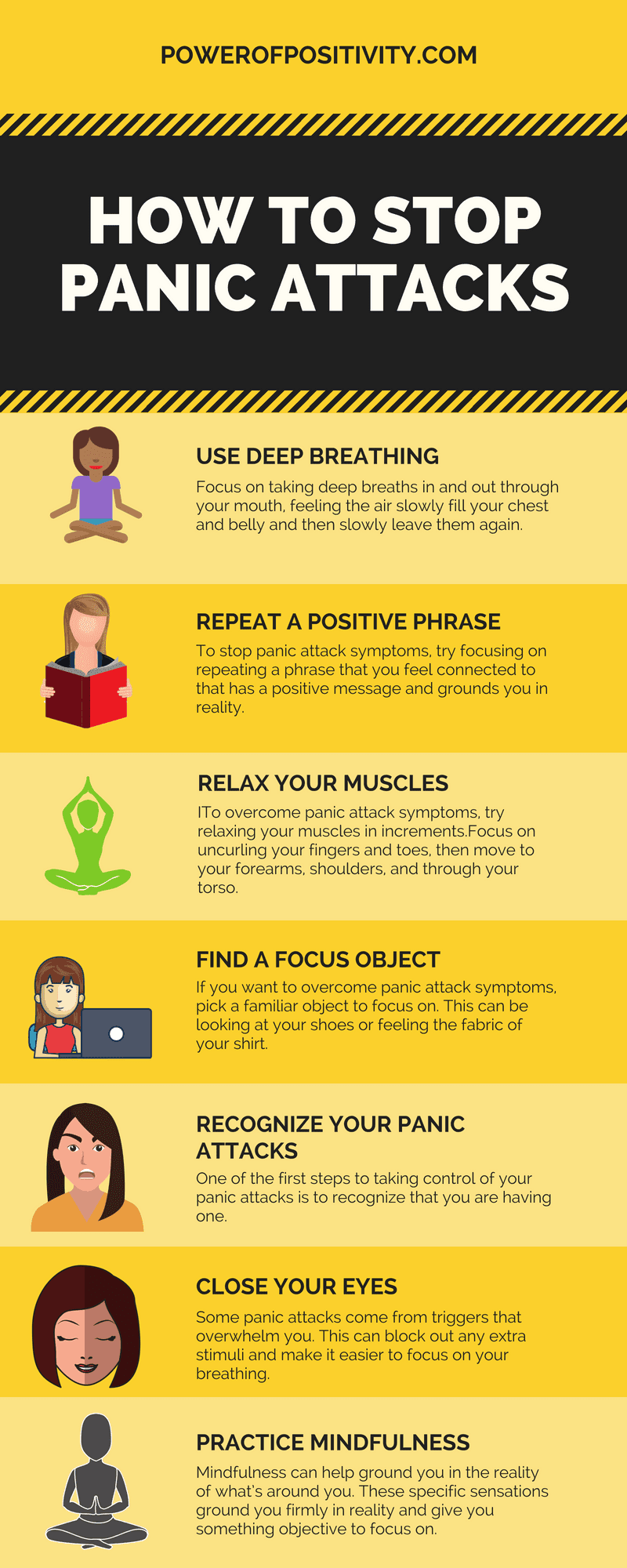
A rational explanation may not be evident to you when you feel frozen by fear. This is a similar feeling to a panic attack, but it can last much longer. Rapid breathing, fast heartbeat, sweating, and nervousness are all symptoms of anxiety, but not being able to leave your home for days due to intense fear is a sign of a psychic attack.


panic attack infographic

6. You feel much better after a shower or a bath

Dion Fortune suggests protecting yourself against a psychic attack is crossing a source of moving water. For example, consider a stream. A shower is also a source of moving water, so this will help to cleanse negative energy as well.

To add to the psychic protection, use a salt scrub in the shower or bathe in a saltwater bath. Salt also has a cleansing and purifying effect and will help wash away any lingering negativity. While you shower or bathe, say a prayer or blessing to cleanse away the negativity and purifying your psychic energy.

7. Feeling like you can’t control your movement or thoughts

Dion Fortune describes herself as not being in control of the placement of her feet after one potent psychic attack. Burning white sage can cleanse the space around you of negative energies. Wave the smoking bundle of sage around your home as you invoke positive energy. As you sage your home, tell the evil to leave.

(C)Power of Positivity, LLC. All rights reserved

5 Signs You’ve Found Someone Who Completes You

Finding someone special who can complete you is a treasure that you should try to hold on to, and there are at least five signs to look for when you think you’ve found them.

To be clear, you are a whole, complete person yourself and you don’t need another person to complete you. However, when you find the right person, you become a more fulfilled person, which is why we say that they ‘complete’ you.

5 Signs You’ve Found Someone Who Completes You

1. They help you to be a better you

The person who complements you might be a better word than ‘completes,’ because you were a whole person before you met your soul mate. If your partner helps you to be more you than you were before you met them, it’s a sign that you’ve found someone who completes you.

In a healthy romantic relationship, self-completion is more possible with the person who fits you best. You are able to become the person you were meant to be, with them by your side. A psychologist writing about psychoanalysis and love says that the French philosopher Jaques Lacan would change the line ‘You complete me’ to ‘”You provide me with the opportunity to imagine my own self-completion, and therefore I love you.”

13529179_10153615569227371_6196698505820630539_n

When you can say that someone completes you, it may be that you recognize qualities in them that you yourself do not have. For example, you might love your partner’s ability to be patient when you have difficulty with it yourself. It is not that you need this person to help you be more patient, it is that you are inspired by their personality and qualities that make them uniquely them.

2. You want to work toward a future together when you find someone special

You can visualize your future and you have a hard time picturing a future without them. This doesn’t mean that the person who completes you has to be a person you marry and grow old with, but you can certainly see a future where you two are happy together.

Ideally, you have goals and your partner has goals, and being in a relationship should not change that. You don’t ask your partner to put their goals on hold for yours, because that would be selfish. Rather, you allow them to pursue their dreams and help them along the way, and all the while you pursue your own ambitions too.

3. You are still able to define yourself without the label of a relationship

‘You complete me’ was the line that Tom Cruise’s character uses in the movie Jerry McGuire to win back his love interest, but in real life, your partner should not define who you are, either with or without them. If your self-concept has not changed, in spite of meeting the one who completes you, then it’s a very good sign.

Researchers who looked at romantic relationship breakups say that there is danger in defining yourself by your partner when ‘Partners develop shared friends and activities and even overlapping self-concepts. This intertwining of selves may leave individuals’ self-concepts vulnerable to change if the relationship ends.’

4. Someone perfect for you gives you support when things go bad, and also when they go great

You might think that the one who completes you would lend a hand when you’re dealing with a difficult time in your life, and they should. But your best match for a partner is also tremendously supportive when things are going great.

Related article: How To Use The Law Of Attraction To Find Love

Researchers looked at romantic couple behaviors and asked each partner to rate how understood, validated, and cared for they felt in each talk that they had with their partner. At a follow up 2 months later, scientists found that ‘responses to positive event discussions were more closely related to relationship well-being’ than were responses to negative event discussions.’ In other words, talking about and giving loving support during the good times was more important than giving support during negative life events.

5. You can accept your partner as they are, without wanting to change them

Desiring to change your partner into a different person is an act that is selfishly narcissistic. Your partner was a separate person with their own wants and desires before you met them, and they still are. If you can allow them to be themselves, fully, and without the desire to mold them into something else, it’s a sign that you are mature enough for a love that completes you.

Related article: 4 Signs Your Partner Is A Perfect Match

When you meet your perfect mate, you don’t immediately try to mold them into someone who fits you better. Instead, you allow them to be themselves, grow, change, learn, and develop into the person they are going to be. The only difference is that they will have your support as they become them, and you will have their support as you continue to become you.

5 Signs You’re Dealing With A Difficult Person

People learn behaviors by observing through stimulus and response. They then act accordingly through positive or negative reinforcements. But, how do you deal with a problematic personality when you try to deviate from their attitude, and it still backfires? Difficult people have a way of bringing out the worst in others. Their negativity and behavior are toxic. Sometimes you can feel them before even speaking with them. They act according to their negative reinforcements.

We must all learn (sooner or later!) how to deal with difficult people. “People who irritate us usually have something to show us about ourselves. “Ask yourself: How is this person holding up the mirror to me?” suggests Sandra Crowe, author of Since Strangling Isn’t an Option. For example, being around my chronically late friend reminds me of how quick-tempered and impatient I can be — not my favorite traits. Reminding myself of this may keep me from bouncing off the walls when I find myself waiting for her yet again.”

Difficult people are everywhere in our lives. They come in all colors, shapes, sizes, religions, and nationalities. But, how do you pinpoint the signs that you are dealing with a difficult person when you first meet someone? Sometimes we are sucked right into their pessimism without warning. Or, perhaps we don’t notice the hints.

Here are five signs you are dealing with a difficult person:

Have you seen these red flags?

difficult

1. A difficult person makes it all about them.

Difficult people are dramatic, and reactions from others fuel them. They need to be the center of attention. You know this person whose life seems to be a soap opera. You ask her what she did during the weekend, and she moves through elaborate storylines. These folks don’t just tell a story in a few sentences. They share a novel. And, to even ask them, “How are you doing today?” is opening a can of worms. They are selfish, narcissistic, and full of opinions.

2. They don’t do a favor without collecting.

These people are always scheming about how they can get something for nothing. If you ask them for a favor, realize it will be like selling your soul to the devil. That favor will not go unnoticed. Difficult people are not compassionate–they are self-serving. These folks will remind you over and over what they did for you. Never mind that you have helped them in the past. That’s not in their best interest. They will bully you into repaying whatever support or assistance you got from them.

3. They are victims.

The victim is the one who never gets over a trauma. They’re stuck in the past. They utilize illnesses, family, and events to manipulate them into getting what they want. They live in constant victimization mode. These people will reel you into their lives by making you feel sorry for them. They tell and re-tell stories of pain and failures. Negativity is their means of communication. The best way to stop their behavior is to continue giving positive statements and not buy into their pity party.

4. Difficult people can be oblivious.

Believe it or not, there are people out there who have no idea what’s going on in this reality. They live in a world that only makes sense to them. These people are problematic because they constantly deny what’s going on. They are flaky. They can be intolerable and hard to handle. These are not the people who are dreamers and trailblazers. These are the ones who bring about drama by creating a world that is not understood. They are delusional. It’s hard to have a serious conversation with an oblivious person. You hope they get the notion that the universe doesn’t revolve only around them.

5. Difficult people whine, blame and gossip.

The truth is that a person sharing gossip with you is also telling your business to others. They blame everyone for their mishaps. They’ll whine about the weather, the boss, the traffic, and anything that can bring attention. They complain about everyone. They make up stories, embellishing details to make them seem more attractive. To stop the nonsense, you have to express your disgust about their behavior.

Difficult people don’t like when the tables turn, and they are no longer in charge of stories. When they don’t get what they want from you, they move on to someone else. They don’t appreciate being called out about their negativity.These folks can’t find a speck of sunshine on a cloudy day. They move through manipulation, control, and bratty behavior. You start to see their signs the minute they show zero empathy for another. You can stop the behavior with positive reinforcement and let them know that you will not tolerate their attitude. We must be grateful for those rude and obnoxious souls who show us what we will never become.

Are You the Difficult Person? Here’s How to Change

Let’s face it – we’re all a bit difficult to deal with at times. Our imperfections make us human, so don’t beat yourself up about not being flawless. However, we should always strive to get along with our fellow humans to the best of our ability. Having a problematic personality can make this challenging, but innate characteristics aren’t set in stone. We can change throughout life by making a concerted effort and exercising self-control.

If you’re a difficult person, we have a few pointers below on how to improve. Remember that we’re not calling anyone out here, just advising those who may need it.

difficult

1.     Listen more than you talk.

How often do you truly listen to people during conversations? You might think you’re listening, but you may not fully hear the other person if your attention wanders. With the advent of technology, many of us have become distracted and not present when we’re with people. However, we owe it to our fellow humans to show compassion and offer a listening ear when they need it.

It isn’t very kind or tactful to scroll on your phone or act like you don’t care about another’s thoughts. Even if you’re a busy person, you can probably spare a few moments to converse with your loved ones. Regarding work-related conversations or encounters with strangers, it’s equally important to practice active listening. We’ve become very disconnected from each other in modern life, but we can heal by putting our guards down and reaching out.

Please realize that we’re all one, and in caring about others, you’re also showing kindness toward yourself. Imagine that you’re talking to yourself in conversations with others, and you’ll begin to grasp this concept.

2. Practice empathy.

Perhaps you find that you care more about yourself than others. Don’t worry; most people fall under this category, and it doesn’t make you an awful person. However, extending this care to others and including fellow humans in your love will make it easier to get along with people. In general, most people enjoy being around others that have compassion and kindness toward them.

Empathy doesn’t come naturally to everyone, but you can always learn how to care about other beings. Volunteering at a homeless shelter, making dinner for your family, or giving free hugs to strangers are just a few ways to become more empathetic.

Putting yourself in others’ shoes and seeing life from their perspective will help you grow as a person. We all have to share this planet, and it becomes a much better experience if we help each other along our journey.

3. Have realistic expectations of others.

You may have lofty expectations of yourself and others as a problematic person. There’s nothing wrong with setting standards, as long as you allow room for flexibility. No one will live up to these expectations 100% of the time because humans naturally make mistakes.

Also, it isn’t fair to expect so much from people in the modern world where we’re all thin. Keep in mind that people are just doing their best to get by. When they disappoint you, you’ll have greater understanding and compassion toward them. Most people don’t hurt others on purpose; they have a lot on their plate and can’t always attend to your needs.

4. Find fulfillment within yourself.

If you’re a difficult person, you may look to others to feel complete or validate your existence. However, no one can genuinely make you happy unless you’ve found that within yourself first. Disagreements usually occur between people when they have conflicting desires or unrealistic expectations.

Much of this heartache and strife could be avoided if people felt whole on their own. Your relationships will become more fulfilling by not needing anything from others, and you’ll feel more secure.

Practicing meditation, mindfulness, and other reflective techniques will help you remember your true self. Peace, joy, and total consciousness are your natural state, where your desires are finished, and you can rest in the truth.

Becoming more spiritually inclined will reduce the tension and turmoil within yourself to have a clearer picture of the world around you. Polishing the mirror inside your mind will bring profound peace, where all difficulties dissipate.

Find peace within, and you will see it all around as well.

5. Have self-compassion.

Before you can heal your relationship with others, you must face any issues within yourself. Expanding on the point above, the universe acts as a mirror, where we see the world through our lens.

If our lens is cloudy and unclear, we only get a small glimpse of reality based on this narrow-minded view. However, removing unnecessary thoughts and biases will allow us to expand our limited mindset and perceive higher levels of consciousness.

This process starts by forgiving yourself for past mistakes and loving the person you’ve become. Remember that you’re worthy of this gift of acceptance because you’re a child of the universe and deserve to be here like everyone else. The turmoil in modern life stems from our unhealthy relationships with ourselves, so world peace can only happen if we find inner peace first.

Being a problematic person means you haven’t yet accepted yourself as pure love and bliss. When you change how you view yourself, the world won’t seem like a scary place anymore.

difficult

Final Thoughts on Coping With a Difficult Person

We will inevitably encounter a problematic person throughout life and might even be one ourselves. Whether it’s you or someone else, you should always have compassion and come from a place of love. Difficult people usually have unhealed trauma or other problems to deal with, taking it out on others.

When you interact with these people, keep in mind that they’re struggling through life just like you. Compassion and empathy will help us heal our relationships with ourselves and others and create a more equitable world.

How To Solve The Happiness Equation

It really is true that scientists have discovered a happiness equation, and they describe all of the factors that have been used to accurately predict whether or not you will be happy.

Happiness has been explained as achievable by focusing on having a positive attitude, expressing gratitude, being generous, and a number of other pieces including love and social support, but how can we use this information to find the right balance of happiness in our lives?

We will look at all of the pieces that make up the scientific happiness equation and how you can use this information to solve your own happiness.

How to Solve The Happiness Equation

The study, conducted by University College London and published in Nature Communications, says this new Happiness Equation shows us how our happiness depends not only on what happens to us but also how our situation compares to other people. Researchers feel confident about the formula because they showed that they could use it to predict levels of happiness in study participants based on these factors.

The Role of Trials in the Happiness Equation

In the Happiness Equation, our faulty memory plays an important part. Researchers call life events ‘trials’ and they say that more recent trials are weighted more heavily by the Happiness Equation that plays out in our brains. Past trials are more easily forgotten and so our bias is toward more recent events that are present in our memories.

There is no right or wrong to our faulty logic and the fact that we give more importance to recent events than past events, but knowing this can help us to pause to evaluate our prior experience with similar situations. If something pleasurable just happened, we tend to want more of it right away, rather than more of something that made us happy in the past.

Gambling on Happiness

In the Happiness Equation, as in life, we take chances where we don’t know what the payoff will be. For example, by choosing to going to college, we make an investment and hope that we will have a good-paying job as a result, but it is not a guarantee.

The researchers say that how part of the Happiness Equation is how we feel about the reward that we get based on the gamble or risk that we took to get it. If it was a big risk, with a big reward, we feel fantastic. If it was a small risk with a smaller reward, we feel less happy. Your expectation makes a difference in your resulting happiness.

The One Variable In the Happiness Equation

In our previous article ‘10 Ways To Increase The Dopamine In Your Brain,’ we talked about how this important brain chemical is key in your brain’s pleasure and reward center. If your brain is getting plenty of dopamine, your brain is happy too.

Some people are just naturally higher in the neurotransmitter dopamine than others, which is why this one variable is uncontrollable from person to person in research studies.

In the Happiness Equation, dopamine level is a variable associated in previous neurological research, and your own baseline level of this happiness neurotransmitter may be higher than another person’s. Dopamine controls your desire or ‘liking’ of something and also your willingness to pursue it or ‘wanting.’ Getting something you want equates to pleasure and lots of dopamine.

What Do Guilt and Envy Have To Do With the Happiness Equation?

In the Happiness Equation solution, the part you play in solving it depends on your natural level of social comparison. How often do you compare what you have to what others have?

Guilt is what we feel when there is an inequality of reward received compared to another person. In other words, you have more than someone else has, and the inequality makes you feel guilt.

Envy is what we feel when we are missing out on a reward that the other person received. In comparison to the other person, we have less and we are envious.

Expectations and Comparison in the Happiness Equation

Solving the Happiness Equation comes down to your expectations and comparisons to others. If you expect more than you get, you will be less happy. If you compare what you get to what others got, you will be less happy.

One key finding from this research shows that we are unhappy in any situation where our peers, or even people who we just met, are treated unequally, whether they get more or less than we do.

Comparison is something that we do as social creatures because we interact with others often. In another study of happiness, researchers say ‘Humans are intensely social, and data indicate that one of the most important factors for happiness is social relationships with other people. Social pleasures may still include vital sensory features such as visual faces, touch features of grooming and caress, as well as in humans more abstract and cognitive features of social reward and relationship evaluation.’ When we evaluate our relationship to others, we engage in comparison by asking if things are equitable between us.

7 Signs You’ve Met Someone From A Past Life

Have you ever met someone with whom you had an instant connection, and you just intuitively felt that you had met them somewhere, somehow, before Could they have been from a past life experience?

If you’ve experienced this feeling before, then you have likely met someone from a past life who you have run into once again on your current journey.

You might not immediately think “Hey, I knew them from a past life” when you meet them, but you just know that their soul and yours have crossed paths at some point in time before. You might not have even believed in reincarnation or past lives before this experience, but something so powerful and intense can easily open your mind to other possibilities.

Meeting someone from a past life usually feels amazing, but sometimes, bad memories or feelings could come up due to your past relationship together. Just be mindful of how you feel, and trust your intuition. Not all relationships last forever, and some of them teach us painful lessons. However, if you’ve met someone in a past life, it likely means you have unfinished business with them here on Earth.

Here are 7 signs you’ve met someone from a past life:

past life

1. They may be from a past life if you feel at home when you look in their eyes.

You finally feel as though someone understands you. You don’t feel judged or uncomfortable in their presence. Besides that, it feels like looking into their eyes is like looking into your own. You feel one and the same with them like you have connected with someone who knows your soul to the core.

Meeting them feels like coming home, and you could talk with them for hours on end. Contrarily, you could sit in silence for a long time and not feel awkward, like you have to fill the empty space. You can be totally yourself, and they just get you. The relationship with them feels easy, not strained or forced.

2. You feel overwhelming emotions upon meeting.

The person you meet draws up a wellspring of emotions within you. You can’t place it exactly. But something about the encounter felt incredibly powerful and life-changing. You feel you haven’t seen them in ages and have suddenly crossed paths in such a surprising way.

You probably didn’t even know the person lived in your area, or maybe you met on travels to a foreign place.

Whatever way you meet them, you know it’s more than just a coincidence. You might cry, laugh, or fall into a warm embrace when you see them because you just can’t hold back your emotions. This person means a lot to you in your heart, so seeing them again for the first time in months or years will inevitably stir up some powerful feelings.

3. They may be from a past life if you have plenty of memories with them.

You don’t know how or why… But you both share memories of past lives together. You might recall living in the same place, having the same occupation, or crossing paths along travels in a foreign country.

You just intuitively know and remember these things, and the memories have carried over into all the lives you have shared with this person.

4. You can read the other person like a book.

Even if you don’t say it, this person can read your mind. They know your thoughts and emotions without you having to explain, which makes having a relationship with this person feel easy, for once.

Nothing feels strained, and you can read them just as easily as they can you. You both have a telepathic connection and cherish it greatly.

5. They may be from a past life if time means nothing in their company.

You sort of forget about the reality around them – time doesn’t mean anything when you have them at your side. Upon meeting them again, you two might spontaneously decide to catch up, and before you know it, five hours have passed. You feel so in tune and engaged with them that you easily lose track of time, space, and all of reality.

6. You have a strong connection even when you’re apart.

Even if you didn’t know it at the time, you and this person have probably communicated before. You may have gotten powerful messages before that seemed to enter your consciousness out of the blue – this could have been someone trying to contact you telepathically.

Maybe you see the same numbers on the clock day after day, which also means the universe needs to deliver you a message. Signs appear when you least expect them, and could point to a past life connection with someone special.

past life

7. You click instantly.

You may have felt misunderstood and alone for the majority of your life. But meeting them erases all of those painful memories. You have an unbreakable bond with them that feels more powerful than anything you’ve felt before, and you can talk and be with them effortlessly.

Psychic Michele Knight says about past life connections: “We’ve all been in the situation where we’ve met someone new but have this immediate and deep connection – sometimes to the point of being able to anticipate what they are going to say next – or feeling as if they’ve been in our life forever.

Often this can mean they have been in a spiritual sense as this kind of ‘instant karma’ we feel with certain people is exactly that. A karmic, past life connection and the level of comfort and feeling we already ‘know’ someone is merely our shared history catching up with us and playing out in this lifetime.”

(C)Power of Positivity, LLC. All rights reserved
Skip to content