Weekly tips, affirmations, and small actions to feel your best.

8 Traits Of A Good Woman to Never Ignore

Men, it’s time to get a little serious. Finding someone to spend your life with is just as important to men as it is to women. Society likes to pretend that men don’t worry about these types of things, but that just isn’t true. Dating and finding a compatible match is an important part of adulthood for a lot of men. That’s why it’s extremely important never to ignore these signs of a good woman. Make your life easier and commit these signs to memory.

Here Are 8 Traits Of A Good Woman To Never Ignore

“The path of a good woman is indeed strewn with flowers; but they rise behind her steps, not before them.” – John Ruskin

1. Patience

Patience isn’t considered a virtue without good reason! “A patient woman can do a lot to ensure that you are stable of mind and that you are making the right decisions for yourself, and then the people who are in your orbit,” says business consultant Franklin Madison on The Good Men Project.

A good woman is patient, and doesn’t insist on instant gratification. Not everyone can be patient, so you want to keep an eye out for the women who can exercise restraint in all walks of life. Patience really is a virtue, and is a sign of a good woman.

2. Encouraging

Good women won’t want to bring you down. One of the major signs of a good woman is that she’s encouraging. No matter your life goals, she’s always going to stand by your side and be your greatest cheerleader. You’ll never have to feel worried, because she will always be standing by your side. When you’re feeling down, she’ll be there to pick you up whenever you need it, no questions asked.

3. Loyalty

Loyalty can be hard to come by in this day and age. That is why loyalty is the sign of a good woman. Her loyalty to you means you won’t ever find out that she’s talking about you behind your back, or doing anything to hurt you. Even when you’re in the wrong, she will ensure she has your back. You can always count on her to be there when you need it, no matter what.

Why?

Because she chooses what she wants out of life and she holds on to it when she gets it. When you are what she wants, she will give you her everything,” says author James Michael Sama.
find parts of yourself in someone

4. Forgiving

Let’s face it, we all say things we don’t mean. We all make mistakes. A good woman is willing to forgive your mistakes and work through them. When you find a good woman, you will know that you can be human and make mistakes. A good woman won’t just say she forgives you while still holding it over your head. She will forgive you, wholly and completely, and be ready to move on and grow.

5. No jealousy

Good women don’t worry about your ex-girlfriends or try to figure out who you’re hanging out with. Good women, “do not get jealous because they are secure enough in themselves to know what (and who) is worth their time, or what/who isn’t,” adds Sama.

When you find a good woman, you’ll know it by the trust she puts in you. She embraces your friends and realizes that you’re a whole human being outside of the relationship. She isn’t jealous of your family, your ex’s, or your friends. You won’t ever have to deal with the green-eyed monster when you’re with her.

6. Empathy

The mark of a good woman is her ability to feel what you’re feeling. Empathy is a major sign of a good woman. While she can’t read your mind, she can put herself in your shoes and empathize with the way you feel. She cares about you deeply, as well as the other people in her life. When you’re hurting, she doesn’t stop to ask why. She feels it and wants to help you.

7. Humorous

Being able to find humor during the good times and the bad is a skill that not everyone has. Meet Mindful states, “A woman who expresses her comedic sensibility with wit shows both her intelligence and her penchant for laughter; and laughter, let’s note, is both a bonding tool in smooth times and a healing tool in rough times of any relationship.

You will know that you’ve found a good woman when she is able to make you smile even when things are going rough. To you, she is like a slice of sunshine on a cloudy day and she never fails to warm you up.

8. Fun

The most important thing about a good woman is that she’s fun, and that you have fun with her. It doesn’t matter if all you do is hang out at the house and watch television. “The best relationships are between romantic partners who are first and foremost best friends,” says Dr. Gary Lewandowski.

When you’re with her, you’re always feeling like you’re having a good time because she makes it fun. You’re not afraid to try new things as long as she is at your side, making you feel good.

Final thoughts

Finding such a great partner is not hard to come by, especially when you know what you’re looking for. Everyone deserves to have someone to love in their life, especially someone who is wholly and empathetically good. Men, keep an eye out for a woman who shows all the signs of being a truly good woman.
How to Release Attachments to Emotional Abuse (And Stop Blaming Yourself For It)

For many people, blaming themselves seems like a natural part of life. However, many people tend to blame themselves for things that aren’t their fault, or worse: for things that are other people’s mistakes.

According to Health Guidance,It is first very important to understand the distinct difference between blaming yourself and taking responsibility for your actions. When you accept responsibility for a wrong, you are saying that you are the cause for something to have happened.

To begin living for yourself, you must first learn to stop blaming yourself for a mistake that isn’t yours i.e. stop taking responsibility for something you haven’t done. Learning to take responsibility for your own actions and your actions alone is what learning to live for yourself is all about.

You don’t need to blame yourself for things you had no control over or the wrongs others have chosen to do. Here are the best ways to stop blaming yourself for other people’s mistakes so that you can finally live for yourself.

Here Are 4 Ways To Stop Blaming Yourself For Someone Else’s Mistakes

“With emotional abuse, the insults, insinuations, criticism, and accusations slowly eat away at the victim’s self-esteem until he or she is incapable of judging a situation realistically.” – Beverly Engel

1. Recognize your responsibilities

The first step to allowing yourself to be free of blame for other people, is to focus on what is your responsibility. If you’re blaming yourself for someone else’s misfortune, ask yourself if it was your responsibility to make sure that person didn’t make a mistake in the first place. The answer will usually be ‘No’.

This will allow you to focus on yourself, your own needs and the things that you’re responsible for in your life, rather than putting your responsibilities on hold to feel blame for things that other people have done.

Self-blame is one of the most toxic forms of emotional abuse. It amplifies our perceived inadequacies, whether real or imagined, and paralyzes us before we can even begin to move forward,” says psychotherapist, teacher and writer Michael J. Formica.

Remember, blame is a condemnation for something going wrong, and you are never to be condemned for something someone else has done.

forgive yourself

2. Get a reality check

Having a support system is invaluable in so many different situations, and most especially when you need someone to help you with a reality check. Holding onto blame for something that we didn’t do can cause us to feel guilty and continue a feedback loop of blame and guilt. However, when you have friends and family members who are outside of the situation, whatever it may be, you can turn to them for help.

When an unbiased party is able to hear the situation and assess what is going on, you’ll be able to tell whether or not you’re carrying blame for someone else’s mistakes. This reality check can not only help you release that blame, but also move forward with your life.

3. Forgive yourself

Sometimes, the reason that we hold onto blame for other people’s mistakes is because we’re so used to not releasing the blame for our own. It seems like a natural thing to blame yourself for someone else’s problems when you’re so used to blaming yourself for your own! The best way to release that negativity is to learn how to forgive yourself. We all make mistakes! We’re only human. There’s no one on earth who is perfect.

Treat mistakes as learning experiences. Avoid viewing them as failures. Instead, use them as opportunities for improvement and growth,” says life coach Evelyn Lim.

While forgiveness can be one of the hardest things for us humans to do, it can be an invaluable tool in releasing yourself from undue blame. Once you begin to forgive yourself for the mistakes that you have made, you’ll be able to stop blaming yourself for the things that others have done.

4. Move forward

Living in the past is one of the things that stops us from moving forward in life. When we continue to blame ourselves for things that we didn’t do, we’re pretty much keeping ourselves stuck in the past. Moving forward is a key component of being able to release yourself from blame and reclaim your life for yourself.

Mistakes happen every day to everyone and if we all just continued to blame ourselves all of the time instead of moving on, we would have a very sad and depressed world. Blaming yourself will only work to bring you down and will not effectively solve any problem,” adds Mark Thomas on Health Guidance.

When you focus on moving forward and continuing on with life, you’ll find that you’re no longer trapped in a cycle of blame and guilt. Instead, you will find that you are forgiving yourself for past mistakes and allowing yourself to feel positive emotions instead of negative ones. Sometimes, it’s time to just say, “No more”, and move forward with your life and leave the blame behind you.

Boost your self esteem

Final thoughts

In life, we can only take responsibility for ourselves. We can’t control other people’s actions. We can only control ourselves. Learning this makes living for yourself so much easier, and opens you up to a whole new world of positivity. Blame is not something that anyone needs to be carrying for someone else, nor is it a productive emotion to have.

Playing the self-blame game can be destructive. Although reviewing your actions to determine what went well and what went wrong can be highly beneficial, getting stuck in “self-blame” has the potential to be psychologically destructive,” add psychology professors Shoba Sreenivasan, Ph.D., and Linda E. Weinberger, Ph.D.

All you need to do is make sure that you’re taking responsibility for yourself, keeping yourself grounded, and learn to forgive the mistakes you’ve made in the past. Once you do those things, moving forward will bring you to your new life of living for yourself.

10 Foods That Boost Your Fat Burning Hormones

“If you can’t produce enough insulin (you) get diabetes. If you can’t produce enough thyroid hormones, you gain weight and feel very tired and cold all the time. When you make too much cortisol, you feel stressed and anxious and prevent (weight loss.)” ~ Dr. Robert Silverman

Hormones are complicated little buggers, each with their own roles to play inside of the body. Collectively, hormonal glands – which make up the endocrine system – must “hum along” if we’re to think and feel our best.

Hormones and Weight

We all have five hormones that affect fat storage or burning:

Adiponectin, which lowers blood sugar and burns fat; Grehlin, which stimulates hunger and fat storage; Insulin, which lowers blood sugar and stores fat; Leptin, which stimulates satiety (feeling “full”) and fat burning; and Cortisol, which increases blood sugar and cravings.

Off all these, insulin may be best known as the hormone responsible for fat storage and weight gain. Leptin – a lesser-known hormone and powerful fat-burner – serves as a powerful counterbalance to insulin.

In short, insulin stores fat while leptin burns it. Leptin also provokes the “I’m full” feeling.

Balancing the “male” and “female” hormones, testosterone and estrogen, respectively, is just as crucial for fat loss. Progesterone, a secondary female sex hormone, also plays an important role.

Using Food to Burn Fat

Put simply, hormones tell the body what to do – and food impacts the messages that hormones send.

Perhaps the best way to maintain proper hormone balance is to eat the right foods. We’ve put together a list of 10 foods that are both nutrient-dense and contain hormone-supporting properties. All 10 foods aid proper hormone regulation.

Here are the foods that turn on fat burning hormones:

1. Natural Sugars

Sugar, in it’s refined form, is very bad for your health. ‘Refined’ means any kind of sugar that isn’t natural, while natural sugars – such as those contained in fruits – are fine in moderation.

Galina Denzel, author of the book Eat Well, Move Well, Love Well: 52 Ways to Feel Better in a Week, says, “Keep sugar found within natural foods, like eating a whole apple, or a piece of watermelon.”

2. Flaxseed

Ground flaxseed provides a nice dose of fiber, which helps you feel full. Flaxseed contains other weight-loss benefits, such as a healthy dose of omega-3 fatty acids and lignan, a substance which may help stimulate metabolism.

3. Cinnamon

Women, pay attention: cinnamon provides some potent weight-loss properties just for you. An organic compound called cinnamaldehyde helps balance hormones by lowering testosterone production while increasing progesterone levels.

The only drawback is a “sprinkle or two” won’t cut it: you’ll need a supplement.

care for your body

4. Cruciferous Veggies

Vegetables such as broccoli, cauliflower, cabbage, Brussels sprouts, bok choy, and mustard greens are some of the best foods you can eat to burn fat.

That’s because c-veggies are both low-cal and high in fiber. Additionally, they’re mostly made of water, which promotes satiety.

5. Healthy Fats

Dietary fat is utilized by the body for hormone synthesis, critical for maintaining hormone balance. Healthy and essential fats, such as those found in avocados, egg yolks, fatty fish, nuts, oil, salmon, and seeds will do the trick.

An omega-3 supplement is serviceable, but whole foods containing healthy fats are optimal.

6. Apple Cider Vinegar

A shot of apple cider vinegar is perhaps the quickest way to help correct hormonal imbalances between estrogen, progesterone, and testosterone – essential to fat loss.

For optimal results, use a raw, organic and unfiltered ACV.

7. Healthy snacks

Yes, we understand this recommendation isn’t one specific “food,” but hear us out. The unfortunate truth is that we live in a culture that is continuously stressed-out. This stress saturates our body in cortisol, which – as we’ve mentioned – promotes fat storage.

The best way to counteract our body’s stress response is to eat snacks rich in whole grains, lean proteins, and heart-healthy fats throughout the day. In turn, this regulates cortisol production.

8. Red Wine

Drinking moderate amounts of red wine is a healthy dietary choice. Red wine contains a polyphenol called resveratrol, which is a potent anti-inflammatory and hormone-balancing substance.

As with any liquid or beverage recommended here, try not to go cheap. There are plenty of high-quality red wines that won’t bust your budget.

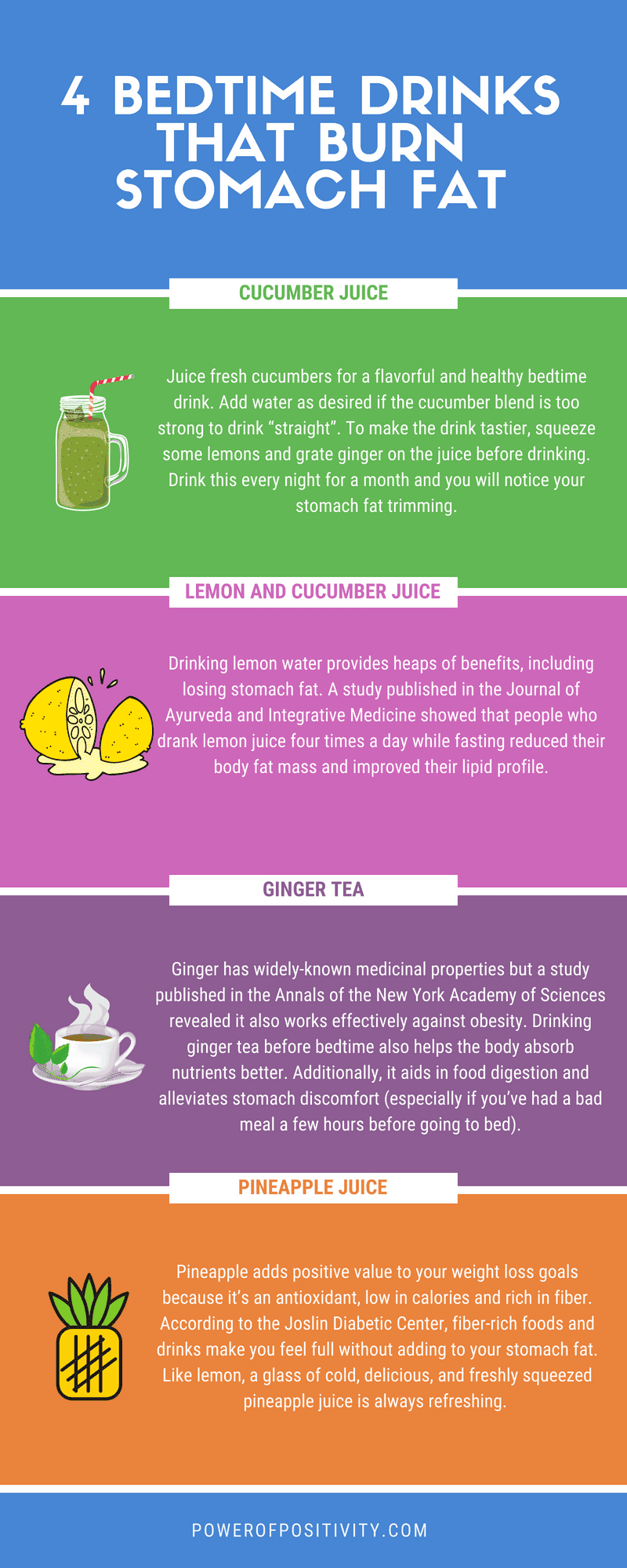
bedtime drinks to burn stomach fat

9. Nuts or Cottage Cheese

Before hitting the hay, make sure to have a small, protein-rich snack, such as some cottage cheese or some nuts. Both contain a good dose of amino acids and magnesium, which will encourage a deeper sleep throughout the night.

A good night’s sleep is critical to balancing hormones, particularly cortisol, estrogen, and progesterone.

10. Vitamin-D

Vitamin D deficiency is very common in developed countries, including the United States and Canada. Healthy Vit-D levels aid healthy hormone production and maintenance.

There are plenty of foods rich in vitamin D, including fatty fish, dairy, orange juice, soy milk, cheese, and egg yolks.

5 Signs You’ve Found True Love, Not Just Attraction

Attraction and love are two very different things. And, believe it or not, it isn’t always apparent to someone when they love another. Is it love – or something else? Are they a crush? A fling? What are the signs?

The typical answer to all of the above questions: “You know when you know.” The problem is that this answer, though quaint, is– categorically untrue – at least for some of us. The main reason for this is – and this is a crucial point – that “people vary in the extent to which they know and can distinguish between their own emotions.”

The question then becomes: “How do I know if what I’m feeling is love – or something else?” Enter our old, and (mostly) reliable friend, science.

Loads of research on love and relationships helps provide a “science-y” glimpse into what distinguishes love and “other emotions” – like attraction – for some of us.

So, what does the science say about what separates love from “other stuff”?

Here are five signs that you’ve found that special someone – and not just “eye candy”:

“Where there is love, there is life.” ~ Gandhi

1. You’re Always Looking At Their Face or In Their Eyes

Eye gaze is a powerful indication of romantic feelings and principal differentiator between lust and love. When in love, experimental studies demonstrate that one’s visual attention focuses more on the other person’s facial features – including the eyes.

Meanwhile, someone in the clutches of lust focuses their gaze toward the body – which is unsurprising given that “body-gazing” dominates visual attention both before and during sexual intercourse.

love

2. You Willingly Make Sacrifices for the One You Love

When in love with someone, we’re all too willing to help at “the drop of a hat.” Personal sacrifice and love are often integral components of a couple happily in love.

Psychologists call these sacrifices “costly commitment signals,” defined as “behaviors that require substantial sacrifice, perhaps in time, emotions, or financial resources – e.g., driving a partner to an appointment or giving a gift.”

In contrast, the lack or absence of “commitment signals” in a relationship is an indication or either (a) lust, or (b) apathy. Either way, love is almost certainly not present.

3. You Replace “I” or “Me” With “We” or “Our”

The words one uses when describing a mutually-affective situation is typically an accurate gauge of how they feel towards that person. So, if you’re unsure about how someone feels about you, pay attention to their words – particularly words and phrases they tend to repeat.

Getting a bit more language-specific, plural words such as “we,” “us,” or “our” tend to be used more with someone we love. Singular words like “I” or “me” are generally used less. Context matters in such situations, however. You’ll notice that these words are often used scenarios involving resources (e.g., “our stuff,” “we bought,” etc.)

For example, a man in falling in love might catch himself using the words “our apartment” as opposed to “my apartment” as the relationship with his girlfriend progressed.

4. Love Means You’re Okay With Some Dependency

Before we delve into the fourth sign – here’s a caveat: personality matters, a lot.

We’re all familiar with two general personality types: introversion and extroversion; the former requires much more alone time than the latter, even in romantic relationships. (However, both typically need less alone time before experiencing love.)

Such “qualifiers” aside, evidence shows that people who are “highly motivated to increase closeness – like those who are in love – no longer hold negative views of dependence when it comes to their love interest.”

love

5. You Find Yourself Missing This Person

Helen Fisher, a renowned relationship expert, states that love – at its core – is a biochemical experience; that is, the brain’s reward system activates as it does when doing something highly pleasurable (e.g., consuming alcohol, working out, playing an enjoyable game.)

Physical attraction also promotes something that psychologists call pair bonding, or, as biologists define it: “the strong affinity that develops between a pair consisting of a male and female, or in some cases as a same-sex pairing, potentially leading to producing offspring and/or a lifelong bond.”

8 Signs Someone Is Trying to Compete With You

Mounting an argument against the effectiveness of healthy competition is challenging. A competitive mindset fuels personal and collective advancement and achievement. It is especially healthy to compete when we seek to improve ourselves.

The problem is that so many of us compare ourselves to someone else. Naturally, if we don’t measure up to someone, we may (sometimes, subconsciously), initiate an unhealthy duel – otherwise known as a “competition.” Or, more accurately, unhealthy competition.

Corporate America is notorious for establishing a cut-throat, war-like environment of competition. Some primary and secondary schools also do this, albeit to a (hopefully) lesser extent.

The big question: does this sort of competition help people thrive?

Amy C. Edmondson, a writer for Harvard Business Review, says that organizations often ignorantly send the wrong message, hence nullifying any supposed “gains”:

“The explicit (and intended) message (of highly competitive environments) is that hard work is needed to be successful here. The implicit (and perhaps unintended) message is that your success occurs when others fail. In a competition, others must lose if you are to win…Self-preservation is a powerful force.”

In a team-based yet individualistically-competitive environment writes Edmondson. “…it’s natural to withhold information that might help others, or fail to help when help may be needed. Clearly, the message (discourages) teamwork. It’s hard to collaborate if you view (consciously or not) your colleague as the competition…”

In essence, what’s the use of individual competition if it thwarts teamwork – and team productivity?

When Competition Gets Personal

If you achieve a modicum of success in anything, you become a target for competition.

People express (or not) these oppositional attitudes in different ways. You may not know someone is competing with you. On the other hand, others (out of immaturity) go out of their way to let you know they’re coming for you. Should the former occur, no big deal and zero harm done. The latter scenario, however, can create a hostile environment – and things can quickly turn bad.

In such cases, knowing when a person is “gunning” for you is beneficial. With the knowledge, you can avoid, disengage, and/or report them (e.g., in a work environment.)

With that said, here are 8 signs someone is trying to compete with you:

“I’m not in competition with anybody but myself. My goal is to beat my last performance.” ~ Celine Dion

1. They’re boastful

A rival will often exaggerate their capabilities, achievements, and talents. Unsurprisingly, they are more likely to boast when you are earning recognition for your hard-won successes. These exaggerations occur for one reason: their own insecurities.

2. They modulate your success

There are few things worse in this world than a sore loser. People who disregard or downplay the successes of others are as toxic as they are annoying. People who envy you the most are the ones who most desire what you possess. With this in mind, it is in your best interest to just avoid such people.

3. They gossip

“Tom’s really not that great a salesman,” “Anne really isn’t that smart,” or similar sentiments (names and job titles interchangeable!) are expressed by those who are engaged in unhealthy competition with someone else. Engaging in gossip is an act of immaturity – and should be dealt with.

compete with you

4. They always want to know how you’re doing

No, they don’t care about your success in this case. While they may approach you with a smile – perhaps even engage in a bit of playful banter – it’s a front to achieve one thing: to find out how they’re measuring up. Watch their expression quickly turn to sour grapes upon hearing anything they perceive as self-defeating (a.k.a., your successes.)

5. They celebrate your failures

A person jealously competing with you gets pleasure from your “failures.” The only thing worse than deviously celebrating your setbacks?

When that same someone talks about them behind your back – which they probably will, and then denies having done so – which they probably will.

6. They imitate you

Someone who competes with you on an unhealthy level strongly desires to be “equal to” or “better” than you. You may notice them walking, talking, and even (creepily) dressing like you. ‘

There’s one caveat, and it involves role models. We will naturally imitate those who we respect – and there’s nothing wrong with this. The difference? Well, we don’t gossip about or attempt to sabotage a role model.

7. They heap false praise

There are few things better than a well-timed compliment. There are few things worse than continuous, false praise. When someone is competing with you out of hostility, they will instead annoy you with disingenuous compliments instead of owning their displeasure. Classy, right?

8. They engage in sabotage

In a worst-case scenario, a person can become so jealous of your apparent successes that they scheme ways of discrediting your hard work and smearing your good name. Such behavior is inexcusable; the sooner you confront the situation for correction, the better.

Therapist Explains What Children Worry About, According to Their Age

We, adults, aren’t the only ones who struggle with fear and worry – children do, too. Therapists say that child concerns tend to differ according to age groups or stages of development.

Why Do Kids Worry?

As any parent can attest, children vary in temperament. Some babies are more relaxed, while others are more anxious; some are criers, some are not, and so on.

Anxiety is only an issue if it interferes with a child’s cognitive, emotional, or social development. (It can be hard to detect this behavior, so if you notice subtle clues, seek the expertise of a psychologist or doctor.)

Come to think of it, why do children worry, anyway? It’s the most straightforward time of life. It’s all brain-related, folks.
(And think about it, did things seem all that simple when you were a kid?)

Short and sweet, children are anxious because of the pace at which their brain develops. During this time, the child is absorbing – and trying to interpret – a vast amount of external stimuli, i.e., the environment of people, places, and things.

To complicate matters, the ability to cope with anxiety and worry doesn’t develop until after adolescence. This is why a child – even a teenager – may throw a tantrum because they feel the frustration of not being understood.

In short, fear of the unknown is a natural part of growing up. It is hardwired into a primitive part of the brain called the amygdala. The brain also grows faster from age 0 to 6 than at any time in life, which is a double-whammy for anxiety.

golden child

What Do Kids Worry About?

A child doesn’t begin expressing thoughts and feelings until age three. Usually, it isn’t until around the age of eight that they can do so with some coherence. So, it’s natural to be curious about what’s worrying your kid!
(Just try not to over-worry, hard as that may be.)

Important note: If you suspect that your child’s anxiety may be interfering with their cognitive, emotional, or social development – a potential psychological disorder – please seek the advice of a child psychologist or therapist.

List of Worries (and the Why Behind Them!)

Infants and toddlers (0-2 years)

  • Being separated from their parents.

Here’s why: Until around eight to ten months, babies believe that what is temporarily gone vanishes. For example, when you leave the room, your golden child thinks you’re gone forever! Then, they wise up to the fact that you’re somewhere – and begin to feel the fear of separation. They love you, after all!

  • Loud noises

Here’s why: The baby brain is super sensitive to information (and sensory) overload. A loud noise (or ‘startling’ sensation) will send their delicate brain into high alert.

  • External ‘Locus of Control’

Here’s why: When your little one begins taking their first steps (a beautiful thing!), they start to feel independence! They feel an ever-increasing need for control over their environment. Anything that seems outside of their control (say, a honking car or burst of thunder) can seem frightening.

things kids worry about

Preschool/Kindergarten (3-5 years)

  • Fear of the dark/being alone at night

Here’s why: Preschool-aged kids have difficulty separating fantasy from reality (do you see all these Batman and Superman costumes?) Anyways, if a child associates darkness with something scary, they’ll likely come crawling into your room at night.

  • People in costume (Santa, the Easter Bunny, etc.)

Here’s why: If there’s a common theme developing, it’s this: kids aren’t comfortable with the unfamiliar. A large man in a red costume, bushy white beard, and a weird-looking red hat isn’t going to impress them much. They’ll probably not like it … at all.

Fast Forwarding to 6-11 Years Old

Fear of strangers, the dark, being alone, and other things outside of their control pretty much dominate your child’s worries until age 6 or 7. Then, kids start fearing these things until around age 11 or 12:

  • Being home alone

Here’s why: While much older by comparison, young kids still question their ability to cope in an uncertain world without their Mom or Pop. The wonderfully vivid imagination may creep around the corner (*pun intended*).

  • Being rejected

Here’s why: Kids are coming to grips with the fact that it’s a big world out there – and they’re worried. Deeply entrenched in our subconscious is the knowledge that we’re, by nature, social animals. Rejection by one’s kind is rarely a welcome (or healthy) development.

  • Something bad happening to those they care about

Here’s why: Kids start to understand – at some level – that death is inevitable. As such, they may begin to ponder something serious happening to someone or something (a pet, for example) that they love.

children worry

Adolescents (Ages 12 and up)

  • Their image

Here’s why: Adolescence is when we ask, “Who am I, and what am I doing here?” At this age, kids begin to fully grasp the importance of social interactions as they transition from a family-based support system to a peer-based one.

  • Their grades or performance

Here’s why: Adolescents begin to comprehend the consequences of failure, which may breed fear. Achievement-oriented kids will especially be hard on themselves following a bad exam score or poor outing on the playing field.

  • Opening up to you

Here’s why: As mentioned, adolescents understand – at least to some degree – the importance of establishing independence. Combine this knowledge with the fact that adolescence can be downright unforgiving (thanks, hormones!), and you may have a child in conflict with themselves.

Of course, the best thing we can do as parents is to reassure them that we are always there for them calmly. No matter what.

Researchers Reveal Why Loneliness Is Dangerous To Your Health

From victims of the Syrian conflict to the issue of depression facing her constituents, Jo Cox was a warrior. Mrs. Cox worked on a project to combat loneliness – one of the most significant sources of depression – until her death in June of 2016.

“Young or old, loneliness doesn’t discriminate.” ~ Jo Cox

Those who believe in Cox’s message – and there are many – have worked tirelessly to ensure that her death was not in vain.

As it so often happens after a senseless tragedy, people began to pay more attention to the message: Loneliness – and the mental illnesses that it so often produces – is unacceptable; and something that is easily solvable.

A non-profit organization was set up in Mrs. Cox’s name – and immediately garnered support from institutions such as the Red Cross and Alzheimer’s Society. Foundations focusing on the protection of children and care for the elderly also joined the Jo Cox Commission on Loneliness.

New Research on The Hazards of Loneliness

The conclusions reached by various research studies on the effects of loneliness and social isolation are both astounding and deeply troubling.

Studies from Brigham Young University (BYU) show that being lonely for long periods can up your risk of dying before your time up to 50%…

While the terms loneliness and social isolation are often associated with one another, there are differences between the two that are worth mentioning.

Social isolation is “defined as a lack of contact with other individuals; whereas loneliness is the perception that one is isolated from other people.

In short, a person can be in the presence of others and feel isolated.

According to a survey by the AARP, about 35 percent of U.S. adults older than 45 can be classified as lonely – or about 30 million people.

alone

Research shows a direct relationship between loneliness and social isolation and poor health. Per multiple studies, including by the medical school at Harvard University, loneliness increases the risk of Alzheimer’s by as much as eight-fold.

Nancy J. Donovan, the study’s co-author and professor at Harvard Medical School, reported in the Journal of the American Medical Association: Psychiatry, that loneliness carries “an increased risk of depression, heart disease, and stroke.

Here are some other eye-opening findings on the devastating effects of loneliness and social isolation:

– The effects of loneliness and social isolation may kill more people than obesity.
– The effects of loneliness and social isolation is more damaging to health than smoking 15 cigarettes a day.

From Politics to Prison

While personality has much to do with one’s degree of need for social contact, nearly every authority on the human condition agrees on one thing: the vast majority of humans require some degree of human interaction.

Perhaps no research proves the above point more so than studies regarding solitary confinement – a method of punishment that isolates prisoners in separate cells. Regardless of how one feels about the practice – which is becoming increasingly common for non-violent offenders –studies are clear about the psychological harm that the punishment inflicts. Here’s how Scientific American describes it:

“(Research) has documented several cases of individuals with no prior history of mental illness who nonetheless developed paranoid psychosis requiring medical treatment after prolonged solitary confinement.”

No One Should Be Alone

As of December 2017 there are an estimated 7.6 billion people living on Planet Earth. Since the dawn of humankind, we’ve depended on each other for friendship, love, and support.

We are social animals. Social isolation and loneliness’s damage remains thoroughly researched, documented, and validated.

Each of us has a part to play in combating loneliness – starting with our children and senior citizens.

Here are some questions we can all ask ourselves:

  • Should I call or visit a lonely person? (Parents, grandparents?)
  • Do I try to help those “cut off” from society? (The homeless, the drug-addicted, orphaned?)

We leave you with this quote from novelist Herman Melville: “We cannot live only for ourselves. A thousand fibers connect us with our fellow men; among those fibers, as sympathetic threads, our actions run as causes and come back to us as effects.”

Relationship Experts Explain 6 Words To Never Forget During An Argument

Brene Brown’s TED talk presentation on “The power of vulnerability” is one of the top five most popular with just over 33 million views. Why has Brown’s TED Talk become so widespread? As it turns out, human beings – as deeply social creatures, are always searching for a way to improve their relationships. (Who knew, right? **Sarcasm**)

“So very quickly – really about six weeks into this research – I ran into this unnamed thing that absolutely unraveled (human) connection in a way that I didn’t understand or had never seen.”

At the very beginning of the presentation, Brown flashes a slide with the quote “If you can’t measure it, it doesn’t exist.”

Brown, being a social worker – a profession that, according to her, lives by the mantra “Lean into the discomfort of the work,” saw this research-based approach to analyzing and measuring the complexity of human interaction a fascinating draw. She wanted to know why a human connection is– at times – an arduous path.

Connection is why we’re all here. It’s what gives meaning and purpose to our lives. This is what it’s all about.” ~ Brene Brown

The One Variable

Brown spent six years “trying to deconstruct shame” and vulnerability. She explains the process – and her eventual discovery:

“My one year turned into six years: Thousands of stories, hundreds of long interviews, focus groups … people were sending me journal pages and sending me their stories – thousands of pieces of data in six years … I wrote a book, I published a theory, but something was not okay.”

This setback of her life’s work – of “something not okay” – led the way to her most important discovery.

“There was only one variable that separated the people who have a strong sense of love and belonging and the people who really struggle for it. And that was, the people who have a strong sense of love and belonging believe they’re worthy of love and belonging.”

This absence of “love and belonging” manifests into loneliness, social ineptitude, and conflict, with plenty of arguments along the way.

“The Courage to Be Imperfect”

Midway through her TED Talk, Brown made an additional discovery: people who have a strong sense of compassion, love, and empathy have “the courage to be imperfect.” Deep connections with other people will always prove much more challenging without the ability to make yourself somewhat comfortable with vulnerability.

This courage to be imperfect also applies to how we treat ourselves – and, of course, our most intimate relationships.

authenticity

The Six Words

The ability to be vulnerable inevitably leads to conflict – both internally and with others. To avoid this “icky” feeling of vulnerability, we tell ourselves stories. We rationalize, we make excuses, and we catastrophize.

Here’s an all-too-common example:

We’re not feeling particularly good about how we look one morning. We take one look in the mirror and say to ourselves “Ew,” and ruminate about how “everyone” is going to think we’re ugly.

The story you just told yourself in this hypothetical scenario is B.S. The story that you just self-narrated is complete crap. And this crap not only affects you, but your relationships as well.

These negative affirmations will, whether we realize it or not, negatively impact nearly every interaction we have that day. As self-esteem suffers, our relationships suffer right along with it.

The problem: instead of saying “oh, what I’m thinking is B.S.” and just moving on, many of us continue to feel these feelings and think these thoughts.

The solution? Challenge the narrative. All it takes are six words:

“The story I’m making up is”….

Followed up by the reason for your anger in the first place. According to Dr. Brown, these six words can resolve almost any internal or external conflict. How? By accepting something that many of us shy away from: vulnerability.

Conflict-wise, it demonstrates your willingness to take responsibility for the part you played in the conflict. This action lowers the guard of the other person (and yourself) – a crucial component for easing the friction that accompanies disagreement.

Not only will these six words help resolve pretty much any conflict, but your self-esteem and outlook will also take a 180-degree turn.

According to Brown, it isn’t always easy to figure out what to say in the midst of a disagreement with yourself or others. This is where asking three fundamental questions may be able to help:

– What am I really feeling? What part did I play?

– What do I need to know about the others involved?

– What are the facts, and what are my assumptions?

Brown makes a poignant final point about an internal or external conflict in her book Rising Strong:

“…the good news is that we can rewrite these stories. We just have to be brave enough to reckon with our deepest emotions.”

May we all find the elusive, infinitely-powerful trait: courage. More specifically, the courage to be ourselves.

10 Signs You’re In A Relationship With A Control Freak

When we get into a relationship, we don’t always know the person we’re dating quite as well as we think. People tend not to show their toxic behavior immediately, which can leave us dating strangers. Some people get into a relationship to only later find out that they are dating a complete control freak.

Many of us visualize a controlling partner as one who openly berates everyone in their path, is physically aggressive, or constantly makes overt threats or ultimatums. Controlling people use a whole arsenal of tools in order to dominate their partners— whether they or their partners realize what’s happening or not,” says clinical psychologist Andrea Bonior, Ph.D.

Thankfully, there are early warning signs for you to keep an eye out for, just in case you feel that you have entered into a relationship with someone who is a control freak.

Here Are 10 Signs You’re In A Relationship With A Control Freak

“The scars from mental cruelty can be as deep and long-lasting as wounds from punches or slaps but are often not as obvious.” – Lundy Bancroft

control freak

1. They go through your phone

For most people, their phone is a pretty private place. However, when you’re in a relationship with a control freak, they may start snooping through your phone. Controlling partners feel that, “they have the right to know more than they actually do,” adds Bonior.

Even if you have nothing to hide, a control freak will want to know what you’re doing on your phone. They may look through your messages and apps. “It’s a violation of your privacy, hand-in-hand with the unsettling message that they have no interest in trusting you and instead want to take on a police-like presence within your relationship,” says Bonior.

2. They don’t like your friends

Control freaks want to maintain order and control in your relationship. Chances are, they don’t like the people you choose to hang out with.

It could be that he refuses to accompany you on group outings with your friends, or that he demands to know where and with whom you are at all times. One of the tell-tale signs that he’s slowly cutting you off from your friends is his readiness to bad-mouth them,” say authors Julie Fishman and Meagan McCrary.

They don’t like your friends, and they don’t hesitate to let you know, even going so far as complaining when you hang out with them.

3. They don’t like when you make decisions

If your partner had ever gotten upset with you when you didn’t consult them before making a decision, you’re likely dating a control freak. They don’t like when you do things without them, and they tend to become upset when you exercise any free will on your own.

4. They’re always telling you what to do

A control freak will often offer advice even when you didn’t ask for it. Worse, they will most likely get upset with you if you don’t follow their advice.

Often under the guise of wanting to help you — whether it’s to improve an area of your life or to keep you from embarrassing yourself — men who find a way of criticizing your behavior and choices are flexing their control muscle,” add authors Fishman and McCrary.

Because they need to control everything, they will want to control everything you do, too. If your partner is constantly telling you what to do, be aware: they are a control freak.

walking away from people

5. They accuse you of lying

Even if you’ve never lied to them before, if your partner is paranoid that you’re always lying to them, it’s possible they’re a control freak. They accuse you of lying about where you’ve been, who you’re hanging out with, and who you’ve been talking to. Nothing ever seems like the truth to them.

6. They have high expectations

Having expectations in a relationship is pretty normal, but a control freak’s expectations are going to be out of this world. You probably won’t be able to please them no matter how hard you try. They’re also always shifting the goalposts to keep you on your toes.

7. They’re jealous

If your partner tends to get extremely jealous when you hang out with friends or your family, then it’s a sign that they are a control freak. “A little jealousy in a relationship isn’t necessarily bad; as a matter of fact, it can be sexy. However, when a man is controlling, his jealousy triggers fits of rage,” adds author Sujeiry Gonzalez.

Jealousy is a normal part of life, but control freaks take it to the extreme. You may notice that your partner gets angry with you when you spend time with someone else rather than them.

8. They want your passwords

The control freak will always want access to your phone, to your computer, to your Facebook … anything that you could keep them out of. They may try to pass this off as proving that you are trustworthy, but it is really to ensure they have complete control over you and your online activities.

9. You are never good enough

To a control freak, you can always use improvement. They constantly try to change you and make you into something you’re not. A control freak will want to control your personality and change it into something that they can keep control over.

This creates a dynamic where you will be more willing to work harder and harder to keep them and make them happy—a dream for someone who wants to dominate a relationship,” adds Bonior.

10. They need to know everything

What are you doing today? Where are you going? Who are you going to be with? When are you leaving? When will you be back? These are normal questions that the control freak will want to know every single time you leave. They need to know everything and become very upset if you don’t answer sufficiently.

Whether they keep their snooping secret or openly demand that you must share everything with them, it is a violation of boundaries from the get-go,” says Bonior.

Here Are 3 Ways To Deal With A Control Freak

Being in a relationship with a control freak can be very unsettling. Often times, the relationship isn’t healthy at all. So, what should you do if your relationship shows all of these signs?

1. Assert your boundaries

You are your person who deserves to have privacy. If there’s no reason for them to distrust you, then you should ensure that your boundaries are fully asserted. You may need to constantly remind the controller about your boundaries several times before they get out of the habit of controlling you.

Repetition is key. Don’t expect instant miracles. Since controllers rarely give up easily, be patient. Respectfully reiterating your stance over days or weeks will slowly recondition negative communication patterns and redefine the terms of the relationship,” says assistant clinical professor of psychiatry and author, Judith Orloff MD.

You don’t need to tell them every single thing that you’re doing. You don’t need to tolerate any behavior that seems to be controlling. Make your boundaries very clear, and if they can’t respect them, then it’s time to cut them off.

2. Have a support system

Tell your friends and family that the controlling behavior is happening. It’s important to have people outside of your relationship know that these things are happening so that they can support you. Make sure that there’s someone else who knows about your partner’s control freak behavior.

3. Leave

A control freak is not in a healthy place to have a relationship, and you deserve someone who trusts you and doesn’t try to control your every move.

Look to your friends, family or co-workers for support during this time. The controller does not define you and will do their best to diminish your self-worth during this process. Letting go of any power they have over you will only enhance your life, and the empty space they leave can be filled with someone who matters,” concludes art licensing agent and illustrator, Kimberly Montgomery.

Asserting your boundaries and having a support system will make it easier for you to safely leave your partner when the controlling behavior starts.

Skip to content