Weekly tips, affirmations, and small actions to feel your best.

4 Behaviors That Help Introverts Reverse Social Anxiety

“Everyone shines, given the right lighting.” – Susan Cain

Social lives are important to each individual person. They’re how we connect with other people and create and build friendships, as well as expand our horizons. Most people learn how to socialize at a young age, and are quite good at it. Other people become social butterflies, and go above and beyond in terms of socializing. However, there are a few people who don’t socialize well and don’t know much in terms of fixing that.

Those who have a hard time socializing tend to run into the issues of having trouble maintaining friendships and fostering good relationships with other people. Social introverts tend to lack confidence (because they’re constantly worried about other people’s perception), which makes it hard for them to take the plunge and interact with people without feeling self-conscious and coming off as awkward.

On the other hand, “many times, people confuse introversion with being anxious, depressed, antisocial, or not fun, and that is not at all true. One of the biggest challenges with being an introvert is trying to control other people’s perception, which isn’t always easy…” says Tyler Turk, CEO and Founder of Crated With Love.

The best way to turn that around is for social introverts to find ways to gain their confidence again. It’s possible!

Here Are 4 Behaviors That Help Introverts Reverse Social Anxiety

1. Ask friends for help

Even the most socially awkward people tend to have one or two good friends who will be willing to help them get out of their comfort zone and learn how to socialize. Friends can point out where you need help in certain social areas – if you’re feeling too awkward talking to other people, or your jokes tend to fall flat, or if you just have a hard time getting out of your house during the week.

By understanding the world of the extrovert, you can be more mindful of their social needs. It can be a difficult needle to thread, but work on developing personal strategies that don’t exhaust you but also don’t result in you being perceived as rude,” says Dr. Alice Boyes.

Whatever you need, friends are a great way to help point out what areas need work and help you build up your confidence without judgement.

2. Don’t give up

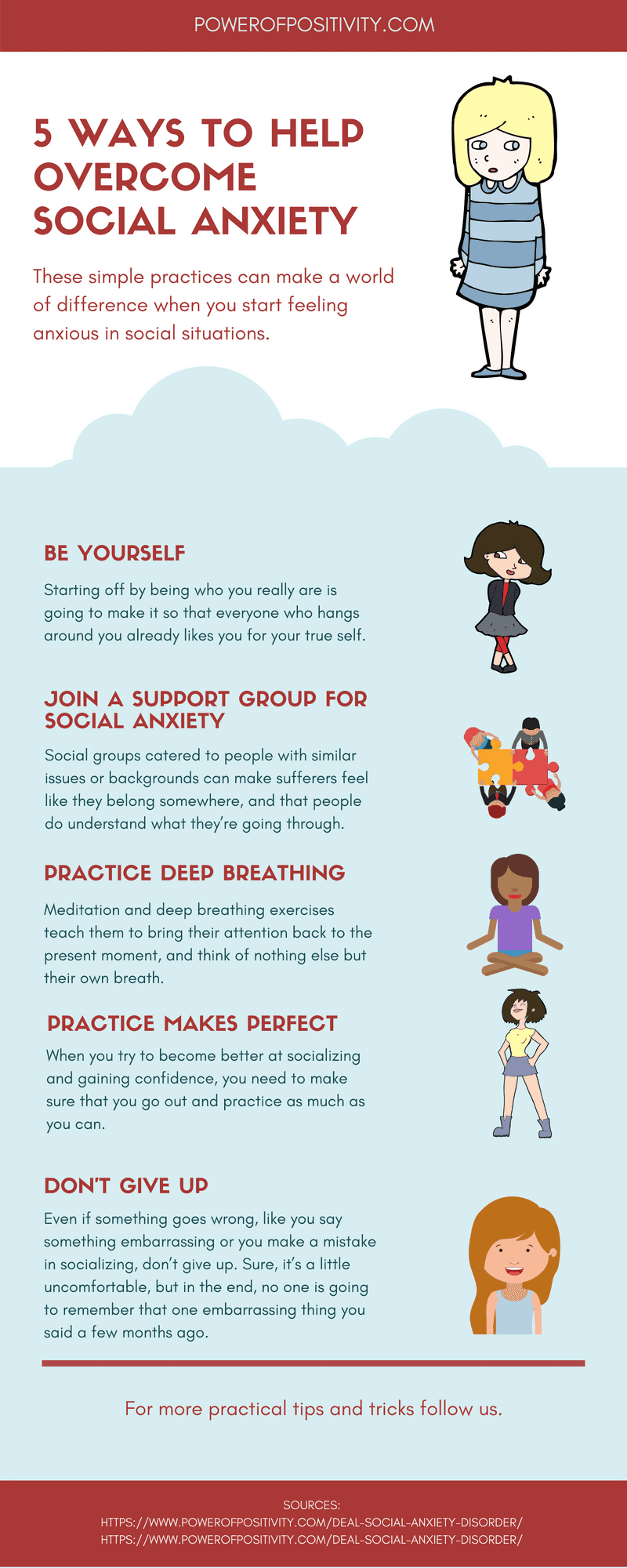
Even if something goes wrong, like you say something embarrassing or you make a mistake in socializing, don’t give up. Sure, it’s a little uncomfortable, but in the end, no one is going to remember that one embarrassing thing you said a few months ago.

Everyone has times in their lives where they embarrass themselves. If you give up trying to socialize just because one thing went wrong, you’ll never gain your confidence back. “Decide that becoming confident is a priority for you and realize that building confidence will require you to step outside of your comfort zone,” says author Joanna L K Moore.

Take a deep breath and roll with the punches, because people will always remember the good things more than they will the bad.

3. Be yourself

This one might seem like a no brainer, but being yourself is actually the most important thing when it comes to being confident and gaining a bit of social skill. If you try to be someone else, you’re only going to feel comfortable when you have that mask on.

You’re probably more focused on the perceived downsides to being an introvert, so find out why it’s good to be an introvert. There is usually a positive and a negative side to any personality trait, so look for the positive ones,” adds Moore.

Starting off by being who you really are is going to make it so that everyone who hangs around you already likes you for your true self. Plus, you won’t have to be pretend to be someone else and mess up. You’ll always find people who like you for who you are, and those are the people that will give you the confidence you need to be social.

4. Practice makes perfect

When you try to become better at socializing and gaining confidence, you need to make sure that you go out and practice as much as you can. Take a friend to help you so that you don’t feel pressured to talk to too many new people at once. But, if you go out to a bar or a social event of some kind, practicing your new social skills will make it easier and easier.

The easier it is to be social, the more confident that you feel. It’s kind of a feedback loop – when you’re not good at socializing, you don’t feel confident, and if you don’t feel confident, you don’t get better at socializing. Practice does, in fact, make perfect, and the more you socialize the more confident you’ll feel.

introvert-extrovert

Final thoughts

Social introversion can cause a lot of problems in someone’s life, especially if they lack confidence, but the best thing is knowing that it doesn’t have to be this way. Confidence is something that everyone can learn, even if it doesn’t feel like it! Once you learn confidence, being more social comes right along with it.

Being an introvert in an extroverted world can be hard enough without struggling with shyness, too. But it is very possible to become a confident introvert. And as you accept your introversion, as well as the other parts of yourself, the confidence will come and your shyness will subside. You will become a confident introvert,” concludes Moore. Don’t let yourself give up.

overcome social anxiety tips

Share this Image On Your Site

(C)Power of Positivity, LLC. All rights reserved
References:
https://www.bustle.com/articles/183583-9-dating-tips-for-introverts-according-to-experts
https://www.psychologytoday.com/blog/in-practice/201302/4-social-tips-introverts
https://introvertspring.com/build-confidence-shy-introvert/

8 Behaviors That Reveal Someone Is Cold Hearted

What does it mean to have a ‘cold heart’? Usually, a ‘cold heart’ describes someone emotionally unavailable. They are not warm or loving type of people.

“…I perceive so-called “cold people” as, more than anything else, people who are shut-down, repressed, and out of touch with their deeper feelings. Further, emotionally alienated from themselves, they can hardly be expected to express to others feelings that they themselves are unable to access,” says clinical psychologist and author, Leon F. Seltzer, Ph.D.

Getting involved with someone with a ‘cold heart’ can often lead to heartbreak for the individual in question. However, people with ‘cold hearts’ have certain behaviors that make them easy to spot.

“A person with a cold heart can only show their love by being cold.” – PureDragonWolf

Here Are 8 Behaviors That Reveal Someone Has A ‘Cold Heart’

loved

1. They don’t ask you about yourself

A cold-hearted person doesn’t often show much interest in the person they’re with. Whether the relationship is romantic or platonic, a cold-hearted person has very little interest in other people. They won’t ask you questions about yourself. Or, if they do, it’s to learn information that is useful to them in some way.

2. Someone with a cold heart seems distant

Not just physically but emotionally. It may seem like they’re never really “all there” when you’re having a conversation. They keep a lot of their feelings to themselves. Someone with a ‘cold heart’ rarely ever opens up about their emotional vulnerabilities. They keep their distance, no matter what.

3. Something is always ‘missing’

You can’t connect with a person who has a cold heart. When you’re with them, it may always feel like a piece of something ‘missing’ from the relationship. Whether the relationship is romantic, platonic, or familial, a cold-hearted person will always have difficulty connecting with the people in their life. Something is ‘missing’, and it’s usually an emotional connection.

4. A person with a cold heart can be manipulative

Someone with a ‘cold heart’ will often try to control the people around them through manipulation. This is because they often lack empathy for other people. “Manipulators often voice assumptions about your intentions or beliefs and then react to them as if they were true in order to justify their feelings or actions, all the while denying what you say in the conversation,” says Darlene Lancer, JD, MFT.

A cold-hearted person will try to manipulate everyone around them. They may try to get close to people and find out information that is useful to them. They will often have skeletons in their closets and a list of people they have manipulated for one reason or another.

5. Someone with a cold heart struggles to maintain good relationships

Someone with a ‘cold heart’ will have no good relationships in the past. “Emotionally unavailable people see a relationship as a source of comfort — something to occupy their time until something better comes along,” says author and relationship expert Sarah Rusca Cline.

They may often characterize their ex-partners as “crazy.” They have a string of bad relationships left in their wake or can’t seem to settle down with one person. They also may have a disconnect from their family. A person with a ‘cold heart’ is also not likely to have very many close friends, either. Keep an eye out for this person’s past and present relationships.

cold heart

6. Self-centered

Me, me, me. Someone with a cooler demeanor will often be focused on how everything affects them – even when it doesn’t. “Unconsciously viewing others as “extensions” of themselves, they regard them as existing primarily to serve their own needs—just as they routinely put their needs before everyone else’s…” says Dr. Seltzer

They tend to be incredibly self-centered. This behavior manifests in playing the victim or trying to one-up someone. If you get a promotion, a cold-hearted person will somehow be able to make it about them. They might say they got a better promotion (even if they didn’t).

7. Lying

Lying is a behavior to watch out for when it comes to someone with a ‘cold heart.’ A lie is a part of manipulation, which a cold-hearted person uses to control the people around them. They may lie about things that don’t really matter, like what they did that day, or what school they went to. A cold-hearted person may also lie about big things.

Usually, someone with a ‘cold heart’ will lie about their past relationships, or any falling out with friends.  “…you’ll see a history of his fabricated storytelling and wonder to yourself how you could have ever believed some of those absurd lies in the first place,” says divorce recovery coach Cindy Holbrook. They lie to make themselves seem more sympathetic.

8. A person with a cold heart will often treat others poorly

Someone with a ‘cold heart’ will often show their hand. “They exhibit a constant need to talk about (display) themselves in flattering and egotistical ways, with frequent reminders of their superior and envy-worthy dispositions,” says professor, author, and private coach, Preston Ni.

In this case, keep an eye out for how they treat people they deem ‘beneath’ them in the social hierarchy. How they treat anyone in the service industry should be observed closely. You should also keep an eye out for how they treat homeless people. A person with a cold heart won’t have the empathy to treat these people as human beings worthy of respect.

What Causes Someone to Have a Cold Heart?

A person can have a distant or cold heart for various reasons, including:

  • Past experiences: Traumatic events or negative experiences in childhood or adulthood can lead to emotional distance or coldness as a way of protecting oneself.
  • Childhood trauma or neglect: Childhood experiences such as abuse, neglect, or trauma can significantly impact a person’s ability to form healthy relationships and connect emotionally with others.
  • Mental health conditions: Mental health conditions such as depression, anxiety, or borderline personality disorder can lead to a cold or distant demeanor as a defense mechanism.
  • Difficulty with emotions: Some people may struggle with regulating their emotions and may withdraw emotionally as a way of coping.
  • Lack of attachment or bonding experiences: People who have had limited positive attachments or bonding experiences early in life may find it difficult to connect emotionally with others.

Of course, everyone’s experiences and reasons for having a distant or cold heart are unique and complex. Working with a mental health professional to address these issues and develop healthier ways of coping and connecting with others can be helpful.

cold heart

Final Thoughts on Someone With a Cold Heart

Getting mixed up with someone with an aloof or distant demeanor can be taxing. However, knowing the signs will put you ahead of the game. Don’t be afraid to remove yourself from the life of a person who is cool as ice. Everyone deserves to have healthier and happier relationships than ones with cold-hearted people.


Therapist Explains How to Clear Your Sinuses Immediately In Just Two Steps

You hear the words sinus and sinuses often, but do you know what they are and what they do?

Interestingly, sinuses are literal air pockets behind the bones of your upper face, between your eyes, and behind your cheeks, nose and forehead. That’s right; sinuses are just air spaces in your skull and facial bones! In total, we have four paired cavities, or sinuses.

It’s what the sinuses do that is far more important. See, the sinuses make up the upper portion of the respiratory tract, extending from your nose all the way down into your throat. Our paranasal sinuses, or air cavities in the cranial bones near our nose, help to moisturize and filter air inhaled through the nasal passages.

In otherwords, these simple air cavities actively filter and remove particles from the air we breathe!

Sinus cavities also allow for voice intonation and resonance. When we’re sick, mucus builds up in these hollow areas, which is why we sometimes sound “stuffed up.” Also, sinus cavities lighten the total weight of that brain bucket known as a skull.

Why Do Sinuses Require “Clearing”?

No doubt you’ve had a cold before. If you’ve had a really bad one, then you know what a “stuffed up” head feels like (“terrible” or “miserable” would be an adequate description here.)

Why do you feel this way? Because the common cold, or cold virus, attacks the upper respiratory tract. Yeah, that’d be the same upper respiratory tract where your sinuses are located. Anyway, this attack causes your sinuses to swell and kicks mucus production into overdrive.

(Side note: Believe it or not, this icky mucus that is the bane of any cold sufferer is crucial to our health. While gross, mucus is actually a useful substance that destroys bacteria and viruses, traps loose particles, prevents water loss, and lubricates air passages among other functions.)

take care of yourself quote

Naturally Clearing Your Sinuses

While over-the-counter (OTC) medicines may help alleviate stuffed sinus passageways, they aren’t well-tolerated by everyone. Besides that, OTC meds may be entirely ineffective (it really just depends on how your body is reacting to the virus.)

Fortunately, the techniques we discuss for clearing your sinuses involves nothing but your fingers!

No more science-ey stuff!

Here’s not one, BUT TWO, ways of clearing your sinuses au naturale!

1. Acupressure

How to:

– Push your tongue flat against the top of your mouth.
– Press the fingers firmly against the brow between the eyebrows.
– Hold for 20 seconds before stopping.

You may feel some slight movement around the back of the throat, which is what you want. This shows that the mucus is softening and draining a bit. You may need to repeat this process several times throughout the duration of your illness.

2. Lymph node stimulation

How to:

– Using your fingertips, push firmly against the area of your collarbone where the notches are found.
– Interjoin your fingers in a “v” shape.
– Using the open area between the palms from the V-shape, perform a “pumping” motion on each side of the neck until you feel some drainage.

This method works by stimulating the lymphatic system, which creates a “suction” area around the lymph nodes. This suction effectively opens up the sinus passages immediately below your brow area. It isn’t uncommon to feel quick relief when this movement is performed correctly!

As with the first technique, you’ll likely need to perform this movement repeatedly until your illness passes. Hey, at least you’ll feel a heck of a lot better!

Sources:
http://healthnfitnessntips.blogspot.my/2017/07/how-to-clear-your-sinuses-in-seconds.html
https://en.wikipedia.org/wiki/Sinus_(anatomy)
https://owlcation.com/stem/Mucus-in-the-Human-Body
https://www.webmd.com/allergies/colds#1
https://www.webmd.com/allergies/features/causes-sinus-problems#1

7 Behaviors That Reveal Someone Is Silently Depressed

Do think you might be depressed?

Depression affects millions of people worldwide, and this number only seems to be growing. The World Health Organization puts the number of people who are depressed at around 280 million. However, this number only represents the people actually diagnosed. Those who suffer silently and choose not to get help out of embarrassment, shame, or pride might make that number jump significantly.

Maybe the person suffering doesn’t even know they have a problem, making silent depression even more dangerous. However, some people don’t know how to express their emotions or don’t feel comfortable doing so. This is why we all need to look out for the people in our lives and watch for the signs and behaviors that someone is silently depressed.

Here are 7 signs that someone might be silently depressed:

“People think depression is sadness., people think depression is crying, people think depression is dressing in black. But people are wrong. Depression is the constant feeling of being numb. Being numb to emotions, being numb to life. You wake up in the morning just to go back to bed again.” – Unknown

depressed person

1. Withdrawal from activities, work, or school

Withdrawal from activities is one of the key signs of depression; this occurs because the disorder takes up all of the person’s time and energy. Depression makes it very difficult to carry on with daily life, aside from what is absolutely necessary, because the pain becomes too great. Those who suffer silently might start dropping one or two activities from their schedule in hopes that no one will notice. Many who suffer don’t want to admit they have a problem and don’t want others to know about it.

If you notice that a loved one is starting to miss out on life, then this is a sign of silent depression.

2. No energy

No surprise here – depression zaps a person’s energy levels to the point where even getting out of bed can seem like running a marathon. The constant, intrusive thoughts of hopelessness and despair combined with high stress, poor appetite, and sleep troubles make life a daily battle. A person that suffers silently from depression might even start withdrawing from friendships and family life because they have no energy left for them.

3. Eating too much or too little

Increased or decreased appetite is a common symptom of depression. Gary Kennedy, MD, director of geriatric psychiatry at Montefiore Medical Center in Bronx, New York, says, “A sudden change in weight, either gaining or losing, can be a warning of depression, especially in someone who has other symptoms of depression or a history of depression.”

If you notice unusual eating habits in a friend or loved one, they could be suffering silently from depression.

4. Trouble sleeping

According to WebMD, 80% of adults with depression have trouble falling or staying asleep. Patients who have chronic insomnia have three times the likelihood of developing depression compared to those without insomnia. Many doctors believe that treating insomnia will help reduce depressive symptoms in people suffering. If someone you know complains of sleep problems on a regular basis, he or she might have depression.

5. Substance abuse

Sadly, substance abuse is common among those with depression, anxiety, and other mental disorders. While it’s understandable to want to escape reality and troubled thoughts for a while, addiction can cause even more problems down the road. If you know someone abuses drugs or alcohol on a regular basis, they might be silently depressed.

6. Faking emotions

A lot of people with depression don’t want to admit it, either to themselves or others. When in others’ company, they will appear overly happy or give vague answers when people ask about how their life is going. They only engage in shallow conversation because they want to avoid judgment cast upon them about their depression. If you notice someone has become distant or only makes small talk, this might point to hidden depression.

7. They have become a workaholic

You might not think of overworking as a symptom of depression, but some people use work to cover up their emotions. They see work as an excuse to escape how they feel, a distraction for the torment that their mind causes them. If you notice someone staying late at work most nights of the week, they might actually be silently depressed and not just a workaholic.

depression

Final Thoughts on Depressed Feelings and How to Start to Heal

Depression seems like a monster in the minds of those who suffer from it. Of course, that makes it critical for them to get the help they need. If you notice someone showing any of the abovementioned signs, don’t hesitate to offer them a shoulder to cry on or an ear to listen. If we all look out for one another, we might just put the stigma surrounding depression to rest and make people feel more comfortable and willing to get the treatment they need.

Editorial note: Updated WHO statistics 09.06.2023, reflecting current published data on their website.

Researchers Reveal Why People With Brown Eyes Are Trusted More

The eyes have your attention from the moment you meet someone, but how much you are trusted may be as simple as being born with brown eyes. Research now reveals the reason behind our bias toward trusting brown-eyed people more than those with any other eye color.

Why we assess trustworthiness

Trust is huge when it comes to human daily social interactions. Whether or not we can extend our trust to share personal things about ourselves in conversation is something we assess in the first moments we meet another person. Will this individual be an ally or an enemy?

As our early human ancestors struggled for survival with limited food and resources, knowing who would help or hurt you could make the difference in being able to raise a future generation. Quick assessments of trustworthiness based on visible appearance were important to cave-dwelling warrior hunters, and snap judgments continue to be a social habit that we use in each interaction in modern society today.

But why would eye color affect whether or not we are trusted? If you yourself have a light eye color that was always previously complimented by others, do you now wonder if you are trusted less often than your dark-eyed peers or family members?

Here’s why people with brown eyes are trusted more

Researchers in an Australian study used personality questionnaires in their work, which revealed that dark eyed Northern Europeans are more agreeable and less competitive than their light-eyed counter parts. “The darker a North European’s eye color, the more likely they are to be altruistic, sympathetic to others and eager to help. Conversely, lighter eyed people are more likely to be observed as competitive, egocentric and skeptical of others intentions.” This bias toward brown-eyed people being trusted more may be simply a tendency toward being a more cooperative personality type than those who have light-colored eyes.

why people with brown eyes trusted more

Blue, brown, green and everywhere in between

It is noted from the moment we are born; eye color is one of the ways that government officials use to recognize distinguishing facial features. For example, they use eye color to identify us on state and federal photo ID cards and birth certificates.

In general, people with lighter colored eyes seem to be thought of as colder emotionally and less sociable than those with brown eyes. Blue and green are cooler colors compared with brown, which is a warm, earthy tone. People with lighter colored eyes are more genetically rare, so they tend to stand out, and as a result, they may be the victims of harmless staring.

Czechoslovakian researchers found that, although when surveyed, people rated brown-eyed people to be more trustworthy than other eye colors, but when pictures of faces were kept the same and only the eye color was changed, the level of trust was not different. Therefore, the researchers revealed in their conclusions that “the key to being perceived as trusting did not come from eye color but rather from facial characteristics that are shared by people with brown eyes.”

Men with brown eyes have a tendency to also have these facial traits:

• Wider chin shape
• Wider mouth
• Mouth has upward-pointing corners
• Wider, larger eyes
• More prominent eyebrows
• Eyebrows are closer together, may have connecting hair between brows

In general, the facial characteristics that were shared by men with brown eyes were considered to be more masculine and were rated more trustworthy.

The researchers note that people who have blue eyes share these common facial characteristics:

• Smaller eye size
• Eyes closer together
• Smaller mouth and lip size
• Mouth has downward-pointing corners

Cosmetic contact lenses might turn your blue, grey, hazel or green eyes brown, but it won’t likely make you trusted more. The lack of trust in light-eyed people seems likely due to a combination of competitive, dominant personality traits and smaller facial features that are less common among the larger population. We say love your eyes, no matter whether you are trusted, and see others with trust, the way you want to be seen.

https://youtu.be/4Zm8vwNCFmA

(C)Power of Positivity, LLC. All rights reserved
Sources:
https://www.medicalnewstoday.com/articles/254866.php
http://discoveryeye.org/20-facts-eye-color-and-blinking/
http://journals.plos.org/plosone/article?id=10.1371/journal.pone.0053285
https://s3.amazonaws.com/academia.edu.documents/32211994/Gardiner_Jackson__2010.pdf?AWSAccessKeyId=AKIAIWOWYYGZ2Y53UL3A&Expires=1520016596&Signature=ppOOPmRksZNSXA%2Bt2oaYr76CLoA%3D&response-content-disposition=inline%3B%20filename%3DEye_Color_Predicts_Disagreeableness_in_N.pdf

How to Make Cinnamon Turmeric Tea to Flush Inflammation Naturally

If you don’t already drink tea, you will probably want to after learning about the many benefits, especially when combined with cinnamon and turmeric to flush inflammation. These two ingredients, plus green tea make for a nutritionally powerful drink. It really tastes delicious! Below, we’ll go over the main health benefits of each ingredient first and then get into what you really want to know: how to make the tea!

Disclaimer: We suggest not combining turmeric with medications or other supplements that have an anticoagulant effect (blood thinners). Check with your doctor or pharmacist before you try any supplements.

Health benefits (besides lowering inflammation)

green tea

Green tea

Green tea’s powerful health benefits come from its high concentration of polyphenols – a potent antioxidant. This helps to neutralize free radicals (cell-damaging molecules) and fight chronic disease. With that said, green tea helps with the following:

– stabilizes blood sugar levels and prevents diabetes
– reduces inflammation in the gut that can cause diseases such as IBS or Crohn’s
– helps to prevent cancer
– lowers bad cholesterol and raises good cholesterol
– lowers the risk of heart disease
– improves liver health
– aids in weight loss
– reduces inflammation
– improves cognitive functioning

These are only a few of the many science-backed benefits of green tea. Still not convinced that you should drink it? Well, read on to learn about cinnamon’s and turmeric’s benefits!

Cinnamon

Astoundingly, researchers found that out of twenty-six of the most popular herbs and spices in the world, cinnamon comes in at #1 for its medicinal benefits and antioxidant levels! Here’s what cinnamon can do for your body:

– great source of manganese and calcium
– great source of antioxidants
– contains anti-inflammatory properties
– improves heart health
– fights diabetes
– protects brain function
– lowers cancer risk
– can fight allergies
– is a natural anti-fungal and anti-microbial agent
– boosts immune system

Turmeric

Turmeric has been used for over 4,000 years to treat various conditions. Studies show that turmeric may help fight infections and some cancers, reduce inflammation, and treat digestive problems. – University of Maryland Medical Center

Here are the six main benefits of turmeric:

– reduces inflammation
– reduces cancer risk
– aids digestion
– promotes brain and heart health
– helps to alleviate arthritis symptoms

Now that you know about these powerful natural ingredients, let’s learn how to make the tea!

How to make cinnamon turmeric iced tea to reduce inflammation:

joint inflammation

Ingredients

  • 1-2 Tbsp. black or green looseleaf tea (or a tea bag, depending on how you want to make it)
  • 1/4 tsp. cinnamon
  • 1/8 tsp. turmeric
  • 1 tsp.+ stevia, honey, or any type of sweetener you’d like
  • lemon slices, optional

Instructions – how to make inflammation lowering turmeric tea

  1. Add the tea, cinnamon, turmeric, and sweetener to the bottom of a french press. (Or, if using a tea bag, heat up a cup of water on the stove or microwave, and add the tea bag to the water. Let steep for a few minutes, then stir in other ingredients.)
  2. Add hot water to about the halfway point of the french press and let steep for 3-5 minutes, stirring once, then press. Let the mixture cool off, and then add ice cubes to your cup.
  3. Once it comes to room temperature, pour the tea into your mug and drink up! Don’t forget to add the lemon slice, if desired.

Sources:
BROOKS, M. (2014, APRIL 16). GREEN TEA’S IMPACT ON COGNITIVE FUNCTION NOW VISIBLE. RETRIEVED FROM HTTP://WWW.MEDSCAPE.COM/VIEWARTICLE/823690
UNIVERSITY OF MARYLAND MEDICAL CENTER. GREEN TEA. RETRIEVED FROM HTTP://UMM.EDU/HEALTH/MEDICAL/ALTMED/HERB/GREEN-TEA
https://www.umm.edu/health/medical/altmed/herb/turmeric

3 Signs Someone Is Suffering From Post Narcissist Stress Disorder (PNSD)

Much like Post Traumatic Stress Disorder, PNSD is a disorder that occurs after living with a narcissist. Living with a narcissist can be extremely taxing on a person. Narcissists tend to be extremely manipulative and abusive. They will often gaslight their victims and make everything about their feelings.

After getting free of a narcissist’s influence, people can often experience a period of helplessness, anxiety, anger, or depression, much like what happens after a traumatic event. People with PNSD react much like people who have PTSD. There are three significant signs for someone suffering from Post Narcissist Stress Disorder.

What Is Narcissism?

Narcissism is a term from Greek mythology, where Narcissus, a beautiful but vain youth, fell in love with his reflection in a pool of water. In modern psychology, narcissism is a personality disorder characterized by a grandiose sense of self-importance, a lack of empathy for others, and a need for admiration and attention.

A narcissist is someone who is preoccupied with themselves and their own needs. They may appear charming and charismatic, but a need for validation and attention drives their behavior. They have a distorted sense of self, seeing themselves as superior to others, and often believe they are entitled to special treatment.

pnsd

The Harmful Impact of a Narcissist Causes PNSD (Post Narcissistic Stress Disorder)

Narcissists can be difficult to deal with, both personally and professionally. Their behavior can harm those around them, causing emotional distress, interpersonal conflicts, and a range of other adverse outcomes.

Some of the ways that narcissists harm their victims include the following:

  • Emotional abuse: Narcissists may abuse emotionally by belittling, criticizing, and demeaning their victims. They may use tactics like gaslighting to manipulate the victim’s perception of reality and make them doubt their judgment.
  • Manipulation: Narcissists are skilled at manipulating others to get what they want. They may use flattery, lies, or threats to control their victims and get them to do their bidding.
  • Exploitation: Narcissists often see other people as objects to be used for their own benefit. They may exploit others financially, sexually, or in other ways.
  • Gaslighting: Narcissists may use gaslighting to make their victims doubt their memories and perceptions. They may deny events that occurred or distort them in a way that makes the victim feel like they are going crazy.
  • Isolation: Narcissists may isolate their victims from friends and family members, making them dependent on the narcissist for social support.
  • Blame-shifting: Narcissists often blame others for their problems and shortcomings. They may make their victims feel responsible for their own mistakes and failures, even when the victim had nothing to do with them.
  • Lack of empathy: Narcissists are often unable to empathize with others, making it difficult for them to understand or respond to the emotional needs of their victims.
  • Jealousy and envy: Narcissists may become envious of their victims, seeing them as a threat to their self-importance. They may sabotage the victim’s success or try to control their behavior to maintain their own sense of superiority.
  • Rage: Narcissists may become enraged when their sense of self-importance is challenged. They may lash out at their victims with verbal or physical abuse, or engage in passive-aggressive behavior to punish them.

Here Are 3 Signs Someone Is Suffering from Post Narcissist Stress Disorder

“Trauma is personal. It does not disappear if it is not validated. When it is ignored or invalidated the silent screams continue internally heard only by the one held captive.” – Danielle Bernock

1. Flashbacks can reveal PNSD

Much like PTSD, PNSD can also cause the survivor of the narcissist to have flashbacks to their time with them. This can happen for any reason. There are things called “triggers”, which can be any range of things. These triggers cause people to “flashback” to their time with the narcissist.

According to the Royal College of Psychiatrists Public Education Committee, “You find yourself re-living the event, again and again. This can happen both as a ‘flashback’ in the day and as nightmares when you are asleep. These can be so realistic that it feels as though you are living through the experience all over again.” Triggers can be certain smells, certain places, specific behavior, or even certain sounds or words.

Many people suffering from PNSD may have difficulty dealing with other people’s emotions because a narcissist will often fly into a rage at the drop of the hat. Someone suffering from PNSD may be triggered into a flashback when they perceive someone as being upset or angry with them. The survivor may also get flashbacks to periods of manipulation by the narcissist.

This may lead to extreme paranoia, where they wonder if the people around them are manipulating them. It may feel like they’re playing a game they can’t win, even if no one around them has an ulterior motive.

respect

2. Avoidance

Someone who is suffering from PNSD may become avoidant of any number of things. This avoidance may manifest in an avoidance of people, places, things, activities, or even emotions. Narcissists tend to control their victims, using manipulation and anger to keep someone under their control. Even once the survivor is free from the narcissist’s power, they may still exhibit PNSD in the form of avoidance.

Often, the survivor will avoid things that remind them of the narcissist’s anger or things they weren’t allowed to do while under the narcissist’s influence. They may also become emotionally avoidant. People who are victims of a narcissist will often be gaslighted into believing that their emotions are damaging to the narcissist. This may lead to someone with PNSD being distant from their emotions because they had to learn not to feel anything to survive the narcissist.

3. Difficulty returning to normal life

One of the major symptoms of both PTSD and PNSD is extreme difficulty returning to everyday life. For a person trying to return to day-to-day life after living with a narcissist, this may include anything from paranoia to panic attacks, to depression. Living with a narcissist can be extremely overwhelming, and someone who does so has to shift their expectations of day-to-day life.

They often have to learn to adapt to a “new normal.” Afterward, when they’re removed from the narcissist’s influence, the survivor may find it difficult to adjust to life again. They may have panic attacks or question their own memories and observations.

But there’s good news. According to Mayo Clinic, “Most people who go through traumatic events may have temporary difficulty adjusting and coping, but with time and good self-care, they usually get better.

How to Help Someone Suffering from PNSD

Knowing the symptoms of PNSD can be incredibly helpful, especially when trying to figure out what can be done to aid a narcissist survivor. Here are some ways to make a survivor’s life easier and help them transition from living with a narcissist to living their lives again.

1. Listen

Survivors will want to tell their truth as they remember it. Allow them to speak. Listen to them and validate what they’re saying. WikiHow states, “Use active listening. Don’t interrupt but try to repeat what you hear in order to make sure you understand. Let the conversation end if it becomes too intense.

Make sure they know that you hear them. It can be incredibly valuable to the healing process for a survivor to be heard.

2. Validate their emotions

They may be feeling all over the place, but the important part is they are feeling. Emotions aren’t “good” or “bad”. They’re neutral and important to our survival. If a survivor tells you that they’re feeling angry, or hurt, or afraid, listen to them. Then validate how they’re feeling. Even if the emotion isn’t appropriate for the situation, survivors often have to relearn how to use their emotions.

3. Support them

People who exit a relationship or living situation with a narcissist often have to build their support system from the ground up. “You can gently encourage and empower your loved one to start healing the rift by interacting with people and the world. Again, don’t push. Your loved one might resist, so simply promise to be there,” adds WikiHow.

Being there for them will mean more than you can imagine. Sometimes, all they need is someone to be there when things get rough. Even if you’re just there to offer a listening ear, you’ll make a world of difference.

pnsd

Final Thoughts on Helping Someone Recovering From PNSD

Dealing with a narcissist is a challenge. But it’s essential to help someone escape their grasp–the situation is not your loved one’s fault. It’s also important to encourage them to gain the support of a mental health professional to recover from the mental abuse. With time and support, it is possible to heal from the harm caused by a narcissist and help the victim move forward.


Scientists Explain Why Your Legs Cramp At Night (And How to Fix It)

Per the Cleveland Clinic, when your legs cramp Nocturnal leg cramps (NLC) are pains that occur in the legs during the night that usually cause awakening from sleep. Though NLC most commonly arises while sleeping, they may also surface during periods of inactivity.

NLC generally target muscles in the calf area, but may spread to the feet or thighs; they can also be quite painful, creating the infamous and sudden ‘tightening and knotting’ symptoms. These symptoms may last anywhere from a few seconds up to several minutes.

Systematically having legs cramp is more common in adults over age 50 but may occur in younger adults and children. NLC appears to affect both sexes equally.

Differences between NLC and Restless legs syndrome (RLS)

‘Night leg cramps, also called nocturnal leg cramps, are painful, involuntary contractions or spasms of muscles in your legs, usually occurring when you’re in bed.’ ~ Mayo Clinic

NLC is not the same as restless legs syndrome or RLS. Symptom-wise, RLS creates a nagging discomfort as opposed to the sudden and relatively severe pain of NLC patients. Another RLS symptom different from those of NLC is the desire to move the legs for symptomatic relief.

Relatedly, movement of the legs often causes the symptoms of RLS to dissipate; this is not the case with NLC, in which the affected muscles must usually be stretched out to experience relief.

What makes leg cramps happen at night?

While the underlying cause(s) of NLC is not ascertainable, most cases wherein a person acquires the condition involves one of the following lifestyle habits:

– Prolonged periods of sitting
– Standing or working on concrete floors for extended amounts of time
– Over-exertion of the muscles
– Poor posture
– ‘Slouching’ instead of ‘sitting’

Pregnancy also appears to increase the occurrence of NLC.

care for your body

Medical conditions which positively correlate with NLC onset include:

– Alcoholism
– Dehydration
– Electrolyte disparities
– Endocrine disorders (e.g., diabetes, hypothyroidism)
– Kidney failure
– Metabolic problems
– Neuromuscular disorders (e.g., motor neuron disease, myopathy, neuropathy.)
– Structural conditions (e.g., ‘flat feet’, peripheral artery disease)
– Parkinson’s disease

Per the Mayo Clinic, if your legs cramp frequently, it is likely to be related to muscle fatigue and nerve problems.

The use of certain medications over a period, including beta-agonists, diuretics, and statins (blocks the production of cholesterol by the liver) may increase the risk of developing NLC.

Testing and Diagnosis

If your legs cramp during the evening hours, it is problematic for two reasons. First, and perhaps most importantly, NLC disrupts your sleep. Over the long term, the propensity to wake up when you should be sleeping may alter your circadian rhythm, throwing your sleep/wake cycle out of whack. Second, the pain can be quite severe; sometimes to the point where stretching and activating the muscles no longer seems to provide much relief.

Therefore, it may be necessary to see a licensed physician for testing and diagnosis (feel free to try the self-care tips first, though!) More than likely, the doctor will order lab work that includes tests for electrolyte imbalances.

The results will ultimately determine whether or not someone is diagnosed with NLC, RLS, or some other condition.

Preventing NLC (Self-care!)

Dehydration seems to be one of the leading causes of people who say their legs cramp at night – and is completely avoidable! With that in mind, make sure to drink plenty of fluids during the daytime. (Note: abstain from drinking too much water before bedtime, as the urge to go to the bathroom during sleeping hours won’t help.)

Speaking of pre-bedtime habits, get into the routine of stretching your leg muscles a few minutes before you go to bed. Riding a stationary bike for a few minutes may work, as well. Also, untuck any sheets or bed covers that may restrict foot movement.

Relief If Your Legs Cramp

The chances are high that, despite all of your (and/or the doctor’s) best efforts, nightly leg cramps may still happen –though they may be much rarer. In such instances, it’s helpful to have a few ideas for (hopefully!) immediate relief. Here are some suggestions:

– Take a brief warm shower or bath.
– Stand up, walk, and jiggle your affected leg(s).
– Massage the cramped muscles with your hands or with an ice pack.
– Lift the affected leg up and flex the foot upwards toward your head.

The American Academy of Orthopedic Surgeons (AAOS) also recommends:

– Applying heat to muscles that feel tense or tight.
– Holding the leg in a stretched position until the cramping ceases.
– Stopping or strictly limiting any activity that may have caused the leg cramps (see above for a partial list.)
– Use of cold packs on tender or painful muscles.

Medical Treatment

Per Medical News Today, there is no prescription medicine recommended for cramps. Instead, an over-the-counter (OTC) pain-reliever may help. Please note that no medical evidence exists that demonstrates the effectiveness of nonsteroidal anti-inflammatory drugs (NSAIDs) – Advil, Aleve, etc. – for NLC.

Supplement-wise, there is some evidence that calcium channel blockers, multivitamins, and vitamin B-12 may also help.

(C)Power of Positivity, LLC. All rights reserved
Sources:
http://mustseecenter.com/legs-cramp-night-stop-happening-ever/
https://my.clevelandclinic.org/health/diseases/14170-leg-cramps-at-night/management-and-treatment
https://www.mayoclinic.org/symptoms/night-leg-cramps/basics/when-to-see-doctor/sym-20050813
https://www.medicalnewstoday.com/articles/180160.php
https://www.medicinenet.com/statins/article.htm

Psychologists Explain 5 Ways To Show Compassion to Someone With A Mental Illness

So many people suffer silently from mental illnesses, but they shouldn’t have to. Recent reports have shown that one in five people have a mental illness diagnosis. People don’t hesitate to tell others if they need treatment or medication for cancer or diabetes. But when it comes to mental illness, many still keep their struggles hidden. Too many people commit suicide because they feel they can’t deal with life anymore and that no one cares about them. However, if we all showed more compassion and understanding to one another, maybe those people would want to stay in this world. Maybe they would regain a sense of hope in humanity.

1 in 5 Adults has been diagnosed with a varying degree of mental illness. That’s over forty million Americans, more than the populations of New York and Florida combined.

You never know what people struggle with in their own heads. So it only makes sense to show kindness to everyone. Think of how different the world would look if we filled it with love, peace, and understanding instead of hate, violence, and disregard. It’s no wonder that mental illnesses have been on the rise worldwide; our external world is full of chaos, stress, disconnection, and increasing responsibility, so how can one’s internal world remain calm?

If you know someone with a mental illness, try to keep the following things in mind because each day is a new battle for them.

Here are 5 ways to show compassion to someone with a mental illness:

mental illness

1. Be there for them.

There’s no denying that supporting someone with a mental illness can be tough. Their symptoms might frustrate or tire you. But remember that they are the ones that have to live with the illness. They have to live with their minds every day, which is beyond frustrating for them. Allow them space and comfort to open up about their struggles whenever possible. Maybe refer them to a therapist who could help, or look up some free online resources for them to look at.

People with mental illnesses should not be shunned and made to feel weaker or inferior; they need love and support just like everyone else, and sometimes, just listening and showing kindness could save their life.

2. Take their mind off the illness.

People are more than just their illness; sometimes, they have difficulty seeing that. Depending on the illness, they might withdraw from social activities and not have much energy to go places. If you know they don’t get out much and don’t have many friends, maybe take them on a fun outing. They might find a temporary distraction from their pain.

According to a blog (now deleted) on PsychCentral by Támara Hill, MS, LPC, “This is called reframing. Reframing is a great psychological tool because it takes a negative statement and puts a positive or more accurate spin on things. For example, instead of saying “you need to get out more, all you do is isolate” you can say “I read in an article that the best way to treat depression is by getting out sometimes and doing something you enjoy. Why not join me for dinner tonight?”

compassion for mental illness

3. Learn about their illness.

Without knowing the ins and outs of what someone goes through, you can’t really “take a walk in their shoes.” However, educating yourself about the illness will show them that you sincerely care about them and will give you a greater understanding of their mental disorder. Once you know why they act or think the way they do, showing compassion will seem easier because you’re armed with knowledge about the illness.

For example, if you once got angry at your friend with social anxiety for canceling plans on you last minute, you might have greater compassion the next time they do that because you’ll know that social outings and situations are very difficult for them.

4. Check up on them.

Everyone wants to feel cared about, but people with mental illnesses just need a little extra love and attention. Maybe they didn’t get the support they deserved as a child, which makes it difficult for them to lead a “normal” adult life. You don’t know their past, but you can treat them like they deserve in the present. Call a couple of times a week. A check-in can greatly impact their self-worth and well-being, especially if they live alone and don’t get out much. Knowing that someone out their cares about them can make it a bit easier to live with their condition.

5. Let them know they aren’t alone.

From the same article referenced above, Mrs. Hill said, “It’s wonderful when we can join with someone and make them feel supported and loved. The healing process or recovery process is always more successful when the person feels loved, supported, and understood. When you make someone feel like you are on their team, they are more likely to be motivated to succeed.”

No one should have to suffer alone, but sadly, many people with mental illnesses do. Restore a person’s faith in humanity; instead of telling them “You’ll get through this,” help them get through it. If we all simply cared about bringing others up instead of primarily looking after ourselves, the world would look a lot different. People need to feel like they belong somewhere. So if you can make someone suffering feel even a little more included, you might just change their whole outlook on life.

Skip to content