Weekly tips, affirmations, and small actions to feel your best.

Benefits of Meditation : 10 Amazing Reasons to Start Meditating Today

Have you ever tried meditation? When you know the benefits of meditation, you certainly will want to try it. Meditation is basically a way to focus on the present moment with your total attention. You avoid other distracting thoughts and focus all your attention on a single reference point. The reference point could be bodily sensations you are feeling, your breath or a mantra which is a single phrase or word. To meditate is deceivingly simple and an experience you will be happy you tried.
There are several styles of meditation. As a beginner, you must know yourself in order to know which style is best for you.

• If you need help with focusing and are a true beginner in meditation, you should try focused meditation. With focused meditation you would concentrate on any of the five senses, visualizations, your breath’s flow, touch or sounds.
• If you thrive best in silence or are looking to grow spiritually, spiritual meditation would be your best bet.
• If you are a person who dislikes silence, you may find peace in the repetition of Mantra meditation.
• Transcendental meditation is best for a person who seeks structured practice of meditation and want to maintain the practice of meditation.
• Movement meditation is best for a person who is tired of sitting all day at a desk or finds sitting still a distraction. That person would find peace in action. Most people think of Yoga as being the action of this type of meditation. However, you can also walk in the woods, work on gardening or practice any movement form.
• If you don’t have access to a meditation teacher, daily practice of mindfulness meditation is suited to you. Both focused observation and attention are promoted by this type of meditation.

Now that you are aware of several types of meditation, you most likely are thinking, “Why should I meditate?” Let’s take a look at the many benefits of meditation, and you surely will have an answer to that question.

The Benefits of Meditation

1. Meditation Decreases Your Stress, Anxiety and Depression

study was conducted by Jon Kabat-Zinn, Ph.D. of the University of Massachusetts Medical School to determine whether meditation decreases a person’s stress, anxiety and depression. 25 people participated in this study. 16 people of 25 who were taught how to meditate over eight weeks were happier and calmer at the end of the eight weeks. The remaining 9 people did not meditate during the eight week period.

All of the 25 participants’ brain waves were scanned three times during the eight week period. The scans of the 16 people who meditated showed their brains had a significant shift in the activity of their brain’s cortex. The activity shifted from the right frontal lobe which is the stress lobe to the calmer left frontal lobe of the brain’s cortex. This shift indicated that those who meditated had fewer negative effects of stress, anxiety and depression and were calmer and happier than those who didn’t meditate.

Another study was conducted by the University of Wisconsin. This study reported that increased electrical activity was found in the left frontal lobe after eight weeks of training in meditation. Since the left frontal lobe is more active in people who are optimistic, it can be assumed that a feeling of optimism was followed by the meditation training. Meditate and be optimistic. Being optimistic is certainly one of the best benefits of meditation.

2. Meditation Improves Your Concentration

If you practice meditation regularly, you can improve your mental focus. By practicing meditation regularly, you actually alter your brain function. You may be equipped better for quiet brain activity than people who don’t meditate.
A recent study conducted by Giuseppe Pagnoni, an Italian neuroscientist, discovered that meditation changes people’s brain patterns and also gives them better mental focus which may improve their cognitive performance.
Pagnoni compared a group of meditators to a control group of twelve people who never meditated. Using an MRI machine, he found that meditators’ brains were more stable in their ventral posteromedial cortex. Pagnoni believed the posteromedial cortex region of the brain is linked to mind-wandering and spontaneous thoughts. Pagnoni’s hypothesis was proven when the greater stability in the posteromedial cortex region of those who meditated was observed. The meditators were better able to rein in wild thoughts and were also better able to focus on a tedious task as well.

3. Meditation Improves Your Cardiovascular Health

By inducing relaxation, meditation can improve your cardiovascular health. It does this by increasing the nitric oxide compound which causes you blood vessels to open up. This then lowers your blood pressure. This was one of the physical benefits of meditation reported in the Journal of Alternative and Complementary Medicine in 2008 that 40 of 60 blood pressure patients were able to stop taking medication to reduce their blood pressure when they meditated.

4. Meditation Can Treat Insomnia

Not being able to get sufficient sleep, insomnia, can cause a person a number of serious health problems. Some people have tried to take sleeping pills to give them help in sleeping. Others have tried to stick to a regular schedule of hours of sleep. However, both of these methods tried failed and the condition persisted. When people tried mindfulness meditation, they were able to develop ways to help them with the consequences of their chronic insomnia and to avoid its nocturnal symptoms as well.

5. Your Risk of Acute Respiratory Infection can be Reduced with Meditation

The risk of Acute Respiratory Infection can be reduced with meditation. Influenza and viruses are illnesses many people suffer from. One of the best physical benefits of meditation is its making your immune system strong. Having a strong immune system can protect you from ARI. However, meditation has also been found to be useful in protecting you. In one research study, the results suggested that regular meditation may help you to reduce your risk of getting an ARI illness.

6. Meditation can Increase Your Tolerance of Pain

A therapy used to help people tolerate pain has been meditation. This is one of the outstanding benefits of meditation. The results of one study showed the pain ratings of people suffering from pain were significantly lowered after they meditated regularly.

7. Meditation can Help with Weight Loss

An eating disorder such as emotional eating is often the cause of obesity in both adults and teenagers. Even when not hungry, some people will eat large quantities of food causing them to be obese. It has been found that by including meditation into their routines they are better able to control both the conditions leading to their poor eating habits and the conditions associated with their poor eating habits.

8. Meditation can Increase Your Immunity

Meditation can not only maintain your immunity it can also strengthen it. Researchers in Infanta Cristina Hospital in Spain found that Transcendental Meditation increased the cell levels in the blood of people. This made them better able to fight off both bacteria and virus infections.

It was also found by a study conducted at the University of California, Los Angeles, that the genes which activate inflammation could be prevented to become active by meditation.

9. Meditation can Reduce the Severity of the Irritable Bowel Syndrome Symptoms

The Irritable Bowel Syndrome causes 10 to 15 percent of our population to suffer. Women are especially victims of this condition since more of them than men suffer from disorder. Mindfulness meditation can be used to help with the reduction of the severity of both the irregular bowel habits and the chronic abdominal pain of IBS symptoms.

The American Journal of Gastroenterology published a study in 2011 showing the participants who participated in a meditation had a reduction in their IBS symptoms. On the other hand, the control group of people who didn’t meditate had no reduction of symptoms.

Another study published in PLOS ONE was conducted by researchers related to Harvard University. The findings of this study showed a link between mediation and the lessening of a condition accompanying Crohn’s Disease, the Inflammatory Bowel Disorder.

10. Meditation Can Make You Happy

Meditate and be happy. One of the fantastic spiritual benefits of meditation is to make a person feel happy. The left side of your prefrontal cortex is the side that produces happiness. The right side of this cortex is the side that produces negative emotions. According to Ronnie Newman, director of research at the Art of Living Foundation, meditation decreases the negative emotions of the right side and increases the positive emotions of the left side. In addition, Newman has also claimed that meditation can increase a person’s acceptance and self-awareness contributing to his or her overall well-being. These are more spiritual benefits of meditation.

benefits of meditation

In Conclusion

It is obvious that meditation can lead to your living a healthier and happier life. Meditation can reduce your stress, increase your immunity, reduce the severity of the IBS symptoms, help with weight loss, help you to tolerate pain, treat insomnia, increase your concentration ability and also have other positive effects on your life. Best of all, meditation can add to your happiness.

https://www.youtube.com/watch?v=FWMSYeRHWU4

12 Inspirational Quotes About Life That Will Get You Through Anything

When life is tough, it can feel like there’s no hope for you. While you might realize this isn’t true, getting out of a rut can be incredibly difficult. You might try to will yourself into positive thinking, but that can be hard without the proper guidance. Thankfully, help is available, in the form of inspirational quotes about life. When you read quotes like these, you can be inspired and remind yourself that there is hope out there, you just have to find it. These inspirational quotes about life are meant to help you out and feel better about life.

12 inspirational quotes about life

1. “I am thankful for all of those who said NO to me. It’s because of them I’m doing it myself.” – Albert Einstein 

Albert Einstein wasn’t just a brilliant scientist, he was also someone who had a great understanding of the needs of humans and the value of not giving up. Had Einstein given up, the world would be a very different place.

2.”The brick walls are there for a reason. The brick walls are not there to keep us out. The brick walls are there to give us a chance to show how badly we want something. Because the brick walls are there to stop the people who don’t want it badly enough. They’re there to stop the other people.” —Randy Pausch 

Randy Pausch courageously battled cancer. This quote encapsulates just how strong Pausch’s resilience and refusal to give in was.

3. “Nobody ever wrote down a plan to be broke, fat, lazy, or stupid. Those things are what happen when you don’t have a plan.” – Larry Winget 

Here’s a reality check. If you find yourself dissatisfied with your health and financial situation, ask yourself if it was just bad luck or if you put yourself in those situations. Then, make a plan to remedy this.

4. “Don’t let the fear of the time it will take to accomplish something stand in the way of your doing it. The time will pass anyway; we might just as well put that passing time to the best possible use.” – Earl Nightingale 

Earl Nightingale understands that we only have the life that has been given to us. Therefore, it’s essential that we not let time slip through our fingers.

5. “Let perseverance be your engine and hope your fuel.” – H. Jackson Brown, Jr. 

Think of yourself as being like a car. You aren’t a broken-down jalopy. Instead, you’re one fresh out of the showroom.

6. “One of the most important keys to Success is having the discipline to do what you know you should do, even when you don’t feel like doing it.” – Unknown 

You can’t just sit around waiting for success to come to you. Instead, you need to push yourself at every moment possible.

7. “Tough times never last, but tough people do.” – Robert H. Schuller 

There is no obstacle you can’t overcome, provided you are willing to work through it

8. Don’t be afraid to stand for what you believe in, even if that means standing alone.” – Andy Biersack 

Your personal integrity is of the utmost importance. Don’t let anyone call the shots in terms of what you believe.

9. “Challenges are what make life interesting and overcoming them is what makes life meaningful.” – Joshua J. Marine 

This is one of the most reassuring inspirational quotes, as it helps with perspective. Instead of seeing challenges as challenges, they can be instead seen as opportunities.

10. “When the going gets tough, the tough get going.” – Joseph Kennedy 

This is one of the best inspirational quotes because of how straightforward it is. There’s no use in despairing during difficult times. Instead, you need to remember inspirational quotes about life and take action.

INSPIRATIONAL QUOTES ABOUT LIFE

11. “The biggest failure you can have in life is making the mistake of never trying at all.” – Unknown 

The best inspirational quotes can serve as rude awakenings. It’s better to try and fail than to never try at all.

12. “If you fell down yesterday, stand up today.” – H.G. Wells, author of The Time Machine

Famed author H.G. Wells further proved his wisdom with one of the best inspirational quotes about life. He reminds us that our past doesn’t have to determine our present or future.

We hope that these inspirational quotes about life provide you with a dosage of inspiration and excitement. As you read them, you should feel better about yourself and your circumstances. It won’t be instantaneous, but it will make a difference.

Many of these quotes come from famed and esteemed individuals. It’s important to remember that they weren’t always as influential or successful as they became. They had to work their way up and learn from their mistakes. By considering their wisdom, you can learn about how much your journey of life matters and how much it should be enjoyed, despite the bumps along the way. Make the most of these inspirational quotes about life and see how much better things turn out for you.

https://www.youtube.com/watch?v=vRnJsClMHU0

11 Reasons you Should Declutter your Home and Life

Living life to the fullest is an attitude that most people share. Does that mean filling every nook and cranny in the home with objects? Like healthy plants in a garden, healthy people require space and time to thrive. You claim breathing space when you declutter your home and living space. You can discover more time for people and activities you love as you declutter life.

Clutter is similar to weeds in a garden. Weeds steal nutrients and water from the soil. Clutter steals time and energy from people. Initially, it takes time to declutter your home, just like pulling weeds from the garden. But positive momentum quickly develops and build as places in the home open up, and new possibilities arise. As Robert Browning so simply put it, “Less is more.”

When you declutter your home, you will realize that a decluttered life is an automatic and recognizable benefit.

11 Reasons you Should Declutter your Home

declutter your home

1. Safety – In extreme cases, the clutter becomes a safety issue as items spill out of closets when the doors are opened. This can be dangerous. Also, normal indoor traffic patterns fill with objects and debris that can pose a hazard as the occupants might trip over objects and get hurt.

2. Maintenance – Because of clutter, areas in poor condition might go unseen. Perhaps a windowsill begins to rot, or a leak in the roof allows rain to damage a wall. All of this could be hidden by clutter.

3. Health – It’s a fact that homes have dust and dust mites that compromise air quality. When a home is full of clutter, it will be difficult to eliminate the dust that attracts mites. There can be such an obstacle course that a window cannot be opened to let in fresh air.

4. Clean – A clutter-free home will be easier to clean. Rodents and insects like living in conditions where items are stacked up, leaving room for garbage to fall in secret crevices, going unnoticed. Remove the piles, and the pests will often leave.

5. Time – Dusting around all the knick-knacks, moving piles to vacuum, and shuffling papers from place to place all take time. As you uncover more ways to declutter life, you find more time to participate in enjoyable activities.

6. Energy – Having many belongings can make it difficult to make choices. Decision fatigue is what some are calling this agonizing process. It takes a lot of mental energy to go back and forth between items picking the one that is perfect yet worrying that it isn’t!

7. Space – Whether a home is large or small, defining the space can be difficult during times of transition. However, when you declutter your home and garage for storage or for a new phase in life, you’ll find room for that home office or the bedroom needed for the college kid who visits home. You can’t enjoy rooms that have too much excess stuff.  Therefore, it’s time to relocate or re-purpose items. Remove unwanted or unnecessary things from the home to liberate the needed space.

8. Freedom – Belongings are meant for enjoyment. Belongings often tie people down because upkeep takes so much work. Some people feel shame because of the mess in the home. Cleaning out an area lifts the mood and frees a person from heavy shame or embarrassment.

9. Peace – The brain can experience stimulation overload from clutter. An orderly home is more appealing to the eye, visually calming.

declutter your home

10. Money – A yard sale can bring in money from selling unwanted goods. Save money by not repurchasing.

11. Fun – When you declutter your home, you will want to celebrate by hosting a party. This gathering will establish fun memories in the home. But you can’t enjoy that time if objects displace guests. Visitors will feel welcome and want to linger in such a beautiful, open space.

The time to act is now! If you are reading this, you’ve identified a place to start. Create a pile to give away, a pile to throw away, and a small pile to keep. Sort through one room. If that seems overwhelming, just do one closet or one drawer. Immediately after you categorize the items, put them away. Put them in the garbage can. Or put them in the care to take away or where they belong in your home.

You will feel so much lighter once your space is less cluttered. As you declutter your home, you will experience the exhilaration of reclaiming and personalizing your corner of the world.

How I Stopped Being Jealous Of Others Success

We have all done it. That eye roll we unintentionally let go of when we hear other people talking about their successes. Whether they are flaunting or not, it is very hard not to immediately compare ourselves to those doing the talking, and wondering whether we are “OK” in our current situation, or if we should attempt to be more like them.

In reality, jealousy is a filter for human thought. It only filters details of what we decide to believe, based on the very limited information that we get about others. Jealousy also colors and shapes our opinions, making them very flawed and, many times, quite unfair.

Here are 5 ways to overcome jealousy and shift toward a positive mindset.

1. Recognize that you feel jealous

Do not ignore the feeling. Recognize when you feel jealous, or you will not feel the urgency to overcome jealousy and nip insecurities right in the bud. Once you allow yourself to recognize your jealousy, you will be able to ask yourself all the right questions. Questions such as:

  • What facts about me are making me feel this way?
  • Is it the person’s success or my lack of success what is making me feel this way?
  • Would I feel jealous if I were in the same level as the person talking?

The answers to these preliminary questions will help clarify half of your concerns and may help you feel better right on the spot. After all, learning the reality behind your thinking is the first step to being more proactive than reactive.

2. Ask yourself how the person achieved his or her goals?

The reason why this is good advice is because you will likely NEVER know the whole story on how the other person achieved his or her goal. All you get to hear about is the finished product. You will not know in detail how the other person’s journey toward achieving the goal began. Also, you will likely never learn about the struggles, tears, and sacrifices that the other person had to undergo to get there.

3. You will never hear the backstory

Continuing with the previous paragraph, the reason for this statement is that people are often too proud, or too shy, to share the darker side of their tale. However, most journeys begin with some major shakeup. Rest assured that big successes never come easily, nor quickly. If anything, learn from others about resilience, motivation, and the grit it took them to keep trying. Feeling jealous will not help you move forward to achieve your own goals.

4. What’s in it for you?

Rather than feeling angry, or jealous, ask yourself the following:

  • How can the success of that person be beneficial to you?
  • Is this person celebrating the completion of a college degree that could end up helping you, like a lawyer, or a medical doctor degree?
  • Can this person become a mentor to you?
  • Is this person’s ranking high enough for you to use him or her as a reference for a future job?

5. Allow the success of others reflect on your social circle

It is always a good thing to have friends in high places. Rather than moving away from them due to jealousy, embrace them and see how they can be of help to you or your loved ones. Think about this: Would you rather have friends who can’t achieve anything and are always complaining? Also, celebrate the fact that the success of someone else is weight off someone else’s shoulder. The more independent and successful all of us become, the less we will become a burden to others. That is always a good thing.

jealous

Final Thoughts

Theodore Roosevelt once said, “Comparison is the Theft of Joy

He was correct. The moment we stop looking within, and start living our lives through the failures or successes of other people, is the moment we stop investing time and efforts toward our own success. Jealousy is a waste of time: it only filters the negative preconceptions we have about ourselves. It does not help us improve our lives, or move forward quicker toward our goals. What it does, however, is prevent us from recognizing that other people’s successes can influence our own lives for the better. We can learn from people’s successes, benefit from them, and even celebrate them!

The basic rules are simple: We must recognize the feeling, ask ourselves the questions proposed here, and shift the mindset. Avoiding altogether the feeling of jealousy is one of the best favors we can do ourselves.

https://www.youtube.com/watch?v=Q0gbfQUEk7A

How to Teach Yourself to Live a Purpose Driven Life

When you think of what it means to live a purpose-driven life, what visions come to mind? Most people think of fancy homes, having a lot of money in the bank and working an enjoyable job. While these goals are important, they are not what defines. They also can’t give us the feeling of living a purpose driven life. If having more money was truly the answer to living a life of purpose, you would never see stories on the news about celebrities and athletes who end up filing for bankruptcy.

People who are living a purpose-driven life wake up each day with energy and excitement. These people can sit back and take in the little things; they observe the world around them with merriment and amazement. Indeed, they love sharing their experiences, knowledge and insight with family, friends and strangers.

To find your life’s purpose, you need to closely examine your beliefs, thoughts, and values. If you have ever set superficial goals that center around tangible things or money, you probably have felt a sense of worry, anxiety, dread, or fear over the process and steps needed to acquire these things.

This happens because your desires internally and subconsciously conflict with your inner core beliefs and desires. Here are some purpose driven life tips you need to take to begin the journey into discovering who you are and what you are meant to do in this lifetime.

Tips to Live a Purpose Driven Life

avoid depression

Make A List

Lists are powerful motivators and great self-reflection tools. To begin this exercise, go to a quiet space to relax your mind. Close your eyes, and begin to inhale and exhale deeply to move your mind and body towards a feeling of serenity. Once you are completely relaxed, you can begin to jot down the qualities or things you value most in this life. You can start with as many as you can list,. But the goal is to eliminate all but a few; this leaves you with the core values you treasure most and should nurture and focus on in this lifetime.

A sample list could include family, friends, and love. Perhaps a list for you looks more like this: ambition, drive, and elegance. Once you have a firm grasp of the traits and people you value most, you can shift your mindset to align your vision and goals with a mission that embraces these fundamental desires. As you begin to set goals for yourself in your path to career and relationship enlightenment, you will quickly be able to see if your goal matches your core values.

If it does, you will achieve harmonious results. If it does not closely align, you will likely be met with discontent and discord in attempting to achieve the goal.

What You Believe Is What You Manifest

When it comes to leading a purpose driven life, the most pivotal shift you can make to seeing the world through a different lens is to shift your mindset. Every thought we have. Moreover, every single thing we see in our spectrum is energy. When you are engaged in a negative thought about money or are judging an idea with negativity, you send that vibration out in the universe. The universe will always respond and present you with what you send out subconsciously into its realm. Positive thought attracts positive results. Thoughts become things, as The Secret tells us.

purpose driven life

When you begin to practice self-awareness and self-compassion, you begin to feel more confident about who you are and what you have to offer the world. With confidence comes creativity, abundance, prosperity and passion that leads to endless opportunities and growth.

Giving Is The Best Gift You Can Give Yourself

Ask any philanthropic person how it feels to give. They’ll likely respond with a radiant glow and an ethereal smile. The best way to enliven your soul and ignite your inner spark is to give selflessly or go out of your way for someone: a stranger, friend, family member or person in need. When you give of yourself freely in the form of time, money, conversation or energy, you profoundly impact the person you are helping. You have an even more significant impact on your spirit and will begin to uncover a purpose-driven life by selflessly giving.

If you take some time to do some soul-searching and ask yourself some critical questions, you will unlock your unique belief system. As a result, you’ll receive the clarity and direction you need to learn to live a purpose-driven life. Start implementing these purpose driven life tips one at a time until they become second nature. Practice self-love and give freely to begin leading a purpose-driven life.


12 Steps to Move on Peacefully for a Better Life

What do I expect from myself? This is a question you must reflect on in order to process and move on from life’s challenges. You’re only going to get what you expect from any situation.

Heartache, job loss, illness, death; any of these can incarcerate your thoughts, making you feel burdened; ushering you into self-doubts and whys. However, it is in the healing steps, the vulnerable moments, that you find your strength. Here are simple steps that will help you move on in life.

12 Steps to Move on Peacefully for a Better Life

1.Breathe

Breathing is life and is going to be your best friend when learning how to move on.

When studying what causes emotions(1), psychologist and scientist insist you invoke joy by breathing slowly, deeply and through the nose; breathing regularly while relaxing your rib cage.

You do not have to join a yoga class — it is suggested, see step 10 — or cognitive therapy group in order to breath right; just use this highly underrated life necessity to guide you into the surrender; use slow, belly deep breaths to help combat anxieties.

2.Surrender

“Surrender is the simple but profound wisdom of yielding to rather than opposing the flow of life.” Eckhart Tolle, The Power Of Now(2)

At some point you have to accept controlling everything isn’t possible, self-control is. Manifesting positivity forces you past the darkest of situations and into serenity.

If you allow the circumstances five minutes ago to infest the present, you have not surrendered. Breathe! Surrendering to yourself is the torch lighting the path to move on. Surrendering allows calmness and unloads a bountiful flow of self-compassion.

3. Feel

You need to go through the emotions, allowing them to pass; holding onto them is dangerous.

  • Denial
  • Grief
  • Anger
  • Regret
  • Sadness

These are just a few feels you can go through, don’t take them personally. They are real and part of moving on but do not define you. Allow yourself to accept feelings and in accepting, you become aware of how to relieve suffering.

4. Observing Emotions

Once you’re able to unload, you must observe.

1. Observe the cause of the emotions. You’ll start getting those “uh-huh” moments and you’ll be able to stop consuming-thoughts.
2. Observe the actual emotion. Take a deep breath and watch your newly surrendered self tap-out of the ring of negativity, allowing those feelings to wrestle there way out.

This step allows you to take each feeling and use what’s needed. Be mindful and inhale, dismissing what isn’t.

5. Forgive

Forgiveness isn’t for others, Indeed, it is for you. The Mayo Clinic (3) suggest that being unforgiving allows the past to affect future life stages, assisting depression and anxiety, which can keep you from creating new connections.

There is no guide on forgiving, you just have to do it; in between breaths. Forgiving isn’t weakness, it’s action.

6. Examine Life, Presently

“When I say “life”, I am talking about life, per se, not what you do. You generally think life is your family, your work, your business, your wealth, whatever else you possess but these are all accessories of life.”, explains Sadhguru (4).

Deeply examine the freedom of circumstance once you have forgiven or grieved (5), observed and surrendered.

What is left? You are left; the whole you!

Only pain left with the sadness: examine you, embrace you, love you, forgive you.

7. Create

“Learning to use all your emotions creatively is very important, “ Sadhguru says.

Now in motion, move on motivationally by creating the space you deserve. Start manifesting all those wants and wishes.

Opening up to your creativity can release hidden emotions. The subconscious likes to assist the ego in opening baggage when we start feeling good.

When used appropriately, creativity can really manifest some good stuff. Paint, draw, write, do pottery, or anything that has, or is, striking your passions. This can redirect your energy, aiding in peace.

8.Nurture

Just as we observed the negative, we must observe and nurture the positive; apply that you are learning how to move on.

Continuously remind yourself of the process you are going through. To nurture is to award progress.

9. Relax

Take some time to process the process; meditate or just breath. Allow yourself time to mend.

Enjoy the peace, sit back, and take in the successes of breaking through. You’ve moved on from the problem and into the relaxation of the mind.

move on

10.Interact

Now, breathing normally, get out and enjoy life. Take a yoga class maybe, to center and keep your breath. Enjoy nature and the presence of others. Discuss it with others.

There are people out there that have gone through your situation before and want to listen. People appreciate progress in conflict. You may be what someone needs to get through their surrender.

11. Reflect

Reflect on who you were in the beginning compared to who you have become; a more centered, self-loving individual.

You used your oppression as progression. These little steps are sustainability for consistant subcontious assistance.

12. Release

Let go of it all and exhale! You are still here and stronger because of it.

So take those memories and keep them as ammunition against future struggles. You are free to lead a better life!

How to Deal with Stress and Fight your Fears

Approximately 44 percent of Americans suffer from stress, which can increase in severity with age. Stress is not only challenging to experience. But it can result in many different side effects that include insomnia, depression, and high blood pressure. Most people suffer from moderate to high-stress levels. This stress elevation can make it challenging to think clearly and remain productive throughout the day.

For many adults, it can be challenging to break habits or practices that trigger stress or allow it to build. Although stress is common, there are many steps to take to deal with stress.

Tips to Deal with Stress

Perform Self-Care

Only 27 percent of people who suffer from stress make it a point to exercise and stay active throughout the week. This movement can result in unhealthy habits and a poor diet that lacks proper nutrients.

You can deal with stress by finding an activity that you enjoy performing, which can include dancing, bike riding, playing tennis, or light jogging. You should exercise three to five times each week to ensure that you’re increasing your heart rate.

Self-care also includes finding time for yourself during the week without any interruptions. There should be one day that is set aside to have off where you can practice hobbies or activities you enjoy, which can improve your mood.

Consider Supplements

There are many different natural supplements that can reduce anxiety and stress to ensure that you remain healthy and balanced. Valerian root is ideal if you suffer from a sleep disorder or are restless at night due to stress because it has a tranquilizing effect. It is proven to lower anxiety because it can alter GABA receptors. Omega-3 fatty acids are also important to obtain for the body because studies show it can reduce stress by 20 percent. Kava-kava is used as a sedative that is becoming more common in Europe and the U.S. and can calm your nerves when dealing with stress.

Avoid Procrastinating

Stress is often triggered by deadlines or feeling rushed to complete activities in your personal life or in the workplace. You’ll want to break the habit of waiting until the last minute to complete items on your to-do list to avoid feeling overwhelmed. If you scramble to catch up, you’ll feel under pressure and can have difficulty focusing or thinking clearly. Providing yourself with breaks can make it easier to remain productive.

Get More Sleep

Many people who suffer from stress also have poor sleeping habits because they can have difficulty relaxing at night or allowing their brain to rest. When you want to know how to deal with stress, write down your thoughts or reminders to clear your head and make it easier to relax when you want to deal with stress.

Melatonin is considered an ideal product to use to fall asleep easier at night and is considered to be a natural sleep aid. Consume two to three milligrams approximately two hours before bed to feel the effects.

Limit Your Caffeine Intake

You may enjoy caffeine to wake up in the morning. However, it can also have adverse reactions to increasing stress levels. The stimulant is known to make many people jittery or anxious, making it necessary to switch to decaf coffee. It’s also necessary to cut out other foods that contain caffeine from your diet to deal with stress. These foods include chocolate, soda, tea, and energy drinks.

Try Relaxation Techniques

There are many relaxation techniques that can be practiced to ensure that you feel more at ease and ready to conquer the day when learning to deal with stress. Yoga or meditation can make it easier to slow down and control your breathing. You can also listen to music, write down your thoughts in a journal, and read a relaxing book to ease your nerves and feel less tense. Stepping back from your schedule and routine can allow you to remain more positive and at peace when you need it most.

Spend Time with Loved Ones

Those who have difficulty finding the time to socialize or spend time with their family members and friends are at a higher risk of suffering from stress. Isolation and a lack of human contact during the week can make it easy to feel more alone and also lead to depression. If you want to know how to deal with stress, you’ll need to prioritize visiting loved ones or making phone calls to maintain your relationships. Studies show that spending time with those you care about release oxytocin, which is a natural stress reliever.

deal with stress

You’ll likely laugh and feel more at ease when in the company of another person. In turn, the laughter brings more oxygen to the body and organs. Laughing can even relieve tension and relieves your stress response.

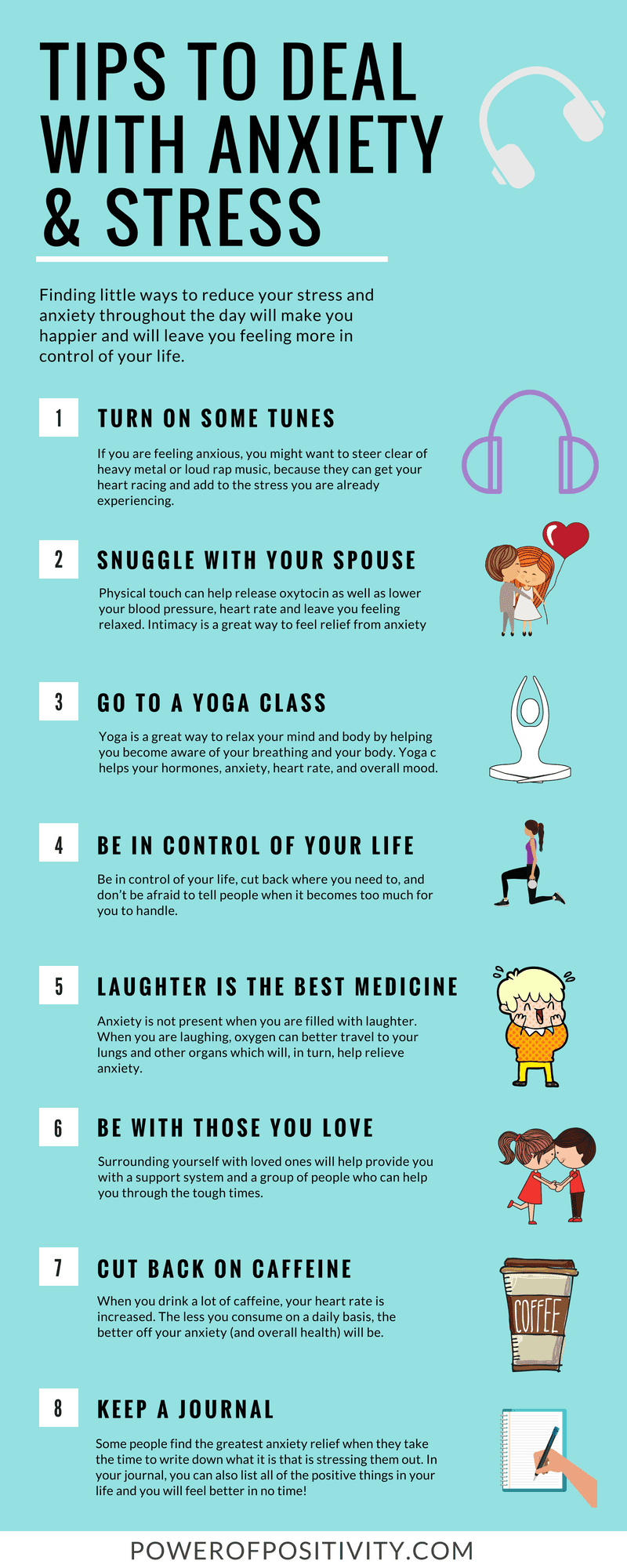
deal with anxiety infographic

Maintain a Balanced Schedule

In our society, many people are overworked and have too many obligations to manage. You may have the habit of overcommitting yourself to too many activities throughout the week. Of course, that can make it challenging to have downtime. When dealing with stress, make it a point to have a balance by limiting your commitments. Practice saying no and turning down requests to ensure that you can protect your health and well-being.

5 Psychological Tricks That Boost Productivity

According to most psychologists and behavioral experts, procrastination is a basic human instinct. The reason is quite simple: we are far more attracted to the allure of instant gratification than to the productivity level that is good for us in the long run.

An excellent example of this phenomenon is saving money. Americans are some of the worst savers in the world. Consider the following two statistics: (1) 75 percent of full-time workers say they live paycheck-to-paycheck. (2) Nearly 40 percent of Americans have nothing in savings. We know that we should save money for the future – but our impulses get the better of us.

Productivity works much the same way. We delude ourselves into thinking we’ll always have time, so we rationalize wasting it. We are going to talk about this a bit more.

Here are five awesome productivity hacks you can implement RIGHT NOW.

“Absorb what is useful, reject what is useless, add what is specifically your own.” – Bruce Lee

With a bit of discipline and a slight shift in mindset, you can become your most productive self!

Let’s get to it!

1. Know Thyself

When are you at your most productive? Are you a morning lark or a night owl? What are your “I’ll do it later” triggers? (Email, instant messaging, unexpected calls, etc.) Do you work better in alone or with others?

Know where you are most productive and start from there. Don’t worry about appearing unconventional or ruffling feathers. If necessary, explain your choices to others (manager, co-workers, and such). Tell them that making the most of your time at work is important to you. Chances are that you can come to a mutually-beneficial relationship.

life quote

2. Keep a Notepad

We humans have a big problem with following irrelevant streams of thought. One minute we’re focused like a laser and the next we’re obsessing over what we’re going to eat for lunch. Or how long it is until the next break time. Or how many vacation days we have.

When a something comes to mind that requires your attention, write it down. Get this extraneous stuff out of your head, and you’ll be much more productive (not to mention relaxed) as a result. Consider scheduling 15 to 30 minutes at the end of the day taking care of the “extra” stuff that crops up in your mind during the day.

3. Control Your “Spotlight”

“A wealth of information creates a poverty of attention.” This quote is attributed to Herbert Alexander Simon, a Nobel Prize-winning American economist and political scientist who devoted much of his career to the study of human decision-making.

In simple terms, we must be judicious in managing our attention. Scattered thoughts manifest into disordered, negative energy; whereas centered thoughts manifest into focused, positive energy. So watch where you direct your mental energy. Disregard the unimportant, choosing instead to cast your spotlight on things that generate a high return.

4. Get Grit

Angela Duckworth, a Distinguished Professor of Psychology at the University of Pennsylvania, and author of Grit: The Power of Passion and Perseverance (an awesome book!) says “…there are no shortcuts to excellence. Developing real expertise, figuring out really hard problems, it all times time – longer than most people imagine.”

While some are born with a bit more “stick-to-itiveness,” all of us take the path of least resistance at times. In this regard, Duckworth writes – and research shows – that grit can be developed by “…working on something you care about so much that you’re willing to stay loyal to it … it’s doing what you love, but not just falling in love – staying in love.”

Grit and self-discipline become easier the more we stick to it. When you feel like you have hit a wall, keep going! Eventually doing even the unpleasant things will become second nature.

being alone

5. Manage Your Energy

There are plenty of hacks that you can use to manage your energy – and it is critical that you make every effort to do so. Our productivity (or lack thereof) often comes down to what we’ve got left in the tank. You can be the grittiest, most disciplined, intelligent, and focused person on the planet; however, if you don’t have the energy to manifest these traits, it all amounts to less a hill of beans.

With this in mind:

  • Eat a good breakfast: consume protein and some natural sugar in the A.M. to get your day started right.
  • Carry a water bottle: drink at least 64 ounces of water throughout the day. The brain and body function best when well-hydrated.
  • Take regular breaks: more isn’t always better; this certainly applies to extended periods of work. Make sure you’re taking mini-breaks throughout the day.
Sources:
http://scienceblogs.com/cortex/2010/04/02/attention-and-intelligence/
https://www.psychologytoday.com/us/blog/adaptation/201707/5-productivity-hacks-actually-work

10 Causes of an Overactive Bladder (and How to Fix it)

Overactive Bladder (OAB) is a widespread condition affecting millions globally.

According to the Urology Care Foundation, OAB affects over 30 million Americans. This number is likely to be much higher. Counting those who experience intermittent OAB and those who’ve gone undiagnosed, estimates rise to a whopping 30 percent of men and 40 percent of women.

Symptoms and Risk Factors of an Overactive Bladder

Symptoms of OAB include:

  • Frequent urination, defined as urinating eight or more times over 24 hours.
  • Waking in the middle of the night to pee more than once (a condition known as nocturia).
  • Inability to hold your urine.
  • Wakefulness.
  • Accidental leaking of urine from sudden urges (called incontinence).

The risk factors of OAB are various. They include age-related physical or cognitive decline, neurological diseases such as dementia (e.g. Parkinson’s), and obstruction of the bladder from constipation, enlarged prostate, or surgical complications. They can also be caused by nerve damage to the urinary region, neurological disorders such as multiple sclerosis, stroke, bladder stones, or tumors. Prescription or over-the-counter (OTC) medications that increase the amount of urine production may also be a factor.

bladder

Ten Main Causes of Overactive Bladder

It’s important to note that while these are prominent causes, OAB can also result from other conditions or factors not listed here. Always consult a healthcare professional if someone suspects they have OAB.

1. Bladder Fullness

The bladder is a muscular sac located inside the pelvis. It stores urine produced by the kidneys. It stretches to hold urine and contract when it needs emptying. Holding urine for extended periods may seem harmless initially, but it can set the stage for complications.

When individuals consistently delay trips to the bathroom, they train their bladder to hold more urine than it should. This habitual retention can strain the bladder muscles over time.
Moreover, repeatedly clenching the bladder muscles can eventually lead them to become overactive, which can manifest as a frequent and sometimes uncontrollable urge to urinate. This phenomenon only exacerbates OAB symptoms.

2. Diuretics

Diuretics, often called “water pills,” promote kidney urine production. Their primary function is to help the body eliminate excess salt and water.

While diuretics are essential for many patients with heart-related issues or fluid retention, they inevitably increase urine output.

Consequently, individuals on these medications can experience an increase in the frequency of urination, exacerbating or simulating OAB symptoms.

3. Cognitive Decline

The brain and the urinary system are closely interconnected. The brain interprets signals from the bladder and sends messages back to control urination.

This signaling system can get disrupted as cognitive functions decline due to age or specific conditions like MS or stroke. The result? A disconnection in the signals between the brain and the bladder causes unexpected or frequent urges to urinate.

Moreover, other neurological conditions, not just cognitive decline, can also impact bladder control, underscoring the importance of the nervous system in urinary health.

4. Menopause

Menopause is a natural transition in a woman’s life, marking the close of her reproductive years. However, with this change come various hormonal shifts.

Estrogen, a hormone, plays a crucial role in the health and strength of the tissues in the urinary tract. When levels of this hormone decline during menopause, the bladder and urethra muscles can weaken, leading to challenges in holding urine.

Consequently, incontinence or an overactive bladder might become an issue for some women post-menopause.

5. Diabetes or Pre-diabetes

Elevated blood sugar levels characterize diabetes due to the body’s inability to produce or process insulin effectively.

An elevated blood sugar level may cause the kidneys to try to filter and absorb the excess sugar. When they can’t keep up, the body expels the surplus glucose through urine.

This excess glucose in the urine draws more tissue water, leading to increased urine volume. As a result, individuals with diabetes or even pre-diabetes might urinate more frequently, potentially giving rise to OAB symptoms.

6. Urinary Tract Infections (UTIs)

UTIs are infections occurring anywhere in the urinary system: the kidneys, bladder, ureters, or urethra. The most common type of UTI affects the bladder.

A UTI can irritate the bladder, leading to a strong urge to urinate even when the bladder isn’t complete. Some individuals might also experience a burning sensation when urinating, pain, and even cloudy or bloody urine.

While UTIs are treatable with antibiotics, they can exacerbate or simulate OAB symptoms if left unchecked.

7. Bladder Stones

Bladder stones are hard mineral masses that form in the bladder. They can develop when the urine in the bladder becomes concentrated, allowing minerals to crystallize and bind together.

These stones can irritate the bladder lining, leading to symptoms similar to those of OAB. Other symptoms often include pain in the abdomen, blood in the urine, or painful urination.

Treating bladder stones often involves a surgeon removing them.

OAB

8. Excessive Caffeine or Alcohol Intake

Both caffeine and alcohol are known diuretics, which can increase urine production and potentially irritate the bladder.

Consuming large amounts of coffee, tea, or alcoholic drinks can stimulate the bladder, leading to a frequent need to urinate.

Moderating or spreading intake throughout the day can help manage these OAB-like symptoms.

9. Medications

Some medications have side effects that may increase urine production or irritate the bladder. That includes certain antihypertensives, antipsychotics, anticholinergics, and over-the-counter cold and allergy medications.

If someone suspects that their medication might be causing OAB symptoms, they should consult their healthcare provider. They might adjust the dosage or switch to a different medication.

10. Neurological Disorders

Other neurological conditions can impact bladder function besides multiple sclerosis (MS) and stroke. Parkinson’s disease, spinal cord injuries, and brain tumors are examples.

These conditions can disrupt the nerve signals involved in bladder control, leading to OAB symptoms.

Preventing and Fixing an Overactive Bladder

Prevention is always the best medicine. With this in mind, let’s first talk about lifestyle choices that lower your risk of an overactive bladder.

The most important factors in preventing OAB are maintaining a healthy weight and getting regular exercise. A healthy body optimizes the functioning of the urinary tract and other vital organs. Further, an active lifestyle is the best way to counteract diabetes and obesity. Other prevention measures include limiting alcohol and caffeine, quitting smoking, and managing any known medical conditions.

Now let’s say you’re struggling with a bit of OAB. Are there measures you can take to counteract it? Many signs point to “yes.” One noteworthy finding reported by Harvard University showed that 70 percent of women who used alternative remedies reported being satisfied with the treatment. These treatments might include supplements, herbs, and therapies.

While research is still a bit sparse (as it often is with alternative treatments), three have shown promise.

Pumpkin seeds.

Pumpkin seeds are rich in omega-3s, which possess anti-inflammatory solid traits. One study found pumpkin seed oil to improve urinary tract function and reduce the symptoms of OAB.

Bladder retraining.

The general idea is to reset your bladder muscles. Eventually, you may get to a point where trips to the bathroom become much less frequent. First, start keeping a journal of how frequently you visit the bathroom. Next, delay your bathroom trips for a few minutes at a time. After a while, this 10 minutes will become a piece of cake, allowing you to hold for 15 minutes, then 20 minutes, and progressively longer.

Kegel exercises.

Kegel exercises (ideally in conjunction with regular exercise) strengthen pelvic floor muscles and limit involuntary contractions. Here’s a rundown of how to do Kegel exercises:

  1. “Find” your pelvic muscles by cutting off your urine mid-stream.
  2. Make sure that your bladder is relaxed (read: empty).
  3. Lie down flat on a comfortable surface. Put your arms comfortably at your sides.
  4. Relax your butt and tummy area.
  5. Squeeze your pelvic muscles for about 5 seconds; reduce hold time to 2-3 seconds if it is easier.
  6. Release your muscles for 10 seconds. Repeat.
  7. Perform these movements ten times each session. Try doing Kegel’s at least 3-4 times daily.

overactive bladder

Final Thoughts on Overactive Bladder

Overactive bladder (OAB) is a condition that affects millions of individuals worldwide, impacting their daily routines, sleep patterns, and overall quality of life. While the frequent and sudden urge to urinate might seem like a minor inconvenience, it can lead to broader emotional and psychological effects, such as anxiety, embarrassment, or even depression.

Understanding the various causes of OAB, as discussed, underscores the fact that it’s not just a standalone condition but often a symptom or side effect of other underlying issues. From neurological disorders to dietary habits, a wide range of factors can contribute to or exacerbate OAB symptoms.

However, it’s crucial to remain hopeful and proactive. With the advancement of medical research, various treatments and management strategies are available, ranging from lifestyle changes to pelvic floor exercises. Moreover, awareness and understanding of OAB are growing, leading to reduced stigma and more open conversations.

Are you experiencing these symptoms? Then contacting a healthcare professional is essential. Early diagnosis and intervention can make a significant difference in managing the condition and improving one’s quality of life.

Lastly, society must support and empathize with individuals dealing with OAB. Compassion and understanding can go a long way in helping someone navigate the challenges of this condition.

Skip to content