Weekly tips, affirmations, and small actions to feel your best.

15 Behaviors a Cruel Person Displays Before Revealing Their Intentions

Cruel people are good at fooling those around them until the time is right. They’ll make you think that they are a kind-hearted, good person and then flip on you in an instant. When you’re caught unaware like this, it can be a shock that the person you thought you knew could be so toxic.

Cruelty can come from anyone, including parents, siblings, co-workers, friends, and romantic partners. They’ll likely be skilled at hiding their intentions until they’re ready for you to see their harmful ways. However, even if they try to hide it, there will be signs of who they are.

If you know what to look for, you’ll see subtle signs of their true intentions right from the start. Pay attention to how people make you feel daily, and if there’s any fleeting sense that something is off, don’t ignore it. It’s easy to brush away reg flags in the early stages of knowing someone, but these signs can make a difference.

Fifteen Behaviors a Cruel Person Displays Before Revealing Their Intentions

Learning the behaviors that an evil person displays before revealing their intentions protects you in the long run. It keeps you one step ahead of the cruel person, allowing you to prepare for what they intend. You can escape the toxic situation before the harmful behavior intensifies.
cruel

1. Cruel People Don’t Respect Boundaries

It’s a bad sign when people are persistent even after being told no. You might not recognize it as a toxic behavior at first, but not respecting simple boundaries signifies a much deeper issue. As you get closer to the person, they’ll continue ignoring your limitations, and their behavior will become more severe.

Not respecting boundaries is a sign that someone wants to gain power and control over you. They might use guilt or coercion to convince you to meet their needs or desires. It’ll be subtle in the beginning but

2. They Enjoy the Misfortune of Others

An evil person might smile or feel excited when they see other people experience misfortune. Whether they see disaster right in from of them or on the news, they’ll enjoy hearing all about it. It’s natural for people to be curious, but finding joy in misfortune is a toxic trait.

For some reason unknown to the rest of us, these people bask in the bad feelings of others. Even if they experienced a similar unfortunate situation in the past, they seem to forget about it for the time.

Unfortunately, they may eventually take it a step further and start creating bad situations for you and the people around you. They want to enjoy the moments of misfortunate that they brought on. If you can recognize them for who they are early on, you can prevent these malicious attacks from occurring at all.

3. You Receive Warnings from Others

If someone’s friends and family give you warnings about them, it’s a huge red flag. They might not say it directly, but they’ll issue warnings in the form of stories about their lives. If they tell you they went through a hard time but dismissed the issues or make excuses. It’s a warning sign of impending disaster.

Friends and family don’t want to speak ill of the person, but they’ll give you clues. It’s a way of letting you know that something is wrong and you must do something about it. Other times, friends and family will come right out and tell you that the person isn’t healthy.

Either way, don’t ignore the warnings from those closest to the person. However, don’t take a lack of warning from friends and family as a good sign, either. Sometimes the people closest to them will hide things or lie to help them out.

4. Cruel People Don’t Reveal Who They Are

A person with bad intentions won’t reveal their true self, and it’ll leave you feeling confused. One day they’ll portray kindness, love, and a caring heart. The next day they might be harsh, inconsiderate, or distant without reason.

These people will also be who they need to be when they want to get something. Evil people might change who they are, depending on where they are and who they are with. Cruel people switch their behaviors and hide themselves to play games with others. They do it to assert dominance over you and maintain control.

5. They Show Signs of Manipulation

The longer you know someone with bad intentions, the more manipulation you’ll experience from them. It’ll be subtle at first, but their toxic behaviors will gradually worsen. They manipulate the people in their lives to reel them in and get what they want.

Manipulative people are comfortable lying and taking advantage to obtain their desires. They’ll also do kind things for others, but it’ll come with a high price that no one knew about until later.

6. They are Rude and Belittle People

As you get to know the person, they’ll become ruder as they get comfortable. They’ll order people around, say rude things, and display unfriendly behaviors toward others. Even worse, they can’t seem to stop belittling people.

Belittling someone is a form of manipulation, but it’s also rude behavior. They’ll say hurtful things about someone’s body, interests, hopes, goals, hobbies, home, friends, and dreams. As they say these things, they want to change your opinion of yourself and make you question your decisions.

7. They Never Apologize

An evil person doesn’t apologize to others, even when they should. They won’t own up to their mistakes, and they believe it’s not their fault. These people create elaborate lies to avoid admitting guilt for anything they’ve done.

An evil person also cannot show remorse. They aren’t sorry for what they’ve done and how they’ve made you feel. Plus, if you mention that they didn’t apologize, they’ll deflect or try to make you feel like it was your fault.
cruel

8. Cruel People Are Controlling

Evil people feel like they must control the people in their lives. They’ll feel uncomfortable and powerless if they can’t manage even one aspect of your life. It’ll seem like they don’t trust you to do anything without them knowing or looking over your shoulder.

The early signs of controlling behavior are hard to see because they often come off as polite and concise. However, they’ll gradually start controlling everything as they get more comfortable.

9. They Don’t Like to Help Others

When people know that they shouldn’t bother asking someone for help, it’s a sign of a cruel person. Even when they can help someone, they won’t do it.

If you see them in public, they won’t hold the door for others or help someone pick up a stack of dropped papers. The usual things that most people do to help others will be far from the toxic person’s mind. However, if they ever decide to help someone, it comes at an intense price.

10. Cruel People Are Habitual Liars

Everyone lies sometimes, but habitual liars can’t seem to stop. They’ll lie about things that don’t matter at all, and they’ll lie about important things. These people lie pathologically, and they often don’t even realize that they do it.

They use lies to make them seem more substantial, brighter, and better than others. Plus, they often lie about their accomplishments and experiences, but they also lie about the people in their lives.

11. They Get Defensive Easily

When someone gets defensive or denies something, it’s their attempt at making the situation false. If someone offers a suggestion or gives constructive criticism, they’ll twist it all around. The person might turn it into a joke, but they also might turn it into an offensive statement that doesn’t make sense.

More subtle signs of defensiveness are when they pout, change the subject, or withdraw. They also sometimes act passive-aggressive when they get defensive.

12. Cruel People Try to Ruin People’s Happiness

When someone shares something exciting or joyful, a cruel person will say something to ruin the moment. They have a way of turning any positive news into negative because they are secretly envious. Evil people don’t want those around them to be happy.

Likewise, if they see people having a good time, they might find a way to ruin it. Whether they join and act inappropriate, or they put an end to the experience altogether, they’ll ruin everyone’s happiness.

13. They Throw Everything Out of Proportion

Toxic people turn everything into a big deal, and everyone will hear about it. They speak in absolutes, frequently using “always” and “never.” Their absolutes are rarely accurate, but they use them to incite an argument or debate.

These people want you to react, so they throw it out of proportion so that you’ll defend yourself or what you said. If you don’t respond, they’ll use it as a way to prove their point.

14. They Don’t Take Responsibility for Their Emotions

Cruel people blame their emotions on everyone around them. They project their feelings onto others because they aren’t strong enough to deal with it alone. Deflecting responsibility for their feelings is a defense mechanism that helps them cope with their problems.

15. Cruel People Are Judgmental

An evil person will exhibit signs of being judgmental early on. They might make offhanded comments about someone’s appearance, and they’ll point out flaws about everyone and everything. Evil people behave like no one is better than them.

Plus, they’ll secretly tell you their judgmental opinion of others that you both know. They try to draw you in and get you to agree with them or give your own negative opinion. Avoid falling into the trap because you don’t know their true intentions.

cruel

Final Thoughts on Behaviors a Cruel Person Displays Before Revealing Their Intentions

Knowing these behaviors that a cruel person displays before revealing their intentions can help protect you. Having people with bad choices in your life is a risky situation, and it’s best if you know who they are.

Remember to look for these signs when meeting someone new, whether at work or in your friend group. They can help you spot a cruel person early on, allowing you to stay one step ahead.
15 Balanced Life Behaviors Most People Forget

Good habits help your life better, but bad habits can create chaos and cause unhappiness. If you want to be successful and have joy in your life, you must learn to develop good habits that will help you become a better person.

Fifteen Balanced Life Behaviors You Should Always Remember

Think of the process of developing good habits as a positive step towards becoming a better version of yourself. You know that some things like eating right and getting enough sleep are givens, but what other habits can you develop to enhance your journey? Here are some things you can begin today.

1. Express Gratitude for a More Balanced Life

One of the best ways to have a balanced life is to express gratitude every day. You have many things to be thankful for, and you should never lose sight of all your blessings.

Even on the darkest day when the sun doesn’t seem bright, you must still focus on your blessings. Develop the habit of writing down all the things the Universe has blessed you with, and it will keep you through the times when being grateful isn’t as easy.

balanced life

2. Smile

Smiling is such a little thing that has such a significant impact. When you smile, you shift your mental attitude from negative to positive. It’s hard to be upset when you’re smiling.

Since smiling is contagious, you’ll create an atmosphere of joy, and people will be more apt to have good interactions with you. Plus, according to the National Library of Medicine, smiling can increase your immune system, which ultimately helps with your stress levels.

3. Utilize Daily Meditation

If you need a more peaceful life than what you’re living, maybe it’s time to utilize meditation. Did you know that you must start by changing your mindset to develop good habits? Meditation can help you ease those negative racing thoughts, and it can help get you into a more positive headspace.

4. Practice Mindful Living for a Balanced Life

Many people are present in the world, but they’re not engaged. Mindful living is all about noticing the things around you and not just going through life on autopilot. When you eat dinner, do you stop and focus on the flavors of each bite you take, or do you rush to get onto the next task?

So many people are suffering because they live life in such a hurry that they miss the beautiful things right in front of them. Having a balanced life requires attentiveness and focus.

5. Speak in Friendly Tones

Your tone means everything when you speak. If you’re upset or frustrated, you’ll inevitably say things that you regret later. Did you know that communication errors are one of the biggest causes of issues globally?

It’s effortless to let your emotions get the best of you, but you must develop the good habit of speaking in a friendly tone. Even if the conversation is harsh and heated, remember to speak kindly and control your reactions. It can mean everything towards a good outcome.

6. Spend Time with Friends and Family

Living a balanced life with contentment and peace comes from simple things, like spending time with your family and friends. It seems that everyone is in a mad dash these days, and there’s not enough quality time spent with the ones you love. Remember, your family is the ones that will be there when everything else around you is crashing, so it’s essential to make time for them too.

7. Simplify Your to Do List

Stop cramming so much into your day that you couldn’t have a peaceful day if you wanted to! You’re not a superhero who has incredible strength or superpowers, nor can you do miraculous things, so quit putting so much pressure on yourself. Simplify your day by making it all about things you can accomplish.

You will not only feel better crossing things off, but you’ll have a sense of accomplishment that balances you. A long list is an enormous burden, so just cut it short and make it doable.

8. Volunteer for a Balanced Life

It would be best if you took the time to give back to those in need. The Food Research and Action Center found that 38 million Americans, or around 13 percent, go without proper nutrition each day.

That means that someone in your community, family, or place of employment is struggling to feed their family. Even people that go to work each day are still one paycheck away from being homeless. You will build meaningful relationships with those who need it most, as well as learn a new appreciation for your life.

balanced life

9. Exercise

Part of a balanced life and developing good habits is to exercise. Yes, people always put their physical health on the back burner to focus on matters at hand, but it eventually catches up with you. The first step is the hardest in this journey towards health, but it’s worth the effort not to have problems down the road.

Not only does exercise give you more energy to accomplish all your daily tasks, but all those feel-good endorphins it releases helps to make you a happier person.

10. Use Positive Affirmations

Reciting positive affirmations can do wonders in helping you develop a positive attitude. Sadly, pessimism can be a genetic trait that seems impossible to eliminate, but you can rewire your brain from negative to more positive ones. How many times have you used the words “I can’t?” Perhaps you tell yourself that you can’t do the following things:

  • Maintain your weight
  • Find your soul mate
  • Have financial freedom
  • Pay off debt
  • Get the job of your dreams
  • Be a success

It would help if you changed the way you look at things and what you say, and you can start to change this by using positive affirmations.

11. Keep A Healthy Sleep Routine

How much rest do you get each night? Did you know that you should be in bed no later than 10 pm if you want to wake up naturally feeling rested? Your sleep is not a negotiable item in your life, as sleep deprivation will certainly mess with your level of contentment in life.

When deprived, you will feel grouchy, tired, have mood swings, and don’t have the attention you need.

12. Find A Hobby to a More Balanced Life

Do you have a hobby? Strive to find things to do that don’t cost money, but it helps you focus and boost your creativity. A balanced life has many aspects, including allowing you to have some fun.

People think they need lots of time to develop a new hobby, but it’s all you need if you can allow yourself a couple of hours a week.

13. Eat a Balanced Diet for a Better Life

It’s much easier to grab a burger on the way home, especially when you’re super busy. However, while the burger is cheap and filling, it’s not going to do a thing for your waistline. The chef at the local eatery isn’t concerned with your nutrition as much as taste.

If you want to live a balanced life, balancing your meals is a simple place to start. It would help if you had proper nutrition and fuel your system and not cause a mechanical breakdown.

14. Experiment with Right Brain Activities

Sometimes your thoughts are loud and racing, which is often caused by the brain’s right section being more active than the left. If you need peace and stability in your life, it’s time to focus on the right side. Some things that can help to strengthen this hemisphere include adult coloring, crossword puzzles, games like sudoku, painting, and meditation.

Many people don’t realize that those folks with a right brain that’s more active than the left tend to be calmer throughout life. So, it’s essential to make sure that the right side is working at optimal levels.

15. Go Outside in Nature

You need lots of vitamins to live a balanced life, but one of the most important is Vitamin D. The good news is that you get this from the sun, and all you need is around 20 minutes a day. Spending time in the great outdoors not only makes you feel better, but it improves your health.

Having balance in your life is about so much more than the food you eat, as your daily habits play a significant role in the equation. A walk around the neighborhood can add years to your life if it helps you keep your weight down and your vitamin levels up.

balanced life

Final Thoughts on Balanced Life Behaviors to Implement

Developing good habits doesn’t need to be an overwhelming task. Start small, find a couple of things on the list that you can do with ease, and then add in some more challenging ones. There are so many things that you can do that can add balance and harmony to your life.

What things do you want to try, and are you ready for the first step towards a new journey? If you can become healthier, happier, and more balanced overall, why not start today?

12 Quad Exercises That Melt Away Fat and Shape Your Thighs

Quad exercises help shape your thighs, helping you reach your goals and feel better about yourself. You’ll notice an improvement in the shape of your thighs as you tone the large area of your legs. With regular exercise, you’ll experience continued improvement in the appearance of your body.

The four muscles on the front of your thigh make up your quadriceps. They help raise your thigh and extend your knee, allowing flexibility and movement. By targeting this muscle group during exercise, you’ll promote the balanced development of all four.

While you can’t melt away fat in only one area of the body, these quad exercises will help burn calories. You’ll melt away fat all over your body while toning your thighs at the same time. Since this group of muscles is so large, toning it burns lots of calories compared to other areas.

These quad exercises can help you melt away body fat and shape your thighs. Consistency when exercising leads to results, so implement some of these exercises into your routine two or three times each week. Before you know it, you’ll notice that your thighs are more sculpted and defined.

Quad Exercises That Melt Away Fat and Shape Your Thighs

Are you ready? Let’s get to it!

1. Short Arc Quad Exercises

This exercise helps with properly contracting your muscles, preventing pain and injury. It also helps tone and defines the area.

You’ll need a yoga block, basketball, or something similar to prop your knee on. As you support your knee, make sure its back stays against the item even as you start moving. If you want more of a challenge, you can add a small cuff weight to your ankle.

How to Do It

  • Start by lying on your back with your yoga block beneath one bent knee
  • Slowly straighten the bent knee, keeping the prop beneath it
  • As you straighten it, tighten your muscles and point your toes toward the ceiling
  • Hold the position for five seconds before slowly lowering your leg, and repeat 15 times on each leg

2. Burpee

Burpees are a fat-burning exercise that engages every muscle of your body. They’re also an excellent way to build strength and tone muscles.

How to Do It

  • Start in a squat position, keeping your palms flat on the ground
  • Kick back your feet so that you’re in a plank position, but keep your arms extended
  • Return your feet to the starting position
  • Stand up
  • Repeat the exercise 10-20 times

3. Squats

Squats are great for your legs, thighs, and core, making them a well-rounded exercise. They build and tone muscles, helping you achieve the healthy shape you’re looking for. Plus, squats burn lots of calories, helping with fat loss.

You’ve likely heard of many variations of squats, but learning the basics is essential for preventing injury. Once you’re comfortable with the proper form and range of motion, you can increase the intensity by mixing it up.

How to Do It

  • Start with your feet hip-width apart.
  • Reach your arms back and move into a sitting position, as if you were sitting on a low stool with your hip crease just below your knees
  • Keep your core tight and avoid bringing your knees forward
  • Return to the start position and repeat 15 times for a complete set

couch squat

4. Curtsy Lunge Quad Exercises

This exercise targets your inner thighs and helps with stabilizing your hips. It improves your overall posture, too, allowing you to feel better overall.

How to Do It

  • Start by standing straight.
  • Move your left leg behind you and to the right, crossing your thighs
  • Bend both knees as if you are doing a curtsy
  • As you bend, place your palms together
  • Repeat the exercise using your opposite leg, completing one rep
  • Do three sets of 12 to 15 reps, taking breaks in between sets

5. Straight Leg Raises

This simple exercise is a great way to get your quad muscles working. Once you get comfortable with the straight leg raise, you can add weights to your ankles.

How to Do It

  • Lie flat on your back
  • Bend one knee to a 90-degree angle with your foot flat on the floor
  • Keep your other leg straight with your toes pointed toward the ceiling
  • Lift the straight leg off the floor using the front thigh muscles and hold for five seconds
  • Lower your leg to the floor, and repeat 10-15 times

6. Step Ups

This exercise uses many of the same muscles you use for a squat. However, you’ll use these muscles differently, strengthening weak areas. Step-ups help promote balance and stability while burning calories and shaping your thighs.

You will need something to step onto at least 12 inches high. If the exercise is too easy, consider adding resistance by holding dumbbells. You can also use a taller step to increase the intensity.

How to Do It

  • Place one foot on the step and push through your heel to stand all the way up
  • Bend your free knee up so that you are standing on one leg
  • Put your free leg back down and return to a starting position
  • Repeat this 15 times, and then switch feet

7. Glute Kickback Quad Exercises

This exercise strengthens your muscles, beneficial for any experience level. Focus on keeping your head facing forward throughout the movement. When you extend your leg, keep it parallel to the floor.

How to Do It

  • Kneel on the floor or an exercise mat, keeping your hands directly under your shoulders
  • Keep your back parallel to the floor.
  • Raise your heel toward the ceiling, and hold this position for a few moments
  • Return to the starting position and repeat with your other leg, doing 10-15 reps on each side

8. Leg Extension Quad Exercises

The leg extension machine is popular at the gym, but you can achieve the same results at home. You’ll need at least one set of dumbbells, a foam roller or rolled towel, and a solid chair. It helps melt away fat and build up your quads.

Doing two sets of leg extensions at the end of your exercise routine can boost your results. However, don’t keep pushing until you experience muscle fatigue because it can lead to injury. Aim to feel a burn, and then allow your muscles to rest.

How to Do It

  • Find a chair, bench, or any other solid surface to sit on
  • Put a dumbbell in front of your feet on the floor
  • Place a rolled towel or foam roller just above the back of the knees to elevate your legs and increase the range of motion
  • Shift into a sideways seat position, making sure the rolled towel stays in position
  • Use your feet to lift the dumbbell, pushing your heels into the ground to get started
  • Retract your muscles as you raise and lower the dumbbell, holding it at the top for a few moments
  • Repeat the exercise 15 times, rest, and do it for another 15 reps

9. Terminal Knee Extension

This exercise is an effective method to strengthen your muscles while in a standing position. You’ll tone your thighs while simply supporting your body weight. You’ll need a resistance band or something similar.

As you do this exercise, make sure to move slowly and steadily. Your knees should be directly over your toes, and make sure you don’t shift forward to avoid excessive strain.

How to Do It

  • Tie your resistance band around a fixed object so that it’s anchored at knee-height
  • Step into the loop with one leg and pull it up around your knee
  • Bend your knee slightly, and then slowly straighten it while placing tension on the band to produce resistance
  • Once your knee is straight, hold the position for three seconds
  • Repeat the exercise 15 times on each side

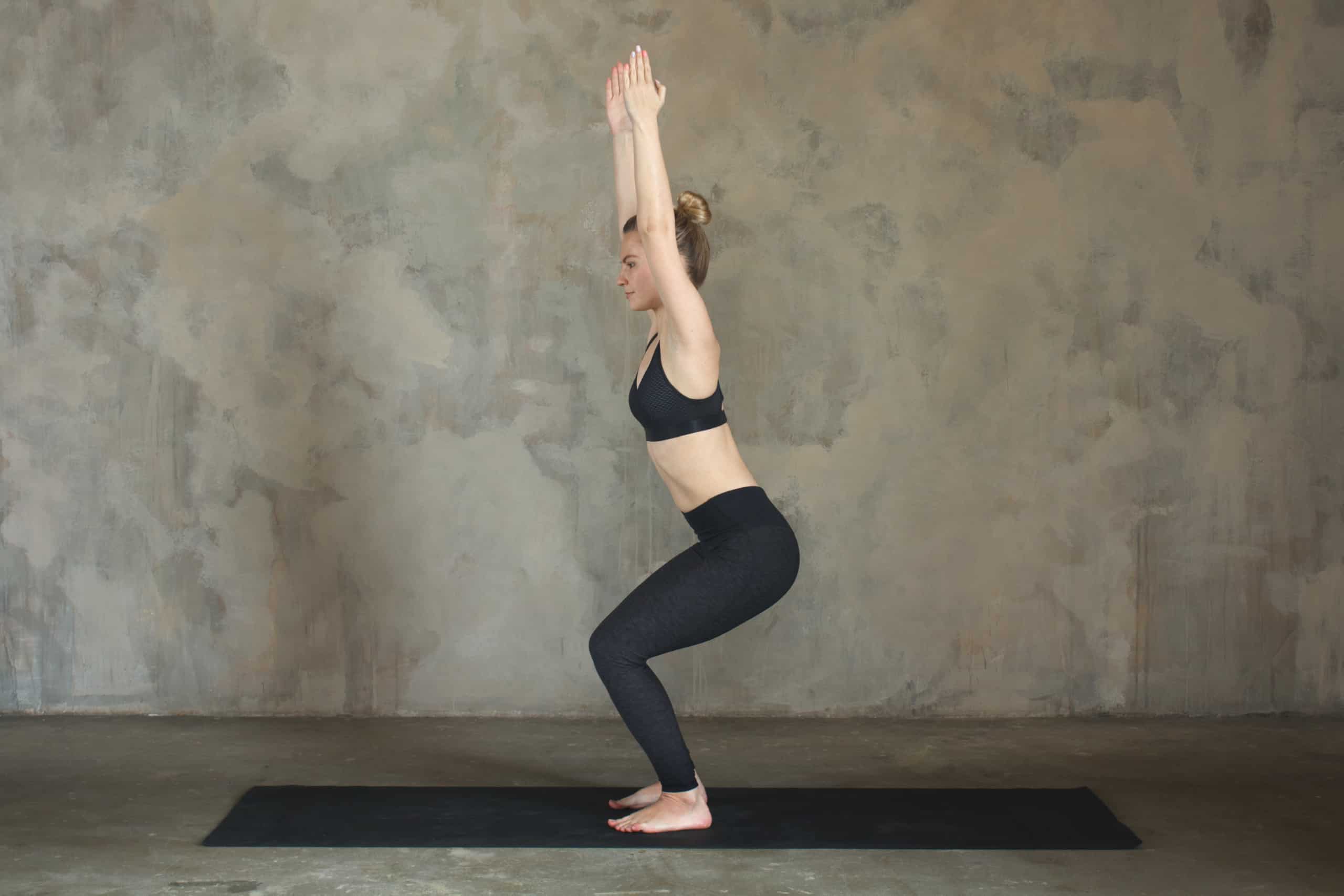
10. Chair Pose

This exercise is a standing yoga pose that strengthens your entire lower body. It specifically targets the quad muscles, improving balancing while shaping your thighs.

How to Do It This Quad Exercise

  • Start with your feet together and arms relaxed at your sides
  • Bend your knees and lower your hips similar to the way you would sit in a chair
  • Lengthen your lower back and lift your arms toward the sky
  • Make sure you keep your weight on your heels, knees bent, and butt low
  • Hold for ten seconds, then return to the start position
  • Repeat the pose two to three times
quad exercises

The yoga chair pose is excellent for balance and melting fat.

 11. Box Jumps

This exercise will increase the strength and power of your legs. It targets all of your lower body muscles and your core, melting the fat in the process.

How to Do It

  • Start by facing a sturdy platform (around 12 inches tall) with your feet hip-width apart
  • Press your hips back while swinging your arms behind you, and then bend your knees into a jumping position
  • Push through the balls of your feet, jumping straight into the air and landing on the sturdy surface
  • Both feet should land on the platform at the same time simultaneously
  • Return to the start position and repeat the exercise five to ten times

12. Wall Sits

Wall sits are one of the best quad exercises to shape your thigh muscles. Implementing wall sits at the end of your workout ensures you get the most out of it. It’ll produce a muscle burn that doesn’t let you forget how hard you’ve been working.

How to Do It

  • Start with your back against the wall.
  • Slide down until your knees and hips are at a 90-degree angle
  • Tighten your core and keep your back flat against the wall
  • Hold the position and focus on your breathing until your legs reach fatigue
  • Slide your back up the wall and return to the starting position
  • Rest for 30 seconds before doing another wall sit

Final Thoughts on Quad Exercises That Melt Away Fat and Shape Your Thighs

Melting away fat and shaping your thighs can be easy when you know the best quad exercises. Start slowly, and don’t overdo it until you become more comfortable with your new exercise routine.

These quad exercises won’t only help shape your thighs, but they’ll increase your mobility and balance. Don’t push yourself if it starts to hurt or result in injury. As you get more comfortable, your range of motion will increase, too, allowing you to increase the intensity of your workout.

Neurology Explains How Cognitive Flexibility Might Be as Important as IQ

For society to flourish, cognitive flexibility is essential. However, with IQ in the limelight over the past couple of decades, it’s all people can think about. Whenever people discuss intelligence, IQ is the first thing mentioned. Everyone uses the number as a guideline to determine how intelligent someone is. According to the Standford-Binet test, if you have an IQ above 132, you can get into Mensa (the High IQ Society).

Having a high IQ seems to be everything you could ever want if you aspire to be the brightest in the room. But lately, that perception has started shifting. Even though IQ can be an excellent measurement of your reasoning ability, that can give you a general idea regarding how well you’ll use the information to make predictions and answer questions. But IQ doesn’t consider many important attributes, like knowledge, ambition, and drive.

And IQ tests favor people who can think on the spot. While they can show you some essential details, these tests can also be arbitrary. The results can change depending on the conditions taken in, and they can also fluctuate as time passes. But neurologists seem to believe that they have found something as important, if not more important, than IQ. Cognitive flexibility, or adapting to your environment, can also tell you some essential things about human intelligence.

What Is Cognitive Flexibility?

Cognitive flexibility measures how well people adapt to their environment and respond to it. It occurs either when you think about multiple things at once or when you modify your thoughts in response to changes in demands. In a nutshell, it’s all about flexible thinking.

Cognitive flexibility is considered a core aspect of executive functioning (the processes that allow people to plan, focus, and juggle more tasks at once). Because of this, people with attention disorders, hyperactivity, or learning disabilities show lower levels of cognitive flexibility. Thus, these people will have trouble with their executive functioning.

In comparison, IQ levels are more like a number that compares you with people in your age range. They show you how well you do on a test compared to the people in that range. They test math and language skills and memory and information processing speed. But IQ scores don’t and can’t measure practical intelligence. They can’t determine if you will or won’t do things well in your life. Not just that, but it doesn’t measure your artistic skills, your creativity, or your curiosity.

It’s also dependent on your mindset when you take the test. If you are in a bad mood and your thoughts are distracting you, your IQ score will be lower than it should be. But cognitive flexibility isn’t measured by a number. It isn’t determined using a test. It’s just something that describes someone’s ability to juggle many thoughts at once efficiently. Sure, you might have some off days if you have high cognitive flexibility, but it won’t matter.

cognitive flexibility

How Cognitive Flexibility Might Be as Important as IQ

On a typical day, you will still be able to display all the abilities of a cognitively flexible person. But why are those abilities even desirable? What can they tell you about how smart and resourceful you are?

1.    It Shows How Well You Can Concentrate

IQ levels show how well you can solve a problem on the spot. But, in real life, it’s not as important as concentrating and sticking to the job. In life, “eureka” moments can be helpful, but people appreciate a person who can be present and dedicated much more.

When you have high cognitive flexibility, you can adapt to the ever-changing environment. Even when the things around you get crazy or when distractions surround you, you can still focus on your work. You can work around those distractions and tune them out. That’s something that isn’t intrinsic to having a high IQ.

A person with a high IQ might be more likely to get distracted. All the information around them might way too stimulate their brain. But a person with high cognitive flexibility will look past the complications and stick to the safest course of action. They are the people who can concentrate the best and will navigate most situations smoothly.

2.    It Makes You More Reliable

People with high cognitive flexibility are the people you know you can count on no matter what. Because of how well they can adapt to their environment, they can overcome whatever obstacles they need to to get things done.

When you adapt to your environment and juggle many thoughts at once, you can become an incredible problem-solver. Even though this seems valid only for people with a high IQ, that’s not the case. Maybe people with a high IQ can solve problems better, but that’s not always true. As long as there are intuitive and logical problems, they can solve them. Otherwise, that might not even be the case.

But cognitively flexible people are the ones who will be able to juggle an issue as well as other responsibilities at the same time. Thus, the likelihood of solving all of them is higher. Plus, if they can’t solve a problem, they will adapt. Maybe they’ll ask someone for help or research how to solve the issue. That makes them very reliable people, on a personal and professional level.

cognitive flexibility

3.    Cognitive Flexibility Signals A Higher Creativity Level

The IQ tests only measure limited math and language knowledge and some logic and memory skills. But they have no way through which they can ever take into account things like creativity and artistry. And a number couldn’t ever be able to determine something as subjective as creativity.

When creativity comes into the discussion, most people assume that it means artistry. You can be creative only if you can draw, paint, sing, play instruments, or otherwise be artistic. But that’s not the case at all. An engineer can be highly creative, and they can use that creativity to find a better, more efficient way to do their job. They might find a new, innovative way to do something routine or even come up with an entirely new concept.

Of course, artists are also very creative, though not all have to be. Some of them learn artistry methodically, though their creativity levels are low. So, creativity does not necessarily tie to artistry.

But IQ tests don’t consider this side. They dismiss people based on their logical abilities alone. If you aren’t the most rational person and can’t come up with answers on the spot, you are labeled as being less competent than your peers. But creativity is just as important as logic, if not more important sometimes, and it should never be dismissed.

4.    Cognitive Flexibility Helps You Overcome Negative Life Events

Just because you have a high IQ level, it doesn’t mean that you are better suited to get over the hurdles you stumble upon throughout your life. Sometimes, people with higher IQ scores can even be detached emotionally or have trouble adapting. But cognitively flexible people have been shown to deal with adverse life events more efficiently.

Because you are flexible to changes in the environment, changes and negative situations will not impact you as harshly. You will have the ability to get over the initial shock and try to make sense of all that’s happening. Cognitive flexibility can also be beneficial in an emotionally charged situation. It helps you take all those emotions and try to rationalize them all simultaneously. Cognitive flexibility has links to a better ability to understand the feelings and thoughts of the people around you.

This can mean that you fit in better in your groups and are better suited to handle critical situations. Cognitive flexibility can also help protect you against several biases. For example, it will make you less vulnerable to confirmation bias. These people are better at spotting flaws in the world around them and themselves. This allows them to devise better strategies and overcome those flaws.

Unlike people with high IQ, cognitive flexibility allows you to be more emotionally available. It will also help you be more self-critical, but in a healthy way that will enable you to become a better version of yourself.

cognitive flexibility

Final Thoughts On How Cognitive Flexibility Might Be as Important as IQ

IQ has been used for over 100 years to determine how intelligent people are. But that’s a bit reductive, and it leans towards false advertising. In reality, while IQ tests can show you some essential details about yourself, they never tell you the whole story. For example, they don’t consider general knowledge, creativity, and artistry skills. They only take into account language and math skills, as well as your memory and how quickly you solve problems.

Plus, the tests depend on how you feel when you take the test one day. This means that if you are stressed or distracted, your IQ test will show a lower score than you are. But that’s not the case when it comes to cognitive flexibility. This is not determined by a number but rather an observation of a person’s ability to juggle multiple thoughts at once. As long as you can adapt and modify your thinking in response to your environment, you are considered flexible. This concept might be even more helpful than IQ is for a few reasons.

Being cognitively flexible shows that you can stay focused and that you are reliable. But more importantly, it takes into account essential attributes, like creativity and artistry. It gives meaning to being creative instead of brushing over it as IQ does. And most importantly, it helps you manage adverse life events better. It can help you understand emotions, socialize more efficiently, and avoid biases. Cognitive flexibility is a great thing to consider when considering factors like intelligence.

7 Ways That Healthy Attachment Helps Form Long-lasting Love

Everyone wants to find that special someone with who they can build a future. But finding love and maintaining a healthy attachment is quite a difficult task. Most people can’t differentiate between lust and love, so they jump into a relationship solely based on attraction. But love is not all about looks or about material conditions. To find love, you need to open up your heart and learn to become emotionally attached to your partner.

Attachment is quite a tricky subject. It is a crucial ingredient for a strong relationship. But if you do it wrong, it can become toxic. Most people tend to fall into unhealthy attachment patterns in their relationships. But you can avoid making that mistake if you make it your mission to learn how to use healthy attachment patterns. And, you will find that healthy attachment can help you find and nurture a loving relationship.

What Is Healthy Attachment?

When you get close to a person and begin building trust and connecting with someone, you become attached. People are attached to their families, friends, and romantic interests. Sometimes, you might even find yourself attached to a random person on the street, just out of sheer empathy. But attachment is also a patterned behavior learned throughout one’s life.

As a child, you have some role models you can look up to, like your family. You see how they interact, and you try to emulate that. If your parents are distant and cold, chances are you will develop an insecure attachment style.

If you develop toxic attachment patterns, your love life will always be lacking. You risk seeing yourself in a bad light, which in turn makes you have low self-worth. Because of this, you might cling to any person that shows you even the tiniest drop of attention. You are much more vulnerable and risk becoming a victim of abuse. If you believe you aren’t worthy of love, you will settle for any situation, no matter how bad.

Most people make the mistake of thinking that love and attachment are synonyms. But there are two different concepts. To have a strong relationship, you need an attachment, but attachment alone doesn’t equal love. So, be careful not to get the two confused. If you get attached to someone, that doesn’t mean you are in love with them. If you base your relationship on attachment alone, you might fall into co-dependent behaviors.

healthy attachment

7 Ways That Healthy Attachment Helps Form Long-lasting Love

If you want to avoid any toxicity in your relationships, you need to learn how to do attachment in a healthy way. You need to trust people, open up to them, set boundaries, and allow yourself to develop feelings. What you need to avoid is desperately clinging to someone who mistreats you. When you learn to get attached healthily, you will find that your relationships will become much more stable. And, you can even find and nurture true love.

1.    Healthy Attachment Builds Trust

When you become attached to a person, you start feeling a sense of safety when you’re with them. If your attachment style is healthy, it will allow you to have faith in your partner.

When you are close to someone, and you aren’t attached to them out of fear, you will allow them to earn your trust. They will be able to show you through actions that they will never betray or hurt you. Trust is at the core of every loving relationship. The stronger your trust is, the stronger your bond will be. The people you can trust are those you will love in your life. And that love can only get stronger in time.

2.    Allows You To Open Up

Of course, physical attraction is essential in any romantic relationship. But that’s not enough to form love. You need to connect to your partner emotionally; if you want to create a deep bond, you need to open up.

As you become attached to someone and you start trusting them, you feel more comfortable opening up to them. You will feel like they offer you a safe space to talk about your feelings. That not only promotes communication, but it lets the other know what your needs are.

Through the process of communication, you can start understanding each other better. You will get to know all aspects of your partner, and they will get to know you. When you start learning each other on a deeper level, that’s when love starts creeping into your life.

3.   Healthy Attachment Promotes Intimacy

Closeness is not enough if you want to have a truly intimate relationship. You can be close with many people, but that doesn’t mean you’d be comfortable being intimate with them. But when you are attached to someone, and you feel safe with them, that’s when you’ll feel safe to be close.

Attachment means that you know the other person will accept you for who you are. You understand and feel that they won’t rush you into doing anything you don’t want to do. You know they’d never hurt you. On the contrary, they’d go out of their way to take care of you. Additionally, being attached to someone means always putting them first.

When you and your partner are attached, you will never forget important things like date nights and other couple’s activities. You will want to spend quality time, just the two of you. And this intimacy is precisely what’s needed in a relationship to keep that spark alive. There’s nothing better for nurturing love than a bit of intimacy.

4.    Promotes Mutual Understanding

When you love someone, your relationship is driven by passion. But, as time passes and that initial lust starts fading, you need to lean on other things. Mutual understanding is one of the essential pillars in a romantic relationship, especially long-term.

When you are emotionally attached to someone, you are ready to make sacrifices for each other. You are prepared to listen to each other, even if you are fighting. Healthy attachment promotes a sense of understanding between people. You feel like you can talk and be listened to, and the other feels the same. And it’s not just about being heard.

It’s much deeper than that. It’s about being heard and understood. That means when you fight, you are more likely to be open to trying to settle. This mutual understanding is essential for promoting real, true love.

healthy attachment

5.    You Are Still Independent

One of the biggest dangers of unhealthy attachment is falling into co-dependent behaviors. You might find yourself obsessed with your partner and need to cling to them for dear life. But that’s not the case if you learn to attach yourself to others in a healthy way.

A healthy attachment system will allow you to stay independent even in relationships. You will understand that having your own life is essential if you want to be the best partner you could be. And your partner will also have their own life. That doesn’t mean you won’t do anything together.

On the contrary, the attachment will mean that you will want to share as many experiences as possible. But you won’t feel pressured to give up everything just for the sake of your partner. You will have a healthy bond, but you will also give each other the space you need.

6.    Healthy Attachment Promotes Respect

If you are looking for love, you need to find someone who will respect you. And, it would be best if you also appreciated them. Attachment is one of the ways through which this mutual respect can be reached. When you connect with someone, you start understanding who they are and why they act the way they do.

As you get closer to them and start bonding, you start seeing the world through their eyes. That encourages you to start respecting who they are and all they do for you. When you respect your significant other, you honor their needs and wishes. But you also learn to respect your own needs. This will create a necessary balance for every loving relationship to last.

7.    Makes You Happy

Unfortunately, some people end up in relationships where they have to settle for feeling less than content. Because they have unhealthy attachment styles, they risk being manipulated, mistreated, and even abused. And, in those cases, they can’t even get out of that situation.

If you want to be truly happy in your relationship, you need to make sure that you don’t attach yourself blindly to people. Make sure that you are satisfied with yourself and ready to add a relationship to your life. If you feel like you are desperate for a relationship or you are obsessed with your partner, chances are the relationship won’t bring you love.

But, if your attachment comes from a genuine interest in another person, then it’s healthy. And that kind of connection will make you feel complete. When you think that happiness from attachment, you will be the best version of yourself. And that’s the path you have to take if you want to find true love.

healthy attachment

Final Thoughts On How Healthy Attachment Helps Form Long-lasting Love

Attachment is one of the trickiest things to get right in any relationship. And, because today’s society hasn’t gotten used to the fact that they have to teach kids how to have a healthy relationship. Because of this, kids grow up seeing some patterns in their parents and trying to emulate them. As a result, a lot of those kids develop toxic attachment styles. They might become obsessed with their partners, or they might settle for whatever they can get.

But everyone can learn to have a healthy attachment style. As long as you work on being happy when alone, you won’t develop toxic relationship behaviors. And a healthy attachment style will help you and your partner bond, communicate, and respect each other. It’s the fundamental way you will open up to someone and develop intimacy. If you want to find and nurture true love, the best way to do it is by allowing yourself to get attached.

Science Explains What Happens to Your Body When You Go Through Menopause

When women reach a certain age, they experience menopause. While it is common knowledge, not many people know what happens to your body when you experience it. It causes many changes, resulting in a variety of symptoms.

Menopause can increase the risk of osteoporosis and other conditions. While it’s a normal part of life, it’s a milestone that signifies the time to watch out for other health issues. Do whatever you can to prevent worsening symptoms.

Learning all you can about this time in life can help you handle it gracefully. You’ll know what to expect and find comfort in understanding what’s happening to your body. Adjusting to the hormonal changes will be challenging, but you can do it.

What is Menopause?

Menopause signifies the end of a woman’s fertility cycle. It is safe to say you’re menopausal when your periods have stopped for a consecutive year. Their ovaries no longer produce estrogen and progesterone, both essential to fertility.

Most women stop having periods between 45 and 55, but that’s not always the case. Sometimes the beginning stages can begin years before periods stop, too. In other cases, women will continue having their periods into their late 50s.

early menopause

The Difference Between Perimenopause and Menopause

Perimenopause is the time right before menopause begins when the transition starts. Hormone production starts to decline, causing some of the symptoms and causing an irregular menstrual cycle. The period doesn’t stop entirely during this stage, and women can still get pregnant.

When your periods cease completely, you’ll have officially entered the menopausal stage. It’s hard to know when it’s happening because periods might be irregular before they stop. You must wait a year to know for sure, but you’ll experience the common symptoms of the change.

It is also essential to discuss postmenopause, the third and final stage. Once you’ve gone twelve months without a period, you’re referred to as postmenopausal. After a year without periods, any vaginal bleed is abnormal.

What Causes Premature Occurrences

While menopause occurs naturally with age, it can also stem from other causes. These instances include surgery such as a hysterectomy, disease treatment, or an illness. When the reason isn’t natural, it is induced menopause.

A condition called premature ovarian failure can also cause early failure. It occurs when ovaries stop releasing eggs prematurely, and the hormone levels change. When premature ovarian failure causes perimenopause, it’s another example of induced menopause.

Additionally, some sources indicate that the age of onset is genetically predetermined. However, things like chemotherapy or smoking can speed up ovary decline, causing it to occur early.

Signs and Symptoms of Menopause

Decreased production of estrogen and progesterone in the ovaries leads to many symptoms. These symptoms include:

  • Irregular or nonexistent menstrual cycle
  • Hot flashes
  • Weight gain
  • Vaginal atrophy and dryness
  • Mood swings and unexplained irritability
  • Decreased sex drive
  • Sweating
  • Racing heart
  • Frequent headaches
  • Trouble sleeping
  • Discomfort during sex
  • Sore breasts
  • Frequent need to urinate
  • Dry eyes, skin, or mouth

The later stages include all of the above symptoms, but also a few others, including:

  • Fatigue
  • Depression
  • Muscle and joint pains
  • Crankiness
  • Hair loss

Everyone’s symptoms are different, so some might require medical attention and others don’t. You can discuss your situation with your doctor to determine the best course of action. What works for other people might not work for you, even if you are in the same family.

What Happens to Your Body in Menopause

When women are born, they already have their eggs stored in their ovaries, and they won’t produce more. Over the years, the ovaries produce estrogen and progesterone, releasing eggs once a month. The release of these eggs is called ovulation, when menstruation occurs.

When the body stops producing estrogen and progesterone, ovaries stop releasing eggs, and menstruation stops. It leads to many other changes in the body, drastically changing a woman’s life.

Your Body Temperature Rises

When you experience a hot flash, your body temperature rises quickly, making you uncomfortable. It affects the top half of your body, and your skin might become red or blotchy. Increased body temperature causes sweating, heart palpitations, and dizziness.

Hot flashes can occur multiple times a day, but you can learn your triggers and avoid them. Common triggers include:

  • Drinking alcohol
  • Consuming caffeine
  • Eating spicy foods
  • Being in a hot environment
  • Experiencing stress

It Affects Bone Health

When estrogen production declines, it affects the calcium in your bones, too. As the calcium decreases, it interferes with bone density, causing osteoporosis. This condition makes you more likely to suffer from hip, spine, and other bone fractures, and bone loss accelerates.

You want to make sure to eat plenty of foods with calcium, including dairy products and leafy greens. Another way to keep your bones healthy is to take daily vitamin D supplements.

menopause self care

It Links to Heart Disease

Menopause can cause dizziness or cardiac palpitations, contributing to heart disease. The low estrogen levels affect the retention of flexible arteries, impacting blood flow.

You can reduce your chances of developing heart conditions by doing the following:

  • Watch your weight
  • Exercise regularly
  • Eat a well-balanced, healthy diet
  • Stop smoking

You Might Gain Weight

Hormonal changes can cause you to gain weight, and aging contributes, too. When menopausal, you might notice that you put on some pounds, but it doesn’t have to happen. Be extra vigilant about eating a healthy diet and exercising regularly.

Diagnosis of Menopause

You will likely suspect that you’re menopausal when your menstrual cycles stop and you experience other symptoms. Discuss the experience with your doctor, and they might make a diagnosis based on what you told them. It will help track your periods and share the patterns with your doctor.

If you’ve had a hysterectomy or an endometrial ablation, you won’t be able to use your periods as a way to tell. Your period ceases after these procedures, so you’ll have to watch for the other symptoms instead. The most telling sign you’ll notice is hot flashes.

Additionally, a doctor can request blood tests to check your hormone levels. A decline in your thyroids can cause irregular periods and cause similar symptoms. Your doctor might check to rule out a thyroid issue instead.

A doctor might also test for follicle-stimulating hormone (FSH) because it increases when you’re getting close. They might also do an estradiol test showing how much estrogen your ovaries produce, allowing a doctor to recognize a failure. Checking estrogen levels can also show if you’re at risk of osteoporosis, and a bone density test might follow.

Finally, the anti-Mullerian hormone (AMH) test gives insight into the eggs in your ovaries. Your body produces it in your reproductive tissues. When it declines, it indicates an ovary failure.

How to Ease Menopause Symptoms

While the symptoms are unpleasant, there are ways you can treat them. They will go away eventually, but you don’t have to suffer through them right now. It’s sometimes as simple as making lifestyle changes, and the sooner you start, the better you’ll be.

One of the ways to ease the symptoms is to make healthy lifestyle changes. Eliminate unhealthy habits like smoking and excess drinking, and avoid caffeine or spicy foods. If you’ve noticed any other triggers, do what you can to avoid those, too.

Additionally, dress in layers to help with hot flashes no matter where you are. If you notice mental health issues such as depression, you’ll want to address them immediately. Some people use meditation and relaxation techniques to reduce stress and improve their symptoms.

Other healthy lifestyle changes you can try include the following:

  • Weight loss or management
  • Regular exercise
  • Reduce the room temperature
  • Drinking a cold glass of water to ease hot flashes
  • Use a lubricant for vaginal dryness
  • Do Kegel exercises
  • Acupuncture
  • Breathing exercises

Doctors can prescribe medication, but it isn’t necessary for everyone. It depends on the severity of your symptoms, bone loss, and overall health. However, it’s always best to make lifestyle changes to see if it helps first.

Your doctor might also use combination hormone therapy (HT) or replacement therapy (HRT). Both treatments help stabilize levels and help with night sweats and hot flashes, and they can help prevent osteoporosis. Some people shouldn’t use replacement therapy, so it’s essential to be open and honest with your doctor.

menopause self care

Final Thoughts on Science Explains What Happens to Your Body When You Go Through Menopause

As a natural part of a woman’s life, understanding menopause is essential. As hormones fluctuate, you’ll experience many changes that might be hard to handle at first. Easing the symptoms can make all the difference, and you can also do things to stay healthy throughout.

Lifestyle changes are often all it takes to overcome all the changes occurring in your body. However, discuss your symptoms with your doctor so that they can tell you if what you’re experiencing is normal.

Knowledge is power, and understanding what’s going on with your body will make you feel better. You don’t have to be afraid of this time if you apply what you know to make the milestone more comfortable.

7 Dangers of Setting Unrealistic Goals in Life

Everyone wants to be able to have a plan for their life. Having a checklist and expecting to hit certain milestones can give you hope and meaning in life. Goals are crucial for boosting your motivation. But with all good things, you’ll find a catch – unrealistic goals.

There’s a lot of pressure on people in today’s society. If you aspire to be an artist, most people will tell you that it’s a waste of time. That you won’t be able to make any money. Or even that being an artist is not a meaningful career path. And that happens with a lot of choices. If you want to take a break, people might say you are weak. If you don’t aspire to make millions, people might think you are lazy.

There’s so much stigma and pressure in this world that people start molding their lives in a way that matches what others expect of them. Instead of doing what they want, they set unrealistic goals in life. Or maybe it’s not even about the pressure. Perhaps it’s about them not realizing the extent of their abilities. Setting goals can be a challenging task, but that’ll only hurt you if your goals are unrealistic. So, here are seven dangers of setting unrealistic goals and how to avoid them.

Healthy Goals And How To Set Them

When people set goals for their lives, the main mistake is trying to set those goals believing it would fix whatever is wrong in their lives. Unrealistic goals are often set with certain flaws in mind. Some people might think they are ugly, and that’s why their goal is to work out and lose a lot of weight. And while working out is a good goal, you should never set a goal because you are trying to “fix” yourself. Instead, just like exploring hobbies such as playing games on an 온라인 슬롯 사이트, your goals should be about finding enjoyment and fulfillment. You should fix goals because they will bring you happiness in life, not just mask your insecurities.

You must set a healthy goal because you are trying to better your life. But you shouldn’t set it because you don’t like who you are, and you believe that goal will change you. That goal is set because you have a desire, and you are trying to fulfill it. When trying to set a goal, you need to understand why you want to be healthier why you want to do more. If it’s because you genuinely want to be happier, that’s great. But, if you do it because you don’t like yourself, maybe don’t set a goal. Maybe start by making peace with yourself before starting to set goals.

unrealistic goals

Healthy goals need to be attainable and measurable. For example, having “fly in outer space” as a goal might not be very realistic. Or “be more intelligent” is not that easily measurable. But a plan that’s about nutrition, physical health, or career will do you a lot of good. For example, one of the most straightforward goals you can set is to drink more water. Or go on 15-minute walks every day. Or trying to get a promotion in the next couple of years. And, what you need to remember about goals, is that you should never beat yourself up if you don’t achieve them.

Seven Dangers of Setting Unrealistic Goals in Life

Simply working towards them will do much good, certainly better than doing nothing. But this is the best-case scenario when it comes to setting goals. Most of the time, people set goals in a very unrealistic way. They force themselves to aim higher than realistically achievable. They beat themselves up if they don’t achieve everything they want. Unrealistic goals can destroy your life if you are not careful, and here are seven ways in which that could happen.

1.    Unrealistic Goals Don’t Allow You To Experience Things

When you have unrealistic goals, chances are you become obsessed with them. They can take over your whole life. All you can think about is reaching that goal, and nothing else matters. You don’t allow yourself to have fun. You don’t allow yourself to enjoy life. All you do is work endlessly until that goal is met. Being this obsessed with a plan will take all your free time. You won’t have time to experience things anymore. You won’t stop taking in the feelings that life offers you.

If you don’t meet your goal, you will beat yourself down. This kind of living will only make you feel bad about yourself. You won’t be in the moment anymore. Your mind will always be focused on the future instead of experiencing the present. And, if your expectations aren’t met, that will only cause you that much more harm.

2.    They Lead To Disappointment

Disappointment is a normal part of human life. But most people get disappointed every once in a while. People with really unrealistic expectations are the ones who not only get disappointment often, but they set themselves up for it.

When your expectations are too high or unattainable for some reason, you put a lot of pressure on yourself. All that pressure builds up, and when you eventually fail, everything will shatter around you. All that pressure will crash on you like a wave, and the disappointment will be too much to handle. And, continuous disappointment can lead to feeling guilty and ashamed.

3.    Unrealistic Goals Shatter Your Confidence

When you set unrealistic goals, chances are you won’t meet most of them. That’s precisely why they are unrealistic. Because, for your context, those goals are just not suitable. That doesn’t mean you aren’t capable of doing great things. You don’t know how to set the right goals for yourself. And, all that failure can make you feel like you aren’t good enough.

When you see that, no matter how hard you try, nothing seems to work, that can take a toll on your confidence. You will probably think you are not enough, like you can’t get anything right. When you lose your faith, it will be harder for you to take on new goals.

4.    They Don’t Let You Be Flexible

unrealistic goals

Sometimes, unrealistic goals can be so strict that you end up mapping your whole life based on them. If your goal is to work in finance, but along the way, you find you are passionate about art, chances are you’ll stick to finance. Even though art would make you happier, your goal is finance, so you’ll stick to it no matter what.

Unrealistic goals make you lose all flexibility. You will find yourself striving towards the same goals for ages, even though your desires might have changed. You won’t be as spontaneous anymore. You’ll lose out on opportunities. If you keep this up, you might find yourself stuck in an unfulfilling life, with many regrets haunting you.

5.    Unrealistic Goals Cause You Stress

The more unrealistic your expectations are, the more pressure you will feel every day. You will feel like you have to reach those goals no matter what. In addition, you’ll have to juggle other responsibilities, like work, family, and friends. All these tasks combined can lead to a spike in stress levels.

When you are stressed, that affects your mental health and your physical health. When your body secrets stress hormones, like cortisol, your body is affected. The heart rate goes up, your breath quickens, and your head starts hurting. All these short-term effects can cause heart conditions and other issues in the future. And, if you are stressed, you are bound to feel less happy and sometimes even perform worse.

6.    They Affect Your Relationships

Sometimes, you become so obsessed with your goals that you start neglecting the people in your life. As long as they don’t play a specific role that helps you achieve your goal, you might be inclined to push them away.

When your expectations are too high or unrealistic, you tend to spend all your time working to achieve them. And that doesn’t leave you enough time for quality relationships with friends and family. If you are a workaholic, chances are you will put your family in a secondary place. Even if you think that it’s only temporary, in reality, you might never be able to mend those relationships again. So, it’s best to make sure you don’t ruin those relationships in the first place.

7.    Unrealistic Goals Make You Vulnerable

Most people tend to use unrealistic expectations as a defense mechanism. If you have high expectations, you have the strength and confidence to stand your ground. Or at least that’s what you think. You feel like if you loosen your expectations, you will get hurt. But that’s not the case.

Unrealistic expectations can make you more vulnerable. Those high expectations can make you desperate. This makes it harder to see signs of exploitation and manipulation. If someone promises to help you with your goal, you might be inclined to do just about anything for them. With more manageable expectations, you can get out of your head. This will allow you to read people better, which will make you less vulnerable.

unrealistic goals

Final Thoughts On Dangers of Setting Unrealistic Goals in Life

Having goals is all fun and games until they become so unrealistic that they are simply unattainable. In a desperate attempt to be perfect, many people set goals that are impossible to reach. And these goals can negatively impact your whole life.

Having unrealistic goals forces you to become obsessed with planning your future, so much so that you forget about the present. They set you up for disappointment, which in turn shatter your confidence. It can make you feel like a failure like you are not enough no matter how hard you try. These expectations don’t let you go with the flow and remove all your flexibility. You won’t do things on a whim. Instead, you will pass on all opportunities that don’t match your goals.

Unrealistic expectations can ruin your relationships. When you can’t make time for the people who love you, they will eventually distance themselves. Plus, when you focus on those goals, chances are you will push them away yourself. Lastly, these expectations can cause you stress, making you vulnerable. As soon as you learn to set healthier expectations, you will find that many areas of your life will improve significantly.

6 Signs of Love Addiction (and How to Stop Chasing Partners)

Love addiction is a real thing. When you fall in love, it can feel like you’re on top of the world. It’s the best feeling anyone could ever experience. Having someone there for you through thick and thin can make you feel safe and understood. Love is one of the things that can give meaning to someone’s life. Most people are in a continuous search for true love. Some find what they are looking for early in their life. Some have to wait a little longer. For some, true love gets away. But some people jump from one relationship to another not because they are looking for the right one. They do it because they are addicted to love. In essence, they suffer from love addiction.

Love addiction is a subject not taken seriously enough in today’s society. Most people dismiss it or don’t even know it’s a thing. But this addiction is as real as it gets, and it can drastically affect your life and wellbeing. But, like any other addiction, you can work towards curing it. As long as you work towards getting better, you can learn to break this vicious cycle. So, here are six signs of love addiction and how to stop chasing partners.

What Is Love Addiction?

Love addiction is a behavioral issue that causes someone to develop an unhealthy obsession with a partner or love interest. This pattern usually develops in a romantic relationship, although it can also occur in platonic relationships from time to time.

People who develop love addiction are usually afraid of being alone or rejected. Still, oxymoronically, they are also the people who never seem to hold on to a relationship. They get wary of real emotional connections, and they are more attracted to the chase. They like falling in love. But relationships don’t seem to last long past the honeymoon phase. They spend time “hunting” for the one, or so they think. They display unhealthy behaviors.

love addiction

These people can develop the most toxic obsessions with people who show them even the tiniest sign of attention. And when they do eventually end up in relationships, they feel like they need to be in control of everything all the time. They don’t know how to engage with a partner healthily. That’s because they don’t clearly understand what boundaries are and why they are essential. They don’t build their relationships on trust and understanding. Their relationships receive fuel from desire and a love of the chase.

Although it doesn’t involve any substances, this addiction is also based on a person’s desire to feel the rush of endorphins. And, when the relationship becomes “boring,” and that need for endorphins isn’t fulfilled, they jump on to the next one. If you suffer from love addiction, you will never find yourself truly happy and content with someone. You will never be able to settle down, and your relationships will be toxic and emotionally draining. If you discover the addiction and accept that you need to work through it, you will finally find true love.

7 Signs of Love Addiction

Watch for these red flags that may indicate you’re in a toxic union.

1.    Always Switching Partners May Reveal A Love Addiction

It’s normal to switch some partners throughout your lifetime. But these people don’t just end relationships because they don’t work anymore. They either get bored or get dumped.

Because they aren’t interested in having stability, they don’t value their qualities in a relationship. For them, a partner who has a stable job and is kind to them isn’t enough sometimes. They need thrill, excitement, passion. All those seem like they’d have their place in a relationship, but you should never build a relationship based on just those qualities. Those qualities are fleeting. In a long-term relationship, you will sometimes have to deal with some off days.

But, because sunshine and rainbows are all that love-addicted people desire, they will only stay in a relationship as long as the honeymoon phase is still going strong. They give up on the relationship and start searching for a new rush when that fades away. And that’s in the best-case scenario when it comes to love addiction. Unfortunately, these addicts tend to be so toxic that they get dumped in many cases.

2.    Controlling Behaviors

For love-addicted people, falling in love is like a drug. They need it if they want to feel happy and complete. So, when they find someone who can offer them that, they try to cling to them as hard as possible. And, they don’t know how else to make sure their partner will never leave them besides engaging in controlling behaviors.

They are the people who always need to know where their partner is, what they are doing, who they are with. They will bombard you with tons of texts and calls, and they always need to be in touch with you. These behaviors create toxic relationships that can take over your whole life.

If you feel anxious or try to dictate what your partner is doing, chances are you suffer from love addiction. In that case, you should try setting some boundaries and giving the other person the space they need.

3.    People Who Have a Love Addiction Often Have Past Trauma

Like all other addictions, this addiction doesn’t form out of anywhere. In most cases, it’s a behavior that a person develops due to traumatic experiences they have lived through.

Usually, people abandoned or neglected as kids develop separation anxiety. This can fuel the love addiction, as they constantly need to feel desired. Or, it might be that they feel like they aren’t in control of their life, so they try to control someone else’s. Low self-esteem can also be a factor, as relationships make these people feel worthy.

When your past influences your idea of how relationships should look, chances are you won’t be able to solve that alone. If you feel like you have some unresolved trauma, reach out to a psychologist and get the help you need. If you heal the root issues, you will be one step closer to getting rid of the addiction.

love addiction

4.    Co-Dependency

If you are struggling with love addiction, chances are you are displaying co-dependent behaviors. This behavior is often learned, and it’s a condition that doesn’t allow you to have healthy relationships.

This behavioral condition often makes people settle for relationships in which they are abused or mistreated. These relationships are one-sided and fuelled by the victim’s need to “fix” their partner. The people affected by co-dependency usually go into survivor mode. They develop toxic coping mechanisms. They don’t share their problems with family and friends. Nor do they stand up for themselves. They lose their sense of self and focus their energy on their partner.

But, love-addicted people can also be the perpetrator. They can also be the ones who display abusive behaviors. They make their partners display co-dependent behaviors. Ironically, they don’t intend to be offensive. They become that way because of their trust issues and trauma. So, if you find yourself in any of these cases as a victim or abuser, you need to change something about yourself. Try to break out of those toxic relationships and force yourself to be alone for at least a couple of months.

5.    They Can’t Spend Time Alone

Love addiction can affect all areas of someone’s life. It doesn’t just lead to an unhealthy relationship, but it makes it impossible for the addict to be alone. Whenever they are alone, they feel neglected, and they experience symptoms similar to withdrawal.

If they aren’t with their loved ones, they need to be surrounded by people. They have a constant need for attention. At the same time, some love-dependent people isolate themselves whenever they are with someone. But, as soon as they are single again, they will try to return to the friendships they have given up on to be in that relationship. And, as soon as they go through with a breakup, they start searching for a new relationship. They can’t be happy and content when they are single.

If you think you might be addicted to love, ask yourself how much time can you last as a single person? Is it just a couple of weeks until you start feeling like something’s missing? If that’s the case, you need to work on loving yourself and learning to be happy regardless of your relationship status.

6.    Love Addiction May Cause You To Avoid Intimacy

Even though someone who has a love addiction needs to be in relationships all the time, they still stray away from creating meaningful relationships. They focus on keeping things light and fun to avoid the struggles and sacrifices that come with an actual bond.

Even though they are obsessed with their partner, they still refuse to open up and trust the other person. They are scared of emotional intimacy, which would mean showing who they are. They are afraid of being abandoned and have low self-esteem. Thus, they choose to be more guarded. They can control the narrative as long as they do not open up. They can act perfectly and show their partner the best possible version of themselves. This is a defense mechanism.

If you know that you avoid having deep, meaningful interactions with your partner at all costs, that might be because you have a love addiction. Try to work on your fears and force yourself to open up little by little.

love addiction

Final Thoughts On Signs of Love Addiction (and How to Stop Chasing Partners)

Love addicts are obsessed with the idea of being in love. The hunt for a partner is their drug, the thing that makes them feel worthy and fulfilled.

More often than not, this behavior is due to trauma, like neglect, abandonment issues, and low self-esteem. These people don’t know what a genuine, meaningful relationship looks like, so they fall into toxic patterns. They are controlling, obsessive and afraid of being alone. But they are also scared of being intimate, and they feel like they need to help “fix” someone to be worthy.

The best way to get over this addiction is to fix the core issues. Go over your trauma and fears, and try to cope with them. Talk to friends and family about your problems, and, if needed, even seek professional help.

10 Ways Writing in a Mood Journal Can Increase Positive Thinking

When you feel emotional or need to vent, you don’t always want to share your private thoughts with those around you. Keeping a mood journal is an ideal way to express your feelings in writing. You may be surprised at how it may help your overall well-being.

Ever since language development, humans have shared their lives, experiences, and traditions in oral histories. These stories were passed on through generations. When writing was discovered, folks began putting things on paper to preserve the legacy of their civilization.

Thanks to wise and creative people throughout history, we get a glimpse of the events and thought processes in the past. Historians have gleaned valuable information from diaries that were preserved. If Samuel Pepys hadn’t kept his iconic diary, we might not have known as much about the Black Plague in Europe as we do.

The reflections of countless other people, both famous and familiar, have provided a chain of human history. Of course, your journey may not prove to be historically relevant to society that’s centuries into the future.

How Can Mood Journaling Benefit You?

Journals and diaries are as varied as the people who keep them. Some folks enjoy keeping entries of their daily activities. You can also keep a journal that chronicles your travels and other interests. Other people keep a record of milestones in life, such as school years, college, marriage, and births.

Mood journals can be a combination of all these types. The only difference is that you can weave more of your thoughts and feelings into it. The only rule for journaling is that there are no rules. Your diary is a visual extension of your mind and spirit, and you can create it however you please.

Recording your memories, thoughts, and feelings needn’t be a difficult chore. It’s much more than the dreaded school essay on what you did over the summer. Keep reading to discover ten ways that keeping a mood journal can help minimize negative energy with positivity.

pop meme1. Lower Your Stress Levels

The evolution of humans includes a hard-wired survival mode. When you are confronted with a threat, real or perceived, your brain goes into autopilot. It signals your body to dump hormones like adrenaline and cortisone into your bloodstream. They boost your body’s strength to survive by fighting, running, freezing, or fainting.

Whenever you are stressed, your brain reacts accordingly. These stress hormones are only meant for temporary life-sustaining events. However, chronic stress overwhelms your body with these hormones and can be detrimental to your health, says an article published by National Institute of Health.

Do you want to lift your spirits and possibly lower your risks for certain diseases? Reducing your stress levels is a good start. When you keep a mood journal and document your feelings, it can help relieve tension and undue stress.

2. Boost Your Creative Potential

Whether you realize it or not, everybody has a bit of creativity in their genes. It’s just more pronounced in some people. What better way to have a creative outlet than journaling? Since you make the rules, the creativity you express in your mood journal is limitless.

Here’s a chance for you to channel your inner writer or artist. Feel free to compose poetry or stories. Draw pictures or cut ones out of magazines that add color and fun to your journal. Add quotes or anything that gives you joy as you write your life’s story.

3. Express Your Thoughts More Effectively

Perhaps you are one of the plethora of people who are better at writing their feelings. It’s especially true when you are coping with subjects that are hurtful or make you uncomfortable. Your mood journal is an outlet to express your emotions and thoughts as they come to you.

As you get used to writing your thoughts, you’ll find it easier to express them more effectively. Maybe your journal will be a springboard for learning how to speak up for yourself. The more open you are with your journaling, the more confidence you can have in speaking.

4. Help You Achieve Your Goals

Consider the classic analogy of life being a journey. If you haven’t decided on a destination, how are you going to get there? Will you know if you’ve arrived or not?

Setting goals is your way of choosing your destination. It’s up to you to plan the steps required to achieve your dreams. Think of these steps as a roadmap.

Now, let your journal help you define your goals and break them into smaller achievable steps. As you make decisions about your life, refer to your goals. Are your choices bringing you closer or farther from your best life?

5. Build Your Self-Confidence

Although toxic people can do much to break your spirit and make you think you are nothing, the choice is yours. You have the power to create confidence in your character, skills, and abilities. Nobody can rob you of that power unless you willingly give it to them.

When you’re writing in your mood journal, consider making a list of your attributes and all your achievements. Be honest and compassionate and see yourself for the beautiful person you are. You’ll soon discover that you’ve been worthy and more than enough all along.

pop meme6. Gain a Broader Perspective

Sometimes, you get stuck between the four walls of your mind and can’t see beyond them. It’s often difficult to see solutions to your problems when you’re too close to the situation.

Keeping your thoughts and observations in a journal is an excellent way to brainstorm. As you review past entries, perhaps you’ll get a better perspective of how to manage your life. Solutions to your problems can be evident with a bit of soul-searching.

7. Charts Your Emotional and Spiritual Growth

The purpose of charts and graphs is to present a visual aid for progress or digression. When you think of your life as brain waves, you’ll see that it’s all ups and downs. The only time the line is flat is when you’re deceased.

Everyone has these mountains and valleys, and it’s part of learning and growing. Your journal work can help you discover how you are maturing emotionally and spiritually. When you’re discouraged, you can read about some of your past victories.

8. Builds Self-Discipline

Anything you want to achieve in life requires self-discipline. Nobody can force you into wanting to be a better person or to do more with your life. Those choices are in your hands.

Remember that you have no set rules for how or when to journal. However, you can decide how often to write, and it makes you responsible for yourself. When you define your goals in your writings, it gives you the urge to continue on the right path.

9. Gives You an Emotional Outlet

According to an article published by News in Health, your physical health is linked to your mental well-being. If you keep your emotions bottled up, they are bound to cause you physical, emotional, and spiritual issues.

If you don’t feel like talking about a problem, it might be easier to share it in a journal. You can rant, rave, and say whatever is on your mind. Use this venue to pour out all the hurts and disappointments you have. You needn’t share it with anyone unless you want to.

Many people find relief after they’ve given voice to their deepest emotions. Take a deep breath and revisit your emotional entries later. Can you see your problems from a fresh perspective, and are you open to healing?

Emotions were meant to be expressed and not stored in your mind’s cellar. As you explore your feelings and thoughts, you may see changes you need to make. If you can’t change a situation, then recording your emotions may help you be more accepting.

10. Develop Your Intuition

Have you ever heard the admonition to trust your gut feelings? In most cases, your inner voice is correct. Have you ever met someone attractive, kind, and intelligent, but you had a feeling that you weren’t right for each other?

Another benefit of journaling is to help develop your intuition. Don’t second guess yourself as you record your feelings and thoughts about people or situations. You may see how your inner voice was right, and you dodged a complicated issue.

Of course, we are all guilty of being too cautious, and maybe you judged a person or issue prematurely. Keeping a journal can help you decide if that was the case. However, learning to listen to your inner voice is a habit you won’t regret.

mood journalFinal Thoughts on Keeping a Mood Journal

Whether you keep your notes in a binder or on a thumb drive, a mood journal offers many benefits. You learn more about yourself and can better express how you feel. Not only will this be helpful to you personally, but it may help dispel negative energy in your relationships.

Skip to content