Weekly tips, affirmations, and small actions to feel your best.

3 Signs of Short Term Memory Loss (And What Causes It)

You may be wondering why someone can remember an event from 10 years ago but not remember an event from 10 minutes ago. This is because there are two main types of memory loss–short term memory loss and long-term memory loss. Here, we will be focusing on the short term memory loss causes and short term memory loss symptoms.

Memory loss is a condition that affects most adults in some capacity or another as a part of the normal aging process. Memory loss becomes a concern when it impairs daily functioning or when it is caused by a disorder or disease.

Short Term Memory Malfunction

The short term memory storage can only hold a very small amount of information for a small amount of time. When these short term memories are deemed important, our brain goes through a process to transfer them to our long term memory. In short term memory loss, there is a malfunction. The brain either can’t hold on to the short term memories or the short term memories can’t be transferred to the long term memory storage area and gets booted by new incoming information.

Short Term Memory Loss Symptoms

Short term memory loss usually starts off slow, unless it is due to an injury. Since it starts off slow, there may be symptoms in the beginning that is indicative of the condition. Some of these symptoms can include being confused often, not being able to remember things that should easily be remembered, or even trouble speaking logically.

Short Term Memory Loss Causes

There are a lot of short term memory loss causes. These reasons can generally be separated into three main categories. They are Outside Factors, Diseases/Disorders, and Injuries.

Outside Factors

Outside factors are causes that happen outside of the body but don’t fall under the injury category. Medications, drugs, and alcohol fall in this category. Drugs and alcohol have been proven to have drastic negative effects on all areas of mental functioning including memory. As for medication, there are some that can affect a person’s memory with continued use. Here are a few that affect short term memory:

  • Benzodiazepines
  • Cholesterol-lowering drugs
  • Dopamine Agonists
  • Antihistamines

Diseases/Disorders

Diseases/disorders are a big contributor to short term memory loss causes. Some of these diseases or disorders can directly cause it while others can be more of a secondary cause. Alzheimer’s is one of the more well-known diseases that causes memory loss. It is irreversible and slowly destroys memory and other cognitive functions over time. The effects can become so severe that people have a hard time performing basic daily functions. The disease causes abnormal lumps to grow in the brain called amyloid plaques and tangled masses of fibers called neurofibrillary grow in the brain also. The damage starts in the hippocampus, the part of the brain that controls memory. This is why the first signs of the disease is short-term memory loss.

Other short term memory loss causes in the diseases/disorders category include:

  • Sleep apnea
  • Sleep deprivation
  • Poor nutrition
  • Depression
  • Stress
  • Stroke
  • STDs

Injuries

Head injuries can cause memory loss. Certain types of injuries could cause short term memory loss and others could cause long term memory loss. Traumatic Brain Injury (TBI), for example, is known to mostly cause short term memory loss. This injury can cause people to forget the circumstances surrounding their injury and they may also forget smaller future details such as appointments or phone calls.
short term memory loss

Concussions can also cause short term memory loss. In a recent study conducted by researcher Mark R. Lovell, PhD of the University of Pittsburgh Medical Center, high school athletes suffered from short term memory and cognitive impairment for up to a week after getting a concussion. Other studies have also shown that people will continue to suffer memory problems and cognitive impairments in the future after having a concussion.

Summary

Memory loss is a common condition that affects many people all over the world. Most of the time it is normal, age related forgetfulness but there is a large number of cases of memory loss due to medical reasons or injuries. Memory loss could be short term which can seriously debilitate a person’s way of life.

Unfortunately there is no cure for memory loss and the condition can’t be reversed. If the short term memory loss isn’t caused by a progressive disease or disorder, then there is a possibility that it may not get worse. The memory loss could be managed with effort, even if the person requires help from family, friends, or medical professionals.

https://www.youtube.com/watch?v=lFdcCXmGpy4

(C)POWER OF POSITIVITY, LLC. ALL RIGHTS RESERVED
REFERENCES:
HTTPS://WWW.ALZ.ORG/WHAT-IS-DEMENTIA.ASP
HTTPS://WWW.PHARMACYTIMES.COM/NEWS/8-MEDICATIONS-THAT-MAY-CAUSE-MEMORY-LOSS?P=8
HTTP://WWW.MSKTC.ORG/TBI/FACTSHEETS/MEMORY-AND-TRAUMATIC-BRAIN-INJURY
]HTTPS://WWW.WEBMD.COM/BABY/NEWS/20030131/EVEN-MILD-CONCUSSIONS-CAUSE-MEMORY-LOSS-IN-HIGH-SCHOOL-ATHLETES#1

How to Lose Weight On A No Sugar Diet

Losing weight is never an easy task, and perhaps the best way to lose weight healthily is to make a lifestyle change that includes exercise and diet changes. There are even a variety of diets out there that can help someone lose weight, but one diet that truly helps someone lose weight is the no sugar diet.

Through limiting and cutting out sugar, you can effectively lose weight and feel better overall. In this article, you will find several weight lose tips that involved the no sugar diet. By following these tips, you can work hard to experience that feeling of weight loss. Here is what you need to know.

Sugar is Everywhere

Before you can start a diet without sugar, you need first to understand what items contain sugar and which are safe to eat. Things like soda and candy are obvious places of sugar. The trouble comes when you don’t realize what other things contain sugar that is part of a regular diet.

For example, pasta sauce and even bread contain sugars that are hidden in the forms of other names. Sweetened drinks like sweetened tea and sodas are some of the biggest culprits, and most sodas have more sugar in one drink than the American Heart Association recommends a person to consume on a daily basis.

You should always note that natural sugars found in fruits are healthy sugars. While you should be avoiding added sugars, natural sugars are good for your body when eaten in moderation. Fruits are the biggest source of natural sugars, but some vegetables like corn might have natural sugars as well. Remember to keep these sugars in moderation as you start your no sugar diet.

Consume More Fiber

Aside from just cutting out sugar every day, you need also to be filling your body with better, healthier nutrients. Fiber is one nutrient that needs to boost when you eliminate most sugar for your diet. Fiber helps to fill you up and help curb those feelings of hunger. It can also help lower the impact that the dreaded added sugars can have on the body, lowering the blood sugar and preventing spikes as well as weight gain.

There are many foods that are high in fiber. Lentils, split peas, lima beans, and even broccoli are several vegetables that are high in fiber and healthy for your body. There are also several fruits that you can add to your diet that have natural sugar that is healthy for your body. Raspberries, blackberries, pears, and avocados are great for your zero added sugar diet, and they are high in fiber.

Avoid Fast Food

It should be a no-brainer, but fast food is a huge culprit when it comes to added sugar. Processed and fried foods have added sugars that go by different names on the ingredient list. These sugars are often the cause of weight gain in individuals.

Luckily, avoiding fast food and even cutting it out altogether can help eliminate sugars in your diet, helping with your weight lose. A great way to avoid fast food is to cook at home. Get whole foods like fresh vegetables and meats. When you cook at home, you can easily control how much sugar and calories are in your food, which is especially important for your no sugar diet.

Don’t Give Up

When starting a new diet, it is easy to get discouraged and let down, especially once the hunger cravings start up and the weight loss is slower than you expected. It is during this transition time when most people quit their diet and resume their past habits. However, just a little self-motivation and determination can help keep you on the right track.

no sugar diet

One way to keep up with your goals is to write them down and look at them every day. When you feel discouraged and worried about reaching your goals, you can look back at your goals to motivate you. If you feel discouraged about how far you are from your goals, writing down your progress and taking photos can help you see how far you’ve come.

Conclusion

When it comes to weight lose tips, going on a no sugar diet can help aid in your weight loss and more. Eliminating added sugar from your diet can help lower your blood sugar, reduce your risk of getting diabetes, and even help with the symptoms of diabetes if you already suffer from the disease. Reducing sugar can help lower blood pressure and reduce the risk of heart attack as well.

However, sugar is found everywhere, which is why weight lose is difficult for many people. Hidden forms of sugar in fast food, dipping sauces, and more can be a huge problem when it comes to dieting and trying to earn that weight lose. Reaching your goals and losing the weight can help you feel and look better, and reducing sugar in your diet can help you do just that.

7 Natural Remedies For Anxiety That Have Helped Me

My journey with anxiety began more than ten years ago. I felt so alone, but there are more than 27 million Americans taking antidepressants, so the problem was not just me. This horrible feeling came out of nowhere, and it nearly destroyed my life. It was if someone had punched me in the stomach and taken all my air. I was always on high alert. I was dizzy, exhausted, scared, and stopped driving due to overwhelming fear. A quick trip to my doctor, begging for relief, led me down the path of antidepressants. If only I had known about natural remedies for anxiety, I could have saved myself a great deal of heartache.

I could not find a medication that worked well because the side effects were worse than my original problem. I was desperate, and I began to study natural remedies for anxiety. At this point in my life, I would try anything. I liked the fact that holistic options produce little to no side effects. Nature provides us with so many beautiful ways to heal the body, and the Eastern ways are becoming more commonplace in our Western World. I did a lot of trial and error in my journey to find the right herbal treatment. Thankfully, you can use my advice, and you do not have to do so much experimentation. Here are the best natural remedies for anxiety.

(*Note: Even though I’m sharing 7 natural remedies that I’ve found, please always do your own consultations with your wellness advocate!)

1. Vitamin D

Vitamin D is like taking a happy pill. Did you know that more than one billion people around the world are deficient in this necessary vitamin? The leading cause is a lack of sunshine. There are five significant illnesses linked to an insufficient amount of this vitamin in the body, one of which is anxiety/depression. It can affect your bones, moods, and your overall health. When looking for natural remedies for anxiety, it is one of the best methods. Yet, so many people have no clue their levels are off. Just sit outside in the sunshine for at least 20 minutes each day. If sitting outside is not possible, then taking a supplement can help.

2. Magnesium

Did you know that if you are suffering from anxiety, it can be caused by a low level of magnesium? This vital element promotes heart and nervous system health within the body. A deficient level could be the cause of anxiety issues. Your doctor can check your magnesium levels, and a pure supplement can fix this issue. Natural remedies for anxiety are the best because there is no side effects.

3. Learn the Art of Deep Breathing and Meditation

You do not always need to ingest something to make you feel better. Often, it is what we exhale that does wonders. Anxiety causes your system to work overtime, including your breathing. When you feel like you cannot catch your breath, it is often caused from hyperventilating. That is why experts recommend breathing in a bag. Deep breathing exercises can cleanse the body of negative energy and provide adequate oxygen. It calms the heart when the racing beats of anxiety take over.

4. Get Rid of Carbs and Sugar

When considering all natural remedies for anxiety, you must understand that your diet plays a big part in the entire function of your body. Did you know that having a diet rich in carbs and sugar can make anxiety worse? For instance, if you must have a soda three times a day, caffeine can increase the heart rate as it stimulates the production of adrenaline. Anxiety is also known for making the heart race. So when a person with anxiety feels their heart begin to go a bit faster, it can send them into a full-blown panic attack. Some say there is a correlation between higher sugar levels and anxiety that cannot be denied.

5. Try a Massage

One of the best natural remedies for anxiety is a massage. Muscles often tense under the stress and strain that the body feels. Releasing that tension can work wonders for those suffering from constant unease. Best of all, a massage puts the entire body at ease. If you do not have time or the money for a full body massage, then try a mini massage. You can stimulate the temples and neck muscles as well as any other areas that are prone to hold stress and tension.

6. Exercise

One of the main reasons why you are experiencing anxiety can be because you have a chemical imbalance in your brain. You do not need to take medications when there are natural remedies for anxiety. Exercise naturally raises serotonin levels and makes you feel better. The benefit of a half hour workout can be the same as taking an antidepressant drug.

natural remedies for anxiety

7. Increase Eggs in Your Diet

Do you eat eggs for breakfast? If you do not have them as a part of your regular breakfast routine, then you should consider adding them. A recent study shows that low choline levels can affect the chemical messengers in the brain. Choline improves cognitive function and improves complete brain wellbeing. Low choline levels can be the cause of much of your anxiety. Eggs naturally raise these levels, and they can be beneficial to your overall mental health.

While there is a time and place for medication, many people can decrease their anxiety naturally. Some of the all natural remedies for anxiety worked for me, and they can work for you too. You do not have to suffer in silence. You can take control of your health starting today!

https://www.youtube.com/watch?v=lFdcCXmGpy4
(C)POWER OF POSITIVITY, LLC. ALL RIGHTS RESERVED
REFERENCES:
1. HTTPS://USATODAY30.USATODAY.COM/NEWS/HEALTH/2009-08-03-ANTIDEPRESSANTS_N.HTM
2. HTTPS://WWW.WELLNESS.COM/REFERENCE/THERAPIES/EASTERN-MEDICINE
3. HTTPS://WWW.HEALTHCARE.SIEMENS.COM/CLINICAL-SPECIALITIES/BONE-METABOLISM/VITAMIN-D/VITAMIN-D-DEFICIENCY
4. HTTPS://WWW.EVERYDAYHEALTH.COM/NEWS/ILLNESSES-LINKED-VITAMIN-D-DEFICIENCY/
5. HTTPS://WWW.PALEOHACKS.COM/KETOSIS/CARBS-AND-ANXIETY-IS-THERE-A-RELATIONSHIP-30347
6. HTTPS://WWW.PREVENTION.COM/HEALTH/MENTAL-HEALTH/A19701070/NATURAL-REMEDIES-ANXIETY/

How to Change your Life from Negative to Positive in Just 7 Days

One does not need to look far to find negativity. Some contend the media thrives on it and that validates the theory that somehow negativity gets them more readers and viewers. While this may be true to a certain extent in much the same way a car accident gets “viewers,” the reality is the human mind and heart do not thrive in a negative environment. If a person gets advice seeking to “change your life for better,” it will almost always include some encouragement towards positive thinking.

Everyone can think of someone they know who at least seems to be happier when they are complaining or focusing on setbacks. But even cursory observation will almost always reveal the fact their happiness only corresponds to the energy they invest. When the shouting and arguing is over, people who focus on the negative are just as miserable as one might imagine.

The reason positive attitudes are so powerful is because they help reveal opportunities. Positive people who listened when they were told to change your life for better react to opportunity in productive ways. Negative people do not. This is one of the many reasons it often seems positive people accomplish their goals and negative people are more frequently frustrated in similar attempts.

Change your Life from Negative to Positive

Small Obstacles

Ask 100 people who have faced frustrating problems in their lives, and a fair percentage of them will tell you it will not take an Earth-shaking effort to change your life. Far more often than not with these folks, the adjustment they made was very small, but it was something they overlooked because they were so busy fighting an epic war against an imaginary dragon.

Like any martial arts teacher will tell you: A man cannot fight when he can’t find his opponent. Positive thinking makes it possible for a person to put “change your life” advice into action and to see the details and the small adjustments that a negative thinker will miss because they have built the problem into a towering imaginary monster.

This is something that shouldn’t just be considered and then set aside. Positive thinking applied to obstacles and frustrating problems is second only to compound interest as one of the most powerful forces in the universe. It creates a rare commodity called “insight” that is responsible for many of the greatest advances in human history. Change your life indeed.

Big Opportunities

Positive thinking has a lot in common with forward momentum. Negative emotions often cause people to stop and then to become unusually concerned with what’s going to happen next. Positive thinking, on the other hand, causes people to explore, accomplish the “change your life” imperative and move ahead because they believe whatever comes next might be an even bigger opportunity than the last.

These kinds of emotional dynamics are vitally important for anyone facing challenges in their lives. With the proper application of forward momentum, the opportunities that all of us encounter in our lives and the ability to recognize those opportunities through thinking of them in terms of how they might help instead of the danger they might pose, a person can take huge strides forward in a relatively short amount of time.

The negative alternative is a person who is investing all their energy into obstructing themselves. Freedom in a lot of cases is being set free from the limitations a person puts on themselves rather than being let out of a metaphorical cage constructed by someone else.

In order to take full advantage of the opportunities encountered in day to day life, a person must be able to apply the energy from their own positive outlook. When that energy combines with forward momentum, great things can happen.

The Science

According to Barbara Frederickson, the question a person should ask when facing a challenge is “What is the positive outcome that we’re aiming to create here?” This dovetails with her advice to avoid narrowly focusing on problems instead. Frederickson’s work on positivity ratios seems to support her hypothesis that positive thoughts should outnumber negative thoughts.

While the data may or may not be conclusive in either direction, common sense tells us that a person’s outlook is likely to be negatively impacted if their negative emotions and thoughts outnumber the positive. Kevin Eikenberry connects this positive outlook to leadership, and his points are all well taken. A leader cannot succeed for any appreciable length of time without some kind of positive outlook. People rarely follow someone who does not inspire them in some way, and negativity does not strengthen bonds between people and their leaders.

change your life

The key to the “change your life” goal and mastering the relationship between positive thinking and success is to understand how one affects the other and to recognize the dynamics of emotion. From an objective standpoint, it is easy to see how negativity can bring someone down. From a subjective standpoint, on the other hand, recognizing negative thinking can be as big a challenge as anything else and it can lead to the same kind of stagnation as any other setback.

However, once the relationship is clear, the path from positive thinking to success becomes much more clear.

https://www.youtube.com/watch?time_continue=1&v=eltx2WGABkw

Sources:
http://blog.kevineikenberry.com/leadership-supervisory-skills/three-reasons-leaders-must-have-a-positive-attitude/
https://www.theglobeandmail.com/report-on-business/careers/careers-leadership/leadership-and-the-power-of-being-positive/article14336439/

9 Simple Amazing Tricks People Use to Deal With Rejection

Rejection can feel like you’ve been run over by an 18-wheeler if you allow it to make you feel that way. It’s a negative emotion that can affect your very core, but it can’t do that on its own. You have to be the one that allows rejection’s negativity to harm you. The following tips will help you to not only deal with rejection but prevent it from ever getting to you or bothering you in the first place. These simple tips will blow your mind because they will teach you how to deal with rejection and be done with it.

1. Understand That It’s not About You

The majority of rejections, whether they come from employers, teachers, parents or romantic partners, are about the other person. Very seldom does rejection have to do with the person who is being rejected. Often, rejection is about who the other person is and what they want rather than a flaw in your character or being. If you understand that it’s not about you, then you’re less likely to take it personally.

2. Change the Word

The term rejection is an ugly word by itself. It implies that the “rejectee” is somehow defective. What you can do to deal with rejection is change the terminology so that you can think of it as what it is: Another person’s denial. You haven’t been rejected as a defect of any kind. You’ve been denied something. The two terms will have a completely different effect on your psyche and emotional status.

3. Look at the Big Picture

The thing that you got rejected for may not have been your destiny. For example, a man or woman may have “rejected” you as a romantic partner, but perhaps that person was married with two children. You may have been “rejected” from getting a job, but the environment may have been hostile, wicked or just not the right fit for you to grow. There are a million reasons that you may have been refused such things. Don’t focus on reasons that place you at fault. Look for a minute at the big picture and consider other reasons.

4. See Rejection as a Growth Opportunity

Another tip for how to deal with rejection is to look at it as a growth opportunity. If your employer refuses you for promotion the first time, you could take some time to develop your skills or learn more about the trade. When you come back for the second interview, you may have grown enough for the employer to reconsider the first decision.

5. Don’t Allow Rejection’s Seeds to Grow

Rejection needs negative energy to grow just as plants need water to grow. If you disallow rejection to turn into negativity, you’re drying out its seeds and stopping it from blossoming into low-self esteem or damaged self-worth. It’s okay for you to feel disappointed that you did not get what you wanted, but it’s not okay to beat yourself up with the seeds of rejection.

6. Connect With Your Higher Power

If you are a spiritual person, you can take some time to meditate and grow closer to your higher power, who loves you just the way you are. You will not experience the sting of rejection from an entity who has nothing but love for you. Meditation can soothe you, heap you deal with rejection and heal the wounds that you may have allowed yourself to feel.

7. Do Self-Affirmations

Words have tremendous power. They can lift or deflate a person. If you’ve never practiced self-affirmation, now is the perfect time to start doing it to deal with rejection. You can deal with rejection by reminding yourself that you are smart, beautiful, intelligent and so forth. Tell yourself positive things as many times as you need to.

deal with rejection

8. Stay in the Positive

Always stay in a 100 percent positive frame of mind. Think about the future. Think about the success that you will have the next time you have to deal with situation X, Y or Z. Keep your head up and smile so that negativity can’t touch you.

9. Move on to the Next Chapter

As mentioned before, it’s okay to spend some time being disappointed about something. It’s sad when another person’s denial doesn’t allow you to live your current dream or have what you want. Let that be the end of it, though. Don’t spend your life trying to figure out what you did wrong or what was wrong with you. The answer to that question is that you did nothing. The other party simply exercised his or her right to tell you no. Accept that and then move on to bigger and much better things.

Now you know how to deal with rejection and turn its negativity into a positive tool that you can use to grow. From now on, you should never let rejection get you down in the first place.

https://www.youtube.com/watch?v=m-qoeOxXwXM

References:
https://www.psychologytoday.com/us/blog/fighting-fear/201308/how-cope-rejection
https://tinybuddha.com/topic/dealing-with-rejection-2/
https://www.gotquestions.org/overcome-rejection.html
https://www.psychologytoday.com/us/blog/the-squeaky-wheel/201307/10-surprising-facts-about-rejection
https://www.forbes.com/2010/02/03/job-rejection-employment-leadership-careers-hiring.html#621c27192286

How to Teach Yourself to Deal with Social Anxiety Disorder

If you have never dealt with social anxiety disorder, consider yourself lucky; according to the anxiety and depression association of America, more than 40 million adults in the United States suffer from anxiety, which roughly 18% of the country’s population. Unfortunately, there are no definitive answers when it comes to the cause of this disorder.

Many studies have cited genetics, environmental factors, and brain chemistry as possible reasons, but no one has been able to unequivocally say that any one thing, in particular, is the root cause of the disorder. However, there are two cold hard truths that apply to social anxiety; firstly, the disorder is treatable, and second, if left untreated, it can disrupt every facet of your life.

HOW TO DEAL WITH SOCIAL ANXIETY DISORDER

When it comes to treating social anxiety, the treatments can vary in the same way that the etiology of the disorder itself does. There is no “one size fits all” treatment option with respect to anxiety. The one thing this is salient, however, is the incessant worrying that can encroach on one’s professional and personal life.

With a little bit of trial and error, it is possible to find a treatment that works for you, specifically. That said, less than 40 percent of those who suffer actually seek treatment. Ironically, the very fact that they have social anxiety is probably the one thing that holds them back the most.

WHAT IS SOCIAL ANXIETY DISORDER?

Before we delve any further into this article, let’s take a moment to identify social anxiety. Although social anxiety has become more prevalent worldwide, it is still a disorder that is ill-understood, especially outside of scientific circles. Social anxiety is the third largest mental health problem in the United States, perhaps even the world.

It’s not unusual to equate anxiety with shyness, but the two are not the same. Those are only dealing with shyness will, over time, become comfortable in a given situation and the shyness will begin to dissipate. However, for those dealing with anxiety, the looming feelings of insecurity, anticipatory anxiety, depression, inferiority, and indecision are omnipresent, and they can begin to take over your life.

BEFORE TRYING MEDICATION

In a day and age where everyone seeks instant gratification, this is not the mindset that you want to adopt when trying to overcome anxiety. That said, there are instances where medication may be the only option. But in most cases, therapy sessions with the right therapist may suffice. Also, self-help books, deep breathing, and meditation can alleviate certain social anxiety disorder symptoms including ruminating thoughts, profuse sweating, and tremors, for example.

PSYCHOTHERAPY FOR SOCIAL ANXIETY DISORDER SYMPTOMS

If you haven’t considered psychotherapy, perhaps you should. This treatment option is one that improves symptoms amongst those struggling with social anxiety. During therapy, individuals learn how to identify and cope with their negative thoughts. Also, they develop skills that allow them to become not only comfortable but also confidence in social situations. It is important to note, however, that psychotherapy is most beneficial in individual and group settings.

social anxiety disorder

A NATURAL SOCIAL ANXIETY DISORDER TREATMENT

Before turning to prescription medications, you should know that there are herbal remedies that can be highly effective. Herbal supplements like valerian, kava, theanine, and passionflower have all been proven to have a calming effect on those who have taken them.

However, much like prescription medications, they have their fair share of side effects, although not to the degree typical of prescription anti-anxiety medications. As with any medication, you’re encouraged to do your due diligence and carefully read product labels, and also, do your own independent research.

PRESCRIPTION MEDICATION FOR YOUR SOCIAL ANXIETY DISORDER

There is a reason why this treatment option is being discussed last; prescription medications should be a last resort when choosing a social anxiety disorder treatment. Some of these medications can be habit forming. They can also lead to liver problems and have other damaging side effects as well. Some of the more commonly prescribed medications for those with social anxiety disorder include

  • Benzodiazepines
  • Beta-blockers
  • Antidepressants

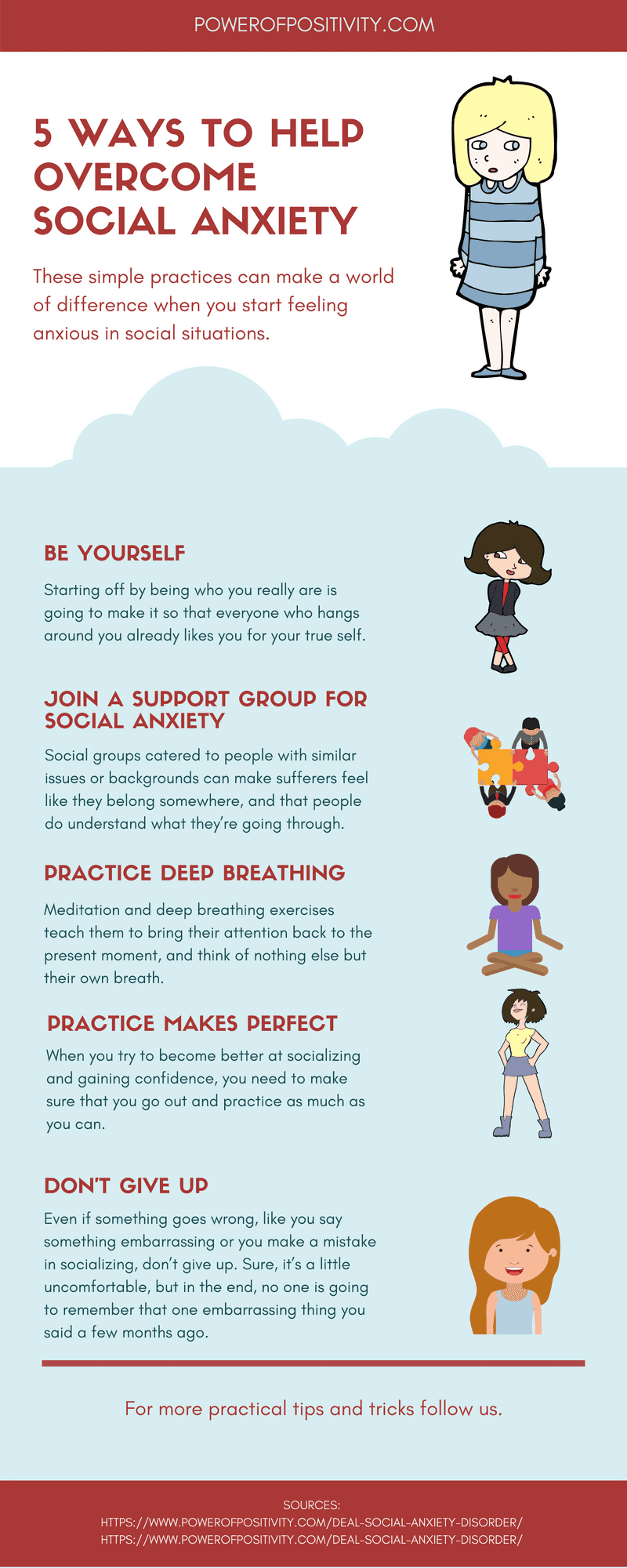
Ways to help overcome social anxiety infographic

SPEAK OPENLY ABOUT YOUR ISSUES

As with anything involving your overall health, you should have an at length conversation with your practitioner regarding the efficacy of the medication, side effects, and the proclivity towards addiction. Also, you should speak candidly regarding your social anxiety disorder symptoms. This discussion can help your physician or psychiatrist recommend the appropriate pharmacotherapy for you.

In summation, your social anxiety disorder does not define you, having the courage to seek help does. So, get help today.

10 Things You Need to Know Before You Try Low Carb Dieting

Paleo, keto, Atkins – you’ve probably heard of these low carb diet plans and others. Diets that are low on carbohydrates and high on fat and protein have been popular for a while now as a way to lose weight and get healthier. Maybe you’ve even thought about following one of these diets yourself.

If you’re thinking about ditching the carbs, there are some things you ought to know first. Eating low carb can be great for you – but it’s not for everybody, and it’s essential to prepare before starting this diet plan. Here’s what you need to know about low carb dieting.

10 Things to Know Before Starting a Low Carb Diet Plan

health quotes

1. A low carb diet isn’t a magic formula for weight loss.

Contrary to common belief, carbs are not responsible for weight gain – at least, not in and of themselves. It might be easy to gain weight if you eat a carb-heavy diet full of bread, pastries, and soda, but that’s because many high-carb foods are also calorie-dense and unsatisfying. Ultimately, losing weight comes down to how many calories you eat – not how many carbs you eat.

2. However, going low carb could help you drop pounds naturally.

Some people do manage to drop weight easily once they switch to a low carb way of eating. Why? Cutting out carbs means you’ll eat a lot more protein and fat, both of which are very satiating macronutrients. In other words, you’ll feel full more quickly and stay satisfied longer, so you won’t be tempted to overeat or graze on snacks.

3. You’ll probably feel bad for a little while after you cut out carbs.

If you drop carbs, be prepared for the “keto flu.” In a nutshell, when your body is used to using carbs as its energy source, it doesn’t know how to convert fat and protein into energy at first. As a result, many people feel tired and foggy-headed after cutting out carbs. Good news, though: keto flu typically lasts only a couple of weeks before you start to feel normal again.

4. People who exercise frequently may need more carbs in their diet.

Working out and eating low carb doesn’t always go hand-in-hand. Carbs are the best source of quick energy for the body, and if you’re staying away from them, you might feel weaker and less energetic during your workouts.

5. You might be surprised how many foods are high in carbs.

Carbs aren’t just in bread, pasta, and rice. They’re also in everything that contains sugar – and many foods have hidden sugar. Fruit also tends to be relatively high in carbohydrates, and vegetables contain carbs. Because of this, it’s not realistic or healthy to cut all carbs from your diet.

low-carb

6. Cutting carbs will help to stabilize your blood sugar.

If you struggle with frequent cravings or hunger pangs between meals, reducing your carb intake could help. Carbs – especially refined- like bread and soda – cause your blood sugar to spike and then crash. Loading up on protein and fat will keep your blood sugar a lot more stable.

7. Not all carbs are created equal.

A carb is not just a carb, at least in terms of nutrition. For instance, a package of ramen noodles is pretty nutritionally void, while a bowl of oatmeal contains high levels of healthy fiber and protein. A low carb diet isn’t a zero-carb diet, so don’t be afraid of working your favorite healthy carbs into your meal plans.

8. You’ll probably lose a few pounds of water weight quickly in the beginning.

If you lose five pounds during your first week of low carb dieting, don’t panic. It’s most likely just water. Carbs tend to hold onto water as you’re digesting them, so once they’re out of your body, you’ll see a corresponding drop in your weight.

9. You can still reduce carbs if you’re vegetarian or vegan.

A low-carb diet doesn’t have to be heavy on meat. Eggs, dairy, and cheese can stand in for meat if you’re vegetarian. You can fill your plate with vegetables, nuts, seeds, soy, and heart-healthy oils if you’re vegan.

10. Low carb dieting isn’t for everyone.

Some people adapt better to a low carb diet plan than others. After you get past the first couple of weeks, low carb dieting should make you feel good, not cranky or sluggish. If you cut carbs and find that you can’t stop obsessing about how good a bowl of pasta salad sounds, it could signify that your body functions best when you eat more carbs.

low carb dieting

Final Thoughts on Low Carb Dieting

Low carb dieting is popular for a reason. It can be a great solution if you want to stop eating junk food, improve your energy levels, or shed a few unwanted pounds. Of course, it’s always a good idea to check in with your doctor before you start a new diet plan.

Just keep in mind that not everyone functions optimally on a diet that restricts carbs. If you try low carb dieting and it doesn’t work out for you, that’s okay – there are lots of ways to be healthy, and reducing carbs is just one of them. Listen to your body, and you’ll find the perfect diet plan that works for you.

Sources:
https://ketosummit.com/what-is-keto-flu-how-to-cure-keto-flu
https://draxe.com/hidden-sugar-foods/
https://www.healthyeating.org/Healthy-Eating/All-Star-Foods/Grains/Article-Viewer/Article/208/health-benefits-of-oatmeal
https://paleoleap.com/everything-you-need-to-know-about-water-weight/
https://www.healthline.com/nutrition/low-carb-as-a-vegetarian#section5

5 Warning Signs That Reveal It’s Time To Get Help For Anxiety

Anxiety is a touchy subject that sparks serious debate. Some people believe related disorders are over-diagnosed. When considering the statistics, it is easy to see why. Nearly 50 million Americans have been diagnosed with an anxiety disorder. People who remain without diagnosis are not included in these statistics.

Other people claim these cases are rising because more things are vying for our attention. Again, we can find little to argue against this point. Many will agree we work too much, play too little, and rely on our digital devices far too often. As a result, we are overstimulated, which leads to stress and angst.

In reality, anxiety both reflects the times and serves as a normal human reaction to overstimulation. We might find it difficult to distinguish between “normal” and “abnormal” anxiety levels. To help, let’s look at potential warning signs of an anxiety disorder, according to scientists.

Here Are 5 Warnings That Tell You It’s Time to Get Help for Anxiety

1. It Is Interfering With Your Life.

When the symptoms become severe enough to the point of disrupting your life – relationships, work, health, sleep, etc. – it’s time to get help. When you have reached this point, you’ll usually know. If you don’t seek help yourself, don’t be surprised if friends or family bring the behavior to your attention.

Left unchecked, anxiety disorders can wreak havoc on your daily life. The sooner you make an effort to solve this issue, the better.strong quote

2. It Is Making You Sick.

Many of us tend to “separate” brain functions from those of the body. Science shows, however, an inextricable relationship between mind and body (sometimes called the “mind-body connection.”)

Our entire body acts as one big feedback loop. Each part of the body is interconnected. Consider your gastrointestinal (GI) tract or gut. The GI tract is referred to as the “second brain” because of its rich network of neurons. Your “gut feelings” are actual feelings!

If you’re struggling with a bad case of anxiety, you might have noticed it in your stomach, muscles, and elsewhere. Don’t ignore these signs. Get some help.

3. It Is Making You Exhausted.

For a person who experiences normal levels of mental and emotional agitation, the physical symptoms are temporary. The “on-edge” feeling eventually fades, and we regain our normal physical state. People with anxiety disorders typically experience something different.

Individuals with Generalized Anxiety Disorder (GAD), for instance, often complain of feeling a near-constant state of underlying worry and tension – and frequently for no reason. Despite knowing that no threat exists, someone with GAD cannot help but feel on-edge most of the time. Of course, this near-constant state of tension takes its toll on the body’s energy reserves. If your energy is being depleted by stress, you will feel more tired, more often.

4. It Is Making You Hopeless.

Studies show that as many as 85 percent of people with an anxiety disorder suffer from depression – and vice-versa. Depression, which is a serious mental health disorder, can produce symptoms such as:

  • Feelings of guilt, worthlessness, and helplessness.
  • Insomnia, early-morning wakefulness, or sleeping too much.
  • Loss of interest in things once considered pleasurable.
  • Trouble concentrating, remembering details, and making decisions.

Clinical depression can lead to thoughts of self-harm or suicide. Often, a sense of hopelessness and helplessness preempts these thoughts.

5. It Is Changing You.

This last symptom affects nearly everyone with an anxiety disorder. Like depression, this condition alters your brain chemistry. Importantly, this makes you find it more difficult to go through daily life. In short, if chronic and left untreated, these symptoms can make you feel as if your life is being “ruined.”

As one who has suffered from a severe anxiety disorder (PTSD), this author wholeheartedly sympathizes. If you feel your life is being ruined by these emotions, please seek the help of a mental health professional.

Final Thoughts: There ARE Options.

In conclusion, this condition has a way of screwing up your brain chemistry. You can easily reach the point of feeling every day seems like a hopeless endeavor.

First of all, remember that these are just feelings. While recovery is not a simple process, you certainly can achieve it. These treatments, backed by science, can help with anxiety disorders:

  • Cognitive-Behavioral Therapy (CBT): Focuses on changing thought patterns and automatic behaviors.
  • Breathing Exercises: A direct link exists between how we breathe and how we feel.
  • Medications and Supplements: Studies show that certain anti-anxiety medications and supplements can help some people feel better.
  • Meditation and Mindfulness: Many recognize this as a legitimate treatment. Either mindfulness or meditation help regulate levels of disquiet through controlling emotions. You can find one example of this on the web: mindfulness-based stress reduction, or MBSR, an emotional regulation technique. (Google MBSR founder Jon Kabat-Zinn, if interested.)

Most of all, never give up hope. Remain positive that you can find the help you need. While it might seem far, hope and change are sometimes a single step away.

https://youtu.be/VlUfp0uZXvA

(C)Power of Positivity, LLC. All rights reserved
Sources:
http://www.ulifeline.org/articles/439-anxiety-vs-anxiety-disorders
https://www.inc.com/amy-morin/10-reasons-american-teenagers-are-more-anxious-than-ever.html
https://www.self.com/story/when-to-see-professional-anxiety

7 Panic Attack Symptoms you Should Not Ignore

With the high-stress and fast-paced environment associated with contemporary society, panic attacks have become relatively common. However, many people are oblivious to the signs of a panic attack. Having the right knowledge about panic attack symptoms is helpful in understanding the attack. Panic attacks (PA) involve episodes of intense fear and tend to invoke feelings of terror in an individual and often strike without any warning; for example, as one is driving or in a meeting.

In some cases, panic attacks can even occur during sleep. However, the attacks are not caused by real danger and usually have no apparent cause. Although panic attacks do not pose a real danger to one’s life, they can significantly affect an individual’s quality of life.

Frequently, PAs tend to last less than ten minutes. However, in some individuals, the symptoms can persist for longer periods. The risk of having subsequent attacks for individuals who have had PAs is relatively high. If attacks occur repeatedly, and there is a high likelihood of getting more attacks, a person can be considered to have a panic disorder. Research shows that 2.7% of adults in the United States will suffer a panic disorder every year. This article aims to enlighten you on panic attack symptoms you should not ignore.

Panic Attack Symptoms you Should Not Ignore

1. Aggressive Heart Palpitations/Racing Heartbeat

During a panic attack, the heart goes into overdrive. When the sympathetic nervous system is awakened, the heart rate increases in an effort to deliver more oxygen to muscles to prepare an individual to run or fight. Therefore, during a panic attack, the heart palpitates aggressively.

The palpitations can exacerbate the level of panic and cause the person to perceive that the heart has a problem. To identify panic attack symptoms, one should observe whether the heart palpitations are associated with fear, stress, or anxiety. If the heart palpitations are accompanied by an emotional response, then you are experiencing a PA.

2. Dizziness, Weakness, and Light Headedness

Studies show that panic attacks cause dizziness due to the hyperventilation and anxiety accompanied by the condition. During the PA, the irregular breathing causes less oxygen to go the brain; albeit for a short period. Hence, confusion and dizziness can occur. The lightheadedness is also accompanied by a characteristic weakness. Weakness arises from an interrupted blood flow. Due to the lower blood volumes in the hands and feet, you might feel weaker in the legs and arms. This is just as a result of redirection of blood to bigger muscles to prepare you to take any action.

3. Chills and Hot Flashes

At the initial stages of a PA, the body experiences hot flashes for a short period. During the attack, your blood is retracted from areas that the body perceives are not needed including toes, skin, and fingers and redirected to the big muscles that can help you flee or fight. Subsequently, the skin around the feet and hands turns pale and cold.

4. Shortness in Breath

The body responds to panic attacks by causing you to breathe faster and deeper to help your heart deliver more oxygen to the muscles in preparation for the perceived danger in the environment. In some cases, breathing is interrupted and can become irregular leading to breathlessness.

5. Nausea

The digestive system responds to a PA by slowing down to a crawl. The stomach begins to experience a churning feeling because the food is not moving efficiently through the system. Consequently, you might experience feelings of nausea which may significantly affect appetite.

6. Uncontrollable Shaking and Perspiration

Once the body enters an attack cycle, the muscles become tense and you might begin to feel shaky or see the body trembling. The flight or fight response is primarily in charge of this response. Some individuals might see the hands, lips, or shoulders begin to shake uncontrollably. Other panic attack symptoms include sweating profusely during the attack. The sweating serves to cool the overheating body.

panic attack symptoms

7. Aloofness to Reality

One of the common panic attack symptoms is a surreal feeling of reality. You might begin to feel like you are in a dream or like the body has taken over all sense of control. An individual can begin feeling like the present environment is not real or might see dangers that are not real.

Evidently, the level of fear and terror that associated with PA is usually unrelated to the goings on in the environment. One key fact to remember to enable you to differentiate between a PA and a heart attack or other debilitating conditions, is that the PA is caused by “perceived danger.”

Panic attacks are reactions to what people term as fearful and scary and are not caused by real health problems. To overcome panic attacks, it is important to understand that the fear is superficial. There are numerous strategies you can apply to help you overcome PA such as meditation, psychotherapy, regular physical activity, support groups, or medications.

https://www.youtube.com/watch?v=FWMSYeRHWU4

Skip to content