Weekly tips, affirmations, and small actions to feel your best.

How to Make Blueberry Raspberry Crumble Bars

Blueberry raspberry crumble bars make the perfect refreshing summer treat. While they’re a dessert, of course, they’re light and airy enough to enjoy guilt-free! This recipe will make enough for a family, but we won’t judge if you decide to eat the whole pan. These scrumptious crumble bars have the perfect ratio of sweetness and tartness, taking your taste buds on an exciting culinary adventure.

You probably have a lot of the basic baking ingredients stuffed away in your cupboards somewhere. If not, it just takes a quick trip to the store to gather what you’ll need. So, let’s get to the good stuff! We’ll share our secret on making the best blueberry raspberry crumble bars you’ll ever taste.

How to Make Blueberry Raspberry Crumble Bars
crumble bars

Kitchen gadgets you’ll need:

  • Large mixing bowl (as usual)
  • Smaller bowl
  • Whisk
  • Large spoon
  • Large baking sheet
  • Parchment paper
  • Large cooking pot
  • Measuring cups and spoons
  • Knife
  • Aluminum foil
  • Rolling pin or coffee mug

Ingredients for bottom and top crumble layer:

  • 4 cups rolled oats
  • 4 cups all-purpose flour
  • 1 tbsp baking powder
  • 1 1/2 cup coconut sugar
  • 1/2 tsp salt
  • 1 1/2 cup coconut oil
  • 1 tbsp vanilla

Ingredients for blueberry raspberry filling:

  • 1 cup frozen raspberries
  • 1/2 cup brown sugar
  • 3 tbsp lemon juice
  • 1 cup frozen blueberries
  • 1 tbsp corn starch
  • Fresh raspberries and blueberries

blueberry raspberry bars

Directions for making the crumble layers:

  1. You know the drill for these recipes by now, right? We thought so! Have your large mixing bowl handy. Pour in the oats, all-purpose flour, baking powder, coconut sugar, and salt.
  2. Whisk the ingredients until fully combined. Next, pour in the coconut oil and vanilla, using the large spoon to blend them into the oats.
  3. Once they’re thoroughly combined, use your hand to mix the ingredients further. The texture should resemble crumbly oats.
  4. Now, grab your baking sheet and line it with parchment paper. Pour 2/3 of the mixture onto the pan, and save the rest for later.
  5. Use your hand to spread the mixture evenly across the pan, pressing down firmly along the edges. Next, use a coffee mug or rolling pin to roll the oats. This ensures they’ll bake evenly and won’t fall apart on you.

Directions for making the blueberry and raspberry fillings:

  1. Set that aside and get out your cooking pot. Pour in the frozen raspberries and turn the heat on medium-low. Stir occasionally.
  2. Once they come to a slight boil, pour 1/4 of the brown sugar and mix it in.
  3. Next, mix in 2 tbsp of the lemon juice. When the raspberries have cooked down to a sauce-like, slightly chunky texture, remove from the heat.
  4. In a small bowl, pour in your frozen blueberries. Mix in the remaining 1/3 cup of brown sugar, 1 tbsp lemon juice, and corn starch. Use a small spoon to blend the ingredients, mashing down the blueberries in the process.

Putting it all together:

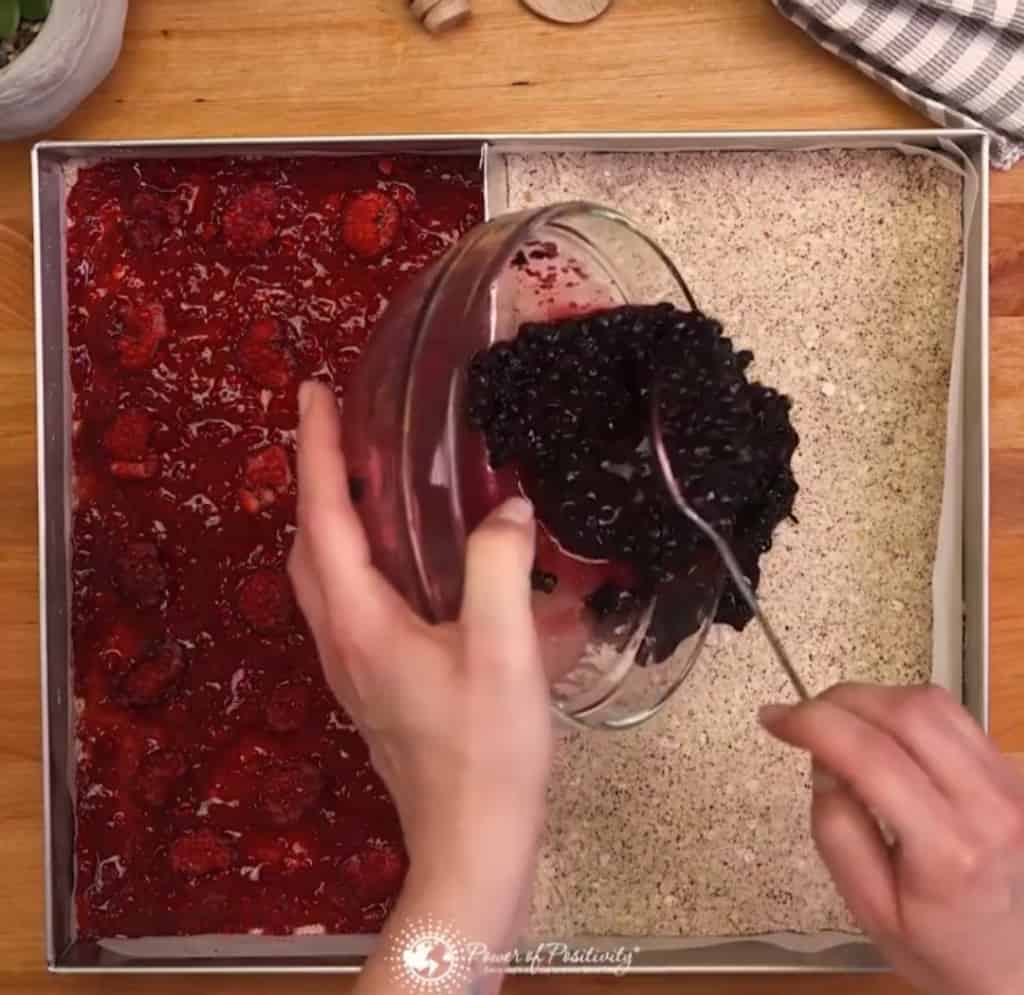
  1. So, now that you have your two fillings for the blueberry raspberry crumble bars cut down the middle of the crumble layer with your knife.
  2. Next, take a piece of aluminum foil and fold it up lengthwise. Use this to separate the blueberry and raspberry fillings where you made the cut down the middle.
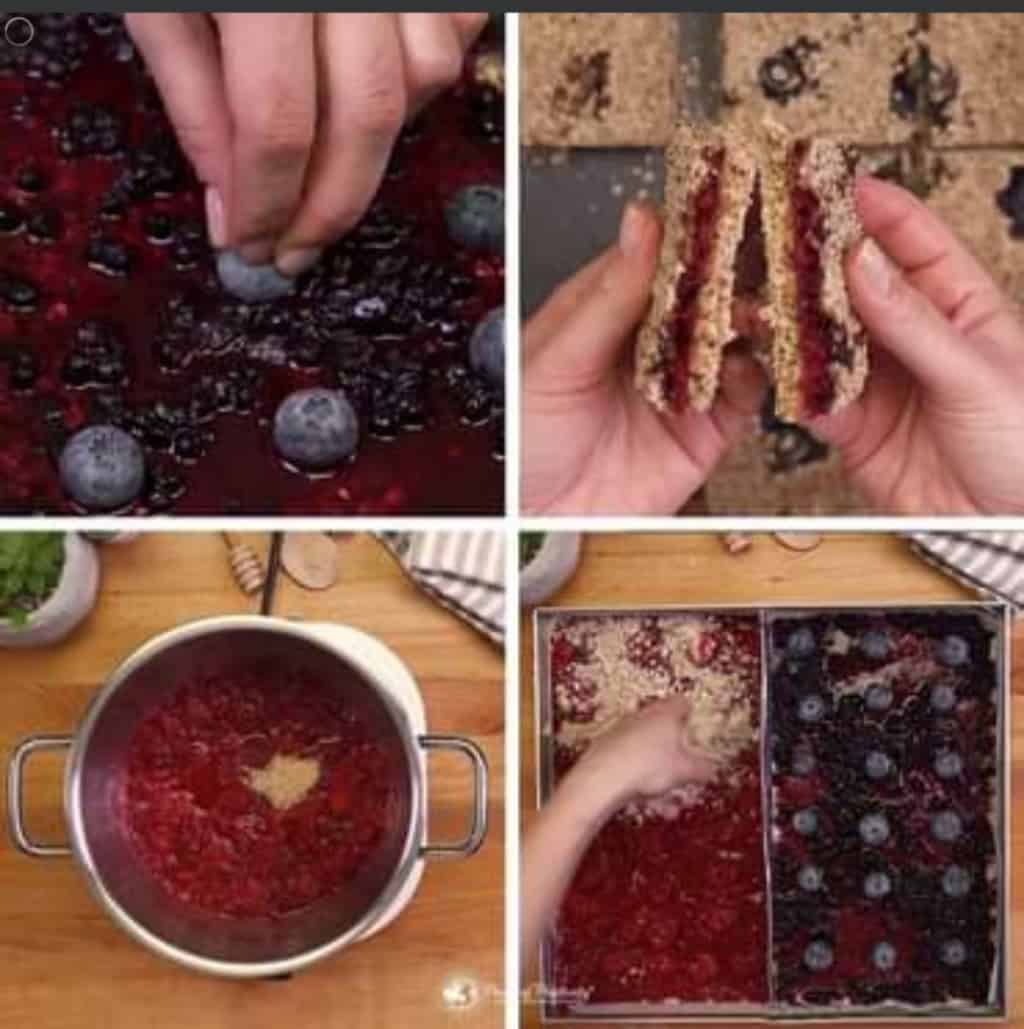
  3. Now, spoon the raspberry filling onto one side of the pan. Take a container of fresh raspberries and place them uniformly throughout the filling. This will add some texture to the crumble bars.
  4. Repeat this step with the blueberry filling on the other side. Place fresh blueberries on top of the filling, about three per row. If you want to be exact, we used about 18 blueberries total.
  5. Finally, sprinkle the rest of the oat mixture on both the raspberry and blueberry fillings. Pat it down with your hand, then bake the crumble bars at 350 degrees F for 40-45 minutes.
  6. Now, remove the parchment paper and aluminum foil. Cut the bars lengthwise on each side, then make three cuts widthwise. You should end up with 8 crumble bars of each filling.

We hope you enjoy these delectable crumble bars! They’re gooey, crunchy, sweet, and tart at the same time, giving them the perfect texture and flavor.

A few more tips:

To ensure your bars turn out amazing, here are a few extra pro tips we gathered along the way:

  • Want an extra crunchy crust and topping? Add about 1/2-1 cup of butter to the recipe! You’ll want to make sure it’s softened first, so it’s easier to mix in. Not only will the addition of the butter provide more texture, but it will also give the crumble bars a richer flavor as well.
  • If you’re a big berry fan, feel free to add other types of berries like blackberries or strawberries!
  • Chill the bars for 30 minutes to an hour before cutting them. It will make the slices much cleaner and easier to cut.
  • Serve with vanilla ice cream or whipped cream on top! (You can also eat them for breakfast since they have fruit, but you may want to opt-out of the ice cream in this case).
  • Freeze or store in the fridge if you have leftovers. Keep in mind that the crumbly texture won’t keep as well in the freezer. However, the crumble bars will still taste amazing!

Final thoughts on these amazingly delicious blueberry raspberry crumble bars.

If you’re drooling after reading this recipe, we don’t blame you. Maybe it will give you more motivation to get into the kitchen and start baking! It doesn’t seem all that appealing to stand over a hot oven on hot summer days. However, these bars will help cool you off with the refreshing berry layer, so it’s totally worth the effort, in our opinion.

Many variations of crumble bars exist, but there’s none quite as revitalizing as these berry crumble bars. Desserts get a bad rap these days because they’re usually heavy and filling, but this recipe is just the opposite. Ready to try them out for yourself? We thought so!

Talented Woman Designs Unique Polymer Clay Jewelry

Eliza, the owner of Boogie Bee Jewelry on Instagram, creates unique polymer clay jewelry such as watches and earrings. The jewelry features cute themes such as aliens, animals, mushrooms, and other wildlife. With bright colors and adorable prints, these fun earrings appeal to almost 30k followers on Instagram.

A type of modeling clay, polymer clay, doesn’t contain any clay materials. It’s made of synthetic materials like plasticizers and PVC (polyvinyl chloride). However, since its characteristics resemble clay so closely, many people consider it “man-made clay.” The polymer clay shares natural clay’s flexibility, versatility, and simplicity, making it attractive to artists.

The history and background of polymer clay

  • Polymer clay didn’t make its debut in the world until the late 1930s. While it’s a relatively new arts and crafts medium, the pliable clay has grown in popularity worldwide.
  • It was first discovered in Germany by doll maker Fifi Rehbinder. She had trouble finding her standard supplies due to political uprisings at the time. So, she decided to make her materials, creating a plastic clay she called “Fifi Mosaik.”
  • About 30 years later, in 1964, she sold her formula to manufacturer Eberhard Faber. They named it Fimo, and toy stores across Europe started carrying the polymer clay.
  • The clay didn’t appear in the US until the 1970s. An immigrant family from Germany received the Fimo brand clay as a Christmas present from their grandmother, still living in Germany. In 1975, the family started importing the clay into the US, and companies jumped on the bandwagon also.
  • Others in the US also began to create their versions of polymer clay. In the 1960s, Zenith Products Company accidentally made a polymer clay while working on thermal transfer compounds. It didn’t work as they’d hoped, but the owner’s daughter suggested using it as an arts and crafts medium. The company named it “Polyform,” known today as the popular polymer clay “Sculpey.”
  • Sculpey started selling colored clay in 1984. Until that time, artists had to create their colored dyes for projects.
  • Today, many different companies sell polymer clay, and it’s even available in other varieties. Liquid polymer clay, mica clays, glitter clays, and glow-in-the-dark clays are some other popular options.

Interesting facts about polymer clay

  1. It stays soft until baked in the oven. You can bake it in your regular home oven since it’s non-toxic. Most name brands recommend to bake the clay at 275 degrees F for about 30 minutes.
  2. In addition to making jewelry, some people use it to create picture frames, figurines, keychains, ornaments, and more. The sky’s the limit when it comes to what you can start with this bendable clay.
  3. It dries much quicker than traditional air-dry clay. Once it’s out of the oven, it’s ready to use once it cools.
  4. It doesn’t dry out, so you can store it for years and pick it back up where you left off. However, it does keep best in a cool, dry place out of sunlight.
  5. You don’t need much to get started. If you’re making earrings, you’ll need the clay, earring backs, jump rings, flexible superglue, and parchment paper for baking. For tools, you will need to have an acrylic rolling pin, a sharp craft knife, clay cutters, a baking sheet, a toothpick or large needle, and jewelry pliers handy.
  6. Before you make your creations, you’ll need to condition the clay. To do this, roll and knead it in your hands to increase flexibility and softness. Many artists use a pasta machine to make the process easier; run it through about 20 times for best use.

Eliza’s journey with selling her polymer clay creations

“So, I started my jewelry account in January of this year (2020), which has been crazy. But making art in general, I would say it’s been my whole life. My earliest memories I can recall my mom painting and always doing something fun to my bedroom,” Eliza says. “Like we would have really decorated and coordinated furniture in my rooms and…I remember she painted vines on one of my walls one time. I definitely helped with that, and I think I liked it.”

Eliza enjoys making her earrings in natural light whenever possible. She often works on her balcony or even sitting outside in the grass. Being natural helps to inspire the creative process.


She advises anyone entering the polymer clay art world to ask for help if they need it. For example, if you follow a creator online who inspires you, don’t hesitate to reach out to them. Often, if you’re polite and open-minded, they’ll offer you advice on getting started.

Eliza learned the hard way and tried to set everything up herself. She wanted to find things out on her own, but this made the process much more difficult. So, for any newbies, she suggests not following in her footsteps and getting the advice of long-time makers.

She says, “You’d be surprised how many people are willing to help you.”

If you’d like to check out her creations, please visit her Etsy shop! She’s currently taking a break, but you can still peruse her earrings and other jewelry. We guarantee you’ll find something that catches your eye.

Final thoughts on this talented woman who designs polymer clay earrings

If you’ve never heard of polymer clay before, you’ve probably seen it at least once in your life. Many crafters use it to create many arts and crafts, from figurines to jewelry, because it is durable and flexible. Not to mention, it’s pretty easy to use; you roll it, pop it in the oven, and it’s ready to go! After baking it, you can create almost anything you can imagine, and it will last for years to come.

Working with polymer clay looks quite fun, so maybe you’ll want to give it a try. If you’re not the artsy type, you can still use it for practical things like bookmarks, planters, and even dishes!

Which pair of earrings in the video was your favorite? Let us know in the comments!

This Tiny Home Can Travel Over Land and Water

Living in a tiny home comes with a lot of perks – it’s eco-friendly, cheaper, and encourages minimalism. In today’s world, people want to cut costs wherever possible. One of the easiest ways to accomplish this is to eliminate mortgage payments and downsize your home. Enter the tiny house movement.

Living in a tiny home gives you a unique opportunity to reflect on what’s really important. We actually don’t need very much to survive – just food, water, shelter, clothing, and positive relationships. When you reduce your expenses and “unnecessary necessities,” you start to appreciate simplicity much more.

Many people in the tiny home movement also enjoy a closer relationship with nature. Many of these homes are built in forests or secluded places so that the owners can reconnect to the natural world. Not to mention, some of them are mobile as well, giving people the opportunity to explore different areas. You can start living in a mobile home, and Home Nation will build a custom home for you based on your preferences.

How Zeltini Got the Idea for This Tiny Home

That’s the idea behind Zeltini, which builds electric tiny homes that can traverse both land and water. Aigars, the founder and CEO of Zeltini shared more with us about his company and how it’s changing the face of the tiny home industry.

“When I was in Amsterdam, I stayed in an eight-meter longboat, and I just fell in love with the whole concept of living in a boat,” Aigars said. “But, I kind of like land as well, so I thought, “Okay, that’s it! I’m going to build amphibious homes.”

“So, Z-Triton is a houseboat trike; it’s a small, little amphibious electric camper. It’s both a tiny boat, a tricycle, and a little house for two people,” he explains.

The bike can switch to boat mode in about five minutes by simply lifting the tires and inflating small rafts on each side for stability. The company hopes to ship worldwide eventually, though they’ll start with Europe first as they’re based in Latvia. If you want to invest in a boat or any watercraft, you may need to install modular floating docks in your property.

More about the tiny home that can travel the land and seas

A few specs about the unique e-tricycle camper:

  • 100% electric recreational vehicle
  • sleeps or rides two people
  • electric boat motor with cabin steering
  • electric bike assistance/motor
  • integrated solar roof panels with Li-ion battery pack
  • range = 2 days (50km land + 20km water)
  • includes a pot on the roof for your favorite plant! (coolest feature, in our opinion)
  • fold up kitchen table
  • cooling/heating
  • USB charging, GPS, sound system, etc


View this post on Instagram


A post shared by Aigars Lauzis (@aigars.lauzis)

These unique tiny homes have everything you could ever want in a recreational vehicle. While you probably wouldn’t want to live in them full-time, they’re perfect for a weekend getaway into nature. They have all the comforts of home along with modern technology, so it’s the best of both worlds. Whether you’re driving or boating, you can take your tiny home with you for the adventure!

“The mission really is to shift the way people travel. It’s also what Z-Triton really aims to be – the most fun, sustainable and unique way to travel,” Aigars says. He also enjoys bringing happiness and smiles to people’s faces and giving them an opportunity to reconnect with nature.

The company began in 2018, intending to create meaningful projects that contribute positively to the planet. The unique tiny home does just that, making life better for humans and the Earth they inhabit. Nowadays, Zeltini focuses mostly on the manufacturing aspect of the company. They’re building a team and creating prototypes to have Z-Triton market-ready by summer 2021.

Currently, you can reserve a tiny home on the website, but they’re only delivering in Europe for now. However, once they run initial tests on product quality and gain customer feedback, they will start shipping overseas. Zeltini also plans on doing test rentals and public demos as soon as this summer.

The story behind the revolutionary tiny home company

 Taken from the website, “There is a rather unique back story of Z-Triton. Aigars, the Founder, cycled from London to Tokyo and came up with the idea of amphibious e-camper while staying for a few months in Shanghai. Z-Triton is his take on a cycle-touring upgrade.”

From 2013-2017, Aigars embarked on a solo cycling adventure across Europe and Asia. In total, he biked a whopping 30,000km, stopping four times along the way. He worked as a designer in Istanbul, Dubai, Singapore, and Shangai. While taking a break from traveling in Shanghai for a few months, he got the idea of how to upgrade cycle touring.


View this post on Instagram


A post shared by Z-Triton (@ztriton_amphibian)


The tiny home boat bicycle was born, and he got to work creating sketches and the first model of the product. After creating a mock-up, he began testing at a local park near his apartment. Upon returning to his native Latvia in 2017-18, Aigars began setting up his design and prototyping studio, Zeltini.

In 2018, Aigars and his team started the grueling work of early prototyping. They employed 3D modeling, CNC milling, woodworking (Kārlis Zemītis), metalworking (Gatis Kreicbergs), 3D printing, and lots of creativity to create the alpha prototype Z-Triton. Last year, all their hard work finally paid off. The final prototype was complete, and the fun part began. They took the tiny home out for trial runs on the water, busy city streets, and nature trails.

After posting the product to social media, it gained traction quickly. Customers can now pre-order their very own floating tiny home on wheels, though shipping will only take place in Europe for now. The company expects to ship worldwide once further trials and testing are complete.

Final thoughts on the tiny home that can travel on both land and water

The Z-Triton tiny home/boat/bike will change the face of the industry forever. Now, people don’t have to stay in one place in their tiny dwelling. They can also take it out for a spin or a boat ride! There’s truly nothing else like it out there, and hopefully, it will catch on worldwide.

Would you buy one of these tiny homes? Let us know in the comments!

3 Positive Ways To Curb Bad Behavior In Children Without Punishment

The more we scientifically learn about parenting, the more we discover that punishment isn’t an effective way to correct children. It can even do a lot of harm to a growing child, and it might even make the undesirable behavior much worse! In other words, it’s a counterproductive practice that needs to be significantly reduced among parenting styles.

But it can be hard to understand or learn how to correct a child when punishment is off the table, especially if you were raised with punishment yourself. How can you stop a kid from acting negatively while only projecting positive things? Here are three positive ways to curb bad behavior in children without punishment.

1.    Change Your Reaction To Bad Behavior in Your Children

Children rarely ever misbehave on purpose or with malice. They may do so because they don’t understand that what they’re doing is wrong, or because they’ve learned that doing so gets them the attention they need, or because they’re just trying something out.

So when you react with punishment to these innocent or non-malicious sources of misbehavior, children learn that they can be punished for just about anything, even things they don’t think are wrong. It creates an environment of fear. This is why changing your reaction to misbehavior first is an essential step in curbing bad behavior in a positive way. Here’s how to start:

bad behavior in children·         Don’t Use Negative Reinforcement

It’s easy to impulsively provide negative reinforcement as a teaching method when your children misbehave. But research shows that negative reinforcement doesn’t work at all. Instead of helping a child improve their behavior, it’s likely to do almost nothing at all or even make that behavior worse!

·         Ignore Mild Acts of  Bad Behavior in Children

When children misbehave because they want attention, they don’t care if the attention they receive is negative or positive. As long as they get the attention, they consider the action they performed to get it worth doing again. Little acts of rebellion that are harmless, like whining, making a fuss, or fiddling with things they shouldn’t, are ones you can safely ignore. Turn away and wait for your child to ask nicely for attention before you give them any, reinforcing that they cannot act out in order to get what they want!

·         Don’t Shout

Sometimes, on impulse, you may want to shout at a child who is misbehaving. Not only will this frighten many kids, but it’ll also be a way of giving attention to a child who may be misbehaving on purpose. Explosive reactions are scary but they’re also a signal that something is happening, and neither of those is a thing you want a child to associate with your shouting. Focus on teaching instead.

For example, if your child throws a toy on the ground after they’re done, don’t yell, “Stop throwing your toys everywhere! You make such a mess!”. Instead, show them how to handle the toy. “See, when you’re done with your toy, you can pick it up and put it back in the toy basket.” Then, let them demonstrate, and praise them for trying. When they continue to perform the positive behavior, praise them again for learning.

·         Use Natural Consequences

A lot of life’s actions have natural consequences, and these can teach children pretty well! Instead of punishing your children, allow natural consequences to be their teacher, with your presence around to explain and cement it into a teachable moment. For example, if a child leaves their toys outside even though they’ve been told not to, their toys may get dirty.

You will then point this out to your child and help them make the connection between their actions and the natural consequence, including the logical consequence that your child has to clean the toys now before they can be used again. This will help to show your child the natural result of their actions.

2.    Model The Behavior You Want To See

Kids learn by copying their parents or guardian figures. They like to mimic the behavior that they witness. So if you want to curb bad behavior in children, make sure you avoid doing any of it yourself! Research has shown that kids learn well by observation in their early education years, so letting them see the positive behavior you want them to perform helps by:

  • Encouraging them to copy you and “be like you”, especially at a younger age.
  • Showing them as they grow up that you truly mean what you say and practice what you preach.
  • Giving kids a set of example behaviors that they can try to include in their everyday life, especially in a situation when they’re not sure what to do.
  • Reducing the time you have to spend on directly teaching them, giving you more time to guide them through the behaviors they’re naturally picking up.

bad behavior in childrenHow to Model Better Behavior

You’ll have to be a good role model to curb bad behavior, and that can be difficult. As a parent, you’ll find that you have to learn to control your natural human impulses and actions. It’s more complicated than it looks to always behave well! So, in that vein, you should also be modeling ways to correct your behaviors when you perform harmful actions. You can do this by:

  • Being open about your flaws and showing your child that flaws are human and normal, then showing them how you work to improve yourself from these flaws so that you can be a better person.
  • Apologizing when you do something wrong, whether to the people around you or your children; make it clear that you respect your child and will apologize to them if you hurt them as much as they should apologize to you if they hurt you.
  • Showing how you forgive others and how you are forgiven so that your child knows that they can receive forgiveness if they apologize well, too.
  • Demonstrating the ways with which you make up for bad actions and help the people you’ve hurt to feel better.

3.    Use Praise For Good Behavior

It seems like a no-brainer to praise kids when they behave in positive ways, but not many parents do this well! This lapse occurs because it’s easy to accidentally not notice when a child is behaving well – they’re quiet, out of your hair, and in no need of correction. But if you don’t give them attention while showcasing positive behavior, they’ll learn that negative behavior is the only way to grab you!

On top of that, studies show that the use of good praise has a positive effect on the behavior of a child by improving their growth and development, giving them the motivation to learn, and providing a reason to correct themselves. So, how can you correctly utilize praise? Here are some tips:

·         Try Your Best To Notice Good Behavior–Not Just Bad Behavior in Your Children

As previously mentioned, it’s easy to overlook good behavior because it’s what you expect and want. Misbehavior stands out, and little good acts don’t, after all. That’s why you need to make even more effort to pay attention to the good things! Keep an eye on your child and give them praise for their positive actions. For example, you might say, “You shared well with your sister. Good job!” or “You’re being very responsible by keeping your toys after you finish with them.”

·         Don’t Be Stingy With Praise

While you shouldn’t exaggerate praise, you also shouldn’t treat it like a prize to be hard-won. Praise your child often and in small ways whenever you notice positive behavior, especially if that behavior is new. This kind word gives your child a clear indication of the desired behavior and establishes healthy, encouraging rapport in your bond.

·         Never Use Praise Sarcastically

Praise is supposed to be a solely good thing. Never something used to shame. Don’t say, “Oh, look who finally started doing the dishes. It only took you several hours!” for example. This lack will only leave a bitter taste and teach a child that they won’t receive genuine praise no matter what they do. Instead, provide sincere compliments, such as “I’m glad to see that you’re doing the dishes like I asked you to. Good job!” Then, if applicable, you can offer a correction or set a better expectation, such as “I know dishes aren’t fun! I don’t like doing them either, but the sooner they finish, we can relax. So in the future, I would like for you to do the dishes within one hour of meals, okay?”

·         Use Praise Instead Of Material Rewards

There’s nothing wrong with giving your child a material reward now and then, but using that as the primary reward method can lead to reliance on extrinsic motivation. You want your child to feel good about good behavior, not only to behave well because they’ll get something they want in exchange. Try to use praise much more than material rewards, and instead of using material items as rewards, give them as presents.

·         Remind Your Child That You Believe In Their Goodness

Children misbehave now and then, and when that happens, you can remind them of the positive and good behavior you know they’re capable. This reminder is a positive way to use praise to correct misbehavior. For example, you might say, “I know you’re a kind person, and it wasn’t very kind of you to refuse to share with your sister. Can you think of something you can do with your sister now to show your kindness?”. The goal is to direct your child towards positive thinking of themselves and their actions, so they feel encouraged to behave well.

Note that your praise must be genuine when you provide it, and you should not exaggerate it. Exaggerated praise can contribute to low self-esteem and decreased positive thinking in people of all ages, according to studies. So make sure that you praise fairly and in moderation – too much of anything is bad, after all!

bad behavior in childrenFinal Thoughts On Some Positive Ways To Curb Bad Behavior In Children Without Punishment

Punishment is a method that doesn’t work as well as we used to think when it comes to curbing bad behavior in children. Learn to use positive methods instead, such as changing your reaction to misbehavior, modeling desired behavior, and using praise for good behavior, can work much better in raising a well-behaved child!

Nobody’s Perfect…Cut Yourself Some Slack

Everyone makes mistakes from time to time. However, when you don’t do everything just right, does it trigger frustration or even anger from you? Nobody’s perfect.

So now you should reflect and wonder. Why are you so hard on yourself?

When’s the last time you got mad because you didn’t do something just right? Perhaps it was a foolish mistake that showcased the inner perfectionist. Sadly, being hard on yourself is something that most people do, and it’s completely normal.

However, while it’s normal to be down on yourself, it doesn’t mean it’s healthy. Part of self-care is learning how to love and take care of yourself, and this includes being able to speak positively rather than negatively.

Nobody’s Perfect… So Why Are People So Critical of Themselves?

nobody's perfectYou know that nobody’s perfect, and there are many lessons you learn in life that mold you into a better person. Still, why do people beat themselves up when they stumble? A recent study shows that women tend to be a bit more critical of themselves than men.

According to research by Tech Times, the average female will put herself down more than eight times each day. Even more shocking is that 89 percent of these women are more eager to compliment others before themselves.

Now, this doesn’t mean that men don’t put themselves down either. It simply means that this study showed ladies are more inclined to be critical of their abilities. In many instances, you give the small mistakes in your life more attention than they deserve.

The interesting thing is that you will likely not even remember these minor blunders one month from now. However, the big mistakes are the ones that make you feel like a complete failure, and they’re the ones that stick with you.

You must remember that big or small, your mistakes don’t define you, nor do they make you a failure. It’s a common misconception that your disasters destroy you. Each time you stumble and fall, you learn a lesson that helps you grow and change.

How many times does a baby fall before they learn to walk? Even though the toddler’s parents told them not to touch the stove, they did it anyway. However, they learned that the stove is hot so that they won’t make that mistake again.

If you don’t make a few mistakes along the way, how will you ever learn anything? It takes a “burn” from something like touching a hot stove to teach you what is dangerous. Think of your blunders in life as steppingstones toward being a better you.

Five Common Reasons for Your Critical Nature

Since nobody’s perfect, why do you expect yourself to be faultless? Some experts believe it’s the very foundation of human thinking. However, this thought process is fueled by many things in life.

1. Competitive Nature

One thing that seems to be a challenge for most people is the rising competition to be more and do more in life. It’s a natural part of humanity, but it doesn’t make it easy on your psyche. Why do people feel they need to set the bar higher and higher, and they’re never satisfied with what they’ve achieved?

Sure, each person has an inner drive that encourages them to do better, but it’s not always beneficial. Social media has changed the way people view themselves. No longer are you just competing with people in your local neighborhood, but you have friends all over the world showcasing their accomplishments.

Social media sets ridiculous standards that make perfection seem commonplace. If you constantly compare yourself with the world around you, you will never measure up. Then, once you do get to the top position, you will live in fear because you have so much to lose.

One of the biggest reasons people beat themselves up is that they constantly compare their accomplishments to others. Remember that nobody’s perfect, so stop putting so much pressure on yourself.

2. Nobody’s Perfect, But Many Still Have Unrealistic Expectations

According to TechRepublic, the Netherlands has the shortest workweek in the world. People in this country work around 29 hours each week.

However, the same article states that the average workweek in Columbia is fifty hours, and Americans work around 41 hours a week. The workweek is getting longer, and the push for productivity and more work is burning people out. Not only does your boss likely have unrealistic expectations, but you also put added stress on yourself to be and do more.

3. The Trap of Perfectionism

The world by nature is very competitive. You don’t need to look too far to see the effects of this cutthroat side of folks. Look at social media.

Everyone posts the best moments of their life on display for all to see. You may see a perfect family living in suburbia, making good money, and living out all their dreams. Sadly, what they don’t show you is the authentic version of themselves.

The problem is these little snapshots of perfection send your brain a message that you need to measure up to their standards. Nobody’s perfect, so why do people try to portray that for the world to see?

You will never be perfect because it’s impossible to reach perfectionism. Even when you reach a goal, you’ll always find bigger, better, and more you can achieve. What you’re doing is setting yourself up for failure and low self-esteem.

Following the tracks of perfectionism will send you in a downwards spiral.

perfectionism4. Poor Confidence and Esteem

When you set the bar in your life at unobtainable levels, you set yourself up for low self-esteem and poor self-confidence. Did you know that people with esteem issues are more likely to be hard on themselves? These negative emotions can cause you to avoid social settings and be fearful of leaving your comfort zone.

You’ll be afraid to try anything new or face challenges because you don’t believe in yourself.

5. Restricting Beliefs

Do you limit your beliefs in what you can achieve? Self-limiting beliefs will alter your abilities. When you set the bar too high and you cannot reach it, you’re sending a message that you’re a failure to your psyche.

Have you ever used the following phrases when you’ve failed?

  • “I am such a failure.”
  • “I knew I couldn’t do this anyway.”
  • “All I ever do is mess up.”
  • “I’m a loser.”

All this negative self-talk is just giving yourself evidence to verify your idiosyncrasies. Your self-limiting beliefs will cripple you if you allow them.

Changing Your Mindset

Why do people not understand that it’s okay not to be okay? There’s absolutely no reason to beat yourself up constantly over things you cannot control. Nobody’s perfect, so stop being too hard on yourself.

Here are some tips for you to practice increasing your self-awareness and stop being so critical.

•Stop making comparisons

It doesn’t matter if your sister has a bigger house and makes more money than you. When you constantly compare yourself to others, you’re sending a message to yourself that you’re not good enough. Trillion-dollar industries were created because of these comparative natures, but it doesn’t make it helpful.

•Accept yourself as you are

There are going to be times when you can’t get done everything you need to do. Don’t chastise yourself when you can’t get something completed, and don’t care so much what other people think of you. Instead of beating yourself up, remind yourself that you’ll try harder the next time.

•Be thankful for your blessings

When you practice gratitude, it lightens your feelings. Being thankful for everything the Universe has blessed you with is undoubtedly the right attitude. The next time you beat yourself up over failure, you need to stop and start counting your blessings. It’s a game-changer that also alters your attitude.

• Try journaling

Developing self-awareness is essential, and Journaling gives you pause to reflect on your thoughts. It’s better to get out all the frustrations and negativity you have inside on a piece of paper. It would help if you had a healthy outlet for your feelings, but you don’t need to beat yourself up.

nobody's perfectFinal Thoughts: Cut Yourself a Break, Nobody’s Perfect


You know that nobody’s perfect, so why do you try to fit yourself into this perfect mold for a human being? Being hard on yourself is something that everybody does, and it’s going to happen no matter what you do. However, you can choose how to handle these thoughts when they enter your brain.

You have the authority to detonate them and render them powerless. Life happens, and if you don’t stumble and fall a few times along the way, how will you ever learn any lessons you can use? Perfectionism is only a thing that exists in the minds of people, but it’s nothing that you’ll ever achieve.

There’s always the need to do, create, see, and be more. The desire to want more can motivate or destroy you, but the choice is up to you.

9 Ways Imperfection and Vulnerability Can Help You Achieve Goals

You probably thought now and again that it would be better if people had no imperfections and vulnerabilities. If not that, there are likely traits of yours you wish you could erase so you could become the person you’re supposed to. But that’s too limited a way of thinking and doesn’t acknowledge the nuance of life. Life is not really about eliminating every last imperfection. It’s about living despite them. It’s about using what you don’t like about yourself to get ahead, rather than letting that stuff way you down.

Weaknesses are, oddly enough, a source of strength. Here are nine ways imperfection and vulnerability can help you achieve goals.

1.    Introspection Breeds Imperfection

Your imperfections and vulnerabilities create opportunities for introspection. Things you don’t like about yourself get you to think rigorously about your status in life. It can result in long and awkward trains of thought, but it’s worth the time.

·         Long-Term Plans

Being introspective involves brainstorming solutions to your character flaws. The craftiness you develop will keep you sharp. You’ll be able to settle on long-term plans to facilitate your gradual improvement.

·         The Right Goals

List your imperfections and ask who you would be without them. You might realize you’re comfortable with some imperfections while others are worth addressing. What you realize will help you set the right goals for self-improvement.

imperfection·         Find Yourself

Parsing through your imperfections and vulnerabilities will help you separate your needs from your wants. You’ll understand what sort of person you are, making it easier to determine which goals are worthwhile. Setting yourself in order makes your goals that much more achievable.

2.    Be Relatable

Being vulnerable is relatable. Be okay with that instead of burying your weaker parts in a stoic facade. Vulnerability avoidance creates the fear that people will see who you really are.

·         Don’t Turn People Down

People often reject group activities because they think they’ll look bad. That sort of fear can make you turn down helpful opportunities and experiences. You won’t achieve your goals unless you do things you aren’t sure of and appear vulnerable in front of others.

·         Mutual Understanding

Revealing what you’re insecure about is helpful to whoever you’re talking to. It can relax them and open them to expressing their emotions better. If you’re upfront with your imperfections, people are more likely to answer personal questions.

·         Dismantle Barriers

Don’t try to cover up what you don’t like about yourself, placing a barrier between yourself and others. Someone who is never self-deprecating isn’t relatable or even that normal. This could be relevant during a job interview when you want to seem down to earth.

3.    Stay Fired Up

If you have imperfections and vulnerabilities, then congratulations. You’re like everyone else. If so many other people have achieved their goals despite their flaws, you can do it too. Stay positive and enthusiastically pursue what you want.

·         Chance Of Failure

The chance of failure provides the stakes so that you’ll fight to improve yourself. If you started out perfect, you wouldn’t need to learn how to hustle. Be thankful that overcoming flaws makes you a force to be reckoned with.

·         Mark Milestones

To push yourself forward, keep thinking about your flaws and how you’re beating them. When you overcome something holding you back, please make a note of the milestone and appreciate it. If you remember that life isn’t static, your flaws are just another part of the ride.

·         Be A Conqueror

Celebrate that you can do things right in spite of your flaws. Conquering what you don’t like about yourself makes your life richer. Look back on the things that failed to get in your way and take pride in where you are.

4.    Your Imperfection Is Interesting

Your imperfections and vulnerabilities are also quirks that make you unique and interesting. These character traits are often framed as bad or at least worth keeping under the radar. Yet you wouldn’t really be who you are without your quirky side, so draw strength from it.

·         Reject Shame

Shame holds you back and reduces the energy you need to achieve your goals. Imperfections and vulnerabilities can be amusing aspects of your personality, so let them encourage you. Fitting in isn’t as important as getting ahead.

·         Don’t Demonize Yourself

Your goals are easier to achieve when you understand that your flaws are a normal part of life. It would be best if you tried to improve yourself, but there’s only so much you can do. Author Suzanne Degges-White, Ph.D., notes that putting too much emphasis on overcoming flaws makes slip-ups more guilt-inducing than they might be otherwise.

5.    Stress Teaches You

Your various flaws are probably a source of stress for you. But don’t fret because managing stress builds character. With all the twists and turns you’ll face, dealing with your weaknesses will teach you strength.

·         Stress Increases Empathy

Recent research, which describes stress as “an essential psychobiological mechanism,” shows that this emotion leads to greater empathy and prosocial behavior. It’s not surprising, given that experiencing hardship makes us relate to other people’s hardships. Bonding without someone over shared stress could help you accomplish mutual goals.

·         Life Skills

The chances are that in solving the problems associated with your flaws, you’ve picked up a lot of valuable information. This keeps you resourceful and likely makes you an asset in employment. Don’t hesitate to bring up how you’ve beaten your vulnerabilities in a job interview, as it’ll make you look reliable.

·         Creativity

Adversity makes you creative. When you’re coming up with solutions to your vulnerabilities, you’re flexing your mind and learning valuable life lessons. That sort of growth is crucial when you’re striving towards your goals.

be creative6.    Cut The Perfectionism

It would help if you had positive thinking rather than perfectionism. You gain nothing from overly high standards besides disappointment and frayed nerves. To come to grips with life, you must come to grips with your weaknesses.

·         You’re Human

You’re a human, not a machine. Burning yourself out while trying to be perfect, instead of admitting you have flaws sets you up for failure. Understand your vulnerabilities ahead of time and approach goals accordingly.

·         Pace Yourself

Set achievable goals while knowing your flaws aren’t totally dealt with. You will find time to address your weaknesses, so in the meantime aim for something achievable. Instead of getting frustrated that you aren’t perfect, stay positive and remember that you’re a work in progress.

7.    Confront Fear

The fear of our flaws is often the source of self-imposed paralysis. Thinking about imperfections and vulnerabilities in new ways can alleviate that. This is the kind of humbling, strengthening challenge that makes a good life experience.

·         Stare Down Your Imperfection

Instead of staying in your head, plagued by endless “what if” questions, put yourself in situations where you have to confront your imperfections and vulnerabilities. The exposure will make you not only more tolerant of yourself, but more tolerant of other people’s flaws.

·         Investigating Your Imperction

Your various imperfections are important to figuring out what makes you tick. If you can successfully probe the nature of your flaws, you can learn interesting new things about yourself. With that information, you can set goals for yourself that more closely match what you want in life.

·         The Wrong Kind Of Fear

You can’t live in fear of yourself. What sort of life is it where you recoil, terrified at your own character traits? You’ll be held back from achievement if you’re not at peace with yourself. With a little positive thinking, you can think of your flaws as motivators on the road to betterment.

8.    Confidence

Everyone needs confidence to survive. Some people struggle their whole life to maintain it. Confidence is associated with leadership and ambition but also with arrogance and insincerity. Some assume that those with confidence don’t have imperfections that bother them, but that’s not the case.

·         Personality Regulation

It’s actually good to have character flaws because they keep you in check. Some research shows that high confidence isn’t the same as healthy confidence since overconfident people can be defensive and preoccupied with their self-worth. Coping with your flaws actually makes you balanced. Imagine there was literally nothing negative about you. It would enable a smug sense of superiority. Confidence can come from succeeding even though you have flaws.

·         No Secrets

In addition to positive thinking, confidence can build up your ability to live with and call attention to your flaws. According to author Mark Manson, resilience comes from baring your weaknesses for the world to see, which makes others lose their power over you, and permits you to be honest. Acting more honestly relaxes you and keeps your goals in clear sight.

9.    Modesty

It should come as no surprise that living with imperfections and vulnerabilities can keep you modest. It’s a good trait that a lot of people have a hard time maintaining. As long as your flaws don’t consume you, having them in the back of your head isn’t so bad.

·         Friendliness

Modesty helps you with friendliness, especially if you’re relatable and can relate to others. When you meet someone, consider what your flaws are, and as you get to know the person, you can compare and contrast flaws. This is not only a good way to make conversation, but it also makes you more positive and forgiving of mistakes.

·         Open-Mindedness

Research has found that people are frequently overly confident in their own knowledge, although you can’t approach your goals with a level head. Let your flaws guide you by reminding you that you don’t know everything.

open mindedFinal Thoughts On How Imperfection And Vulnerability Helps You Achieve Goals

Making peace with things you don’t like can be one of the hardest hurdles. But the momentary pain of overcoming it all is better than a life where that stuff goes unresolved. If the insecurity of your weaknesses or imperfections festers too long, you might end up hurting those close to you in your frustration. You owe it to yourself to use your insecurities and vulnerabilities to your advantage and live the best life possible.

10 Positive Habits to Teach Yourself Intuitive Eating Habits

Have you ever considered that your body can tell you what it needs? This may include the foods you consume. However, temporary cravings may be interrupting this internal voice like an irritating tv commercial.

Perhaps you can benefit from following intuitive eating habits. While humans are hardwired to find and consume the foods we need, the intuitive process was best defined by registered dieticians Evelyn Tribole and Elyse Resch in 1995. According to an article published by Tribole, the method combines your instinct, emotion, and rational thought.

The premise is that you can listen to cues from your body as a healthy guide for eating. Tribole and Resch developed ten principles that they claim can help people enhance their inner awareness and clear obstacles.

Since you’re an individual, it’s a singular process your body tailors for you. Eating intuitively is as simple as it was for the earliest humans. When you get hungry, you find something to fill your growling stomach.

Your body instinctively knows the best foods to satisfy its needs. When you’re full, you stop eating. You don’t need to permit yourself to eat, and you’re not overwhelmed with emotions connected with food.

According to this intuitive theory, your body will adjust to your ideal weight. It assumes that you will have an automatic draw to nutritious food and an individualized balanced diet. At first, the eating plan sounds like a blank check for eating anything you want.

Wouldn’t it be like tossing moderation and your well-being to the wind? When you understand the ten guiding principles behind the theory, you may find that these objections are missing valuable points.

10 Principles of Intuitive Eating

intuitive eatingAfter the research on their eating theory, Tribole and Resch developed ten guidelines. They give you better insight on how to listen to your inner voice and avoid common pitfalls. Here are the principles as published in an article by the British Heart Foundation.

1. Stop the Diet Cycle

One way to rely more on your intuition for nutrition is to reject the concept of dieting. As soon as you hear the word, you may automatically assume a temporary program of food deprivation. You get a whole list of forbidden foods that may instantly create cravings.

Instead of using external lists and other traditional diet tools, you learn to trust your intuition as an eating plan. Intuitive eating habits transcend the temporary goal of eating to lose weight. Fortunately, you will probably lose weight as you focus on your inner voice.

2. Redefine Hunger

It takes a while to realize that hunger isn’t your enemy. You are discovering how to honor your hunger by redefining it. Your body has automatic physical triggers that alert you when it needs food. As your tummy growls and your mouth waters in anticipation, your intuition says it’s time to eat.

3. Change Your Relationship with Food

Once you’re beyond the fruitless cycles of dieting, you can finally make peace with food. There are no more restrictions or an overload of a particular food group. Building intuitive eating habits allows you to enjoy any nutritious food in moderation.

4. Re-evaluate the Food Laws

If you’ve spent years yo-yo dieting, you’re probably familiar with the laws imposed by the “food police.” These are preconceived notions that are drilled into your mind by the diet and fitness industry. Unfortunately, many of these notions may not be accurate or healthy for you.

5. Know When You’re Full

Another principle to this theory is to respect or recognize when you’re full. If you stop during a meal and listen to your body, you may not be hungry at all. The many times you reach for second helpings may be out of habit and not from hunger.

6. Discover Satisfaction in Eating

Do you take time to savor your food, or do you gobble it down in a rush? If not, you’re missing the proverbial feast of the senses. Part of eating intuitively is to relish the sight, scents, textures, and flavor nuances of your food.

7. Stop Using Food as a Reward

Here is a defeating practice that’s often ingrained in you since your childhood. Well-meaning parents and grandparents have stuffed their youngsters with comfort food for generations.

As a result, you may still reward your successes with food that’s loaded with empty calories, fat, and sugar. Intuitive eating habits may help you discover a better reward alternative.

8. Be Kind to Your Body

Perhaps you’ve started countless diets because of a negative body image. Instead of hating your body and dieting to get skinny, your inner voice wants you to be healthy. You begin to listen to your inner voice and learn to eat with self-compassion and love for yourself, regardless of shape or size.

9. Get Your Body Moving

Did you ever wonder why your ancestors didn’t need modern gym equipment to stay in ideal physical shape? They did it naturally by working and enjoying recreational activities. You are more apt to get your body moving if you consider it fun rather than a dreaded chore of exercise.

10. Make Good Health a Top Priority

As you heed your body’s intuitive nudges, you may find that you’re eating to live instead of living to eat. Instead of trying yet another diet, your goal switches to being healthy rather than being skinny. Your body will tell you what it needs to be healthy and fulfilled.

pop memeHow To Cultivate Intuitive Eating Habits

The more you listen to intuition for eating, the less you will depend on yo-yo dieting. According to an article published by the Boston Medical Center, Americans spend approximately $33 billion a year on dieting products. Unfortunately, says the paper, at least two-thirds of the population still battle obesity.

Given these odds, it’s obvious that the diet plans are failures, not the people. Are you ready to leave the diet merry-go-round and start listening to your inner voice? Here are ten intuitive eating habits to cultivate each day.

1. Eat When You’re Hungry

Most people are programmed to eat breakfast in the morning, lunch at noon, and dinner in the evening. Those eating plans don’t work for everyone.

Your inner voice may cue you to eat several smaller meals during the day. It would be best if you ate when you’re hungry and stop when you’re physically complete.

2. Practice Mindful Eating

Some people rush through their meals obliviously. Instead, practice taking small bites, chewing well, and savoring your food.

It helps to put your spoon or fork down for a couple of minutes between bites. Delight in the nuances of your food, and you may be satisfied with less.

3. Be Your Own Advocate

You know what’s best for you, despite well-meaning advice from family and friends. Listen to your inner voice when you are hungry and politely ignore those that tell you how to eat. Your intuition is always out for your best interests.

4. Practice Natural Portioning

An article by Dr. Lisa Young in the Journal of American Dietetic Association states that food portions have expanded exponentially in America over time. One way you can control portions while eating intuitively is to serve food on smaller plates. It looks like you have more, even when you don’t have as much.

5. Get Up and Move

You can follow the principle concerning exercise if your goal is to be active every day. Take pleasant walks through the woods, a stroll through your local park, or you can take the stairs instead of the elevator at work. All these exercises get your body moving as you burn fat and calories naturally.

6. Healthy Reward System

How do you practice the principle of re-evaluating your rewards system without food? Instead of diving into a plate of chocolate chip cookies when you’ve met a goal, reward yourself with a manicure or a new outfit. You should buy an attractive notebook for journaling or hang a picture of something that brings you joy.

7. Set Yourself Up for Success

You aren’t as apt to graze on junk food if it’s not in your house. Be proactive and fill your refrigerator and pantry with a variety of tasty whole foods and snacks. When your inner voice gives the hunger signal, you’ll be ready to respond with nutritious options.

8. Meditate Each Day

Meditation is an excellent tool for learning how to recognize your inner voice. Find a peaceful place to sit or lie down and allow thoughts to flow in and out of your mind with compassion. You’ll recognize that still, small voice that can gently guide you to better nutrition.

9. Keep a Food Diary

If you are an emotional eater, keeping a food diary can help you sort through your feelings. What emotions and past trauma have you covered with a blanket of food? As you explore your feelings and find other coping skills, you may rely less on food and will eat when your intuition speaks.

10. Play with Your Food

When you’ve cleared your kitchen of junky processed foods, you make space for whole delightful foods you’ve never tasted. Your body craves a variety of food that bursts with flavor. After tasting new products and other nutritious foods, your body may request them more.

intuitive eatingFinal Thoughts on Developing Intuitive Eating Habits

Your body is one of the most elaborate machines in the Universe, and it will tell you what it needs. Try using these suggested habits to become more familiar with your inner voice. When you’re in sync with your body, you can enjoy better health and more satisfaction for a lifetime.

Japanese Scientists Study Revolutionary Binaural Hearing Aids

Japanese scientists have uncovered how the human body can act as a transmission medium for binaural hearing aids. The researchers say that as society ages, wireless body area networks (WBANs) will enhance the quality of life for the elderly. One type of WBAN technology, called human body communication (HBC), utilizes the human body as a medium for electromagnetic signals. Since wearable technologies have exploded in popularity, scientists wanted to study making head-worn devices such as hearing aids safer.

About binaural hearing aids

Unlike ordinary hearing aids that amplify sound, newer hearing aids are connected via a radio signal. Since binaural hearing aids combine signals from both ears, it makes hearing much more natural for the user. The auditory center in the brain filters speech from sound, helping to block out background noise. This helps improve speech intelligibility, even in very noisy environments.

We often take our wireless, portable devices for granted since most don’t know life without them. Every year, scientists continue to innovate, making these devices smaller and more efficient. In the coming years, researchers believe that most new electronics will utilize wearable technology. However, for wearables to surpass portables, scientists will have to redesign how devices communicate with each other.

That’s the purpose of the Japanese study – figuring out how to master HBC to improve the functionality of devices such as binaural hearing aids. For portable devices, an antenna radiates signals into the surrounding area while trying to find a receiver. However, this won’t work for wearables since this transmission method uses a lot of energy and poses cybersecurity concerns. Plus, the human body is an obstacle since it absorbs electromagnetic radiation and blocks signals.

binaural hearing aidsSo, how does the human body allow wearables like binaural hearing aids to work?

 Scientists had to get creative since the usual method of connecting portable devices to a wireless signal doesn’t work for wearables. The Japanese team investigated HBC, which uses the body as a transmission medium for wireless signals. Basically, we’re all comprised of energy and have electrical fields within our bodies. This immense energy can power devices such as binaural hearing aids.

The scientists say that the electric fields can communicate with each other by interfacing skin-worn devices with electrodes. This method uses lower frequencies than those used in other wireless technologies like Bluetooth. However, since research on HBC began over two decades ago, they did not test it on a large scale. So, to understand the possibilities of HBC, Japanese researchers focused their study on binaural hearing aids.

The team included Dr. Dairoku Muramatsu from Tokyo University of Science and Professor Ken Sasaki from The University of Tokyo. Their study marks the first to investigate how HBC can power binaural hearing aids. These devices come in pairs (one for each ear), enhancing audibility and sound localization for the user. The hearing aids send signals back and forth to adapt to the nearby sound field. Since the hearing aids go directly on the skin, they’re a perfect application for HBC.

The study showing how HBC powers binaural hearing aids

The study, published in the journal Electronics, shows how electric fields emitted from electrodes in each ear communicate. The investigators performed numerous simulations showing how the brain itself acts as a transmission medium. Energy from the electrode in one ear distributes in the brain and reaches the receiving electrode in the other ear.

After discovering how the process works, scientists wanted to know if this technology could work in a digital communication system. In fact, a previous study on HBC by the Japanese team involved real human subjects and was also published in Electronics.

For this current study, researchers used human-body models of varying complexity to ensure accurate results. Then, they began their investigation on how HBC would work in regards to binaural hearing aids.

Dr. Muramatsu describes the process: “We calculated the input impedance characteristics of the transceiver electrodes, the transmission characteristics between transceivers, and the electric field distributions in and around the head. In this way, we clarified the transmission mechanisms of the proposed HBC system.

Using these results, they determined which electrode structure performed best among the ones tested. During the investigation, they also calculated electromagnetic levels emitted by the technology. Thankfully, the levels measured were within the acceptable range set by modern safety standards.

The future of human body communication technologies

In summary, this study shows the versatility and potential of HBC technology. Not only can it apply to binaural hearing aids, but it can also potentially power other head-worn wireless devices. For example, if manufacturers of wireless earphones implemented HBC, it would increase functionality while reducing energy needs. It’s also important to remember that radio waves used in HBC weaken quickly outside the body. Because of this, people in a shared space could use the technology simultaneously without interference.

It seems that in the future, we’ll likely have enhanced methods of communication using HBC technology. It would apply to any device worn directly on the skin, such as hearing aids, earplugs, and even jewelry! Sometimes, it’s hard to keep up with the continuous advancements we’re making with technology. The world certainly looks vastly different than it did just 20 years ago, but in some ways, that’s probably a good thing.

With our results, we have made great progress towards reliable, low-power communication systems that are not limited to hearing aids but also applicable to other head-mounted wearable devices. Not just this, accessories such as earrings and piercings could also be used to create new communication systems,” concludes Dr. Muramatsu.

binaural hearing aidsFinal thoughts on the Japanese study showing how to improve binaural hearing aids

In the future, most devices will probably transition from being portable to solely wearable. This will require new technologies that don’t rely on typical wireless transmission methods. Japanese scientists concluded that devices like binaural hearing aids could be safely powered using HBC technology. This involves utilizing the human body as a transmission medium for signals emitted by head-worn electronics.

10 Healthy Reasons to Try Plant-Based Coconut Milk

Even if you’ve never had a carton of coconut milk in your refrigerator, you’ve probably tasted it without realizing it. It’s a staple in Indian-style cuisine and some other global dishes. This creamy delight lends the subtly sweet and nutty flavor of coconut that so many people adore.

Moo-ve Over, Cow’s Milk

Humans have been drinking animal milk for thousands of years. They’ve learned to process this milk into delicious products like yogurt, cheese, kefir, and ice cream through experimenting and accidents. Plus, dairy products have calcium, protein, and fortified Vitamin D & K for strong bones and teeth.

While you’re used to seeing cow’s milk and the occasional goat’s milk products, global milk consumption is more varied. Many parts of the world routinely enjoy milk and dairy products made from the milk of sheep, yaks, camels, and even horses. Goat’s milk was a viable alternative in the US for infants who couldn’t tolerate cow’s milk.

Plant-Based Alternatives

Years ago, soy milk was just about the only dairy alternative you could find in the grocery store. Today, you have a treasure trove of plant-based kinds of milk made from almonds, rice, oats, and even hemp. You’ll also notice various brands of coconut milk that you can enjoy in moderation as part of a healthy diet and lifestyle.

Whether you are interested in drinking coconut milk due to dairy intolerance or ethical reasons, it’s worth a try. It’s readily available in most supermarkets and isn’t too much more expensive than cow’s milk. Let’s see how you can get milk from a coconut.

coconut milkHow Do You Milk a Coconut?

Of course, milk doesn’t come from coconuts or any other plant sources the way it does from mammals. However, this tasty dairy alternative does come from the fuzzy brown coconuts, as you see in the produce section. They use the white coconut meat that’s on the inside when the nut is cracked.

After the coconut meat is harvested and cleaned, manufacturers shred it and mix it with water. It soaks for a bit before they strain it and produce a delightfully creamy beverage like cow’s milk. This plant-based milk has a slightly pleasant aroma of fresh coconuts.

Many people use coconut milk for cereal and add it to their coffee or tea. It also makes rich and tasty smoothies for quick and refreshing snacks. However, there is a different ratio between the coconut meat and water for a product to use for cooking and one used for beverages. Some brands have extra sweeteners and flavorings.

Two Varieties of Coconut Milk

Not all milk made from coconuts is the same. You may find several varieties shelved with other dairy alternatives in the supermarket, like milk from almonds, rice, or soy. It’s usually sold in cartons and can vary in how processed they are or by texture.

• Beverage Type

The variety you find in cartons is ideal for mixing into smoothies or as an addition to coffee or tea. Use it as a yummy alternative to cow’s milk and enjoy it over your cold cereal or with warm oatmeal. If you choose, you can also drink it by itself as a refreshing beverage in the morning or before you go to bed.

• Cooking Type

Are you looking for coconut milk to be an ingredient for an Indian-style curry or a Thai dish? Maybe it’s a featured ingredient in a coconut-inspired dessert you’re making. For this purpose, you’ll need the variety sold in cans in the baking and spice aisle.

The beverage type in a carton is usually thin, like cow’s milk. However, the canned variety is more like a thick cream and combines better for cooking and baking. It’s sometimes called coconut cream.

What About Coconut Water?

Although milk from coconut and coconut water come from the same nut, they are different products. Dairy-free milk is processed from mature coconuts that are fuzzy and brown. Young green coconuts are naturally filled with water, making a delicious and healthy beverage.

An article written by Katie Vavrek of the Ohio State University says that coconut water is a rich source of potassium, sodium, and other essential nutrients. It’s an excellent way to stay hydrated when exercising or outside in the heat. However, coconut water can’t be used the same way you can use milk from coconuts.

Are you considering adding the milk of coconuts to your eating plan? Before you do, talk to your healthcare provider or registered dietician to see if it’s right for you. Here are seven possible benefits this dairy alternative may offer.

1. May Benefit Your Heart

Before you consider adding some milk from coconuts to your daily food plan, realize that it’s good in moderation. This plant-based milk is not low in calories or saturated fats. However, enjoying it in measured quantities may be suitable for your heart.

A study published by Dr. Ian A. Prior et al. demonstrates a possible link between consuming coconut products and a lower rate of heart disease. Prior and his colleagues studied the main diet of people from the Tokelau islands in the South Pacific. Their traditional diet includes a lot of native coconuts and products made from them.

pop meme2. May Act as a Natural Defense Against Microbes

Coconut meat has an essential fatty acid called lauric acid when pressed into non-dairy milk. According to a study published by Dr. Miki Matsu et al. for Cell Transplantation, this compound is an effective natural antimicrobial that may fight germs and viruses that enter your body. The study states that Lauric acid may also be beneficial to your gut microbes.

3. Good Lactose-Free Alternative

Have you been diagnosed with lactose intolerance? If so, you know how the milk of cows and other mammals can wreak havoc on your digestive system. The good news is that plant-based milk from coconuts is completely lactose-free so most people can consume it without any problems.

4. May Promote Healthier Hair, Skin, and Nails

Are you tired of having a dull complexion, limp hair, and brittle nails? Maybe consuming milk from coconuts can be part of the healing solution. The essential fatty acids found in this tasty milk alternative are natural moisturizers and may help prevent premature aging.

These acids also may work as an antiseptic to reduce problems with dandruff and flaky skin. Milk of coconuts also contains Vitamin E and A, suitable for your hair, skin, and nails. Of course, this dairy alternative is only part of a healthy diet and fitness routine.

5. May Help Your Lose Weight

You probably won’t lose weight if you guzzle milk from coconuts as you would water. It does have calories and saturated fat, but it may help you lose weight if it’s part of your healthy diet in moderation. It returns to the essential fatty acids that make up this plant-based milk.

According to an article published by the American Diabetes Association, the essential fatty acids found in the milk of coconut are medium-chained ones called MCFA. The study demonstrates that these MCFAs may help reduce the chances of obesity and may lower insulin resistance.

Although this study is specific to MCFAs, more research is needed to pinpoint the milk of coconuts singularly.

6. It is Keto-Friendly

Maybe you are one of the countless people in the country who are trying to eat fewer carbs and more protein. It’s the main component of the popular keto diet, as well as other low carb eating plans. If you want a keto-friendly milk alternative, try this delicious product made from coconuts.

It’s high in some good fats, but it is low in carbohydrates. According to a Carb Manager chart, one cup of this dairy alternative has net carbs of 11.2 grams. So, you can enjoy it in moderation without worrying about consuming too many carbs in your keto diet plan. Just remember to read the label on the specific brand you buy.

7. May Help Reduce Inflammation

An article published by Harvard Medical School explains that chronic inflammation can lead to heart disease, diabetes, Crohn’s disease, arthritis, and certain forms of cancer. Sometimes, the food that you eat can affect the amount of inflammation in your body. Some foods may cause more, and some may help reduce it.

Compounds found in coconuts are naturally anti-inflammatory. They may help reduce the inflammation in your body that can lead to health problems. Of course, more research is needed for verification.

coconut milkFinal Thoughts on the Benefits of Coconut Milk

If you are searching for plant-based milk that is as tasty as it is nutritious, you may consider milk from coconuts. It has tropical flavor nuances and possible health benefits that you can appreciate. This non-dairy milk can be part of your healthy diet, and it’s a beverage that even your kids can enjoy.

Skip to content