Weekly tips, affirmations, and small actions to feel your best.

Psychology Explains 7 Reasons People Stay in Relationships They Shouldn’t

Relationships are often complex, and most couples have highs and lows in their interactions. It happens to everyone – not everything is perfect all the time.

But sometimes, people will stay in a relationship that’s not working. The relationship goes from having highs and lows, to having all lows.

This is about when people with healthy understandings of relationships decide to cut ties and let the relationship go- sometimes, even amicably, even if the relationship’s ending is saddening.

There are times, however, when someone doesn’t know when it’s time to end the relationship, and keeps staying even long after the expiration date. They’re unhappy in their relationship, but they stay anyway.

What exactly is the psychology behind why people stay in a union that no longer works for you?

7 REASONS PEOPLE STAY IN RELATIONSHIPS THEY SHOULDN’T

“Losing will not always amount to a loss, sometimes you have to lose those toxic relationships and bad habits to create a space for better things.” – Gugu Mona

relationships

1. LOW SELF-ESTEEM

One of the reasons that someone may stay in a relationship that is no longer happy or healthy might be because they have low self-esteem.

Someone who has high self-esteem can see that they’re worth more than a relationship that constantly makes them miserable. They can understand when it’s time to leave for their own mental health.

On the other hand, someone who has low self-esteem may feel that if they speak up about their unhappiness in a relationship, they’ll be faced with rejection.

2. FEAR OF LONELINESS

People who fear being lonely are much more likely to stay in a relationship that isn’t working or actively making them unhappy.

This fear is strong enough to override any other feelings they may have towards their partner. To them, being together and unhappy is much preferable to being alone and unhappy.

The only way that they’ll be able to cure this particular feeling is to learn to find happiness from within. Learning how to be alone and love yourself is key to conquering the fear of loneliness that keeps people trapped in unhappy situations.

3. THEY BELIEVE THEIR PARTNER CAN CHANGE

This happens far too often with unhappy relationships. Many people stay in unhealthy relationships because they believe that their partner’s flaws will eventually sort themselves out. Oftentimes, the wait isn’t worth the misery. People can and do change all the time.

People are constantly changing and growing and adapting to life. Unfortunately, it isn’t someone else’s job to wait around for that change to occur.

It will only bring resentment and unhappiness from both partners. The best thing to do is let your partner find that change on their own.

They may change – eventually. But there’s no reason to wait around holding your breath.

bad relationships

4. FEAR OF FINANCIAL INSTABILITY

This often happens with women for whom their partners are the sole or primary provider of the household. A fear of financial instability in this day and age isn’t altogether unfounded. However, this fear can lead many people to stay in a relationship that has long turned sour.

The best way to conquer this fear is to have resources and a support system. Family and friends are often more than willing and able to help out when someone needs leaving a bad relationship and financial stability is the only thing that is standing in the way. Financial planners are also available to help make a plan for a stable financial future.

5. THEY STAY FOR THE CHILDREN

Children make a bad relationship even more complicated. Sometimes, trying to stay together for the children isn’t the best thing for them, either, and it isn’t the best thing for either partner.

A bad feeling between parents often affects the children just as much as it impacts the parents.

Oftentimes, the unhappiness and abuse that one partner may endure during the relationship is often also suffered by the children.

Staying in an unhealthy relationship only reinforces to your children that they, too, should endure and suffer when they’re no longer happy.

Taking the steps to leave a relationship with children can be daunting and difficult, but it can be done. Reach out to crisis centers if needed, and surround yourself with support from friends and family.

6. ABUSE HAS BEEN NORMALIZED

Unfortunately, when people grow up in abusive households, they’re often more inclined to believe that the abuse they go through is normal. This is a contributing factor into why a person will stay in a relationship that is actively harmful to them.

They may be unable to recognize what is or isn’t abuse, as the harmful parts of a relationship – jealousy, possessiveness, even violence – have become normalized to them over the years.

People who experience this may need help recognizing what a healthy relationship looks like. Being a source of support for someone who has had abuse normalized for them is an important step in helping them leave their partners.

7. THEY BELIEVE THEIR RELATIONSHIP IS ‘GOOD ENOUGH’

People in bad relationships often compare it to other, unhealthy relationships that seem worse. They’ll justify to themselves why they aren’t leaving by thinking, “Well, at least he doesn’t hit me”, or “At least she’s not violent”.

They may not know there’s more to partnerships than they’re currently experiencing. People who do this are more likely to stay in a relationship far past a time anyone else with a healthy understanding of relationships might do.

People who do this are more likely to stay far past a time anyone else with a healthy understanding of relationships might do.

relationships

FINAL THOUGHTS ON STAYING IN UNHEALTHY RELATIONSHIPS

Understanding why people stay in unhealthy relationships is the first step to being able to help someone you love – or yourself – get out. Whether the partnership has simply run its course or become a source of abuse, it is important to understand that partners do not have to be a source of stress and unhappiness.

Relationships can be healthy, happy, and secure. Once someone can recognize why they’re staying, it’s easier to search for resources to allow them to leave.


(C)Power of Positivity, LLC. All rights reserved

25 Things to Let Go Before Your Next Birthday

Do you have things holding you back in life? Perhaps it’s time to set a goal to release that baggage before your next birthday.

“What was so interesting is that he had been influenced, yet he was completely unaware. And he wasn’t just imitating others, he was being different at the same time. When do people act similarly to others and when do they act differently? And how does this all happen without us realizing it?” Jonah Berger, Professor at the University of Pennsylvania

In the preceding quotation, Professor Berger refers to a D.C. lawyer friend of his who bought a new BMW. Prior to purchasing his vehicle, the lawyer was critical of his fellow attorneys who all bought BMWs to “show they’ve made it.” Perplexed, Berger pointed out that the lawyer had just done the same.

“When I pointed out that he had just bought one, and so he was just like the rest of them, he argued that he was different and hadn’t been influenced. When I asked why, he said that while they bought gray BMWs, he had bought a blue one.”

The point that Berger makes is that hidden forces influence us. Forces that shape our attitudes and behaviors, even our individual capacity for reasoning and thinking.  The lesson is that we too often operate in “auto-pilot mode.” We cede control of our thoughts to impulses and whims.

When cognizance is replaced with impulse, our mind is susceptible to irrational (often negative) thoughts. We can “take back the controls” and redirect the mind when we realize this. And we can let go of the things that have hurt our mental well-being.

Here are 25 things to let go of before your next birthday (and you can do it!)

1. Let go of thinking, “It’s too late…”

It’s never too late. Plan and work hard at what you enjoy. Forget about the time.

birthday

2. Let go of anxieties about the future

Buddha said it perfectly “Concentrate the mind on the present moment.” Control what you can and seek a happy future.

3. Let go of envy and jealousy before  your next birthday

Envy and jealousy is toxic thinking – don’t do it.

4. Let go of unresolved anger

Seek a solution for any unresolved anger. Meditation works wonders.

5. Let go of making excuses

We all engage in excuse-making once in a while, and we all need to let go of this behavior.

6. Let go of your fascination with “stuff”

Have hobbies and enjoy them, but don’t become obsessed with material goods.

7. Let go of the fear of speaking your mind

Be upfront, honest, and polite. When you combine the three, you’ll have no troubles speaking your mind.

8. Let go of your financial worries before your next birthday

We all need some cash to live. If you’ve got an income, a roof, and some food – you’re doing alright. Don’t let money dictate your life.

9. Let go of obsessive scheduling

Some people love to schedule, and that’s cool. If keeping a schedule is causing you to flip out, however, it may be worth implementing a bit of flexibility when possible.

10. Let go of being who “they” want you to be

“They” don’t matter. You matter. Forget everyone else’s expectations.

11. Let go of your past mistakes

You can’t move forward with your mind taking you backward. Learn from your “Oops!” and move on.

12. Let go of needless stress

In whatever form. A bit of stress is good for motivation; unnecessary stress is both unhealthy and unwise.

beauty

13. Let go of trying to change people

Making a difference is one thing – and it’s a noble pursuit! But get over trying to change someone who shows no interest or effort.

14. Let go of chronic procrastination

You’ll either manage the time, or the time will manage you. Procrastination is a terrible habit – and it leaves you less happy.

15. Let go of blaming others

Personal responsibility is a part of adulthood. Unfortunately, we don’t all learn that lesson. But personal responsibility = freedom.

16. Let go of “hurriedness”

Ever driven like hell towards somewhere you didn’t want to be? When there was plenty of time? Yeah, that.

17. Let go of laziness

Procrastination + Laziness = Failure.

18. Let go of not seeking out your dreams

Do you know what you’re passionate about? Are you working hard on those passions? Why not? (Think it’s too late? See #1)

19. Let go of irrational insecurities before your next birthday.

We’re all a bit sick of something about ourselves. Can you change it? If not, forget it and move on.

20. Let go of life’s inevitable unfairness

The ole’ adage “Life isn’t fair” has been repeated quintillion-plus times. You’re right – it’s not fair. What are you doing about it?

21. Let go of avoiding your problems

As with procrastination, avoiding your problems is tempting but ultimately leaves you unsatisfied.

22. Let go of regret

Marlon Brando (aka, “The Godfather) once said, “Regret is useless.” Pretty much.

23. Let go of what others think about you

As with everything else on this list, this can be hard to do. But living your life to the fullest requires not giving a damn about others’ ignorance.

24. Let go of overwhelm before your next birthday

Are you doing your best? Not procrastinating or being lazy? That’s all that matters. Release feelings of being overwhelmed.

birthday

25. Let go of anything that doesn’t make you happier or better

This pretty much sums it up. If you’re not a better or happier person because of something you’re holding onto, let go.

Moment-to-moment awareness, i.e. mindfulness, and self-compassion, can help you overcome any internal struggle. Remember your strength. Realize that letting something go can be hard, but as long as you’re moving forward, you are doing just fine!

What Does Your Workout Style Reveal About Your Personality?

What’s your workout style? Did you even know such a concept existed?

– 66% of Americans who make New Year’s resolutions have aimed to get fit. Of those, 73% gave up prior to their goal.

– 4 times: Average number of times people have given up on their fitness resolutions in the past.

– Harris Interactive Poll (on behalf of Bodybuilding.com)

Why is it so difficult for people to stick with their fitness goals? Many within the fitness community attribute these failures to a lack of discipline or commitment. While these reasons are certainly applicable in some cases, it doesn’t explain (or help) much at all. When it comes right down to it, there are a number of reasons why people fail to achieve their fitness goals.

A number of “fad fitness” programs have tried to get people off the couch and moving…with the ultimate goal of making a profit, of course. Some of these programs are legitimate, effective and successful (e.g. CrossFit), but most of them are designed for no other reason than to make a quick buck. Of course, these programs should be avoided.

Personality Plays a Role

One of the reasons people fail to get and stay fit is they choose the wrong method. While there may be a spurt of motivation during the beginning phases, these feelings quickly fade until the person has no desire to work out at all; guilt quickly follows, and the unproductive cycle repeats itself.

This begs the question: what are the implications of choosing a wrong fitness routine?

Dr. James Gavin, professor of applied human sciences at Concordia University says: “Whoever we are, we manifest that in all the realms of our life. Physical activity is just another expression of our personal preferences and style,” Dr. Gavin continues, “When people are similar to the activities they pursue, they tend to be happier, express more satisfaction and stay with it longer.”

Other professors and fitness experts agree with Dr. Gavin: personality types are key to sticking with any tough goal, including those relative to fitness.

So, this article attempts to address a two-part question: what does your personality style say about you, and is there a better way to achieve fitness goals based on our personality?

It is important to understand that there is no “one size fits all” when discussing personality types and individual preferences. This is true for pretty much every human activity, and fitness is no different. The point of this article is merely to educate and entertain (hopefully!) Don’t be offended in the event that you don’t fall into any one particular category.

What workout style is right for you?

Let’s go over five physical fitness methods and their possible personality implications.

1. CrossFit…you’re an overthinker or extrovert

People that sign up for CrossFit know that they’re going to get “HIIT” with a tough workout. HIIT is short for High-intensity interval training, which entails intense anaerobic exercise and short recovery periods.

Those individuals who have a tendency to overthink can seriously benefit from CrossFit or a similar HIIT program. HIIT may provide a necessary “mental break” for those whose brains always seem to be active. Reputable HIIT programs work because they often push people to their physical limits while providing the structure needed by some.

2. You work out alone…you’re an introvert

On the other side of the workout spectrum, we have the “solo sweaters.” Most introverts are not very comfortable in a group fitness setting, and that is totally fine. “Intros” possess a talent for research and rational thinking, so they’re usually pretty good at finding a routine that works well for them (e.g. at-home workouts),  or simply finding time to hit the gym when its empty.

They’re also good at researching and applying effective workout routines.

3. You run long-distance…you’re a ‘Type A’

Type A personalities thrive off setting and achieving set goals; they’re competitive, and love to see positive results. Put all of these things together, and you’ve got the perfect long-distance runner, “Tough Mudder,” or other fitness activities that involve endurance and competition.

Of course, not all Type A’s like competitive running. Some enjoy lifting, biking, etc..

4. You love group workouts…you’re an extrovert

An extravert is a real “people person,” and love doing anything so long as a group is alongside them. Another attribute of extraverts is that they gain energy from being around others – a huge motivator for signing up for that next group class.

workout

So, to all the extraverts out there who need to “get going” fitness-wise – a group workout session may be all that you need! Zumba and CrossFit are two terrific workout programs that strongly appeal to the outgoing among us.

5. You have, want or need a trainer…you’re analytical

Analytical people “like to get to the bottom of things,” and they’re often extremely detail-oriented. They have a thirst of knowledge, and gain satisfaction from knowing that they’re doing something right.

Related article: Which Exercise Is Best For Your Body Type?

It’s not a real big surprise, then, that analytical people like to have a trainer to show them the science behind exercise. Analytical folks will appreciate a thorough explanation to why they’re lifting dumbbells one day and doing wind sprints the next.

There is one exception: analytical introverts. These folks may or may not want someone around them telling them what to do. They may, predictably, research everything they can about workout methods and do their best to apply them.

References:
Klein, S. (2013, October 21). How To Find The Best Workout For Your Personality. Retrieved December 22, 2016, from http://www.huffingtonpost.com/2013/10/21/fitness-personality_n_4110442.html
New Study Finds 73% Of People Who Set Fitness Goals As New Year’s Resolutions Give Them Up. (2012, December 28). Retrieved December 22, 2016, from http://www.bodybuilding.com/fun/2013-100k-transformation-contest-press-release.html
(C)Power of Positivity, LLC. All rights reserved

How To Treat Your ‘Second Brain’ For Anxiety and Depression

Believe it or not, tiny microbes lining your gut actually play a huge part in your mental and neurological health. A groundbreaking study performed by UCLA researchers shows the strong connection between healthy gut bacteria and brain functioning.

Regarding this study, Dr. Emeran Mayer, a professor of medicine (digestive diseases), physiology and psychiatry at the David Geffen School of Medicine at UCLA and the study’s senior author, stated:

“There are studies showing that what we eat can alter the composition and products of the gut flora — in particular, that people with high-vegetable, fiber-based diets have a different composition of their microbiota, or gut environment, than people who eat the more typical Western diet that is high in fat and carbohydrates,” Mayer said. “Now we know that this has an effect not only on the metabolism but also affects brain function.”

While scientists say they still need to do further research into how exactly this occurs, some believe that the gut microbiome release signaling molecules into our gut, affecting our dietary decisions. Since the gut is linked to the immune system, endocrine system, and nervous system, these signals consequently impact our physiological and behavioral reactions.

However, just as the bacteria can influence our behaviors, we can alter them by changing what we consume, which would then alter the bacteria itself.

Research proposes that gut bacteria might influence what we eat by manipulating signals in the vagus nerve, which connects 100 million nerve cells from the digestive tract to the base of the brain.

“Microbes have the capacity to manipulate behavior and mood through altering the neural signals in the vagus nerve, changing taste receptors, producing toxins to make us feel bad, and releasing chemical rewards to make us feel good,” said Athena Aktipis, co-founder of the Center for Evolution and Cancer.

Because of the gut’s profound influence on mental health in humans, many people call the intestines “The Second Brain,” since the microbes found throughout our bodies actually weigh twice as much as the human brain. While experiments that test the impact of gut bacteria on mental health are in the beginning stages, researchers seem to have found a clear link between having more robust gut bacteria and having a healthier brain.

In fact, another study found that young adults who eat more fermented foods, or those containing probiotics, have fewer symptoms of social anxiety than adults who don’t eat fermented foods. This might be attributed to the fact that the healthy bacteria lowers symptoms of anxiety in general in the gut. Studies into how gut health affects depression are ongoing, but we do know that most medicines for depression contain serotonin, a chemical found naturally in certain foods.

“Time and time again, we hear from patients that they never felt depressed or anxious until they started experiencing problems with their gut,” Dr. Kirsten Tillisch, lead author of the UCLA study, said. “Our study shows that the gut–brain connection is a two-way street.”

Our modern world runs largely on heavily processed, nutritionally-lacking foods, which may explain why we have so many digestive and mental health problems today. These toxic foods may explain why Western societies in particular have such high rates of anxiety, depression, bipolar disorder, and other common mental disorders.

So, what can you do to promote healthy gut bacteria to reduce anxiety and depression?

How To Treat Your ‘Second Brain’ For Anxiety and Depression

Eliminate, or greatly reduce, highly processed foods.

Consuming whole, fresh foods straight from nature will allow your digestive system to reset, therefore altering the bacteria in your gut. Opt for fruits, vegetables, nuts, seeds, sweet potatoes, fermented foods, and a small amount of unpasteurized, organic dairy, and lean, organic meats.

Related article: 6 Things People With A Healthy Gut Do Differently

Introduce more fermented, unpasteurized foods into your diet.

Fermented foods contain lactic acid bacteria, a beneficial bacteria that promotes good microbes within the gut. Examples of fermented foods that you can eat include tempeh (made from fermented soybeans), miso, kefir, sauerkraut, kimchi, kombucha, and yogurt.

Eat fiber-rich foods.

A study released by Professor Andrew Smith at Cardiff University in 2002 revealed that eating more fiber results in higher energy levels, more clarity, and a more positive mindset as opposed to eating a low fiber diet. Also, high fiber diets can reduce fatigue and lessen the risk of developing diseases of the bowels, including cancer.

High fiber foods basically include three food groups: fruits, vegetables, and starches such as brown rice, sweet potatoes, and other grains classified as complex carbohydrates.

Sources:
Joe Alcock, Carlo C. Maley, C. Athena Aktipis. Is eating behavior manipulated by the gastrointestinal microbiota? Evolutionary pressures and potential mechanisms. BioEssays, 2014; DOI: 10.1002/bies.201400071
Matthew R. Hilimire, Jordan E. DeVylder, Catherine A. Forestell. Fermented foods, neuroticism, and social anxiety: An interaction model. Psychiatry Research, 2015; DOI: http://dx.doi.org/10.1016/j.psychres.2015.04.023

Rachel Champeau. Changing gut bacteria through diet affects brain function, UCLA study shows. May 28, 2013. Retrieved from http://newsroom.ucla.edu/releases/changing-gut-bacteria-through-245617 March 7, 2017.

How to Train Your Brain To Stop Overeating

Overeating is a problem for many people, but getting to a place where you can recognize hunger cues can be difficult. Not to mention, many people overeat to try to cope with emotions, deal with stress, distract themselves from boredom, or because of an eating disorder.

We will provide some tips in the article below about how to retrain your brain to stop overeating, but please remember, if you continue to struggle with eating habits, consult the help of a licensed professional.

How to Train Your Brain To Stop Overeating

Train your brain to measure your hunger to stop overeating

Ask yourself this one question: ‘On a scale of one to ten, how hungry am I really?’ Think of this scale as a ten as if you went without food for more than 24 hours and a one on the scale as if you had just eaten a big Thanksgiving meal. If you look at your level of hunger this way, you can see that you probably aren’t literally starving and you are also not stuffed from just eating, but that you are really somewhere in between. Identifying the level of your hunger helps you see that maybe you could use just a small snack now and that will allow your hunger rating to come down a bit.

Train your brain to pay attention to the signs of hunger

Is your stomach rumbling? Do you feel a little light-headed? Your body knows when it needs nourishment and it sends signals like a growling stomach that are so obvious that even other people can hear that you’re hungry. So use that information. If you aren’t getting signals like these, could your brain be making you overeat?

Identify your current emotional state to stop overeating

Awareness of your emotional state will help you to see patterns when your brain sends signals to overeat. The phrase ‘comfort food’ is used because it does exactly that; give us a sense of warm, well-being and happiness that is just what we need when we are upset, frustrated, or a little sad about something.

Our emotions can influence us to seek comfort through food. Avoiding this pitfall by increasing your awareness of your emotions before you go to the kitchen to get a snack is one way to train your brain to stop overeating. Post a reminder on the fridge or wherever you keep the hidden stash of cookies that says ‘Wait. How am I feeling?’ Catching yourself before you choose to eat is key.

Train your brain to notice overeating

We all need food to live. It is one thing that none of us can do without, but how much is too much and how can you tell your brain that you’re done eating?

A study in the journal Health Education Research show that improving your level of self-efficacy can help you avoid overeating. Self-efficacy is your belief in yourself to prevent yourself from overeating. Increase your self-efficacy by remembering times when you have stopped yourself from overeating to reinforce and train your brain to stop overeating.

Train your brain to notice marketing influences on overeating

Brian Wansink, food habit researcher and author of Mindless Eating, says that every time we make a food choice, unless we are looking at only raw whole foods, marketing and advertising are working against us to influence us to consume more of products that companies want us to buy. Wansink says from restaurants to grocery stores, ‘Plate shapes and package sizes, lighting and layout, color and convenience: these are a few of hidden persuaders that can contribute to how much food a person eats.’

Related article: 7 Ways to Put Your Metabolism into Fat-Burning Mode

Wansink says that we make a choice not only about what to eat, but also about how much to eat every time we are hungry. Wansink says we overeat for two reasons. One way we can train our brains to stop overeating is to identify the cues that cause us to keep eating after we aren’t hungry anymore. For example, your brain says to eat until your plate is clean? Use a smaller plate. You can’t stop eating chips if you open the bag? Measure a reasonable portion size into a smaller bag and use that as a serving.

The second reason we overeat is that we aren’t good at figuring out when we are no longer hungry. In a study that illustrates this, Wansink’s team designed a fake restaurant and refillable, trick soup bowls that they asked guests not to touch. The study found ‘those who had been given these ‘bottomless bowls’ ate an average of 73% more than those eating from a regular bowl. When asked if they were full, a common response was, “How can I be full, I still have half a bowl left.”

Sources:
http://www.webmd.com/diet/obesity/features/overcoming-overeating#1
Self-efficacy: a contributor to the explanation of eating behavior
https://academic.oup.com/her/article-abstract/5/4/395/569014/Self-efficacy-a-contributor-to-the-explanation-of
From mindless eating to mindlessly eating better
https://www.researchgate.net/profile/Brian_Wansink/publication/44600055_From_Mindless_Eating_to_Mindlessly_Eating_Better/links/551e75cd0cf29dcabb03cd44.pdf

How To Train Your Brain to Be More Productive

The ability to be productive is necessary for all of us. It doesn’t matter if you’re the President of the United States or the President of a book club. Every job, task, and responsibility requires a productive mindset to achieve a positive outcome.

“Time is not refundable. Use it with intention.” – Unknown

Relying on willpower and self-control will only get you so far. Both of these attributes are quickly depleted, so the ability to remain productive quickly dissipates.

The fact is that our brain is the key to establishing and sustaining productivity. While our brain resources (i.e., “energy”) are finite, efficient use of these resources will allow anyone to remain productive throughout the day.

We will discuss some simple ways to ignite your brain’s “productivity mode.” More importantly, we’ll discuss how to sustain these efforts without experiencing burnout.

As with any skill, knowledge without practice is worthless. While we’ll provide some excellent – and scientifically proven – ways to increase your productivity, you must remain committed. This means accepting inevitable setbacks and moving on.

Here are a few ways to train your brain to be more productive:

1. Single-task

productive

Concentrating on one thing – and only thing – is the most powerful skill in improving productivity. Again, single-tasking is the most powerful skill in improving productivity.

The ability to efficiently multitask is a complete myth. Research study after research study has confirmed the fact that the human brain is not physiologically capable of processing multiple stimuli.

After assessing the abundance of research on multitasking, The American Psychological Association (APA) reached the following conclusion: “Understanding the hidden costs of multitasking may help people to choose strategies that boost their efficiency – above all, by avoiding multitasking, especially with complex tasks.”

2. Work at a coffee shop

Many of us desire to “power through” our work by cutting ourselves from the world. These types of folks possess incredible focus and determination, but it may not be the most productive mindset.

In a study published in the Journal of Consumer Research, scientists concluded – through several different experiments – that a bit of ambient noise improved creativity and productivity. An environment with low ambient (?70 decibels) noise may replenish your productive tank.

Of course, it all depends on the individual. Creative people will attest that working with ambient noise stokes our creative and productive nerves.

3. Take a power nap – at the right time

Short periods of sleep are associated with a number of benefits. According to two UCLA professors, one such benefit is a boost to productivity. Some caveats to this benefit must be considered.

First, experts note that a 10 to 20-minute nap is the “sweet spot” for boosting alertness and energy. This time window limits the brain to lighter stages of non-rapid eye movement (NREM) sleep, which makes it much easier to get back on your feet and into work mode.

Second, researchers have discovered that power napping between 1:00 and 3:00 p.m. may enhance the abovementioned benefits.

4. Optimize your environment

It’s hardly groundbreaking news that your environment significantly impacts productivity. Here’s the good news: the right amount of temperature and lighting can drastically improve your work performance.

In a study published by professors at Cornell University, “Results suggest that performance improves as conditions approach a predicted thermal comfort zone.” In other words, you’ll want to regulate the temperature in your office.

Grab a small plugin fan if you’re too warm, or wear an extra layer of clothing if you’re cold. The “optimal” temperature, according to the research, is room temperature – 77 degrees Fahrenheit (25 degrees Celsius).

Studies also suggest that adequate lighting can improve productivity. Light emitted from computers, lamps, overhead fixtures, and natural light (i.e., the sunshine) all fall under this category. Practically speaking, adjust the brightness of lighting objects to prevent eyestrain and eye fatigue. Doing so will help ensure that you remain productive.

productive

5. Look at cute animals

Okay, so this last one is a bit less predictable – and maybe even a little odd to some. In a research article titled “The Power of Kawaii: Viewing Cute Images Promotes A Careful Behavior and Narrows Attentional Focus,” scientists at Hiroshima University in Japan observed a strong correlation between looking at cute images and performance.

(The word “Kawaii” in Japanese means “cute,” just in case you’re curious.)

The authors concluded the study with this:

Kawaii things not only make us happier, but also affect our behavior…viewing cute things improves subsequent performance in tasks that require behavioral carefulness, possibly by narrowing the breadth of attentional focus.”

The next time your boss catches you surfing the web for cute animal pics, just refer him or her to this study. That’ll teach ‘em…or not.

References:
Mehta, R., Zhu, R. (., & Cheema, A. (2012). Is Noise Always Bad? Exploring the Effects of Ambient Noise on Creative Cognition. Journal of Consumer Research, 39(4), 784-799. doi:10.1086/665048
Nittono, H., Fukushima, M., Yano, A., & Moriya, H. (2012). The Power of Kawaii: Viewing Cute Images Promotes a Careful Behavior and Narrows Attentional Focus. PLoS ONE, 7(9). doi:10.1371/journal.pone.0046362

Why You Should Never Tell Someone “Stop Crying” (And What to Say Instead)

How to you console a crying friend or family member? Well, for starters, telling them to stop the tears will only make things worse. We explore why that happens–and what to do instead.

“An emotion is a complex psychological state that involves three distinct components: a subjective experience, a physiological response, and a behavioral or expressive response.” – Hockenbury & Hockenbury, 2007

Emotions are intricately complex psychological states. Consider the studies of two prominent psychologists, Paul Eckman and Robert Plutchik:

– In 1972, Eckman proposed that there were six universal human emotions: anger, disgust, fear, happiness, sadness, and surprise. 27 years later, Eckman expanded his list to include seven other emotions: amusement, contempt, embarrassment, excitement, pride, satisfaction and shame.

– In the 80’s, Robert Plutchik put forth a model called the “wheel of emotions.” Plutchik proposed that humans “mix and match” emotions, similar to how a painter chooses their paints.

Emotions, almost without exception, cannot be compartmentalized.

Perhaps the best way to define emotions is to “explain” them in simple, human terms: every face has a story. You can only see the cover unless someone decides to read you this story.

Sadness is arguably the most misunderstood, abstract, and criticized emotion in the “wheel.” One only need to look at the stigmatization of depression to comprehend this argument.

Childhood Roots

People raised in a strict environment have probably been told to “Stop crying” – or something similar – during their childhood. Kids brought up this way are instructed to hide their feelings, be quiet, and not to embarrass themselves.

Childhood is a time of immaturity – of discovering and trying to make sense of the world. Are people empathetic and kind? Are people ruthless and authoritarian? Do more people love or hate? Do people try more to understand or be understood?

Children taught to repress their emotions often develop problems. Abuse, intolerance, and misunderstanding are incompatible to a child’s healthy upbringing.

Of course, fits of crying are uncommon during adulthood – but they do happen. Why? Many reasons: anxiety, depression, overwhelm, personal problems, loss, etc.

We shouldn’t tell a child to “stop crying,” we shouldn’t tell an adult, either. If anything, observing an adult crying should ring some internal “alarm” that evokes empathy and seeks to understand.

Some people are natural empaths – and others, not so much. (There is nothing wrong with this latter group – it’s simply part of their personality.) The former group, naturally, is better equipped to interact with and help a saddened individual.

Regardless of where you may fall along the empathy /” indifference” spectrum, there are some ways you can learn how to respond to a hurting individual.

Here are ten such ways:

crying

1. “Tell me about it.”

Some people are more prone to open up than others. To make sense of what’s going on, it’s important to probe a little. This will give you a better frame of reference as the interaction progresses.

2. “Sadness is okay.”

Whether it’s a 5-year old child or a 50-year old adult, sadness is a natural human emotion. Some societal elements attempt to replace natural sadness with an artificial “I’m tough” attitude. There are a time and place for both – but it’s up to the individual. Regardless, it’s important to emphasize the rationality behind sadness.

3. “I’m here with you.”

Sad people are often lonely people. As such, it is reassuring to know that another person is with them – and wishes to help. These four simple words may change the person’s entire perspective on their situation.

4. “I’m listening.”

People crying or sad don’t need a lecturer; they need a listener.  Active listening in this situation is crucial. In other words, paying complete attention to what the other person is saying while refraining from adding your two-sense.

5. “Let’s work it out, together.”

For someone experiencing sadness/crying/depression/etc., these words are perhaps more comforting than anything else you can say. First, it sends the message that a solution is possible. Second, the person has a “teammate” in helping solve the problem.

6. “That sounds disappointing/hurtful/etc.”

Empathy is a potent emotion, particularly when expressed in reciprocation. When a person is in a depressed state, their thinking is often confined and limited – as if they’re the only ones who possibly understand. This statement helps dissolve this way of thinking.

7. “I want to be here for you. Feel free to contact me when you need to talk.”

Not everyone is ready to “spill the beans” at first. This is common during periods of grief and loss. Eventually, the person may or may not want to speak with someone. In the event of the former, they know there’s someone they can call.

8. “This doesn’t feel/sound fair.”

This statement warrants a bit of caution. In other words, a comprehensive understanding of the scenario helps ensure that you aren’t (unknowingly) enabling someone’s self-defeating behavior. If you can put confidence behind these words, then, by all means, carry on.

9. “I’ve experienced something similar.”

This is real-life empathy – and perhaps the solution to a person’s problem. Similar experiences are not to be hidden in this case. If you trust a person and want to help, this is one of the best ways to do so.

listens

10. “Don’t be afraid to get more help.”

As much as we’d like to help, we don’t always have all the answers to someone’s problems. If the person is suffering from mental illness or domestic violence, for example, your reach here is limited. Of course, you can (and should) help the person. But you should also encourage them to seek further assistance.

‘Modern Family’ Star Sarah Hyland Has The Best Comeback To Bodyshamers With Emotional Must-Read Message

Sadly, our culture today seems totally infatuated by how someone looks, or even doesn’t look. If you log on to any social media outlet, you’ll likely come across cruel comments that bash someone based on their outward appearance. If the comments are directed towards someone’s weight, it’s known as bodyshaming. This is an all-too-common practice in modern society. People get brave behind a keyboard, because they don’t have to look at the person in the eye. They’re protected by the veil of anonymity. However, this doesn’t mean that the comments don’t have an effect on the person they’re directed toward.

Because there is no face-to-face encounter, people often forget that there is a real, live human being looking at these comments, having to deal with the painful sting that bullying leaves behind.

However, Sarah Hyland from ‘Modern Family’ put an end to the comments people left about her being “too skinny” by being totally open and honest about her health struggles in the past year.

Sarah’s Story

Sarah Hyland is an American actress best known for her role as Haley Dunphy on the ABC sitcom Modern Family. She’s received many nominations and accolades for her performance in the show, such as sharing four Screen Actors Guild Award for Outstanding Performance by an Ensemble in a Comedy Series with her cast members and earning a Critics’ Choice Television Award nomination of Best Supporting Actress in a Comedy Series.

She’s appeared in many other movies, shows, and even a Broadway play and commercials, but her role on Modern Family has been the highlight of her career thus far.

She was diagnosed with kidney dysplasia as a child and received a kidney transplant in April 2012. Unfortunately, she’s had to deal with health problems in the past year or so of her life, which have driven her to bedrest for months at a time. As you might expect from someone on bedrest, she lost a lot of weight, and is currently trying to gain some back. No one should have to put up with bodyshamers, but when they began to attack Sarah’s appearance, she had an amazing comeback to silence them.

‘Modern Family’ Star Sarah Hyland Has The Best Comeback To Bodyshamers With Emotional Must-Read Message

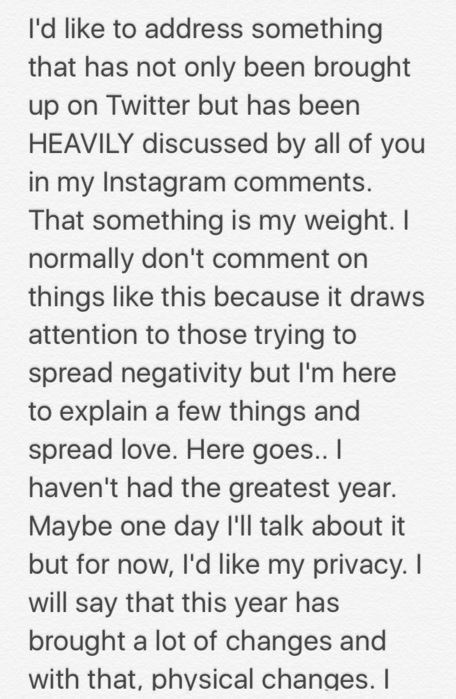
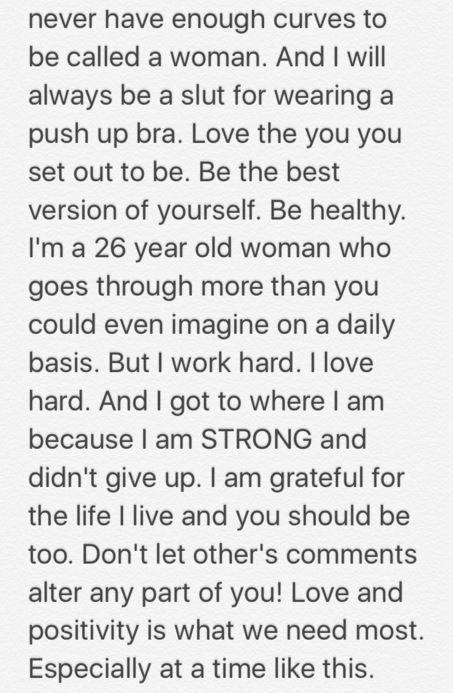
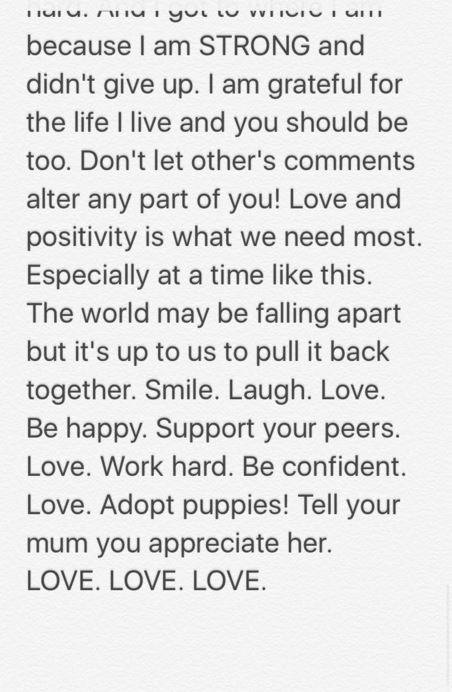
Taken from her Twitter account, this is Sarah’s emotional message to her “haters”:

https://twitter.com/Sarah_Hyland/status/867476483505176576

https://twitter.com/Sarah_Hyland/status/867476483505176576

https://twitter.com/Sarah_Hyland/status/867476483505176576

https://twitter.com/Sarah_Hyland/status/867476483505176576

https://twitter.com/Sarah_Hyland/status/867476483505176576

https://twitter.com/Sarah_Hyland/status/867476483505176576

https://twitter.com/Sarah_Hyland/status/867476483505176576

https://twitter.com/Sarah_Hyland/status/867476483505176576

You tell em, Sarah. If you’ve ever been the victim of bodyshaming, just remember that people’s words can’t hurt you unless you allow them to. Like Sarah said, don’t allow people’s often tactless words to change the outlook you have on yourself. After all, only your opinion of yourself matters at the end of the day.

On the other side of the coin, if you have ever put someone down because of their weight, remember that your words DO affect people, even if you can’t see their reactions personally. There’s never any good reason to shame someone because of their appearance. Period.

Body shaming can happen to anyone, whether you’re in the public eye or not. If you notice people bullying someone due to their weight (or any reason), stand up for them. Why? Because you would want them to do the same for you.

We should not tolerate bullying any longer, because it can have serious consequences on the victims, including suicide.

If we all lifted one another up and supported each other, imagine how different the world could be, whether we’re trying to lose, gain, or maintain weight.

Sources: 
https://twitter.com/Sarah_Hyland/status/867476483505176576

5 Traits of A Star Child

A Star Child is a unique living person who, unlike most of us, has special perceptive abilities. This metaphysical concept of a Star Child is sometimes called a Star Seed or an Old Soul. If you think you could be a Star Child, read about these five common traits that these highly aware individuals share.

5 Common Traits of A ‘Star Child’

1. They are empathic and aware.

Often the first to reach out in empathy, a Star Child commonly sees people who are hurting emotionally and want to help. These people act like observers of others rather than participants in conversations or activities that people engage in. As an observer, they are curious about people and especially how they love. These people
are sensitive to body language, facial expressions, and tone of voice that reveal more than words do.

2. They demonstrate wisdom beyond their years.

At a young age, people may have thought you were a genius due to the significant concepts you could easily understand. This is a common trait for Star Children because they have likely incarnated as a living being before this life. They understand things beyond their physical form and the limits of Earth.

3. A Star Child feels they do not belong on Earth

Feeling that you have more in common with fantasy creatures in fictional stories than you do with human beings is a common trait for Star Children. A Star Child may feel unaccepted by others because of their unusual thoughts and behavior. A Star Child is often a person who finds spiritual inspiration in the stories of aliens, vampire stories, and science fiction novels.

Researchers studying people involved in alternative spiritualities find that as people are selective about spirituality, they create new myths. A belief in Star Children can be seen as an alternative spirituality since this concept is not common in traditional religious paths.

4. A Star Child knows they have lived several past lives

The concept of reincarnation is something a Star Child is familiar with and may feel like they have lived several previous lives. Research Psychiatrist Ian Stevenson from the University of Virginia, investigated reports of Star Children who claimed to remember past lives. In over 2500 case studies, Stevenson documented each child’s statements and then identified the deceased person the child had memories of being in a past life. In each case, he verified facts about the dead person’s life that matched what the Star Child reported.

Swedish stem cell researchers found that the average age of cells in an adult body would be between 7 and 10 years. They say “Considering this sober evidence, we can understand that as we age, our bodily cells are replaced regularly. Hence, we have a constantly changing body. However, our consciousness of who we are, remains unchanging.“ In this sense, our consciousness is immortal, which means that it could possibly travel through many changing bodies in time. The researchers say “This is the rational explanation of reincarnation.”

5. A Star Child finds love everywhere.

A Star Child is often calm, smiling, and the first to hug a stranger in a world filled with unhappiness and frustrations. Unconditional love is all around for the Star Child, because they can see beyond the negative emotions people outwardly display when hurt.

A Star Child commonly uses their loving nature to help heal others around them. They have a high degree of emotional intelligence and they spread positive emotions to those who are being outwardly negative. As a result of the unconditional love they give to others, a Star Child receives unconditional love returned to them from all of those they help.

Skip to content