Weekly tips, affirmations, and small actions to feel your best.

Researchers Reveal: Parents Who Influence Their Kids’ Success Do These 7 Things…

The word ‘success’ is hard to define because it means different things to different people. For the purpose of this article, we’ll define success as: ‘Fulfillment of one’s potential that ultimately leads to happiness.’

You’ll notice that, while many of these studies revolve around academic achievement and financial success, there is an unmistakable relationship between the lessons taught and learned throughout childhood and happiness as an adult.

As it turns out, researchers have discovered that several childhood factors can predict one’s success as an adult. Unsurprisingly, many of these factors are related to the parent-child relationship.

Here are seven things that parents do that can influence their kid’s success, according to science:

1. They let kids be their ‘copycat’

Copycatting = Openmindedness

If your kid seems to copy everything that you do, science says that they’re more likely to be freethinkers. According to a study conducted by researchers at the University of Kwazulu-Natal in South Africa and the University of Queensland in Australia, kids who mirror mummy or daddy’s behavior may be able to read more into people’s actions and develop respect of other peoples’ cultures and way of life.

 

blessing


2. They don’t allow kids to watch aggressive or violent t.v.

Violent T.V. = Aggressive grown-ups

In a 2003 study published in the journal ‘Developmental Psychology,’ researchers found:

“…archival data (of 779 adults) reveal that childhood exposure to media violence predictors young adult aggressive behavior for both males and females.” The study goes on to note that children who identify with aggressive television or movie characters are more likely to be themselves overly-aggressive.

3.They display self-control

Self-control = Good adjustment

According to University of Florida professor Roy Baumeister, parents should focus more on teaching children self-esteem and self-control.

Baumeister cites a 32-year study published by the Proceedings of the National Academy of Sciences, which states that children taught self-control habits early in life are more likely to be physically healthier, financially secure, and less prone to troublemaking in adulthood.

4.They never forget the negative effects of childhood trauma

Better treatment = Better memory and emotional control

Neuroscientific studies show that people who experienced childhood abuse have worse memories and less control over their emotions.

Any dysfunction, trauma, or abuse you experience in childhood affects you into adulthood. No one can escape from it. It’s like having an umbrella in a heavy rainstorm … No matter how big your umbrella is, some part of you is going to get wet.” ~ Tina Fuller

In a study conducted by Harvard University and published in the journal Proceedings of the National Academy of Sciences, emotional and/or sexual abuse during childhood may lead to underdeveloped areas of the hippocampus that control regulation of emotion and memory.

5.They expect more

Higher expectations = Higher levels of education

“Parents who saw college in their child’s future seemed to manage their child towards that goal irrespective of their income and other assets,” says Neal Halfon, a professor at the University of California at Los Angeles professor.

Professor Halfon cites a 6,600 participant survey of children born in 2001.

6.They give More presence than presents

More attention = More achievement

Per a 2015 study published in the journal Child Development, children who receive more attention from their parents realize higher levels of success.

University of Minnesota psychologist Lee Raby adds, “This (study) suggests that investments in early parent-child relationships may result in long-term returns that accumulate across individuals’ lives.”

7. An early (and strong) maternal connection

Maternity leave = Many successes

In the United States of America, the wealthiest country on the planet, just 12 percent of companies offer their employees paid maternity or paternity leave – an abysmal number. Worse, the country seems to be going backward in this regard: 17 percent provided the benefit in 2010.

Mountains of research continue to show that paid maternity leave offers more than a few benefits, including higher educational attainment, IQ scores, and income levels. In fact, this research has been used to try and influence policymakers.
Sources:
http://onlinelibrary.wiley.com/doi/10.1111/cdev.12325/epdf
http://uk.businessinsider.com/scientific-proof-paid-parental-leave-is-good-for-everyone?r=US&IR=T#ixzz3jBLmki5l
http://www.independent.co.uk/news/science/25-scientific-ways-your-childhood-influences-your-success-as-an-adult-a6865296.html

Researchers Explain What Getting Pimples Says About Your Health

You are probably well aware that your skin (including fingernails and hair) reflects your health. According to a technique called ‘face mapping,’ various areas of the face reflect the health status of different internal organs.

“Face mapping is the ability to see the reflection of the body’s organs on each part of the face by observing the face’s complexion — such as luster, dullness, and color— as well as the tongue and face expression,” explains Chinese scholar and co-founder of the skincare line Baszicare Chapman Lee.

The practice of face mapping dates back several thousands of years and is the product of (mainly) Chinese and Indian medical practitioners. The concept of face mapping has slightly evolved to include newer dermatological findings. However, the central idea remains the same: where you’re breaking out reflects what’s going on in your body.

Five Things Your Pimples Reveal About Your Health

Here is what the six areas of your face and what the presence of acne may reveal about your health:

respect your body

1. Cheeks

According to face mappers, your cheek area is associated with lung function.

Medical conditions such as bronchitis, chronic obstructive pulmonary disease (COPD), or respiratory failure may present with acne around one cheeks. Heavy smokers are also more likely to develop skin problems around the cheek area.

Taking care of allergies and avoiding smoking are two ways to clear up this area of the face.

2. Chin and Mouth

The chin and mouth are related to the upper gastrointestinal tract. Skin problems in this area may be due to poor eating habits, e.g., overconsuming fast foods and processed foods. To keep breakouts from occurring in this area, consider eating a natural, fresh-foods-only diet. Also, get plenty of fiber, which helps ease digestion.

The chin area is associated with the kidneys – which contain the byproducts of metabolism – and the urinary tract (bladder, ureters, and urethra.) PMS symptoms often cause inflammation of the skin around the chin area. Reducing your stress and toxins exposure is paramount to clearing up problems around these areas.

3. Lower forehead

Ancient schools of Chinese and Indian medicine taught that the lower forehead is connected to your mind and spirit. The surfacing of acne, pimples, and other blemishes may be due to prolonged bouts of anxiety and stress.

The area around your eyebrows is indicative of liver health. Acne here may indicate that you ingest too many harmful toxins (e.g., alcohol, fast food, nicotine.) Preventing acne requires eliminating or moderating toxin exposure and a new, low-fat diet.

4.  Upper Forehead

The area where your hairline begins ends in the upper part of the forehead. Chinese and Indian medicine practitioners believe that this area is linked to the lower intestines or lower gastrointestinal (GI) tract. Acne in this area may indicate problems with digestion.

Rectifying skin issues around the upper forehead requires consuming plenty of antioxidants (berries, green tea, lemon water, etc.). Also, make sure to eat foods that are rich in dietary fiber (artichokes, peas, beans, lentils).

5. Pimples on the nose

Skin areas around the nose may reveal problems with the lungs and respiratory system. Also, oily skin and dehydration in this area may lead to blackheads and pimples.

Cardiovascular problems are also linked to skin health in this area. Try to limit your exposure to stress – and see if blemishes around your beak clear up (who knows, right?!)

Another way to avoid breakouts around the nose is to eat a healthy, natural diet with plenty of fruits and vegetables. Besides that, make sure to wash your face using the appropriate type of wash for your skin type (and sensitivity.)

How to Care for Your Skin to Avoid Pimples

acne

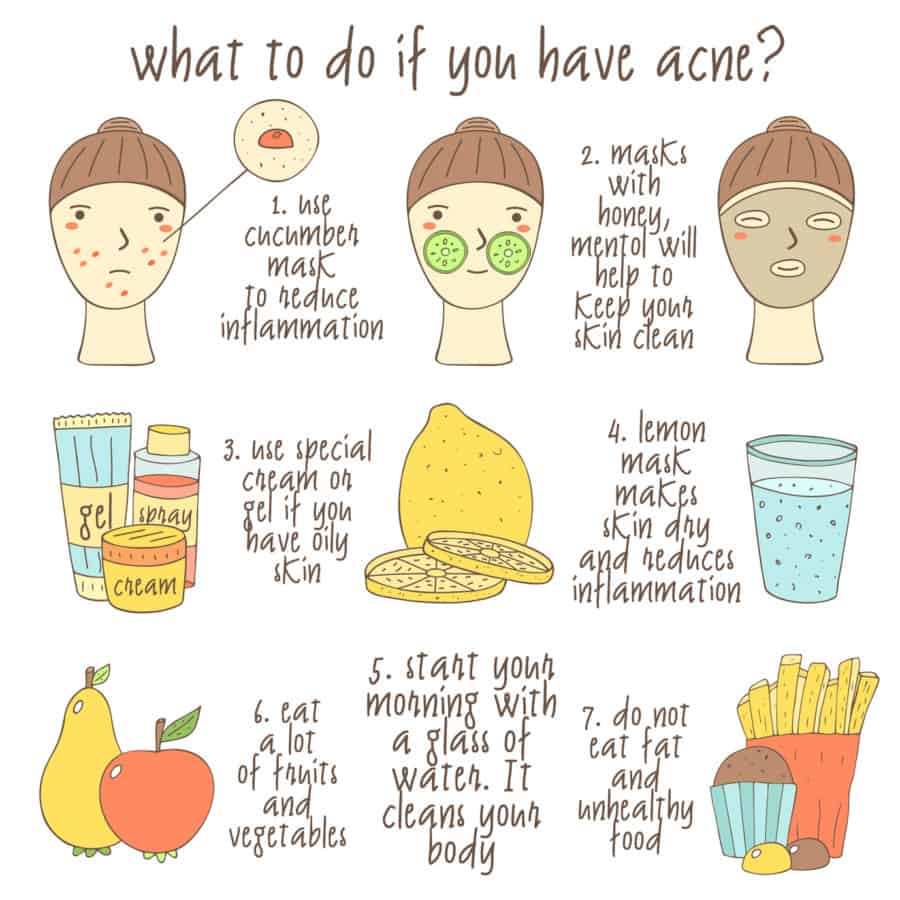
1.     Use a Cucumber Mask to Lower Inflammation.

Cucumbers have a high water content, so making a mask can keep your skin hydrated. Since water contains oxygen, this will help lower Inflammation and keep your follicles from clogging.

2.     Try a Mask With Honey and Menthol for Fresh Skin.

People have been using honey as an anti-inflammatory for thousands of years. Honey also contains antioxidant and antibacterial properties, making it an ideal ingredient for a face wash. Menthol has cooling properties to make the skin feel refreshed as well.

3.     Use Special Cream or Cleanser For Oily Skin.

Many face masks and cleansers are specifically formulated for oily skin. The next time you buy a face cream or gel, pick one suited to your skin type. Alternatively, you could use apple cider vinegar or honey and lemon, as the astringent properties will make your skin dry.

4.     Opt For A Lemon Mask to Reduce Inflammation.

Lemons can naturally help soak up excess oils on the skin and unclog pores. If you have pimples, make sure to try a lemon mask to cleanse the sebaceous glands.

5.     Stay Hydrated Throughout the Day.

Water is essential for almost every function in the body, including keeping the skin hydrated. Drink at least 3 liters of water each day, so your skin stays moist and refreshed.

6.     Eat Your Fruits and Vegetables.

Fruits and vegetables also make the skin glow and provide essential nutrients. If you want clear skin, try to eat several helpings of fruits and veggies each day.

7.     Avoid or Limit Processed Foods.

As we said above, oily, greasy foods can increase the likelihood of pimples. Avoid fast foods and simple carbohydrates and opt for fresh, whole foods instead.

What Causes Pimples?

Although most people associate acne and pimples with teenagers, adults can get breakouts too. A study by the Journal of Clinical and Aesthetic Dermatology found that adult acne affects at least 15% of men and 80% of women in the United States. Pimples occur when oil and dead skin cells clog hair follicles. When the clogged pore becomes infected with bacteria, a pimple or zit forms.

While most people get acne on their faces, breakouts can also occur on the back, neck, and shoulders. Both genetics and environmental factors such as pollution, diet, and stress can contribute to pimples.

The most common causes of pimples include the following:

•   Hormone Fluctuations

A group of sex hormones called androgens can cause pimples in men and women. While men naturally have higher androgen levels, women produce the hormone in smaller amounts. An increase in androgen causes sebaceous follicles to enlarge and produce excess oil or sebum.

Your skin requires sebum to stay hydrated, but too much oil can clog pores. Some women find more acne during menopause due to a decrease in estrogen and an increase in androgens. Women with PCOS and other conditions associated with hormonal imbalances can also get pimples.

•   Diet

The foods we eat affect every aspect of our minds and bodies, including our skin. The American Academy of Dermatology Association says that certain foods high on the glycemic scale can increase the likelihood of acne. Foods and drinks that quickly raise blood sugar, such as white bread, white rice, potato chips, fries, desserts, and sugary beverages, fall under this category.

Eating simple carbohydrates such as these triggers an inflammatory response throughout the body, causing your skin to ramp up sebum production. This creates the perfect environment for zits to form.

However, following a low-glycemic diet that includes fruits, vegetables, lentils, and grains can reduce pimples. Researchers found that 2,258 US patients who followed a low-glycemic diet for weight loss also had less acne. In fact, 87% of the patients reported a reduction in pimples, and 91% didn’t need as much acne medication.

Some people in the studies also reported having more acne when they drank cow’s milk. Researchers found that women who drank two or more glasses of skim milk per day had a 44% higher chance of getting pimples than other women. Interestingly, the researchers didn’t find any evidence that dairy products like cheese or yogurt caused breakouts – just milk. It’s believed that certain hormones in the milk may trigger Inflammation throughout the body, leading to acne. However, more research is needed to confirm these findings.

•   Makeup

Many women find that their makeup can clog their pores, leading to pimples. Oil-based foundations and concealers, in particular, can cause acne because of the excess oils in the products. If you frequently get breakouts from your beauty products, consider switching to brands that don’t use oil. Also, wash your makeup off thoroughly each day to prevent clogged pores. You might want to go makeup-free a few days per month to give your pores a chance to breathe.

•   Stress

According to research, chronic stress can cause pimples due to increased cortisol and androgens. Our bodies produce these hormones in response to stress, causing oil production in the skin to expand. This can lead to breakouts during prolonged stressful episodes. To keep pimples from appearing, practice mindfulness or other relaxation techniques. Keeping your stress low will also improve other aspects of your health, such as mental and emotional wellbeing.

pimples

Final Thoughts on Pimples and Your Health

When you have an acne breakout, it can tank your self-esteem and overall mood. You might not worry about pimples if you’re an adult, but they can pop up from time to time. During periods of high stress or hormonal fluctuations, you might see a few pimples on your chin or cheeks. It’s nothing to feel concerned about unless you start noticing them more often.

However, you can take matters into your own hands and avoid pimples by making lifestyle changes. Exercising, eating healthy, managing stress, and practicing good hygiene can help keep pimples from forming.

8 Habits That Make You Age Faster Than You Should

“You don’t stop laughing when you grow old, you grow old when you stop laughing.” – George Bernard Shaw

There are things that we do in our day-to-day lives that can make us age beyond our years. As we get older, we want to make sure that we’re doing things in our lives to keep us as healthy as possible, rather than adding years onto our bodies.

There are habits that we do every day that can age us faster. Being able to recognize these habits will make it easier to quit them, so that we can keep our bodies and minds young, and make sure that we’re not aging ourselves. Science has proven that avoiding these specific habits will keep you young.

What can we do to slow the aging process? Because physical aging can be accelerated by environmental factors such as lack of physical activity, regular exercise can offset physical aging and improve quality of life,” says Dr. Sandra Hunter, associate professor of exercise science.

Here Are 8 Habits That Make You Age Faster

1. Not reducing your blood pressure

Blood pressure is something that, while we’re young, we don’t think too hard about. It can mean that when it really starts to matters, we’ve already gone long enough not watching our blood pressure that things can get hairy.

According to Hello Heart, “It turns out the early stages of hypertension (those you experience in your 20s, 30s and 40s) and high blood pressure, have a very real impact on how old you look. Even though you aren’t getting heart attack-like symptoms, you are aging faster than you should, and those around you can tell.

Therefore, if you let your blood pressure go unchecked, high blood pressure can even take years off your life, including causing the risk of heart disease, stroke or even heart failure.

2. Not watching your weight

Science has long proven that people who were overweight and who managed to lose some of that weight and keep it off were able to improve their life span. Not watching your weight can make you age faster. When studied, patients who lost at least 2.2 lbs increased their lifespan by 2 months. Maintaining a healthy weight can increase your lifespan, as well as stop you from aging faster.

3. Smoking

Most people know the health risks of smoking, including skin, lung and throat cancer. But smoking can also make you age much faster than your body should be aging. Even after you’ve quit smoking, it’s hard to turn the effects back around that can cause problems years down the line after you’ve quit.

According to WebMD, “Maybe there is no fountain of youth, but there is a surefire way to make yourself look older. Smoking changes the skin, teeth, and hair in ways that can add years to your looks. It also affects everything from your fertility to the strength of your heart, lungs, and bones.

It’s best to never start smoking to begin with, but even if you’ve already begun, quitting is much better than keeping on smoking. It’s one of the most dangerous and biggest things that age you faster.

4. Not living life

Instead of taking chances, and living your life the way that you want to, some people tend to take the easy path. When you don’t live your life to the fullest, and your life isn’t something that makes you happy and fulfilled, it means that you’re much more likely to die sooner, and age faster. People who live in a state that is overwhelmingly positive have reported feeling healthier and happier, and living longer lives.

aging faster

5. Lack of physical activity

If you consider yourself a lazy person, or someone who just doesn’t like to exercise, this could be a habit that’s really shortening your life and making you age way faster than you should be. Science has already proven the benefits of physical activity – even low level physical activity like taking a walk every day.

According to this study, Dr. Mark Tarnopolsky, MD, PhD stated that “a person can slow the speed at which they age by exercising regularly. You don’t have to become a weightlifter, but for a longer, healthier life, starting up some exercise is just the thing.

6. High cholesterol levels

Much like blood pressure, cholesterol is something that a lot of people don’t pay attention to when they’re young. If you have a habit of just letting yourself go without keeping an eye on your cholesterol levels, you may be making yourself age faster – even if your twenties and thirties. Making sure you’re getting enough good cholesterol and lowering your bad cholesterol is a great way to stay healthy and stop yourself from aging faster than you need to be.

7. Not practicing meditation

Stressed out? Anxious? Upset? Feeling lots of negative emotions? Do you just let yourself wallow in those feelings without trying to work through them? Are you the type of person to let yourself get overwhelmed by your negativity? This is a habit that is definitely making you age faster.

According to this study, “… meditation mitigates stress-related cognitions and propagation of negative emotions and negative stress arousal, a longstanding practice of mindfulness or other forms of meditation may indeed decelerate cellular aging.

Getting into meditation and peaceful mindfulness will help reduce your anxiety and stress, while making sure your negative emotions aren’t taking years off your life.

8. Giving up on education

Education, and especially university and beyond, can be inaccessible for a lot of people. But, if you’re capable to going, it’s important to get as high of an education that you can. Studies have shown that education has an impact on your life in so many different ways, and all of them work together to improve your health, help you live longer, and keep you young.

Final thoughts

No one wants to age faster than they need to! Keeping young is more than just about buying moisturizing cream and wearing the right kind of makeup. Staying young also includes taking care your body, from your physical body to your mind and spirit. Turn these habits around to keep yourself from aging faster, and to stay living a long, healthy life.

(C)Power of Positivity, LLC. All rights reserved
References:
https://medium.com/magazines-at-marquette/big-question-why-do-we-age-a-scientists-answer-1ac251fc31e2
https://helloheart.com/high-blood-pressure-premature-aging/
https://www.webmd.com/smoking-cessation/ss/slideshow-ways-smoking-affects-looks
https://www.amssm.org/research-says-regular-exe-p-145.html
https://www.ncbi.nlm.nih.gov/pmc/articles/PMC3057175/

25 Things Everyone Needs to to Do On Their Own In Life


The beauty of life is that it’s ours to create. To build the life that we desire – and there are no exceptions – we must we willing to achieve some things individually, and it all starts with the willingness to teach and learn.

One of the big problems in society – in particular, the modern education system – is that we don’t teach children usable life skills. (Does the anatomy of a frog have any application to everyday life?)

Many of us (including this author) have had to learn some of the lessons on this list the hard way. The wonderful thing is that it’s never too late to grow and learn.

Here are 25 things we all need to learn and achieve on our own:

“The harder I work, the luckier I get.” ~ Samuel Goldwyn

1. How to Make Money Work for You

Saving money is a terrific (and extremely rare!) habit. Even more unusual is the knowledge of how to turn those savings into a profitable investment. Understanding bonds and interest is a good place to start.

2. How to Create a Healthy Network of People

“You’re the average of the five people you spend the most time with.” – Jim Rohn

So many well-intentioned, intelligent people fall by the wayside merely because they chose the wrong crowd and trusted the wrong people.

3. How to Develop a Personal Brand

What you choose to focus on on a daily basis determines the story of your life. If you focus on being a people-pleaser, there’s a good chance that your light will never shine.

4. How to say “No!”

“He who would accomplish little must sacrifice little; he who would achieve much must sacrifice much; he who would attain must sacrifice greatly.” – James Allen

Learn to say no to the things that provide no value.

say no

5. How to Be Persuasive

Some people are naturally persuasive – a marvelous ability to have. These folks are calm, amicable, and reciprocate manners and goodwill.

6. How to Communicate With Others

Small talk – most people hate it. Know why it exists? Because some are terrible communicators. Focus on what you need to say, listen to the other person, and ask questions.

7. How to Tell a Good Story

Natural storytellers are some talented folks. They can seemingly take a bland topic and make it a must-listen – and people love them for it.

8. How to Write for Pleasure or Personal Benefit

Teaching yourself how to journal (just scribble down your thoughts) or write for fun is a powerful life tool. It all starts with making a habit of putting your thoughts on a piece of paper.

9. How to Be Creative

If you experiment enough, you can unleash a creative spark that you never knew existed. People who are highly logical have the most trouble – as they try to “think” creatively. But creativeness begins with a mind adrift.

10. How to Be Alone

“The person that you will spend the most time with in your life is yourself, so better try to make yourself as interesting as possible.”?—?Unknown

11. How to Meditate

Meditation has proven to be one of the most powerful practices in existence. Beneficial as it may be, it requires stillness and quiet – which goes against the grain of modern living.

12. How to Manage Stress (!)

We’re terrible stress managers. Start dealing with stress more efficiently by asking a simple question: “What do I repeatedly think, do, or say that frustrates me?” Now, come up with a solution!

13. How to Be a Better Decision Maker

“The more decisions you make, the better you’ll become at making them. Muscles get stronger with use, and so it is with your decision-making muscles.” – Tony Robbins

14. How to Be Productive

Most people overestimate what they can do in one year and underestimate what they can do in ten years.” – Bill Gates

What do you want to achieve in life? How do you need to use your time to accomplish these things?

15. How to Focus (Ignore Distractions!)

We’re all capable of a high level of focus. Rule numero uno is ignoring distractions – i.e., smartphones, chatter (inner and outer) – which is the gateway to keen attention.

16. How to Retain More of What You Read

This one’s simple, but not easy: approach anything that you want to read with intent. What are you trying to get out of that book or article? Reading with emotion will make the material more memorable. Stop and quiz yourself along the way.

17. How to Manage Information Overload

There is a ton of information available at the press of a virtual button. Starting managing information better by kicking the “I need to know” habit (unless, of course, you do need to know!)

18. How to Become a Better Learner

“Repetition is the mother of all learning.”

Repeat something, anything, until it becomes muscle memory. See, learn, do.

19. How to Live Healthily

Start weaning yourself off of the sugar. Eliminate fast food. Do at least 15 minutes of light exercise every day.

20. How to Create Good Habits

Creating good habits involves positive emotion. Write down your new habit and what it will mean for your life. Now, visualize (see #21!) living out this habit every single day.

21. How to Practice Visualization

Visualization is like daydreaming with a purpose. What do you want? Now, picture yourself as if it is already yours. Repeat, repeat, repeat.

22. How to Set and Achieve Goals

Use the SMART acronym when setting any goal: specific, measurable, achievable, relevant, and time-limited.

23. How to Monetize Your Passion

What are you good at? What do you love to do? What opportunities are out there for you to take or create? Remember, it’s never too late.

24. Specifying Beliefs and Values

Determining one’s beliefs and values toward the world help us to make better decisions – and serves as an invaluable guide.

25. How to Be Self-Aware

“Your visions will become clear only when you can look into your own heart. Who looks outside, dreams; who looks inside, awakes.”
-C.G. Jung

https://youtu.be/GMfiSPXYGdo

(C)Power of Positivity, LLC. All rights reserved
Sources:
http://smarterwebsiteowner.com/smart-goals-for-your-website/
https://medium.com/personal-growth/25-essential-things-you-can-learn-that-will-give-you-the-edge-in-life-626ae97c512

Researchers Reveal Why You Should Do Yoga With Your Partner

Yoga has all kinds of health benefits. It’s good for your flexibility, heart, mind, and soul. When you do yoga, it can help heal all kinds of ailments, both physical and mental. People who have anxiety or depression often report that doing yoga and learning how to breathe correctly with the complicated poses have helped them out immensely.

“Yoga is not just repetition of few postures – it is more about the exploration and discovery of the subtle energies of life.” – Amit Ray

But there’s one more secret benefit to yoga that a lot of people don’t know about, and that’s how it can benefit your relationship. That’s right—researchers now have solid reasons why you should do these poses with your partner.

A couples’ yoga experience can serve as a kind of mini ‘retreat’ or ‘workshop’ to strengthen a relationship. Rather than just going to a class and practicing next to each other, couples’ yoga requires couples to really pay attention to each other in the moment and work together toward common goals,” says psychotherapist and certified yoga instructor Julia Lehrman.

Here Are 5 Reasons Why You Should Do Yoga With Your Partner

couples yoga

1. Yoga connects your body and mind

One of the main benefits of yoga is to connect your mind and your body. Oftentimes we think of our bodies as just vessels without really understanding that our bodies are also ourselves. Yoga helps close that bridge and connect mind and body.

Mind-body exercise is about creating wellness. It’s about cultivating your health by restoring balance… You start to uncover your body’s own wisdom,” says author Shirley Archer.

In order to develop good relationships with people, especially romantic ones, we need to have a solid connection between our bodies and our minds. When we only engage with other people with one or the other, our relationships tend to suffer and be shallow. Yoga will help you have a more rounded and complete relationship.

2. Yoga makes you more sensitive

When you engage in yoga, it can help increase the sensitivity that you feel to both yourself and the world around you. You will learn to listen to your body and your mind, and engage with your thoughts and feelings in a more open and honest way. When you nurture that relationship with yourself, you will inevitably be able to nurture your relationships with others as well. Doing yoga with your partner means the both of you will be able to have more open and honest relationships with yourselves as well as with one another.

3. Yoga helps you live in the present

Living life in the past is something that a lot of people tend to do without meaning to. They hold onto past relationships and old grudges and things that are no longer happening, but still allow them to affect them.

We’re living in a world that contributes in a major way to mental fragmentation, disintegration, distraction, decoherence,” says Buddhist scholar B. Alan Wallace.

When you practice yoga, it helps you live your life in the present instead of hanging on to the past. With yoga, you have to focus on your body, on your breathing, and on your balance. Using these things teaches us to be present in the moment. When both partners engage in yoga together, you’ll both be present in the moment and be able to connect with each other more fully.

4. Yoga lowers your defenses

Yoga is all about releasing tension and energy that gets built up in our bodies. When we open ourselves and release that tension, our defenses lower and allow us to engage with the people around us in a healthier manner. We have all known people, or perhaps been that person, who is always withholding themselves from their partner for fear of getting hurt. That can cause a lot of tension in the relationship.

Thankfully, doing poses together can repair those issues between partners and strengthen your connection. Relationships that have one or both partners who have raised defenses often do not last, so yoga can really benefit those relationships.

Doing yoga with your partner is one way of practicing communication with each other, since you have to be attentive to your partner’s body in each pose you do together. For many couples, it’s a way of deepening the connection between two people and being present with each other,” says Aimee O’Connor for Huffington Post.

yoga

5. Yoga opens your heart to love

Many people who haven’t tried yoga don’t know that yoga can teach you how to feel in new and different ways. Because there’s so much focus on opening and releasing when it comes to yoga. Indeed, connecting your emotions and opening your heart to love is one of the biggest benefits when it comes to doing yoga.

In life we go through many things… a wide array of emotional hurts. Over time, these experiences cause us to put up little walls around our hearts. We believe that if we can just protect our hearts behind these walls, that we will avoid getting hurt, so we slowly begin to close off, adding layer upon layer over our vulnerable hearts. Yoga helps us to heal and strengthen the heart, in both the physical and the metaphysical sense,” says yoga instructor Charity Poole.

When you focus on doing these moves with your partner, having your heart open to love can be extremely important to keeping your relationship strong. Yoga often crosses into spirituality in a way that a lot of people don’t really understand. But, if you put the effort in, you’ll find that your heart and soul open up to love in a way that you’ve never experienced before.

Final Thoughts on Doing Yoga With Your Love

Yoga isn’t just a new age gimmick. It is actually an exercise that is based on health and physical fitness. Not only that, but many other cultures use it to help with mental and spiritual health. When you’re in a relationship, doing these poses together is a great way to make your relationship stronger and connect with one another.

4 Behaviors That Help Introverts Reverse Social Anxiety

“Everyone shines, given the right lighting.” – Susan Cain

Social lives are important to each individual person. They’re how we connect with other people and create and build friendships, as well as expand our horizons. Most people learn how to socialize at a young age, and are quite good at it. Other people become social butterflies, and go above and beyond in terms of socializing. However, there are a few people who don’t socialize well and don’t know much in terms of fixing that.

Those who have a hard time socializing tend to run into the issues of having trouble maintaining friendships and fostering good relationships with other people. Social introverts tend to lack confidence (because they’re constantly worried about other people’s perception), which makes it hard for them to take the plunge and interact with people without feeling self-conscious and coming off as awkward.

On the other hand, “many times, people confuse introversion with being anxious, depressed, antisocial, or not fun, and that is not at all true. One of the biggest challenges with being an introvert is trying to control other people’s perception, which isn’t always easy…” says Tyler Turk, CEO and Founder of Crated With Love.

The best way to turn that around is for social introverts to find ways to gain their confidence again. It’s possible!

Here Are 4 Behaviors That Help Introverts Reverse Social Anxiety

1. Ask friends for help

Even the most socially awkward people tend to have one or two good friends who will be willing to help them get out of their comfort zone and learn how to socialize. Friends can point out where you need help in certain social areas – if you’re feeling too awkward talking to other people, or your jokes tend to fall flat, or if you just have a hard time getting out of your house during the week.

By understanding the world of the extrovert, you can be more mindful of their social needs. It can be a difficult needle to thread, but work on developing personal strategies that don’t exhaust you but also don’t result in you being perceived as rude,” says Dr. Alice Boyes.

Whatever you need, friends are a great way to help point out what areas need work and help you build up your confidence without judgement.

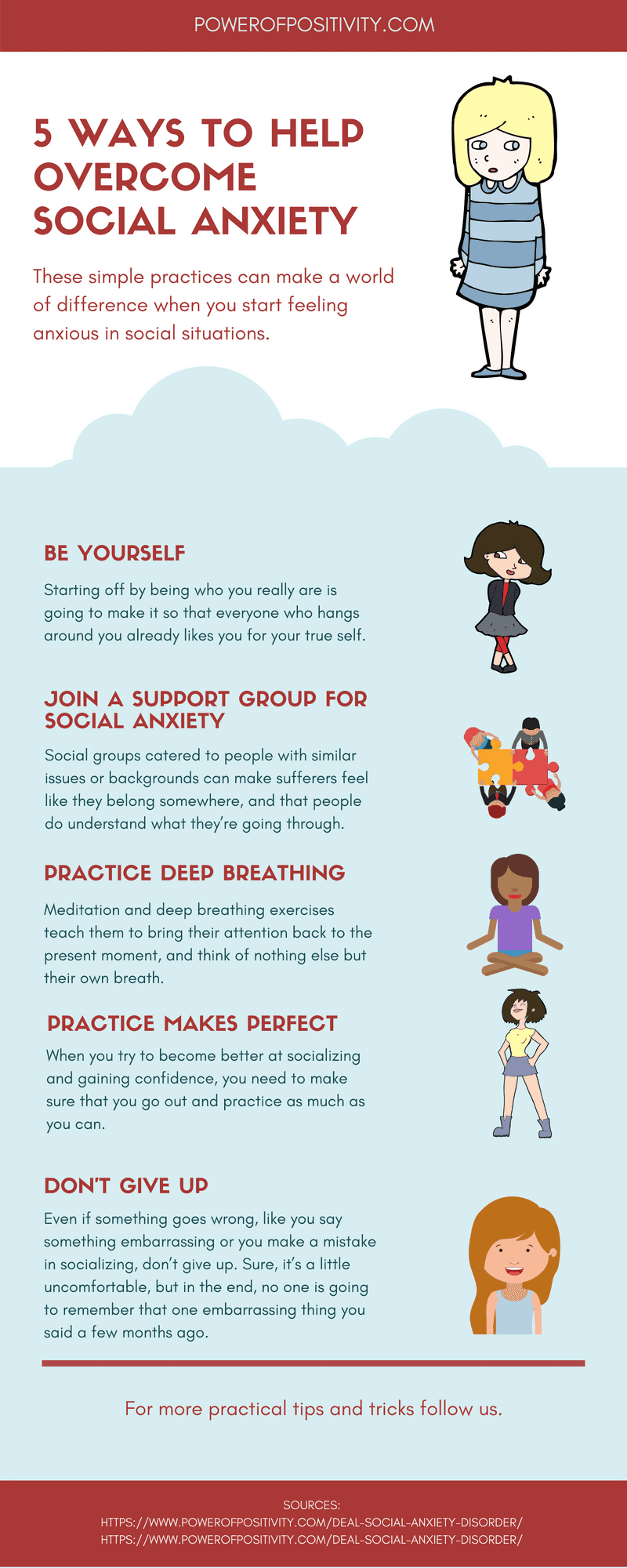
2. Don’t give up

Even if something goes wrong, like you say something embarrassing or you make a mistake in socializing, don’t give up. Sure, it’s a little uncomfortable, but in the end, no one is going to remember that one embarrassing thing you said a few months ago.

Everyone has times in their lives where they embarrass themselves. If you give up trying to socialize just because one thing went wrong, you’ll never gain your confidence back. “Decide that becoming confident is a priority for you and realize that building confidence will require you to step outside of your comfort zone,” says author Joanna L K Moore.

Take a deep breath and roll with the punches, because people will always remember the good things more than they will the bad.

3. Be yourself

This one might seem like a no brainer, but being yourself is actually the most important thing when it comes to being confident and gaining a bit of social skill. If you try to be someone else, you’re only going to feel comfortable when you have that mask on.

You’re probably more focused on the perceived downsides to being an introvert, so find out why it’s good to be an introvert. There is usually a positive and a negative side to any personality trait, so look for the positive ones,” adds Moore.

Starting off by being who you really are is going to make it so that everyone who hangs around you already likes you for your true self. Plus, you won’t have to be pretend to be someone else and mess up. You’ll always find people who like you for who you are, and those are the people that will give you the confidence you need to be social.

4. Practice makes perfect

When you try to become better at socializing and gaining confidence, you need to make sure that you go out and practice as much as you can. Take a friend to help you so that you don’t feel pressured to talk to too many new people at once. But, if you go out to a bar or a social event of some kind, practicing your new social skills will make it easier and easier.

The easier it is to be social, the more confident that you feel. It’s kind of a feedback loop – when you’re not good at socializing, you don’t feel confident, and if you don’t feel confident, you don’t get better at socializing. Practice does, in fact, make perfect, and the more you socialize the more confident you’ll feel.

introvert-extrovert

Final thoughts

Social introversion can cause a lot of problems in someone’s life, especially if they lack confidence, but the best thing is knowing that it doesn’t have to be this way. Confidence is something that everyone can learn, even if it doesn’t feel like it! Once you learn confidence, being more social comes right along with it.

Being an introvert in an extroverted world can be hard enough without struggling with shyness, too. But it is very possible to become a confident introvert. And as you accept your introversion, as well as the other parts of yourself, the confidence will come and your shyness will subside. You will become a confident introvert,” concludes Moore. Don’t let yourself give up.

overcome social anxiety tips

Share this Image On Your Site

(C)Power of Positivity, LLC. All rights reserved
References:
https://www.bustle.com/articles/183583-9-dating-tips-for-introverts-according-to-experts
https://www.psychologytoday.com/blog/in-practice/201302/4-social-tips-introverts
https://introvertspring.com/build-confidence-shy-introvert/

8 Behaviors That Reveal Someone Is Cold Hearted

What does it mean to have a ‘cold heart’? Usually, a ‘cold heart’ describes someone emotionally unavailable. They are not warm or loving type of people.

“…I perceive so-called “cold people” as, more than anything else, people who are shut-down, repressed, and out of touch with their deeper feelings. Further, emotionally alienated from themselves, they can hardly be expected to express to others feelings that they themselves are unable to access,” says clinical psychologist and author, Leon F. Seltzer, Ph.D.

Getting involved with someone with a ‘cold heart’ can often lead to heartbreak for the individual in question. However, people with ‘cold hearts’ have certain behaviors that make them easy to spot.

“A person with a cold heart can only show their love by being cold.” – PureDragonWolf

Here Are 8 Behaviors That Reveal Someone Has A ‘Cold Heart’

loved

1. They don’t ask you about yourself

A cold-hearted person doesn’t often show much interest in the person they’re with. Whether the relationship is romantic or platonic, a cold-hearted person has very little interest in other people. They won’t ask you questions about yourself. Or, if they do, it’s to learn information that is useful to them in some way.

2. Someone with a cold heart seems distant

Not just physically but emotionally. It may seem like they’re never really “all there” when you’re having a conversation. They keep a lot of their feelings to themselves. Someone with a ‘cold heart’ rarely ever opens up about their emotional vulnerabilities. They keep their distance, no matter what.

3. Something is always ‘missing’

You can’t connect with a person who has a cold heart. When you’re with them, it may always feel like a piece of something ‘missing’ from the relationship. Whether the relationship is romantic, platonic, or familial, a cold-hearted person will always have difficulty connecting with the people in their life. Something is ‘missing’, and it’s usually an emotional connection.

4. A person with a cold heart can be manipulative

Someone with a ‘cold heart’ will often try to control the people around them through manipulation. This is because they often lack empathy for other people. “Manipulators often voice assumptions about your intentions or beliefs and then react to them as if they were true in order to justify their feelings or actions, all the while denying what you say in the conversation,” says Darlene Lancer, JD, MFT.

A cold-hearted person will try to manipulate everyone around them. They may try to get close to people and find out information that is useful to them. They will often have skeletons in their closets and a list of people they have manipulated for one reason or another.

5. Someone with a cold heart struggles to maintain good relationships

Someone with a ‘cold heart’ will have no good relationships in the past. “Emotionally unavailable people see a relationship as a source of comfort — something to occupy their time until something better comes along,” says author and relationship expert Sarah Rusca Cline.

They may often characterize their ex-partners as “crazy.” They have a string of bad relationships left in their wake or can’t seem to settle down with one person. They also may have a disconnect from their family. A person with a ‘cold heart’ is also not likely to have very many close friends, either. Keep an eye out for this person’s past and present relationships.

cold heart

6. Self-centered

Me, me, me. Someone with a cooler demeanor will often be focused on how everything affects them – even when it doesn’t. “Unconsciously viewing others as “extensions” of themselves, they regard them as existing primarily to serve their own needs—just as they routinely put their needs before everyone else’s…” says Dr. Seltzer

They tend to be incredibly self-centered. This behavior manifests in playing the victim or trying to one-up someone. If you get a promotion, a cold-hearted person will somehow be able to make it about them. They might say they got a better promotion (even if they didn’t).

7. Lying

Lying is a behavior to watch out for when it comes to someone with a ‘cold heart.’ A lie is a part of manipulation, which a cold-hearted person uses to control the people around them. They may lie about things that don’t really matter, like what they did that day, or what school they went to. A cold-hearted person may also lie about big things.

Usually, someone with a ‘cold heart’ will lie about their past relationships, or any falling out with friends.  “…you’ll see a history of his fabricated storytelling and wonder to yourself how you could have ever believed some of those absurd lies in the first place,” says divorce recovery coach Cindy Holbrook. They lie to make themselves seem more sympathetic.

8. A person with a cold heart will often treat others poorly

Someone with a ‘cold heart’ will often show their hand. “They exhibit a constant need to talk about (display) themselves in flattering and egotistical ways, with frequent reminders of their superior and envy-worthy dispositions,” says professor, author, and private coach, Preston Ni.

In this case, keep an eye out for how they treat people they deem ‘beneath’ them in the social hierarchy. How they treat anyone in the service industry should be observed closely. You should also keep an eye out for how they treat homeless people. A person with a cold heart won’t have the empathy to treat these people as human beings worthy of respect.

What Causes Someone to Have a Cold Heart?

A person can have a distant or cold heart for various reasons, including:

  • Past experiences: Traumatic events or negative experiences in childhood or adulthood can lead to emotional distance or coldness as a way of protecting oneself.
  • Childhood trauma or neglect: Childhood experiences such as abuse, neglect, or trauma can significantly impact a person’s ability to form healthy relationships and connect emotionally with others.
  • Mental health conditions: Mental health conditions such as depression, anxiety, or borderline personality disorder can lead to a cold or distant demeanor as a defense mechanism.
  • Difficulty with emotions: Some people may struggle with regulating their emotions and may withdraw emotionally as a way of coping.
  • Lack of attachment or bonding experiences: People who have had limited positive attachments or bonding experiences early in life may find it difficult to connect emotionally with others.

Of course, everyone’s experiences and reasons for having a distant or cold heart are unique and complex. Working with a mental health professional to address these issues and develop healthier ways of coping and connecting with others can be helpful.

cold heart

Final Thoughts on Someone With a Cold Heart

Getting mixed up with someone with an aloof or distant demeanor can be taxing. However, knowing the signs will put you ahead of the game. Don’t be afraid to remove yourself from the life of a person who is cool as ice. Everyone deserves to have healthier and happier relationships than ones with cold-hearted people.


Therapist Explains How to Clear Your Sinuses Immediately In Just Two Steps

You hear the words sinus and sinuses often, but do you know what they are and what they do?

Interestingly, sinuses are literal air pockets behind the bones of your upper face, between your eyes, and behind your cheeks, nose and forehead. That’s right; sinuses are just air spaces in your skull and facial bones! In total, we have four paired cavities, or sinuses.

It’s what the sinuses do that is far more important. See, the sinuses make up the upper portion of the respiratory tract, extending from your nose all the way down into your throat. Our paranasal sinuses, or air cavities in the cranial bones near our nose, help to moisturize and filter air inhaled through the nasal passages.

In otherwords, these simple air cavities actively filter and remove particles from the air we breathe!

Sinus cavities also allow for voice intonation and resonance. When we’re sick, mucus builds up in these hollow areas, which is why we sometimes sound “stuffed up.” Also, sinus cavities lighten the total weight of that brain bucket known as a skull.

Why Do Sinuses Require “Clearing”?

No doubt you’ve had a cold before. If you’ve had a really bad one, then you know what a “stuffed up” head feels like (“terrible” or “miserable” would be an adequate description here.)

Why do you feel this way? Because the common cold, or cold virus, attacks the upper respiratory tract. Yeah, that’d be the same upper respiratory tract where your sinuses are located. Anyway, this attack causes your sinuses to swell and kicks mucus production into overdrive.

(Side note: Believe it or not, this icky mucus that is the bane of any cold sufferer is crucial to our health. While gross, mucus is actually a useful substance that destroys bacteria and viruses, traps loose particles, prevents water loss, and lubricates air passages among other functions.)

take care of yourself quote

Naturally Clearing Your Sinuses

While over-the-counter (OTC) medicines may help alleviate stuffed sinus passageways, they aren’t well-tolerated by everyone. Besides that, OTC meds may be entirely ineffective (it really just depends on how your body is reacting to the virus.)

Fortunately, the techniques we discuss for clearing your sinuses involves nothing but your fingers!

No more science-ey stuff!

Here’s not one, BUT TWO, ways of clearing your sinuses au naturale!

1. Acupressure

How to:

– Push your tongue flat against the top of your mouth.
– Press the fingers firmly against the brow between the eyebrows.
– Hold for 20 seconds before stopping.

You may feel some slight movement around the back of the throat, which is what you want. This shows that the mucus is softening and draining a bit. You may need to repeat this process several times throughout the duration of your illness.

2. Lymph node stimulation

How to:

– Using your fingertips, push firmly against the area of your collarbone where the notches are found.
– Interjoin your fingers in a “v” shape.
– Using the open area between the palms from the V-shape, perform a “pumping” motion on each side of the neck until you feel some drainage.

This method works by stimulating the lymphatic system, which creates a “suction” area around the lymph nodes. This suction effectively opens up the sinus passages immediately below your brow area. It isn’t uncommon to feel quick relief when this movement is performed correctly!

As with the first technique, you’ll likely need to perform this movement repeatedly until your illness passes. Hey, at least you’ll feel a heck of a lot better!

Sources:
http://healthnfitnessntips.blogspot.my/2017/07/how-to-clear-your-sinuses-in-seconds.html
https://en.wikipedia.org/wiki/Sinus_(anatomy)
https://owlcation.com/stem/Mucus-in-the-Human-Body
https://www.webmd.com/allergies/colds#1
https://www.webmd.com/allergies/features/causes-sinus-problems#1

7 Behaviors That Reveal Someone Is Silently Depressed

Do think you might be depressed?

Depression affects millions of people worldwide, and this number only seems to be growing. The World Health Organization puts the number of people who are depressed at around 280 million. However, this number only represents the people actually diagnosed. Those who suffer silently and choose not to get help out of embarrassment, shame, or pride might make that number jump significantly.

Maybe the person suffering doesn’t even know they have a problem, making silent depression even more dangerous. However, some people don’t know how to express their emotions or don’t feel comfortable doing so. This is why we all need to look out for the people in our lives and watch for the signs and behaviors that someone is silently depressed.

Here are 7 signs that someone might be silently depressed:

“People think depression is sadness., people think depression is crying, people think depression is dressing in black. But people are wrong. Depression is the constant feeling of being numb. Being numb to emotions, being numb to life. You wake up in the morning just to go back to bed again.” – Unknown

depressed person

1. Withdrawal from activities, work, or school

Withdrawal from activities is one of the key signs of depression; this occurs because the disorder takes up all of the person’s time and energy. Depression makes it very difficult to carry on with daily life, aside from what is absolutely necessary, because the pain becomes too great. Those who suffer silently might start dropping one or two activities from their schedule in hopes that no one will notice. Many who suffer don’t want to admit they have a problem and don’t want others to know about it.

If you notice that a loved one is starting to miss out on life, then this is a sign of silent depression.

2. No energy

No surprise here – depression zaps a person’s energy levels to the point where even getting out of bed can seem like running a marathon. The constant, intrusive thoughts of hopelessness and despair combined with high stress, poor appetite, and sleep troubles make life a daily battle. A person that suffers silently from depression might even start withdrawing from friendships and family life because they have no energy left for them.

3. Eating too much or too little

Increased or decreased appetite is a common symptom of depression. Gary Kennedy, MD, director of geriatric psychiatry at Montefiore Medical Center in Bronx, New York, says, “A sudden change in weight, either gaining or losing, can be a warning of depression, especially in someone who has other symptoms of depression or a history of depression.”

If you notice unusual eating habits in a friend or loved one, they could be suffering silently from depression.

4. Trouble sleeping

According to WebMD, 80% of adults with depression have trouble falling or staying asleep. Patients who have chronic insomnia have three times the likelihood of developing depression compared to those without insomnia. Many doctors believe that treating insomnia will help reduce depressive symptoms in people suffering. If someone you know complains of sleep problems on a regular basis, he or she might have depression.

5. Substance abuse

Sadly, substance abuse is common among those with depression, anxiety, and other mental disorders. While it’s understandable to want to escape reality and troubled thoughts for a while, addiction can cause even more problems down the road. If you know someone abuses drugs or alcohol on a regular basis, they might be silently depressed.

6. Faking emotions

A lot of people with depression don’t want to admit it, either to themselves or others. When in others’ company, they will appear overly happy or give vague answers when people ask about how their life is going. They only engage in shallow conversation because they want to avoid judgment cast upon them about their depression. If you notice someone has become distant or only makes small talk, this might point to hidden depression.

7. They have become a workaholic

You might not think of overworking as a symptom of depression, but some people use work to cover up their emotions. They see work as an excuse to escape how they feel, a distraction for the torment that their mind causes them. If you notice someone staying late at work most nights of the week, they might actually be silently depressed and not just a workaholic.

depression

Final Thoughts on Depressed Feelings and How to Start to Heal

Depression seems like a monster in the minds of those who suffer from it. Of course, that makes it critical for them to get the help they need. If you notice someone showing any of the abovementioned signs, don’t hesitate to offer them a shoulder to cry on or an ear to listen. If we all look out for one another, we might just put the stigma surrounding depression to rest and make people feel more comfortable and willing to get the treatment they need.

Editorial note: Updated WHO statistics 09.06.2023, reflecting current published data on their website.

Skip to content