Weekly tips, affirmations, and small actions to feel your best.

11 Scientifically Proven Foods That Improve Your Mood

Are you under the impression that most healthy food don’t taste good? Well not only do healthy offerings taste great, they can also help to improve your mood.

Wait, what… Confused? You’re not alone.

The “health food” industry floods the market with stale, tasteless items – and still make a huge profit. How? Because they slap the package with some apparent health benefit. These companies have brilliantly marketed their cheaply-produced, tasteless garbage. And, well, we’ve just accepted the notion that healthy foods must taste like crap. The real kicker is that much of this “food” isn’t healthy. A win-win for the greedy health companies – not so much for us.

Here are 11 delicious foods that improve your mood by nourishing the body and mind:

The good news is that there are plenty of healthy foods that improve both our mood and health. Moreover, they’re relatively cheap, taste good, and boost our overall health.
omega 3 foods

1. Artichokes

Artichokes are one of the most versatile and delicious foods. It’s packed with nutrients and offers some fantastic health benefits.

One serving of artichokes provides more antioxidants than any other food – some of which are on this list! Artichokes are also rich in fiber, phytonutrients, folic acid, and potassium.

Artichokes elevate cognitive function by allowing more oxygen to reach the brain. They also contain vitamin K and phosphorous – two nutrients essential for slowing cognitive decline.

2. Asparagus Can Improve Your Mood

Asparagus is loaded with vitamins and minerals, including vitamins A, C, E, K, and B6, as well as calcium, copper, fiber, folate, iron, and protein.

K, B6, iron, copper, and protein contribute to the vegetable’s brain benefits.

3. Bananas

Bananas are rich in vitamins B6 and C. They also contain manganese, potassium, dietary fiber, magnesium, folate, and others.

Eating bananas regularly may help lower blood pressure and reduce the risk of developing asthma and cancer.

4. Dark Chocolate

Dark chocolate is absolutely delicious – and one of the healthiest foods. They are loaded with antioxidants to fight against environmental toxins. Cancer researchers believe that the flavonoids in dark chocolate may reduce cancer risk.

5. Eggs

Eggs are an excellent source of inexpensive, high-quality protein. Half of an egg’s protein is in the egg’s white, which is higher in vitamin B6 than the yolk.

Eggs also contain vitamins B6 and B12, vital to cognitive function. Simply put, when it comes to health cost/benefit, eggs are about as good as it gets.

6. Kiwi

Kiwi is delicious and provides numerous health benefits, from inducing sleep to skin health and protection.

The kiwi fruit is higher in vitamin C than any food (sorry, oranges and lemons!) They also have potent antioxidant properties and help aid digestion, as green fruit is abundant in dietary fiber.

vitamin d benefits

7. Improve Your Mood by Snacking on Nuts

Nuts are loaded with protein and contain omega-3 fatty acids. Protein and omega-3’s are essential to for heart and brain health.

They also contain healthy unsaturated fats, fiber, vitamin E, and L-arginine – a vital building block of protein.

8. Pomegranates

Pomegranates are known for their jewel-like seeds (arils) that have been used for medicinal purposed of millennia. In fact, these fruits are flush with antioxidants and vitamins.

Pomegranates fight inflammation, reduce cancer risk, aid digestion, and reduce the risk of heart disease.

9. Salmon

Everyone knows that salmon is one of the best omega-3 fatty foods, but this freshwater fish has some other excellent health benefits.

Salmon is rich in protein and B vitamins. It is also loaded with selenium, a mineral that acts as an antioxidant, boosts immunity, increases blood flow, regulates thyroid function, reduces asthma symptoms, and may help boost fertility.

10. Sweet Potatoes

Sweet potatoes are scrumptious, but most people overlook the many health benefits.

These creamy orange tubers are rich in vitamins A, B1, B6, and C. Additionally, they are a good source of copper, dietary fiber, manganese, niacin, pantothenic acid, phosphorous, and potassium.

Add a bit of butter or margarine. We won’t tell anyone.
improve your mood

11. Yogurt Is A Healthy Food to Improve Your Mood

Yogurt is rich in protein (about 9 grams per 6-ounce serving), vitamins B2 and B12, calcium, magnesium, and potassium. Additionally, yogurt is rich in probiotics, healthy bacteria, and yeast. These properties help maintain optimal gut health and correct any microbial imbalance within the gut.
(C)Power of Positivity, LLC. All rights reserved

Researchers Explain Why Mental Health Class Should Be Mandatory In School

“Over a 12-month period, 27 percent of adults in the U.S. will experience some sort of mental health disorder, making the U.S. the country with the highest prevalence (of mental health problems).” ~ The World Health Organization

What is mental health? 

The World Health Organization (WHO) defines mental health as:

“…a state of well-being in which the individual realizes his or her own abilities, can cope with the normal stresses of life, can work productively and fruitfully, and is able to make a contribution to his or her community.”

In the event that a person voluntarily or involuntary seeks out treatment, Mental Health America lists 13 professions that qualify as ‘mental health professionals’:

– Clinical Psychologist

– School Psychologist

– Clinical Social Worker

– Licensed Professional Counselor

– Mental Health Counselor

– Certified Alcohol and Drug Abuse Counselor

– Nurse Psychotherapist

– Marital and Family Therapist

– Pastoral Counselor

– Peer Specialist

The following three professionals “can prescribe medication; however, they may not provide therapy:

– Psychiatrist

– Child/Adolescent Psychiatrist

– Psychiatric or Mental Health Nurse Practitioner

(Anybody else see the problem with being able to prescribe medication without the ability to administer therapy?)

Should mental health education be required in schools?

Physical education is compulsory in schools, as we all know. As a society, we’ve determined that teaching the basics of physical health to children is crucial.

Isn’t mental health just as important, if not more so?

Researchers Explain Why Mental Health Classes Should Be Mandatory In School

“Absolutely,” says Stanley Kutcher, a child psychiatrist and chair of adolescent mental health at Dalhousie University in Canada, “Our expectation of the education system is different than it was 50 years ago.”

How is our expectation different? Dr. Kutcher gives his perspective:

“(School education) is a social contract that’s changed. Schools taught reading, writing and arithmetic and parents would handle the children. Now the (burden) is on schools but the resources and structures of schools haven’t changed and they’re struggling.”

Proponents of mandatory mental health education cite a heartbreaking trend – one that is unique to the United States in terms of frequency: mass shootings.

Exhibit ‘A’: School shootings

We’re not going to get into the gun control debate.

We are going to discuss the often unspoken factor of mental illness on one particularly disturbing form of violence: school shootings.

When gun violence strikes elementary schools and college campuses, the public – including politicians, think tanks, and pundits – inevitably raise the gun control issue.

The mental health of the shooter(s) is – for most people – an afterthought.

To illustrate, let’s compare and contrast three decades of gun violence:

In the 1960’s, there were a total of 18 school shootings. The largest death toll came on August 1, 1966, when a 25-year-old engineering student by the name of Charles Whitman opened fire at the University of Texas, killing 17 and injuring 31.

In the 2000’s, 61 school shootings were recorded. The largest death toll came on April 16, 2007, when a 23-year old student by the name of Seung-Hui Cho killed 33 and injured 23 on the campus of Virginia Polytechnic Institute and State University (Virginia Tech).

The U.S. has suffered 133 school shootings so far this decade. The Sandy Hook Elementary School shooter, 20-year-old Adam Lanza, took the lives of 28 people, including 20 first grade children and four teachers. He also killed the school psychologist.

Now let’s now turn our attention to the reported mental health states of Whitman, Seung-Hei, and Lanza.

Whitman complained to psychologists at the University of Texas that he’d “been a victim of many unusual and irrational thoughts.” He’d seen no less than five doctors before the going on his rampage.

Don McElfresh, in a letter to the Dallas News, writes:

“To solve problems in our society, we need to seek the causes of the problems. Charles Whitman was an intelligent, motivated, sick individual who needed help.”

23-year old Seung-Hui Cho “had a record of mental health issues since his adolescent years. In 2005, a Virginia court described Cho as “a danger to himself,” mandating that he receive outpatient psychiatric treatment.

In one instance, Cho was sent to a mental health facility on a temporary detention order from university police. Cho reportedly told his roommate “everyone hates me,” and threatened to kill himself.

Per patient records retrieved from the facility, doctors noted: “Essentially, it does not appear that he had any serious intent when he made the suicidal statement.” “He was counseled about the need to act responsibly.”

Finally, there’s Adam Lanza. Of all three perpetrators, Lanza has the longest trail of mental health records; including recommendations from therapists and doctors ignored by his own mother, who Lanza also murdered.

In an article written for Newsweek, Matthew Lysiak, author of Newtown: An American Tragedy, writes:

“I document (in the book), through almost a decade of his mother’s emails, Adam’s downward spiral as he gradually lost his tenuous connection with reality. In 2010, (Lanza’s) illness became so severe he broke off relationship with almost everyone in his life and secluded himself in his bedroom…”

Lysiak’s most poignant point: “No one said anything, and no one tried to stop him.”

No Easy Answer, But… 

Whenever a tragedy occurs, politicians are always “first at the scene.”

“Gun control!”

“Stronger background checks!”

“Harsher punishments for criminals!”

“Better mental health care!”

One thing we do know is that a child’s brain is continually absorbing and interpreting the world around us – and for a much longer period than originally thought.

Is mandatory mental health education the answer? Would it have stopped Whitman, Seung-Ho, or Lanza?

Sarah Brennan, Chief Executive of YoungMinds, a charity that aims to improve the mental health of young people says:

“Schools are critical in helping prevent mental health problems escalating, in building well-being and resilience and helping young people learn the skills they need to cope in today’s world.”

If there’s one thing we can glean from the records, it’s that some proactiveness on the part of society, as opposed to empty rhetoric, just may have prevented so much needless suffering.

There may be something to the idea, after all. 

Sources:
http://edition.cnn.com/2009/CRIME/08/19/virginia.tech.records/

http://www.mentalhealthamerica.net/types-mental-health-professionals
http://metro.co.uk/2017/04/14/why-we-need-to-make-mental-health-education-compulsory-in-all-schools-6574759
http://www.newsweek.com/why-adam-lanza-did-it-226565
https://en.wikipedia.org/wiki/List_of_school_shootings_in_the_United_States#1960s
https://www.dallasnews.com/opinion/opinion/2014/12/18/ut-shooter-charles-whitman-suffered-from-mental-illness
https://globalnews.ca/news/3047489/tortured-mind-how-mental-health-should-be-taught-in-canadian-schools/
https://www.beyondbooksmart.com/executive-functioning-strategies-blog/what-factors-influence-executive-function-development
https://www.nytimes.com/2014/11/22/nyregion/before-newtown-shootings-adam-lanzas-mental-problems-completely-untreated-report-says.html

How to Use The “Happy Chemicals” In Your Brain To Improve Your Mood

“When your brain releases one of these chemicals, you feel good: dopamine, serotonin, oxytocin, endorphins.” Loretta G. Breuning, PhD

Thanks to the Heavens and Universe above for advances in neuroscience. Did you know that Aristotle, who is widely considered one of history’s greatest philosophers, believed the brain was “a secondary organ that served as a cooling agent for the heart?” In fact, Aristotle believed that all intelligence came from the heart.

Indeed, more has been discovered about the brain in the last two decades than in all previous years combined. And there’s still more to learn.

One particularly exciting field within the realm of neuroscientist is the study of brain chemicals, or neurochemistry. Neurochemistry is defined as “the study of neurochemicals, including neurotransmitters and other molecules.”

When we discuss our “happy chemicals,” we’re referring to four neurotransmitters: dopamine, serotonin, endorphins, and oxytocin.

We’re going to have a lot of fun in this article (I know I had a great time writing it!) because we’re going to talk about naturally increasing these chemicals. (As a side-note, I’ve tried some of these “experiments” myself and have felt much better as a result!)

To perhaps a bit of chagrin, we’re not going to delve too much into the science of it all – something that would take closer to 800,000 words than 800. Nope, we’re going with the always reliable K.I.S.S. approach.

Let’s get after it!

A (super) brief look at the four chemicals

Serotonin is a neurotransmitter made up of the amino acid tryptophan – and it’s commonly found in turkey. Serotonin helps to regulate appetite, learning, mood, sexual drive, and sleep.

Dopamine is a neurotransmitter that’s also synthesized from tryptophan (it’s a good day for turkey lovers!) Dopamine influences emotional responses, the brain’s reward and pleasure centers, and body movement.

Oxytocin is a brain chemical that is manufactured, stored and secreted by the pituitary gland. Also called the “love chemical,” oxytocin is crucial in developing and maintaining all relationships, from intimate to platonic and everything in between.

Endorphins are the brain’s natural opioids. They are “endogenous opioid neuropeptides” and hormones. Endorphins create feelings of euphoria and are also effective painkillers.

Changing happy chemicals

Changing the chemistry of your brain is not an overnight process. It takes a bit of time to establish new habits. But this period is probably much, much shorter than you think.

Loretta G. Breuning, Ph.D., and author of Meet Your Happy Chemicals advises her clients to allow 45 days before seeing significant changes in their thought processes and behaviors.

A month and a half? Not bad for a happier brain. While a relatively short period, it’s not an easy transformation. Why? Because our brains will resist any attempt to reprogram its innate wiring. Our brain loves habits, even if they’re unhealthy.

So, Dr. Breuning provides three key pieces of advice during this 45-day period:

1. Do not judge yourself

Your brain needs 45 days of repetition for a newly-formed habit to feel “normal.” You will experience discomfort. Breathe deep, practice acceptance, and stay on course!

2. Make peace with your “unhappy” chemicals

“Unhappy” chemicals serve important purposes. Namely, these compounds are responsible for our survival. They also help the brain communicate and are essential to its standard programming.

3. Choose new habits wisely.

Quite naturally, do not develop or continue “illegal, immoral, or fattening” habits. You’ll see what we’re talking about shortly. In short, “Too much of a good thing is often bad. Good and bad feelings flow at once at your brain decides which choice promotes your well-being,” hence the importance of habits.

How to Use The “Happy Chemicals” In Your Brain To Improve Your Mood

You’re all probably wondering “What do I need to do?” Great question. We’re going to make it super simple! Using research (which we cite at the end of each article), we’re going to discuss how to increase these happy chemicals with nutrition, and other lifestyle choices.

Let’s go one-by-one.

Serotonin

Diet and Nutrition: Eggs, cheese, tofu, pineapples, salmon, nuts and seeds, turkey, leafy greens, and cruciferous veggies. Vitamins B6, B12, C and D; folate, magnesium, DHA.

Lifestyle: Practice gratitude to serve as a reminder that you’re valued. Make sure to get a some “fun in the sun,” even if it’s for just 10 minutes at a time.

Dopamine

Diet and nutrition: almonds, avocados, bananas, beef, chicken, eggs, red meat (in moderation.) Vitamins B6, A and C, protein, folate, copper, DHA, magnesium.

Lifestyle: Take on a new challenge, and make small progress on it every day. Refrain from excess alcohol, caffeine, and nicotine, as these are akin to a cheat sheet on a final exam. Moderation is key.

Oxytocin

Diet and nutrition: (Research is skimpy here). Comfort foods (e.g., chocolate), if anything.

Lifestyle: Touch, warmth, massage, aromatherapy (potentially), intimate behaviors, sexual intercourse, gift-giving, charity.

Endorphins

Diet and nutrition: (Questionable), but may include some chocolate and a big of ginseng.

Lifestyle: Exercise (e.g., “runners high”), scented oils, sense of humor, and plenty of laughing!

Other great ideas

As this is an article and not a research paper, we couldn’t include everything that releases our “happy chemicals.”

Meditation (which may be the best practice), having hobbies, mindfulness, getting “out of your comfort zone,” and many other things boost certain chemicals within the brain.

(There is plenty of published stuff online [see Pinterest!] that describes how to influence your brain chemicals – just make sure to double-check the sources!)

To your continued happiness!

References:
http://www.raysahelian.com/oxytocin.html

https://www.psychologytoday.com/files/attachments/59029/happy-chemicals.pdf
https://web.stanford.edu/class/history13/earlysciencelab/body/brainpages/brain.html

Burn Fat Quickly With This Workout That Takes Less Than 5 Minutes

“In a time where most people are searching for an efficient and effective workout, high-intensity interval training (HIIT) techniques such as Tabata are ideal.” – Kristina Earnest, PT, NASM

There have been so many “cutting-edge” workout routines produced in the last decade-plus that it’s hard to keep track. Most of these routines – usually sold as some type of product for a profit – soon head into the “bargain bin.”

Then there are fitness methods developed using on actual, objective science; high-intensity interval training, or HIIT, is one such method. CrossFit is perhaps the most universally recognized name that incorporates HIIT training, and the company has been a tremendous success.

CrossFit was also developed 20-plus years after Dr. Izumi Tabata, a Japanese scientist at the National Institute of Fitness and Sports in Tokyo, discovered a superior method of HIIT. It wasn’t until 2013 that Dr. Tabata licensed-out his method for commercial use – a home workout DVD simply coined “Tabata.”

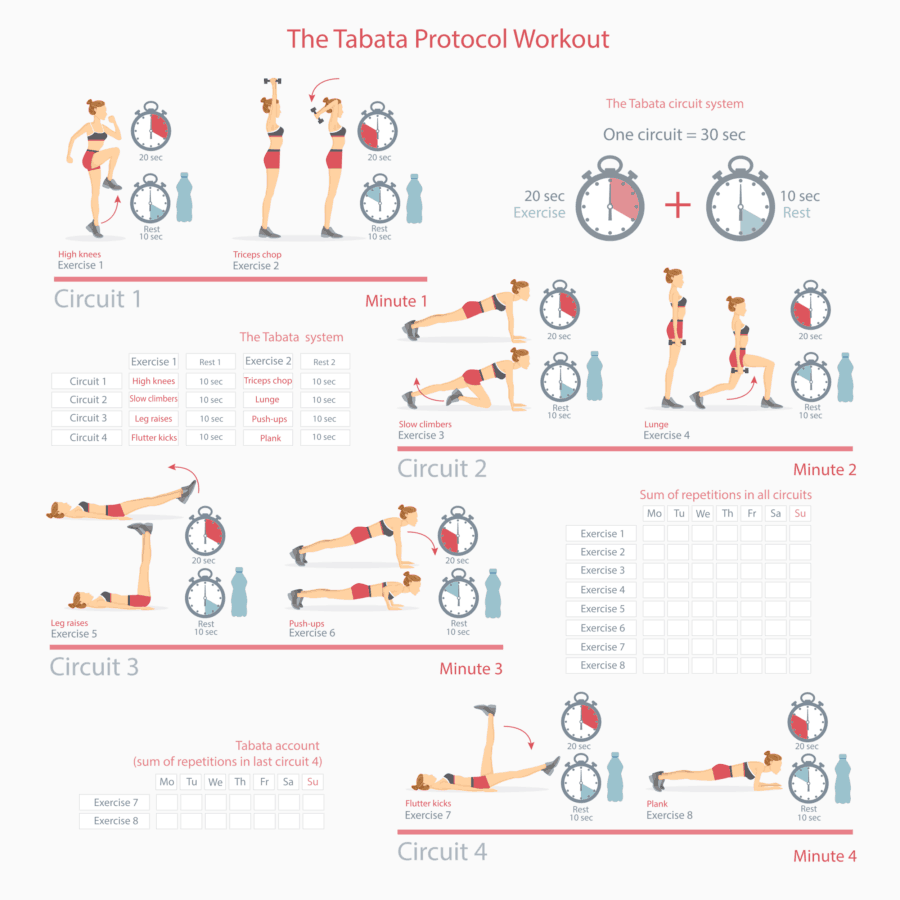
The Tabata Method

The Tabata Method can be explained using a few bullet points:

  • Only one exercise is required, though you may choose to combine exercises.
  • Both strength and aerobic exercises are used.
  • The method integrates more intensity than traditional cardio.
  • The method targets more muscles groups than traditional cardio.
  • One workout takes four minutes.

The basic idea behind a 4-minute Tabata workout is:

– Choose any exercise (or combine exercises)

– Work out as hard as possible for 20 seconds, and rest for 10 seconds (this is one set)

– Complete eight sets

Research shows the effectiveness of just one 4-minute Tabata workout:

Tabata and his team conducted research on two groups of athletes. The first group trained at a moderate intensity level while the second group trained at a high-intensity level. The (first group) worked out five days a week for a total of six weeks; each workout lasted an hour. The (second group) worked out four days a week for six weeks; each workout lasted four minutes and 20 seconds (with 10 seconds of rest in between each set).

The results: Group 1 had increased their aerobic system (cardiovascular), but showed little or no results for their anaerobic system (muscle). Group 2 showed (a much higher growth) in their aerobic system than Group 1, and increased the anaerobic system by 28 percent.

In other words, a regular 4-minute Tabata regimen demonstrated greater aerobic and muscular benefits than a 60-minute regiment – all while exercising one less day per week.

Workout options

Another terrific aspect of Tabata’s method is in its flexibility; allowing the individual to choose which exercise(s) to perform.

As your fitness level improves (which it will), you may want to increase from four minutes to eight minutes; 8 to 12, 12 to 16, and so on. No problem. Simply add another exercise to your routine, and you’re good to go.

Here are a couple of pieces of advice before you get started:

(1) Choose an exercise that you’re comfortable with (have done before)

(2) Have a good, quality timer to keep track of seconds

(3) This workout is difficult – even at the 4-minute level. Your body will be “screaming” for you to stop. It helps to have a mantra/saying/quote to remember to keep yourself motivated.

Burn Fat Quickly With This Workout That Takes Less Than 5 Minutes

As mentioned, you can choose pretty much any activity you’d like. Pushups, mountain climbers, bodyweight squats, and burpees are all favorites. If you’re a lifter, you may incorporate weights into your workout; the same goes for kettlebell users. (Note: if lifting, choose a lighter weight as you’ll fatigue quickly).

First, choose whether you want to do cardio or lift. Second, get your circulation going by doing a light 5 to 10-minute warmup on a stationary bike (optional, but recommended); if no access to a bike, do some dynamic stretching or light calisthenics.

Here are some basic exercise recommendations:

Pushups

– Mountain climbers

Bodyweight squats

– Burpees

Jump squats

– Lunges

Kettlebell swings

– Sprints

Here are some intermediate-to-advanced exercise recommendations (as these are easier to perform following video instruction, we recommend using a search engine to see appropriate technique):

Lateral lunge to knee drive

– Lunge Chop

Mountain climber to single leg pushup

– Skater to curtsy lunge

Squat thrust to lunge jump

– Russian twist

Plank with Row

As always, please be safe when attempting any new exercise program. Checking with your family doctor before beginning HIIT training is a good idea, as well.

tabata

Remember:

– Please perform a light 5 to 10-minute warmup routine (stationary bike or light calisthenics), if possible.

– Hydrate before, during and after exercising.

– STOP if you feel pain (not explainable by muscle fatigue or “burn”)

– Go at your own pace. Start at 4 minutes and increase intervals when comfortable (if desired).

6 Warning Signs You’re In A Toxic Relationship

Toxic relationships can come in all shapes and sizes. Some of them are easy to let go – you recognize the signs and you end it, and that’s that. Other times, a toxic relationship can grow so sneakily and steadily that before you realize it, you’re in a relationship that’s detrimental to both your physical and mental health.

Oftentimes, you may be thinking to yourself that a toxic relationship would never happen to you – that you would know immediately what’s wrong and be able to end the relationship. However, it’s not always that simple. Toxic relationships can happen to anyone, and sometimes there are signs that the relationship is not only unhealthy, but harmful.

6 DANGEROUS SIGNS YOU’RE IN A TOXIC RELATIONSHIP THAT’S HURTING YOU

1. YOU CAN’T BE YOURSELF

Relationships are about loving your partner for who they are, without wanting to change them. A sign of a dangerous and toxic relationship is that you feel like you can’t be who you are. You may find yourself putting on a persona, or changing your personality until you don’t recognize yourself. This is a sign that you need to get out. Your partner should never make you feel like you can’t be who you are, or like you have to change to be with them.

2. YOU’RE NEVER GOOD ENOUGH

Your partner has high standards, and it’s impossible to meet them. You never feel like you’re enough for your partner, and you never feel like anything you do is worthwhile. If you find yourself constantly thinking of ways to appease your partner, your relationship is already unhealthy. A dangerous relationship is one where one partner manipulates and controls the other – and it’s always easier to control people who have a low self-esteem. Don’t allow yourself to be brought down – you are good enough, and someone out there will be able to see it.

toxic relationship

3. YOU’RE CONSTANTLY BEING PUT DOWN

Relationships are about uplifting one another. If your partner is constantly degrading you and talking down to you, then you’re not in a healthy relationship at all. Sometimes, this particular sign can be so slight you don’t even notice it. This can come in the form of constantly criticizing the things you do, like your house work or how well you cooked dinner. If your partner is unable to appreciate you or the growth that you go through, then they’re not worth staying for.

4. YOU FIGHT TO WIN

Arguments happen in relationships, even the healthiest of relationships. However, arguments are often meant to work something out and to come to some kind of compromise. In your relationship, however, you may find yourself fighting to “win”, rather than trying to come up with a solution to the problem. This means that you’ve become full of resentment for your partner – and resentment cannot build a happy relationship.

5. YOUR PARTNER WON’T COMPROMISE

Instead of compromising and working out any issues that the two of you may have, you find that your partner would much rather shirk responsibility and shift the blame onto you. The end of every discussion always has you being the one to bend to your partner’s wishes and demands, or worse, apologizing for trying to come up with a compromise in the first place. Nothing about your relationship is working, but your partner refuses to work on it in any way. This is a sign that it’s just not working.

6. Abuse (mental, emotional, physical or sexual)

Whether it’s verbal, emotional, mental or physical, once your partner starts abusing you, it’s time to go. This can be anything from gaslighting you, calling you names, manipulating you and messing with your head, or physically harming you. If you’ve reached the point where you’re not longer safe with your partner, it’s time to leave. Even if your partner promises never to repeat the abuse, it can be a sign of further incidents down the line. You’re worth more than being abused, and taking yourself to a safer place is your top priority.

Sometimes, it’s so hard to see when a relationship that we once enjoyed has become a source of strain, stress and pain. It can even be tempting to want to try and work it out, even if every time you’ve tried, your partner has been uncooperative. Some toxic behaviors in a relationship can be worked on and fixed, and both partners can grow and move on from the experience.

Other times, a relationship can become dangerous to your well-being – and that’s the time to gather your resources and leave if it’s safe to do so. Build a support network of friends and family, people who can help you when you come to terms with the toxicity in the relationship. After all, you deserve someone who loves and cherishes you and brings nothing but positivity into your life.

15 Reasons To Love Your Partner In Public

A love in danger of failing might find benefit from one or more of these ways that public displays of affection can improve their romance.

15 Ways PDA Can Save Relationships

1. You give and receive love physically

As you touch your partner, you are giving them physical affection and also receiving their touch back. This is a small exchange of how giving can also be receiving at the same time and it mirrors other cooperative aspects of a strong relationship.

2. You feel desired

This isn’t necessarily about sex, but your partner is publicly showing that they chose you, that they want you over other possible partners. Knowing that they are willing to show that you are their choice feels good inside.

3. Your partner feels desired

To others, you are saying that you choose the person you are with. We can’t read their thoughts, but your partner is likely to feel happier knowing that you are comfortable in public with your choice.

4. It signifies your unity

You and your partner are a package deal. For the most part, it’s going to be hard for others to come between you two.

5. Bonding neurotransmitters are released

The neurotransmitter oxytocin is released when we receive affectionate touch. This brain chemical helps us to bond to our partner.

6. Small acts go a long way

Brushing hair from your partner’s eyes is a small act that can convey caring.

7. Touch helps process emotions

Touch is reassuring after a moment of frustration or upset because it brings our focus back to the physical present moment with a pleasant sensation. All is not lost, because you have each other.

8. Easily amp up the thrill factor

The meaning of “I want to kiss you all over” is a little more thrilling when said in public versus a private place.

9. It’s a secret fantasy

Being seen by others in an intimate moment is a common fantasy due to the additional thrill factor mentioned above.

10. It proves you’re more open-minded about love

Researchers studying attitudes toward public displays of affection had subjects read one of three scenarios depicting either a heterosexual, gay male, or lesbian couple engaging in an act of affection in a coffee shop. They found that the participants who had more liberal attitudes toward sexual expression and those who engaged in public displays of affection themselves were more accepting of the public display of affection that they read about.

11. Appreciation for dissimilar couples’ expressions of love

Couples who are comfortable with public displays of affection are more likely to be accepting of expressions of love between same-gender couples, mixed race couples, and couples who are less like themselves.

12. You know your partner’s comfort level

Public displays of affection should never push someone beyond their comfort zone. It’s important to know your partner’s level of willingness to be public. For example, respecting when they brush your hand away, demonstrates your understanding of their safe boundaries.

13. Reduces stress hormones

Cortisol is the stress hormone produced when we are upset, which is likely to be higher for relationships in trouble. Researchers studying Alzheimer’s patients found that therapeutic touch helped reduce levels of cortisol in the body. Lower levels of stress hormones are one way that public displays of affection help us to have longer, healthier relationships.

14. Return to dating mode

Young and in love couples can hardly keep their hands off of each other, even in public. Public displays of affection help you to remember when you and your partner were head over heels in love.

15. Less tech, more talk

Effective communication is so important in a strong relationship and touch is one way to communicate feelings in a way that texting could never replace.

Sources:
http://www.lovepanky.com/love-couch/romantic-love/public-display-of-affection-relationship
The Effects of Gender and Sexual Orientation on the Acceptability of Public Displays of Affection
http://digitalcommons.framingham.edu/journal_of_behavioral_sciences/vol5/iss1/4/
touch and cortisol levels The Effect of Therapeutic Touch on Agitated Behavior and Cortisol in Persons with Alzheimer’s Disease
http://journals.sagepub.com/doi/abs/10.1177/1099800402238331

Avoid An Unhappy Relationship: 8 Early Warning Signs to Never Ignore

“One of the hardest parts of life is deciding whether to walk away or try harder” – Anonymous

What happens when your relationship seems to be bringing more stress than it does happiness? Do you find that you have settled for a relationship that’s less than perfect? Perhaps you find yourself making excuses and simply hoping that you’re going through a rough patch, and things are going to get better.

While relationships can’t be all high, they definitely shouldn’t be all low, either! Here are some signs that your relationship is going through more than just a rough patch – and that maybe it’s time to get out.

8 Early Warning Signs of An Unhappy Relationship

1. YOU START THINKING OF YOUR RELATIONSHIP AS “GOOD ENOUGH”

While you can recognize that your relationship isn’t the best, you’ve convinced yourself that it’s good enough. You find yourself staying with your partner simply because they’re staying with you.

Any relationship is better than none, and you find that you would rather stay in a relationship that isn’t making you happy rather than endure being alone. If you find yourself thinking this, it’s a sign that your relationship is only going to be a source of stress, and that finding a way out will bring a joy to your life you didn’t know was missing.

2. IT’LL ALL WORK OUT … EVENTUALLY

If you find that you keep tacking on “eventually” to the thought of your relationship working out, it is a sign that your relationship isn’t working out at all. No matter what you do to try and fix it, it just doesn’t seem to be working, so you hold out hope that maybe it’ll all just work itself out… except this waiting starts to drag on and on, and you’re not sure if it’ll ever end.

This is a sign that the relationship would probably be better if it was over entirely. Don’t underestimate the stress that holding out hope for a dragging relationship can cause! You deserve a relationship that isn’t all waiting and hoping.

3. YOU’RE WAITING FOR YOUR PARTNER TO CHANGE … SOMEDAY

People can and do change. People grow into whole new personalities, opinions and ideas. However, if you’re staying with a partner who is making you unhappy in the hopes that one day they’ll finally grow into the person you need them to be, you’ll only be setting yourself up for hurt. You deserve a relationship where the other person is already who you need them to be! Waiting for someone to change, or trying to force that change, will only lead to more stress and destruction.

4. YOU DON’T WANT TO BE ALONE

Or, rather, being alone is terrifying to you. Being in a relationship that makes you actively unhappy is better than being alone. This could show itself in a string of short, unhappy relationships. If you find that you’re too afraid of being alone that it makes you get into a relationship with the first person who comes along, regardless of how well that relationship works, you may need to take a step back and examine the source of that fear. Low self-esteem can make people become afraid of being alone for fear of not being able to find someone new. If your relationship is maintained only to make sure you’re not alone, there’s a chance to learn to heal from that fear before starting another relationship.

unhappy relationship

5. YOU FEEL GUILTY

A sign of an unhealthy and unhappy relationship is feeling guilt for thinking about leaving your partner. Perhaps your partner is dependent on you for whatever reason: emotionally, mentally, financially. You know that the relationship isn’t working, but instead of walking away, you allow guilt to keep you. This isn’t a good reason to stay, not for you or for your partner.

Relationships should be founded on trust, love and communication – not guilt. It might hurt, but you can still help them get the support they need, just not as a romantic partner.

6. YOU’RE STAYING FOR THE KIDS

Sometimes, people stay in relationships that have long passed their expiration date because children are involved. If they’re quite young, this might seem like a good thing. However, the older they get, the more that children can realize what’s going on. Staying with a partner for the children can easily cause resentment, and will only create a messier split down the line.

According to Psychotherapist Sean Grover, “Staying in a toxic marriage is certain to cause children more damage than good. In many cases, children blame themselves, feeling their parents’ combative relationship is somehow their fault.” Children can be negatively affected by an unhappy relationship just as much as you can. Sometimes, making the decision to part ways is best for everyone.

7. THE ONLY THING GOOD ABOUT THE RELATIONSHIP IS THE SEX

If you and your partner don’t get along, don’t enjoy spending time together, and can’t seem to compromise, but the sex is phenomenal … this is probably a sign that the relationship just isn’t going to work. Physical intimacy is important, but it won’t fix a relationship that doesn’t have all the rest of the foundations. Luckily, this is an issue that can be caught early, so it’s important to keep in mind how you’re going to feel in the long run.

8. YOU FEEL FORCED TO COMPROMISE

According to adjunct professor of psychology at Georgetown University, Andrea Bonior, “One of the first signs of a toxic relationship is when one partner is very controlling. It can simply be that you feel frightened to share your opinions—you’re constantly walking on eggshells because you’re afraid of your partner’s emotional reactions.”

In a relationship, compromise is important. In an unhealthy relationship, compromise is only met after an ultimatum. You may find that you’re constantly giving in to your partner’s demands and wishes because you don’t want to start an argument, or because your partner never seems to want to compromise on their end. If there’s no willing compromise, then the relationship isn’t equal. You deserve to have your thoughts and ideas acknowledged and your wants and desires considered.

Relationships can have both highs and lows. Not every relationship you have is going to have the honeymoon phase last forever, and that’s okay! Relationships change, people change, but the important thing is that the relationship stays healthy. Even through all the bad times, relationships are meant to be a source of strength and support. If you find that your relationship is hitting some, or all, of these points, it may be time to reconsider what is going to make you happiest in the long run.

(C)Power of Positivity, LLC. All rights reserved
References:
30 Signs You’re in a Toxic Relationship 
http://www.health.com/health/gallery/0,,20976691,00.html#relationship-red-flags-0
4 Reasons Why Bad Marriages Are Worse for Kids Than Divorce
https://www.psychologytoday.com/blog/when-kids-call-the-shots/201703/4-reasons-why-bad-marriages-are-worse-kids-divorce

21 Easy Ways to Be The Reason Someone Smiles Today

“Share your smile with the world. It’s a symbol of friendship and peace.” ~ Christie Brinkley

It’s easy to allow life to get us down. We’ve all got responsibilities – bills, jobs, kids, and so forth. We must also contend with the frequent and random obstructions along the way.

In the midst of life’s stressors, it’s all too easy to think “me, me, me.”

But these are the times we should think about others. More specifically, making others’ days brighter.

Simple acts of kindness have a positive and distinct reciprocal effect. Counterintuitive as it sounds, selfless acts build us up in a way that few things can.

After we’ve done something selfless, it’s common for us to feel an absence of ego. The greatest humanitarians in history – Gandhi, Martin Luther King, Mother Theresa, Desmond Tutu – have all discovered this truth: it is greater to give than to receive.

And all it takes is a smile.

Why a smile of all things?

Well, consider some of these fascinating things about grinning with teeth:

  • Smiling can reduce blood pressure.
  • It is “contagious.”
  • Smiling releases endorphins – our body’s feel-good hormones.
  • It is a universal sign of happiness.
  • Smiling can immediately lower others’ defenses (anger, jealousy, etc.)

Here are 21 ways to be the reason someone else smiles today! :]

1. Show them something funny

Show the person some celebrity fails on the interwebs; tell them about something dimwitted someone else (or you!) did.

And watch laughter ensue.

2. Give them a small gift

If you know the person, consider giving them a small gift. Wrap it up nicely, and it’ll probably make for a pleasant surprise.

3. Listen

This one sounds out of place, but sometimes all a person needs is for someone to listen to him or her. Your thoughtfulness may help produce a smile.

4. Be affectionate

If you know the person well, put an arm around them, give them a peck on the cheek, or otherwise show some physical affection.

5. Bring them a coffee or tea

Coffee and tea are the second and third most popular drinks in the world. One reason is that both can help us relax and enjoy each other’s company.

6. Tell a joke

Who doesn’t like a good (or bad) joke? Even better if you know the person’s sense of humor. So crack one.

7. Give a heartfelt compliment

Even the shy folk amongst us love to hear a warm commendation. Compliments are very powerful and can help make someone else’s day.

8. Reach out to someone who wants to hear from you

How many times do we think about calling someone we’d know would love to hear from us, yet forget? Think about a person who’d love to hear your voice and make their day.

9. Share a meal

There’s something so peaceful and comfortable about sharing a nice meal together. Ordering different items and sharing each other’s food is even better.

10. Tell someone how proud you are

Similar to words of encouragement, saying “I’m proud of you” has a way of lifting a person’s self-esteem.

smiles

11. Write a handwritten note or letter

Nowadays, it’s so easy to type out an email or text message. Do you remember the days when handwritten notes were a “thing”? While the written note may not be too popular anymore, they are assured to serve as a great pick-me-up.

12. Say “I’m sorry.”

Own up to your mistakes. While they may not smile in your presence, they could later when thinking of your honesty and courage.

13. Give a generous tip

Do you know how much crap people who work in a service-related job must deal with? Rude people and bad tips – enough said. If someone does a good job, leave a little extra. You may just make their day.

14. Speak some genuine words of encouragement

We all need some assurance once in a while. Life is rough sometimes. A few well-chosen words can go a long way in helping someone overcome their problems.

15. Be available for them, or let them know you’re there

As mentioned, sometimes we just need someone to listen. If they’re not quite yet ready to talk, that’s okay. Telling them you’re there may just bring a smile to their face.

16. Share an old picture

If you and the person are close, there’s probably a few old pics floating around. Find one of the funniest or most ridiculous and shoot it their way.

17. Bring some hand-picked flowers

Go out into a grassy field, grab a handful of flowers, wrap them up nicely, and give them to the person. While picking wildflowers is rare nowadays, it’s a super sweet gesture.

18. Bring them some food

Everyone loves food. Oh yeah, you already knew that. Anyways, bring them a nicely presented plate or fruits or veggies, or just stop by their favorite fast food joint.

19. Tell them “Thank You.”

Whether we consciously realize this or not, “Thank you” are two of the most cherished words for someone to hear. In essence, you’re saying “Thanks for your hard work, consideration, and care.”

20. Change their screensaver

When the person steps away from their computer, change their screen saver to something that will make them smile. Use your imagination.

21. Make a silly face

Sometimes we have to forget the whole “Act your age” thing. Funny faces have a way of cheering someone up. So peep through a doughnut or stick your tongue sideways and cross your eyes. Silly faces are always hilarious!

7 Signs Your Partner Is Too Clingy

“Love should not cause suffocation and death if it is truly love. Don’t bundle someone into an uncomfortable cage just because you want to ensure their safety in your life. The bird knows where it belongs, and will never fly to a wrong nest.” – Michael Bassey Johnson

Everyone likes to have their own space, even in a relationship. Spending time together is one of the greatest joys in a partnership. On the other hand, time to yourself is something that all people need. That’s true even if you love being around your significant other. Sometimes, though, our partners can hang around a little too much. Being clingy has a whole host of negative connotations, and you may not notice it until it becomes a problem, or when someone else points it out to you.

Relationship development expert AJ Harbinger says, “At some point, we’ve all exhibited needy behaviors. What’s worse, it can suddenly grip us from time to time in certain contexts, even if it’s not a constant characteristic, which is part of why feelings of neediness can be so scary, difficult and unpredictable to manage.

Having a clingy partner can cause issues in the relationship, even if you love them and understand where they’re coming from, whether it be abandonment issues or low self-esteem. Knowing the important signs that your partner is too clingy will help you be able to address the issue and deal with it before it starts to cause problems in the relationship.

Here Are 7 Signs You’re Dealing With A Clingy Partner

1. They’re always texting / calling you

This is one of the earliest and most obvious signs that your partner is far too clingy. The minute you two are apart they are texting you, constantly. They seem to get distressed or uncomfortable if they don’t know where you are or don’t have access to talk to you whenever they want to. If you’re out with your friends, you may notice that they’re constantly sending you messages and making sure that they’re always in contact with you.

But why?

Psychologist Nicole Martinez Psy.D., LCPC says, “People who are jealous and insecure will tend to cling to their partner as a means of keeping a closer eye on them.” The best way to deal with this is to let them know there are certain times that you can’t talk, and set a firm boundary. It may be difficult for them to adjust to, but it’ll make the relationship go a lot smoother.

2. When you don’t respond, they become distressed

If they send you a text message and you don’t respond within a certain period of time, it may cause them to get distressed, nervous, or upset. The reasons for this can be varied. For instance, they may catastrophize a situation, fear you’re angry with them, or feel insecure.

Toronto based dating coach Christine Hart says, Generally, being clingy and being insecure go hand in hand. Letting your partner know that there are going to be times that you can’t respond and that it doesn’t mean anything bad can help quell their fears. Your partner may also want to seek anxiety counseling.

3. They’re far too interested in your social media

If your partner likes to look at your Instagram, or tags you in things on Facebook, this isn’t too much of an issue. However, if they’re starting to dig through your social media and begin to ask you invasive questions about a comment that you received on an old Instagram post, or questioning the people you have on your friends list, it may be a sign your partner is a little too nervous and clingy. Discussing with them honestly what their fears are and why they feel the need to dig so much can help get to the bottom of the feeling that is driving the behavior.

4. They hate when you go out without them

Sometimes, people in relationships have different sets of friends. If your partner becomes upset or distressed when you go out with your friends without them, this is a red flag that your partner is a little too clingy – especially if you only go out occasionally, and they get upset every time. This could be due to your partner not having the same type of support system or friend circle. They may be feeling left out if they don’t go out as much. Encouraging them to find a group of friends that they can go out with will make them feel more at ease when you leave the house.

5. They adopt all your interests … and drop their own

An overly clingy partner will want to have as much in common with you as possible, even if this means abandoning things that they once enjoyed in order to adopt your interests, even if they don’t really like them.

Again, why?

That’s because “the basis around clinginess is the fear of not being loved and not being enough,” says Bernardo Mendez, a relationship coach for women.

The best way to handle this is to encourage your partner to continue to do the things that they like, and even engage in them with them. An overly clingy partner will want you to be the center of their world – and sometimes they have to be shown that you’re not!

6. They hold back their feelings or opinions

Clingy partners tend to be extremely self-conscious or have low self-esteem. This can result in them holding back their true opinions, or allowing your own worldview to become their own. Clingy partners tend to do this in order to make sure that they don’t drive their partners away. So ensure that your partner feels safe expressing their political, religious, or social beliefs around you can alleviate this desire to change their opinions to match your own.

7. They’re more into you than you are into them

This is a tough one to deal with. If you’re dating someone casually, it may be clear that they’re far more into you than you are into them.

Author Elizabeth Stone tells us why this happens. She says, “When we feel insecure and worry that someone is pulling away from us, often we try to pursue them for reassurance that they’ll never leave us—an insecure behavior and attitude that causes them to want to leave us.”

Making sure you set boundaries early in the relationship, especially if it’s a casual one. Indeed, this action will make it so that your partner doesn’t expect too much out of you, or expect more than you’re willing to put forward. It sucks when the lines of a relationship aren’t clearly drawn.

Final thoughts

If your significant other shows signs of being overly clingy. While you still care about them and want to keep the relationship going, it’s important to make sure that you communicate and draw clear boundaries. If your partner crosses those boundaries repeatedly, it may be best to let the relationship go. But, there’s an equally high chance that communication and understanding will help turn a relationship around and make it much more balanced.

(C)Power of Positivity, LLC. All rights reserved
Skip to content