Weekly tips, affirmations, and small actions to feel your best.

Are You Having Doubts About Your Relationship? Ask Yourself These Questions First…

When it comes to love and relationships, doubts will almost always present themselves in some way. Whether you’re a hopeless romantic or a more practical partner, you may find yourself questioning your relationship. Those questions might make you wonder whether you want to spend the rest of your life with this person. Don’t feel guilty. It is completely normal to feel these doubts. They may or may not be well-founded. You may be wondering how you can tell the difference between real doubt, self doubt, and insecurity.

Your doubt may be based on very present feelings or situations. Self doubt can also play a role and cause feelings that might be unfounded. Attachment anxiety is a main cause of this doubt according to many psychologists. This is nothing to be ashamed of. Feeling insecure is part of the human condition. However, you may want to reflect on a few key questions. It is paramount to answer these as honestly as possible. Your relationships affect every aspect of your life.

Feeling stability in your partnership will help you feel stable in other areas of living. Additionally, feeling doubts about your significant other will show. If your relationship is meant to be, you want to be as loving and caring as possible. Doubt may hinder that. You’ll need to figure out why, work on it, or move on.

Thoughts to Consider When Relationship Doubts Arise

The importance of self-examination cannot be understated. It can be difficult and upsetting, but try to think through your doubts. Write them out on a piece of paper. Look at your thoughts logically to figure out what they really mean. There are many factors that affect our relationships and stability. Asking yourself these questions might make your situation easier.

Do You Have a Hard Time Trusting Them?

If you find it hard to trust your lover in general ways such as money management, safety, and communication, it may be time to talk through these doubts or move on. However, feeling insecure may be the root cause of your doubts. Past experiences can effectively blur your vision when it comes to your love life. One bad relationship can cast its shadow over all future partnerships if you allow it to. Have you been cheated on? If so, you may find it difficult to trust someone again.

Love is a vulnerable state to be in. Allowing yourself to openly trust can be very difficult if you have been betrayed in the past. These feelings are categorized under self doubt. Don’t fret, because there are many ways to recover from being cheated on.

Are You Communicating Enough?

One major cause of distrust is lack of effective communication. Your partner is not a mind reader, and neither are you. No matter which side is to blame, communication must be honest and constant to create a solid basis for your relationship. Willingness to communicate is also essential. Talking through tough issues and decisions helps to make compromises easier. However, you may be dealing with a stubborn person. They might be unwilling to learn to communicate. This is never a good thing. When problems remain dormant, they will come out in an ugly fashion. If your doubt is ignored, it will only grow stronger in your subconscious mind. It may make you feel as if you’re going crazy.

Don’t worry, there are many ways to deal with a stubborn partner. Verbal communication is paramount, but other types of communication are just as important. For example, being intimate with your partner is a form of communication. This is especially true when your intimacy isn’t just sexual. It is essential to give and receive love. Doing so will help you feel more comfortable while staying open with one another.

Are Your Doubts Based on Facts or Assumptions?

Depending on the type of person you are, it may be easy for you to become too logical. When thinking through your doubts, you may imagine that you will feel this way forever. You may feel so much doubt that you begin to wonder if soulmates really do exist. These feelings are healthy to a point, but being overly cynical harms your relationship further. However, it is vital to decide whether your doubts are founded.

You can try meditating on this. Sit calmly for twenty minutes, close your eyes, and focus on your breath. Practicing this will allow you to think with a clear mind and heart. Afterward, self-reflect on your problems. You may be hurting, but it’s essential to think about what makes you feel this way.

  • Did something happen?
  • Did your partner say something that made you upset?
  • Do your doubts have reasoning to back them up?
  • Are you assuming things you don’t know about your partner?

This is an easy trap to fall victim to. Assumptions can cause imaginary problems in even the best relationships. This is where communication comes in. If you’re assuming their thoughts, motives, or actions, it’s a good idea to talk this through with them. On the other hand, doubts can be the result of real statements or actions. These feelings are based on fact. When these are pervasive enough, it may be time to move on. On the flip side, you may feel better after a long conversation if assumptions were to blame.difficult times in relationships

Final Thoughts and Motivations

Nobody likes to feel the way you are feeling right now. Even people in the closest relationships can become victims. Instability hurts, especially when you are constantly worrying if the one you love is truly your soulmate. It is incredibly difficult to feel stable when you’ve been lied to, cheated on, or have a stubborn partner. Thankfully, there is a light at the end of this dark and doubtful tunnel. Self-evaluation and communication with your loved one can help tremendously. It is vital to deciphering whether your worries are based on facts or assumptions.

Hopefully, this advice will help you better understand your worries. It is meant to help you work through them with self-reflection, communication, trust, and meditation. Afterward, you will be free to continue with life as usual. Remember, doubts are not the end-all, and you are never alone in how you feel.

https://www.youtube.com/watch?v=yekZBljwsaQ

(C)Power of Positivity, LLC. All rights reserved

Science Explains Why Falling in Love Is Good For You

We have all felt the heady rush, the swooping feeling in the pit of our stomachs, and the general dizziness of falling in love. The incredible feeling, not unlike that of going on a rollercoaster for the very first time, is known to make people unreasonably happy and to put a bounce in their step far beyond their usual behavior.

In addition to all of these wonderful attributes, did you know that falling head over heels for someone is also scientifically good for you?

Falling for Someone Makes You Immune to Pain

According to a study performed by Stanford University, being in love actually reduces your pain receptors so that you only feel about 60% of physical pain that of which you otherwise would have felt 100%.

That’s a pretty significant drop in physical pain receptors and can be the result of why teenagers and young adults who are in love tend to heal faster, on average. The work required to get better and get back to your life again is almost insignificant if you are also sharing a great deal of brain with a loved one, especially a newly found loved one.

This can also be why people who are in loving monogamous relationships live longer on average and die in better condition (as opposed to long, drawn-out disease) than their unhappily matched or single friends.

Is That Cocaine I’m Feeling?

Falling in love is such a head rush that we consider it to be practically ordained by God or we call it “destiny”. What other facts could make us feel this way?

Well, it turns out, the brain can. Massive amounts of neurochemicals are released in the brain when we fall in love and the effect is a massive euphoria state, similar to that of the brain when cocaine is taken in.

Is the brain really affected the same way by falling in love as it by using cocaine? According to research performed by the University of Syracuse, it is. It really is. In fact, so many small obstacles in our daily lives are pushed out of the way and overcome as if they were nothing, that the massive success and resulting heady feeling from small achievement after small achievement can extend the feeling up to four to six days after every single encounter with your loved one.

The mass of utopian feelings created in our brain is so strong that we are often cautioned by our friends and family to NOT make any large decisions while in this state.

Can the Feeling Ever Go Away?

Yes, and it does every time, according to Gary Chapman, author of the bestselling book, The Five Love Languages. He calls these feelings of euphoria the “in love high” state which can last anywhere from two months to two years. After this, he has seen many times, the feeling wears off. In this stage, we say that “the honeymoon is over.”

Does that mean that it can be extended? 

According to Dr. Chapman, it can. In his book, The Five Love Languages, he talks about how everyone has one or two primary love languages or a primary love language and a secondary one. The five love languages, as outlined are Words of Encouragement, Gift Giving and Receiving, Acts of Service, Physical Touch, and Quality Time.

falling in love

By “expecting” the in love high stage to pass, we can look beyond the massive chemical attraction and build massively satisfying long-term relationships with our partners which feel as if the emotions will never die by simply learning how to speak their love language and helping them to speak ours. We fall in love every day because our love tanks are being filled every day.

What Other Things Can Extend These Good Feelings and Subsequent Good Health?

Taking a realistic approach. In fact, out of the successful long-term relationships which have been studied, only a small fraction of them believe in “happily ever after.” However, most of the divorce cases in the world result from the fairy tale mentality that all you have to do is get married and all will be well from then on out.

Lessons from Successful 20-year, 40-year, and Lifetime Marriages? Accept the fact that all relationships, just falling in love or long-term commitment, take hard work, no matter what types of relationships they are and accept the fact that all of the enormous emotional growth and internal maturity will, indeed, pay off in amazing positive results over the years. Expect it to be a continual process, not an end result.

Final Thoughts

Our emotions are, indeed, heavy tools with immense power. They create reduced stress, long-term happiness, better health, and increased longevity. However, like any tool, they must be shaped and trained over the years to adapt to each other and to life’s little changes which add up to big changes over the decades.

Rather than putting yourself first or the other person first, put the entity of the relationship first and continue that heady falling in love feeling for all eternity.

https://www.youtube.com/watch?v=LCiUY7nnVxo

Relationship Experts Explain How To Deal With A Manipulative Partner

It is a shock to realize that you have gotten into a manipulative and controlling relationship–most relationships do not begin this way. We all have stars in our eyes, things are great, and there are lots of promises that are made in the interest of landing a desirable mate.

Once the dust has settled, you may realize that you’ve gotten involved with a manipulative partner. What now? Has your relationship become more rocky than solid? Here are some clear signs that your partner has manipulative and controlling tendencies:

Your Partner Is Dr. Jekyll And Mr./Ms. Hyde

One minute you are the recipient of such sweet treatment it’s enough to give you a toothache, and the next minute you feel like you’re dealing with the wicked witch of the West. The worst part about this up and down treatment is that it’s unpredictable; you never know what you’re going to get. This is an exhausting cycle to ride with a partner; speaking up for yourself and refusing to put up with such treatment will give you a good idea whether your relationship can weather these changes.

You Are The Victim Of Passive Aggressive Behavior

Does your partner deliberately sabotage your happiness and success? Do they display jealousy over other relationships that you have in your life? Do they attempt to control your actions, attitudes, thoughts, and even physical location? If you are the unfortunate victim of any of these situations, you have a manipulative partner. Maybe it’s time to teach that partner that you care about that there is a different, healthier way of relating to you.

Are You Stressed Out By Your Relationship?

If your partner’s behavior, antics, words and actions cause you stress and emotional pain, you are in manipulative relationship. We all make mistakes, and we all have bad days, but our partners should be the ones that we run to, not run from, as life throws its curveballs at us. If you find it easier to be away from your partner than with them, you are likely in a controlling relationship.

What Do I Do Now? How Do I Deal With This?

Regardless of how long you’ve been in this relationship, it’s how you respond to this behavior and attempts at controlling that will determine whether you are a victim. If you are willing to accept them on their terms and not stand up for yourself, then you can expect the behavior to continue and possibly worsen. Many times, relationships that begin as mildly manipulative and controlling evolve into more abusive situations where one or both partners eventually leaves battered, bruised, and disillusioned about relationships. Something must be done before it comes to fisticuffs.

Common Tactics Of Manipulative Partners

Partners with this way of relating to people “never do wrong”. They may use distraction in conversations and situations to divert attention away from their undesirable behavior. They may issue direct or indirect threats as a means of controlling your response to them. When these tactics are ineffective, they may resort to periods of time where they are deliberately charming, attentive, and deceitful in an attempt to woo you and win back your good graces. This honeymoon period always ends, however, when they perceive that you have done or said something that is unacceptable to them. Don’t fall for it, it’s yet another in a long line of behaviors designed to try to control your behavior.

manipulative

What You Can Do About It

Perhaps the biggest decision you need to make is whether or not staying in the relationship is worth your time and effort. Quite often, if the partner is not willing to change or look at his/her own behavior, it’s a lost cause, and you are setting yourself up for a lifetime of heartbreak and pain if you choose to stay.

Should you choose to try to work on your relationship, here are some things you could do to combat their manipulative behavior:

  • Be aware of what is happening: take a rational look at your situation
  • Set boundaries as early and often as possible: let them know how they must treat you
  • Keep them responsible for their actions; have them reflectively look at their actions and behavior
  • Accept no excuses for unacceptable behavior
  • Stand your ground, and be willing to accept the consequences of your own behavior
  • Get support from others around you to help you deal with your situation objectively
  • Act as quickly as possible to send a message that you are focused on change and working on your relationship
  • If nothing is working, then by all means, get out!

No one deserves a relationship that is a stressor in their life. While you must ultimately deal with the consequences of your choices, remember that you DO have a choice. You don’t have to stay if the situation has become unbearable. Stand up for yourself, believe that you deserve more, and be willing to work together to improve your relationship. If your bond is strong enough to weather the changes, you will both come out better on the other side.

https://www.youtube.com/watch?v=lO-TMrAyth4

The Most Powerful Techniques to Build Self Confidence & Self Esteem

Life gets tough sometimes, and self-belief goes a long way in helping you develop a tough skin that can overcome life’s challenges. Studies show that for you to lead a happy and fulfilling life, you need to be confident in yourself and have high self-esteem. No one was born confident, or with high self-esteem, it takes self-initiative to work on yourself and build self confidence.

Damaging life experiences can only shape and define who you are if you let them. You can use cognitive behavioral strategy to talk yourself through self-doubt and build high self-esteem. Often people speak negatively to self; it is important that whatever you tell yourself is positive and encouraging. Even while facing your fears for the first time, it is crucial for you to be positive about the outcome of such an endeavor even before you complete the process.

Here’s how to build self confidence & self esteem:

self love quote

1. Working on Self Love

Build confidence instead of Negative self-talk since its one of the most effective ways you can use to tear down your self-esteem and self confidence. You should learn how to replace your negative comments with positive and encouraging ones. Even though the emotional and psychological wounds you have might not have been self-inflicted, you are the only one who can heal them. As you learn to love yourself, you realize that your perspective becomes positive and optimistic.

Developing self-love can be done by:

• Learning to be your own cheerleader

People’s support for you will only count if you too believe in yourself first. Remember that persistence is key in the journey of self-actualization as can easily be back at square one with just one negative comment.

• Make it a habit of complimenting yourself

Always celebrate your successes and encourage yourself when you face setbacks. Building confidence does not happen overnight; it takes time for your brain to be convinced of the compliments you give yourself. Speaking comments out loud while you look back at your image in the mirror can help as it is you actually talking to yourself helps build self confidence.

2. Surround yourself with Positivity

In order for you to build self confidence, you should surround yourself with positive energy. Seeking out company that adds value to your life will not only help you build confidence but also grow in other sectors of your life.

Surrounding yourself with positivity comes in two different ways;

• Being around positive people

Build confidence by associating yourself with individuals who are positive minded gives you an idea of what confidence looks like. You can even observe a confident person and learn how to show confidence through them. Before you allow yourself to get attached to anyone, ensure that the reason you are attracted to them is that they have a positive attitude. Make sure it is not because they also have low self-esteem. Comments you get from other people might seem like just words, but they carry a lot of weight. Do not let people weigh you down, shielding off negativity will assist you build self confidence.

• Being in a Positive Environment

It goes a long way be in a positive, vibrant environment because it nourishes you and gives you the energy to move forward. The journey of building self confidence and high self-esteem is a continuous and a non-stopping one. As a human being, you are a social being who longs for a personal connection with an individual. It is only in a positive environment that you will be able to meet positive minded people you can connect with. Having a personal connection with someone who has a positive attitude towards life guarantees that this positive energy will rub off on you, one way or another.

Final Thoughts

To succeed in your quest to build self confidence, you should remember to be consistent and intentional. It will not come easy. But putting in all the effort will prove to be worth it in the long run. There are a lot of opportunities in life that you can only grab and work with if you are confident enough. Decide today to make sure self-doubt does not get in the way of tour success. You deserve to feel confident about who you are and what you are capable of doing.

Have an image of who you want to be in your mind and take positive steps towards being that person. Little details like taking care of your health and dressing up might seem negligible. But they contribute massively to boost your confidence. Confidence is armor you wear every day when you feel good in your own skin, it reflects to the public.

5 Habits That Help People Get Out Of Depression

If you deal with depression, you know better than anyone that there is no quick fix to fighting it. Finding your way out of this fog takes intentional and consistent effort to change your mindset as well as your habits. While it certainly is a challenge to escape this time in your life, that doesn’t mean it is impossible.

Getting Out of Depression

“If you are broken, you do not have to stay broken” — Selena Gomez

Fighting any depressive tendencies often feels like a never-ending battle. When you think you’ve won, that familiar dark cloud comes creeping back. To find a way out of my own darkness, I learned that making a few key lifestyle changes helped shift my thinking dramatically. If you’re looking for ways to change your life and overcome depression, read on.

1. Drink More Water

Believe it or not, your water intake is related to the amount of anxiety that you may feel. The less water your body has, the less energy your brain has to work with. Allowing your body to become dehydrated can easily lead to you feeling unnecessarily tired and stressed out.

Instead of letting dehydration run your life, focus on improving your daily water intake. Purchase water by the caseload and be sure to always have a bottle handy wherever you go. Focus on drinking entire bottles at specific times throughout the day, rather than just taking sips here and there.

2. Exercise Often

You may have heard that consistent exercise helps to deal with depression, but haven’t been able to experience it for yourself. If you commit to regular exercise and a solid fitness routine, you’ll see that your mood starts to lift almost immediately.

In a study with Duke University, participants with depressive tendencies were treated with an anti-depressant or regular aerobic activity. The results of this study showed that of the 40% who experienced significant change, those that were exercising regularly had higher response rates.

If you’re new to exercise or are unsure of where to begin, you may find it helpful to start with a fitness class or personal trainer. Having another person or a group of people present to either coach you through the workout or go through it with you will help keep you motivated throughout your workout. Similarly, working out with others helps you stay accountable, helping you stick to your workout routine.

3. Practice Mindfulness

Making time to be mindful may seem like a waste of time, but it’s an important step in becoming centered and overcoming depression. In a recent study with Mindfulness-Based Cognitive Therapy or MBCT, 84 people that were in remission from depression used MBCT to prevent any depressive episodes from returning.

This is why when fighting depression, it is so helpful to make time each day to pause, meditate, and breathe. This practice will allow you to clear your mind, de-stress, and really focus on the essence of life.

This meditative process works to rewire your brain. By being mindful, you are working to improve your memory and concentration, as well as immediately reducing your stress levels and anxiety. As you go on your journey to mindfulness, consider listening to guided meditations or calming sounds of nature.

4. Keep a Journal

Regularly writing in a journal will help you to work through any stressful situations you may be experiencing. Writing out your thoughts will allow you to untangle any ideas and emotions that you may have otherwise left unspoken. Consistently about your days will allow you to be become more in tune with yourself, helping to align both your emotions and mind.

Start journaling by buying a notebook or diary that is just for your daily writing. Each day, set aside a quiet moment to write out all of your thoughts. As you journal, be sure you are away from any distractions like your computer or phone. This will allow you to create a totally stress-free environment for you to truly focus on the task at hand.

5. Read for Fun

Reading for entertainment is lost on most of us. While many of us have self-help or educational books to help us professionally, taking the time to read a good book for fun is something most of us don’t make time for. Instead of picking up books that are solely focusing on self-development, try looking for reading material that allows you to disengage from the stress of the everyday.

When looking for books for entertainment, consider a work of fiction or exciting stories that allow your imagination to run wild. Search the Internet to look for new titles that you might find interesting. Developing a new habit of reading will help you focus.

depression

The Depression Doesn’t Have to Win

Breaking free from depression takes work. While you likely won’t get better overnight, taking intentional steps to better yourself will allow you to work towards the life that you want. Dedicate yourself to making this change and never give up hope that you’ll be able to win the fight.

As you start to change your life with these five simple habits, you’ll be able to see the effects of this condition start to wear away in your life. Once these habits become ingrained into your routine, you’ll be able to keep building on the changes that you have made and finally overcome depression.

https://www.youtube.com/watch?v=CU2LlJxEdJ4

How to Instantly Boost your Self Esteem: 7 Powerful Tips

Self esteem can be thought of as an art, and when it comes down to it, it’s one which can be learned to achieve excellent results in any endeavor or area of life. The nice thing is, looking at yourself with a sense of respect for your capacities is something no one can take away from you.

The majority of people who are looking for the answer of how to build self esteem make the common error in thinking that letting their view of themselves fall on the approval they receive from the external world will help their self-image.

For instance, allowing it to rest in the hands of significant others, co-workers, parents or even social media. It’s quite a substantial detriment to a person’s self esteem, which is why our first tip for you is that you can’t win self-respect, but amazingly you can generate it.

The following strategies will work as they’ll remove the negative cycle of the low self esteem feedback loop. If you implement these techniques more and more, you’ll notice more and more positive changes!

Here’s the advice we gathered to build self esteem from experts in the field:

good enough quote

1. Believe in Yourself 

At the beginning of a journey for higher self-esteem, it’s good to realize that no two people are alike. As cheesy as it sounds, each person has an individual character and personality that allows them to differentiate from the rest of society.

When we’re young, this can feel like a bad thing because it’s tougher to fit in, but in the journey for self-esteem, one of the first things to know is that you can’t please everyone. Embrace your individuality as best you can because who you are is more than enough!

2. Focus on your strengths and not your weaknesses 

It’s easy to look at all the things you think you could be doing wrong. Science has shown that we tend to naturally compare ourselves to others, in the hopes that we’ll easily correct our course.

But, in the days of social media, we have a distorted view of many successes people are putting out there. You get the successes without seeing all the failures it took to get there. Not only does this have a significant toll on your self esteem, but it can drain a lot of your mental energy and willpower.

It’s now shown that making perfection a priority is not as important as it seems. Nobody is perfect of course, so treating yourself like a good friend is an excellent replacement for such an attitude.

3. Stop being pre-occupied with yourself 

Let’s say someone says embarrassing at work like we all do sometimes, and everyone laughed, then they spend the rest of the afternoon replaying the scenario in their mind and beating themselves up about it.

The tragic irony is that most of the time the other people won’t remember the situation even minutes after it happened while it’s affecting you well past the time it happened.

As the saying goes, angels are able to fly because they take themselves lightly. This realization can free up mental energy for more important endeavors.

4. Avoid the comparison trap 

If you analyze who you are and what you have accomplished alongside other’s lives and what they have done, then you have a negative attitude on your hands.

You’re putting yourself in a losing position because there’s always someone who has achieved more or is better than you in some aspect.

So let’s substitute that habit with better practices.

Look at all the progress you have been able to achieve so far. Compare your present self to your past self. Concentrate on the small successes that we can easily overlook. It’ll both inspire you and aid you in while you build self esteem.

5. Deal with setbacks more positively. 

When you’re leaving your comfort zone, on the path to greater success than you’ve seen so far with anything that’s genuinely meaningful to you, then you’ll inevitably encounter roadblocks.

Just because you’ve failed doesn’t mean you’re a failure. You miss every shot you don’t take as the saying goes.

So keep that in mind when you falter and give this a shot:

Instead of treating yourself negatively, challenge that and ask yourself: How might a family member or friend help me in kind of situation? Or how would you support a sibling with something like this?

It allows you to look at your challenges in more favorable light when you talk to yourself like someone who has your best interests in mind

6. Try something new. 

When you’re trying something for the first time, or if you challenge yourself in a small or more significant way and leave the place of comfort you’ve settled in, then your self esteem automatically rises.

It’s something to admire about yourself, and it helps you find your strength as your beating complacency.

So leave the daily things you’ve fallen into behind. Don’t have expectations, rather have the intention of just seeing if you’ll like the new activity.

Like always, if something feels too tricky then try not to get too frustrated. Smaller, more manageable steps that are more long-term are better than sporadic short-term efforts.

7. Remember your why 

What is an easy way to remain consistent with something? Like we discussed before: to recognize the most motivating purposes for why you’re doing it.

This simple thought experiment of self-reminders with reasons that resonate have done wonders for us. We hope it’ll produce the same results for you.

Ultimately, nothing is more important for what you’ll be able to do in life than how you think and feel about yourself. These tips are the best way to take control of your life and your overall happiness, thank you for reading about how to build self esteem!

How to Start your Day with Gratitude to Make your Life Better

Gratitude is one of the most powerful human emotions, but most of us don’t do enough to harness it. In fact, it’s easy to get out of the habit of feeling grateful for much of anything at all. If you haven’t given much thought lately to all the good things in your life, it might be time to change that by training yourself to choose a grateful mindset over a negative one.

Adopting a morning gratitude practice can make a huge difference in your overall mood and outlook on life. When you take the time to practice gratitude intentionally every day, a grateful mindset will become a habit – and you might find that your life improves dramatically. Being thankful for what you have helps you to shed any negativity you’re carrying around and open yourself up to the positive side of life. Here’s how you can incorporate gratitude into your morning routine.

How to Start Your Day with Gratitude to Make Your Life Better

1. Get a journal.

It’s easiest to build and maintain a grateful mindset when you physically write down the things you’re grateful for. Keeping a journal also lets you look back over your past entries, which can be helpful for your personal development. Go out and get a journal or notebook that you like enough to use every day – it doesn’t have to be fancy.

2. Just start writing.

You might not be sure what to write at first, and that’s fine. Write the first thing that comes to mind. There are no rules for practicing thankfulness – you can do it any way you want. One method many people follow is writing out a list of five or ten things you’re thankful for every day.

gratitude quote

3. Pay attention to the little things.

Not everything you write in your journal has to be big and life-altering. In fact, most of what you write about will probably involve the smaller details of life, such as a nice meal, a hot shower, or a beautiful morning sky. Nothing is too small or trivial to include in your entries.

4. Remind yourself to be thankful as you carry out your daily routine.

In addition to writing in a journal, try practicing mindful thankfulness as you go about your daily activities. For instance, take an extra moment to taste your morning tea or enjoy that first breath of fresh air when you step outside your front door. The more you do this, the more you’ll build the habit of appreciating the small things in your life.

5. Share your gratitude practice with someone else.

If you want to get more out of your practice (and make sure you’ll stick with it long-term), team up with a family member or friend who also wants to build the habit of being grateful. Share your entries with each other on a daily or weekly basis.

6. Think of gratitude as a long-term project.

It takes a while to cultivate the mentality of being grateful. If you’ve been stuck in a negative mindset for a while, it will take weeks – if not months – to unlearn that mindset. Commit to writing in your journal frequently, and try not to miss any days if you can help it. Over time, you will train yourself to think differently, and thankfulness will become second nature to you.

7. Cut yourself some slack if you’re imperfect – but don’t give up.

Changing the way you think is hard work. Even if you have the best of intentions, you’ll likely skip a few journal entries here and there, and some days you might struggle to find anything to feel grateful for at all. That’s okay – everyone is human, and almost no one is able to practice gratitude perfectly. The important thing is to keep trying. It takes regular effort to build any habit, including the habit of thankfulness.

Final Thoughts

The power of gratitude can change your life if you let it. Feeling thankful for what you have can transform your whole approach to living. It makes you more content with what you already have – and that, in turn, helps you connect with your true self and build a life that feels true to you.

Starting and maintaining a gratitude practice is simple, though not always easy. In a nutshell, it just involves sitting down every day, clearing your mind, and journaling for a few minutes about what you’re feeling most thankful for. Over time, if you make this tiny habit a regular part of your morning routine, you’ll find that you start every day feeling calmer, happier, and more optimistic.

(C)Power of Positivity, LLC. All rights reserved
REFERENCES:
HTTPS://TINYBUDDHA.COM/BLOG/HOW-TO-START-A-GRATITUDE-PRACTICE-TO-CHANGE-YOUR-LIFE/
HTTP://SIMPLELIONHEARTLIFE.COM/START-A-GRATITUDE-PRACTICE/
HTTPS://WWW.HAPPIFY.COM/HD/THE-SCIENCE-BEHIND-GRATITUDE/
HTTPS://WWW.UNSTUCK.COM/GRATITUDE/
HTTP://EI.YALE.EDU/WHAT-IS-GRATITUDE/

5 Ways to Bring Magic Into Your Life by Learning to Appreciate What You Have

What makes it so difficult to appreciate the simple pleasures of life? Why do we often focus on what we want instead of reflecting on what we’re given? It seems we’re constantly yearning for things not yet achieved, spinning our wheels in a never-ending pursuit of that special tonic that we believe will make us happy. But as we furiously chase that shiny new object, we spend less and less time enjoying our life.

Most of what we’ve attained were dreams or goals. We longed to have our beloved children. Our deepest desire was to be a homeowner. We hoped we’d finally land a decent job. Yet, when we achieve our goals, we still struggle to appreciate life. Taking the best things in life for granted is not new, but you can recognize the magic of daily tender mercies with five principles to help you live a joyful life.

Here’s how to bring magic in your life by learning to appreciate what you have:

appreciate

Live in the Moment 

Being mindful is a state of focused attention on the present. When you live in the moment, you can fully appreciate all the details of your life. The sunrise, a chirping bird, your child’s smile, and even your food becomes more enjoyable. Tasks that once seemed tedious will be more fulfilling when you focus on the present. Research has shown that being present in your daily activities allows you to appreciate life and be more effective in pursuing your goals. But being mindful takes practice; therefore, the best way to start is by doing one thing at a time. Single-tasking helps you remain focused on the present. So take ownership of your time, and remember the Zen Proverb: “When walking, walk. When eating, eat.”

Embrace the Power of Giving 

We’ve all heard the phrase, “It’s better to give than to receive.” But this adage is more than just a religious axiom parents use to induce small children to share. Throughout history, scholars and philosophers have agreed that true happiness lies in helping others. Lending a helping hand to someone less fortunate enables you to appreciate what you have more meaningfully. Studies have shown that altruism releases pleasurable endorphins known as a helper’s high. Whether you’re giving your time or your resources, helping others can increase life expectancy, reduce stress, and improve your mental health. Doing good things for others elicits strong feelings of self-worth and satisfaction, which can help you appreciate yourself and your current situation in life.

Develop a Gratitude Mindset 

Gratitude is a mindset and emotion that enables us to view our lives through hope and positivity. Developing a thankful practice allows a stuck mindset to release itself from the burden of focusing on the half-empty glass. Not everyone is instinctively appreciative, but you can develop a grateful mindset by acknowledging the blessings in your life. Making gratitude a habit will enable you to focus on your goals without dwelling on your failures.

Keeping a nighttime gratitude journal or practicing a morning thank you mantra are great boosters that will help you sustain a positive mindset and appreciate your life. Once you’ve established a gratitude habit, you’ll develop a deeper satisfaction with your life and feel less anxiety about your future.

Embrace Your Challenges 

No one’s life is perfect. As we navigate the bumpy roadblocks in life, we all deal with failure, loss, and sometimes tragedy. Yet, if we allow ourselves to view these struggles as character-building opportunities, we can experience tremendous growth during the unexpected detours on our journey. One of the surest ways to find contentment is to be thankful during the most difficult times in your life. When we understand and appreciate life’s challenges, peaceful security emerges from knowing that our inevitable trials can ultimately be endured.

appreciate

Accept Yourself 

Becoming comfortable with your life is not just about being grateful for the things you have. Accepting yourself unlocks the magic that comes from honoring the real you. Celebrate your uniqueness, and never compare yourself to others. Show yourself compassion, and explore your inner power by taking daily time to appreciate yourself and recognize your greatness.

Often, we find ourselves frantically chasing our goals and planning for the future without stopping to appreciate the pleasures of the here and now. Taking our health, family, and freedom for granted has become the norm. But we can experience the serenity of inner peace by simply appreciating the good things in our lives.

Living with a grateful mindset takes practice. Yet focusing on the present will make you more productive and happier. Acknowledging the grace around you through these five principles will reveal the magic panacea that comes from openly embracing your life.

References:
https://www.rd.com/health/wellness/mindfulness-tips/
https://www.goodnet.org/articles/7-scientific-facts-about-benefit-doing-good
https://www.psychologytoday.com/us/blog/out-the-darkness/201407/the-power-appreciation
http://ninaamir.com/how-improve-your-life-gratitude-mindset/

How to Stop Panic Attacks: 5 Simple Mindfulness Techniques

Panic attacks are more common than you might think. They quickly overwhelm you. Besides those racing thoughts, people also often have physical symptoms such as a racing heart, sweating, and nausea. These incidents can come on out of nowhere, and leave you feeling downright helpless. To make matters worse, they are also often accompanied by severe anxiety and depression. You’ll be relieved to know that you can use mindfulness to stop panic attacks in their tracks.

It’s not uncommon for people who are suffering from these types of attacks to feel like they are alone, but if you are prone to panic them, know that millions of people just like you find ways to overcome them. There are many mindfulness techniques that you can use to overcome a panic attack and lessen its hold on you in the future.

5 Effective Techniques to Help You Stop Panic Attacks

Here are five mindfulness techniques that can help you overcome the symptoms of a panic attack, putting you on the road to recovery:

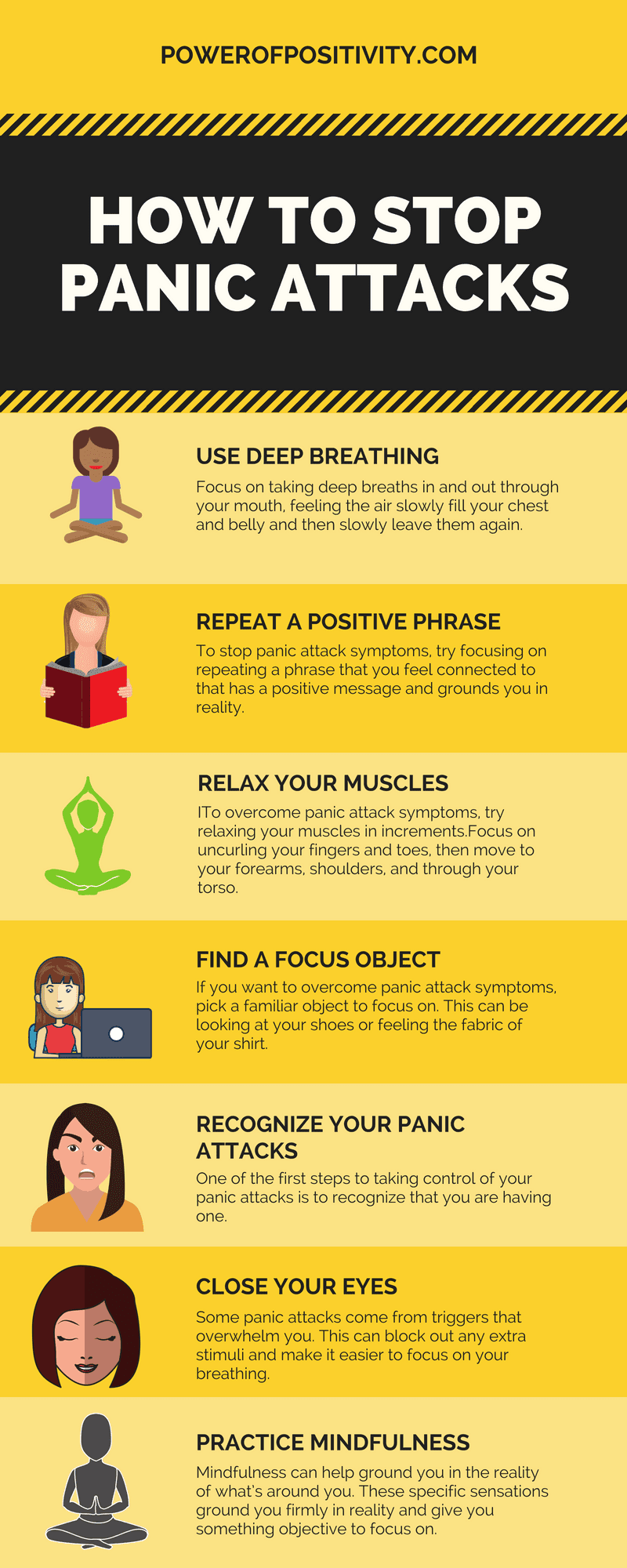
stop panic attacks1. Recognize Your Panic Attacks

One of the first steps to taking control of your panic attacks is to recognize that you are having one. It’s common for people who are having a panic attack to feel like they are having a heart attack or a stroke. But to overcome your panic attacks, you must first recognize when you are having one. If it’s your first time, you should see a doctor immediately to rule out other, life-threatening possibilities. But if you have experienced these before and know that you are otherwise healthy, remember that panic attacks come and go. Life will not be this way forever, even if in the moment you don’t feel well.

Mayo Clinic reports these common early signs of a panic attack:

  • Elevated heart rate
  • Hyperventilating (rapid breathing)
  • Perspiring
  • Shaky or trembling hands
  • Interrupted sleep
  • Unexplained feelings of tension or nervousness
  • A sense of worrying
  • Avoiding dealing with issues.

2. Practice Breathing Techniques to Stop Panic Attacks

Many people have difficulty breathing when they are having a panic attack. To lessen these symptoms, try to focus on breathing deeply. The oxygen that you receive through deep breathing will help you feel better, lessening symptoms like a racing heart and nausea. This technique also gives you something to focus on, lessening your feelings of helplessness.

After many years of debate, a 2021 study emerged. Researchers concluded that using “respiratory-focused interventions,” significantly improved symptoms related to anxiety.

3. Find a Focus Object

If you want to overcome panic attack symptoms, pick a familiar object to focus on.  Mindfulness coaches refer to this method as object-focused meditation or concentration meditation.

This can be looking at your shoes or feeling the fabric of your shirt. Think about all of the details of the object. The texture of the fabric in your hand or the grain on a piece of wood could be your focus object. Think of all of the ways that you could describe this object. Also, if you are in a noisy or crowded space, try to find somewhere it is quieter so that you can focus more effectively.

4. Repeat a Positive Phrase or Mantra

To stop panic attack symptoms, try focusing on repeating a phrase that you feel connected to that has a positive message and grounds you in reality. For instance, you could tell yourself, “This is not forever, and I have a full and happy life to live.”

Choose whatever mantra makes you feel connected to the here and now but also reminds you that the way that you are feeling will pass and that you should not give up hope for a better life that is free of anxiety and depression.

5. Relax Your Muscles

To overcome panic attack symptoms, try relaxing your muscles in increments. Similar to breathing exercises, muscle relaxation meditation is another way psychiatrists suggest trying to the stop panic attacks. Because it helps you focus on one thing, this intervention will help alleviate the symptoms themselves.

Here’s why this activity works.  People who are experiencing a panic attack will often clench their muscles, causing even more pain and discomfort. Focus on uncurling your fingers and toes, then move to your forearms, shoulders, and through your torso.

This could also reduce your feelings of nausea if those sensations are triggered by the clenching of your stomach muscles.


panic attack infographic

Final Thoughts on Knowing How to Use Meditation to Stop Panic Attacks

If you’ve ever suffered a panic attack, then you know how frightening and alone a person can feel when they are having one. If you or a loved one experiences them, there are things that you or your friend or family member can do to overcome them and lessen its hold on you in the present and in the future. Finding the right combination of mindfulness techniques that works for you or the loved one is key. The next time that you or a loved one needs to stop a panic attack immediately, try one technique at a time.

(C)Power of Positivity, LLC. All rights reserved
Skip to content