Weekly tips, affirmations, and small actions to feel your best.

9 Signs You’re Trapped In An Overthinking Mind

Do you find it hard to shut off your mind at any given moment? Do you feel exhausted and anxious because of your thoughts? If so, you are probably a chronic overthinker. Unfortunately, overthinking has become a global epidemic, as we live in complicated times that require so much brainpower from us.

Responsibilities, finances, emotional trauma, and other problems leave our minds in a state of overdrive. Through extensive research, psychology professor Susan Nolen-Hoeksema of the University of Michigan found that young and middle-aged adults especially engage in overthinking, with 73% of 25-35 year-olds identified as overthinkers. Not surprisingly, more women (57%) than men (43%) identify as overthinkers.

So, if you have trouble detaching from your thoughts and feel consistently burdened by them, we have some tips below to help you stop overthinking, and common signs that your thoughts have overtaken you.

9 Signs You Are Trapped In Your Mind

1. Regular insomnia

Overthinkers know the difficulty of falling asleep all too well. Insomnia takes a hold on you since you can’t seem to shut off your brain, and the thoughts slowly paralyze you. Your mind races and you feel too wired to sleep; all the worries from the day keep flooding your mind, and you can’t escape from this mental prison.
13901469_10153687062687371_344616978806475281_n

If this sounds like you, try doing relaxing activities before bed, such as meditating, yoga, coloring, drawing, writing, reading, or even talking to a loved one. Do something that takes the shift off of your thoughts and onto something else that allows your creativity and emotions to come to the surface.

2. Living in fear

If you live in fear of the future, then you definitely are trapped in your mind. In her research, Nolen-Hoeksema found that this fear causes overthinkers to turn to drugs or alcohol in order to drown their negative thoughts.

For this symptom of overthinking, you should start up a meditation practice, or something else that encourages mindfulness and living in the present moment. Other suggestions would be to allow a “window” for the overthinking. Allot 15 to 30 minutes per day to get out all of your worries, whether through writing or talking to someone. This way, you can carry on with your day and leave the worries in the dust.

3. Overanalyzing everything

Overthinkers have one main problem: they have a need to control everything.  They want to plan out the future, but because they cannot predict it, this causes them great anxiety. Besides, they don’t like dealing with anything they cannot control. They have a major fear of the unknown, which causes them to sit and mull over all the options instead of taking action.

In fact, this study from UC Santa Barbara found that overthinking leads to poor decision-making and judgments. 

When you find yourself overthinking, try to bring yourself back to the present moment through deep breaths and thinking about something that relaxes you. Try to think about how these thoughts will serve you in the present moment, and this alone should get rid of them, as you’ll find that they do nothing for you but cause great stress.

4. Fear of failure

Overthinkers also have an incessant desire for perfection in everything they do. They cannot accept failure, and do everything in their power to avoid it. Ironically, this usually involves doing nothing. Remember, fear paralyzes the overthinker, so instead of risking failure, they’d rather not put themselves in a position to fail at all.

If this sounds like you, remember that you are so much more than your mistakes and failures. Also, keep in mind that to get anywhere in life, you have to make some mistakes. These allow you to grow, learn, and reach new heights in your evolution.

5. Constantly second-guessing yourself

Because of their desire for perfection, overthinkers constantly analyze, reanalyze, and triple analyze any situation. They don’t want to make the wrong decision, so they take a very long time to make any choice, because they don’t trust themselves. They are out of touch with their intuition, so every decision comes from the brain, and this isn’t always a good thing. If the brain is so foggy and bogged down that you can’t make a clear decision, then you’re definitely an overthinker.

Learn to trust your intuition, and go with your gut. If it turns out negatively, at least you’ll have learned from the experience, and have more life lessons under your belt.

6. Frequent headaches

If you suffer from regular headaches, you probably think too much. Headaches signal to our bodies that we need a break, and this includes rest from our own minds. Also, if you pay close attention to your thoughts, you probably think the same things over and over.

Worriers tend to have negative thought patterns that run in a loop, so in order to combat this, try to reinforce positive thoughts instead. Spend time on your breathing and focusing on mindfulness, and you should notice the headaches go away in no time.

7. Stiff muscles and joints

Believe it or not, overthinking can affect your whole body. Once your physical body becomes affected by something, it moves into your emotional body, and until the underlying issue gets addressed, you will keep having aches and pains. Overthinking might start in your brain, but its effects creep into other parts of your body, which leaves you feeling exhausted and lethargic.

Try stretching every night before bed, and getting regular exercise. This will help to promote a healthy body, and therefore, a healthy mind. The mind and body work very closely together; if one is out of balance, the others will fall to the wayside, too.

8. Fatigue

When we feel tired regularly, this calls for an action plan on our part. Our bodies want us to tune in and listen to their signals, instead of constantly going from one activity to the next and ignoring its calls. While fatigue can also be caused by doing too much and not resting, overthinking can also cause exhaustion. Think about it (but not too hard, of course): when you think about things constantly, you don’t give your mind a rest. Your mind cannot run 24/7; you’ll eventually get burnt out.

When we lived out in nature, we didn’t have so much to worry about, and therefore, we had less to think about. In the modern world, we have complicated lives that require us to do so much in so little time, but because of this, we have even more of a need to slow down and pay attention to our well-being. If you feel fatigued, slow down and figure out what your body and mind need from you.

9. Inability to stay in the present moment

If you can’t even stay in the present moment and enjoy life as it comes, then you are a victim of overthinking. Thinking too much causes you to lose focus of the world around you, and become trapped in your mind. Becoming bogged down with thoughts removes you from the now, and can disrupt your relationships with others.

Remember to open your mind and heart to the world around you, and not get so wrapped up in negative thinking. Only allow thoughts into your brain that serve your well-being, and try to ignore the ones that only bring you down. Life offers so much beauty and the opportunity for incredible experiences, but you can only appreciate this if you learn to tune out of your brain and into your heart instead.

Also, relationships with others help to silence those negative thoughts. When we pay attention to others, we give ourselves a break and therefore put the focus on someone else. Learn to truly listen to others, bond with them, and ask them questions about their lives. We can stop this chronic overthinking problem together by forming communities again, and learning to support and connect with one another.
anxiety

Final Thoughts on Hushing Your Overthinking Mind

In summary, focus on doing things that make you feel good and encourage you to remain active. Start an exercise program, join groups to connect with like-minded people in your community, eat healthy foods, have a mindfulness practice, and most importantly, learn to cultivate a positive relationship with yourself. Look at your thoughts as tools to help you grow, not as enemies that hinder your progress.

We are dying from overthinking. We are slowly killing ourselves by thinking about everything. Think, think, think. You can never trust the human mind anyway. It’s a death trap.”~ Anthony Hopkins


(C)Power of Positivity, LLC. All rights reserved

Stop Giving Your Life Away…

Stop giving your life away. . .

Stop giving away your power. Start harnessing your strength.

Stop handing your happiness to someone else so they can keep it for themselves. Start taking care of your own needs.

Stop forgetting your inner child. Start embracing the youth that wants to come out and play.

Stop forgetting to laugh because it brings discomfort to another. Start enjoying this journey. Stop trying to fix everyone else, just focus on your self.

Stop returning to the source of your pain thinking it will be different. Start forgiving, letting go, and moving on.

Stop making excuses for the person you love but doesn’t respect you. Start seeing the value of you, and getting the respect you deserve.

Stop trying to fit into what doesn’t work. Start fitting in to what works for you.

Stop fighting your ego.  Start moving through your intuition because if it is making you sick it isn’t good for you.

Stop enabling destructive behavior. Start fostering your own positive growth.

Stop searching for truth when there is no capacity for authenticity through another. Grant yourself freedom to be yourself.

Stop putting everyone else in front of the line, forcing you to always be last. Start standing up for the place you know you deserve to be.


Stop promising another person things that make you stress and cause you anxiety. Start promising yourself the things that make you feel good.

Stop the injustice of disregarding self-respect in order to make another person feel empowered. You have the ability to be anything you want in life.

Stop thinking you’re unattractive. Start loving the beauty of all that you are.

Stop being afraid of fear. Remember that if you are here, it’s because you can handle it.

Stop being stomped by your fear of success, moving on and living your desires. Stop holding back your own blessings. You are not responsible for the state of someone else’s mental health. You are here to give the best part of yourself to the world. When you stop that flow you are stopping the source of love. Stop giving your life away because on your last breath your biggest regret will be that you gave away the joy of being you. You didn’t get to live the life you wanted. You didn’t accept the worthiness of your greatness. You are magnificent! Stop wasting your energy into believing otherwise.

Keep The One Who. . .

Keep the one who. . .

Keep the one who easily forgives and forgets when there are disagreements, struggles and conflicts, because they’re ready to solve life together. Fall in love with the soul who knows your weaknesses, yet is eager to help
you walk in strength.
You’ll know they’re “the one”, when they discover who you truly are and are equipped to dive deeper. They’ll be holding you when you fall apart, wiping your tears and encouraging you to keep going. The one who can accept you at “rock bottom” and help you climb back to “the top”.
Keep the one who knows how to make you laugh when you feel like crying, makes ordinary days feel extraordinary, leaves sweet notes out of the blue to make you smile, reminds you of your greatness, keeps life real, kisses you softly on your forehead, takes your hand in just the right secure way, and makes love to your mind. Someone you can make memories with, even when the power goes out.

They are your cheerleader when you feel depleted; your healer when the world is tough; and your comedian when you need a laugh. Let that person be your sounding board when in doubt, and your inspiration when you are exhausted.

Hold onto them tight. Remember it’s rare to find someone who will love you beyond the good times. Love them with the fierce passion that is needed to keep a relationship strong.

Above all, always keep your love moving through each other. You two will always be changing, such is life. But a forever love overcomes changes, adapts, and keeps going. 

Remember, relationships are like two foreign hearts coming together to create a new language of love. Be patient.

You must keep in mind… you will fall in love with this person over and over. Even at the lowest moments, when you second guess your love, resolve it and look for a reason to fall in love again. This is the cycle of a real relationship, one that lasts forever. 

Copyright © PowerofPositivity.com

3 Types of People You Need To Have In Life

Along our journeys, we encounter all types of souls from all walks of life that help us in this world. No matter the nature of your relationships with people, they all serve a unique purpose that can help you become the best version of yourself, and discover new things about the world around you.

According to an article about the importance of personal relationships, strong ties with others lead to increased longevity, better health overall, lower blood pressure, better ability to deal with stress, and even a feeling of greater wealth!

Even if some people you encounter appear to only hurt you rather than help you, they still serve the vital purpose of teaching you important life lessons that you can use as you travel through your soul’s journey on Earth. Every person you meet, you encounter for a reason, and while some of these relationships might only last a short while, make sure to keep the following types of people around for good, if possible. Certain relationships will enhance your well-being, such as these three.

3 Types of People You Need To Have In Life

1. THE MENTOR.

This person might manifest in your life in a few different forms, such as a teacher at school, your mom or dad, a friend, or a spiritual leader. No matter how they appear physically, they will offer invaluable advice and wisdom to pass on to you as you live, learn, and love. They will likely be older than you as they will have more life experience to share with you.

13680927_10153679588427371_4967167914429300494_n

This particular relationship will include both a student and teacher; the student will realize most of the benefits, but the teacher may also learn from his or her younger friend. You have most likely crossed paths with this person in past lives, and may have even been the teacher to him or her in a past incarnation. In order to feel so comfortable opening up to your mentor, you likely share many past lives and great memories together.

If you don’t have a mentor yet, keep on working on yourself, and the universe will send along the right person at the right time for you.

Remember: “When the student is ready, the teacher will appear.”

2. THE SOULMATES.

Throughout your life, you will meet people that you just feel an instant connection with, like you’ve known each other forever. Some people call them “soulmates,” others refer to them as their “soul tribe,” and still others resonate with the term “soul family.” No matter what you call them, these names all essentially mean the same thing; people you meet who you just connect with on an insanely deep level. A soulmate doesn’t have to mean the traditional man and woman romantic relationship; you can have these types of connections in a platonic way as well.

Some people believe that they came from the same galaxy or star system as their soul family, and therefore, incarnated together in this lifetime to do important work. Still others believe that you choose your soulmates, or soul family, before you even come into this world. Upon reuniting with them, you will instantly feel comforted and loved, as if you never got separated from them in the first place. You will click with them on almost every level, so if you have someone like this in your life, don’t ever let them go.

3. THE OPPOSITE.

While opposites may experience much energetic discordance, this person shows up in your life to help you grow as a person, and teach you difficult lessons. They might seem blunt at times, but they have good intentions for you. They just want to help you, and don’t have the time to sugarcoat the important messages you need to hear. Some may call this person your “counterbalance,” or a being that aims to balance you so that you can reach your highest potential. Their strength will likely be your weakness, and vice-versa.

Related article: 5 Types of People To Keep In Your Life (And 5 To Avoid)

You might have a lot of disagreements with this person, but even if it seems uncomfortable or tense, just remember what this person wants for you. This relationship might manifest as a parent or teacher who you always butt heads with, yet they always give very sound, wise advice. They will call you out on your mistakes and flaws, and show you how you can improve. Many of these relationships actually manifest as something called a “twin flame” relationship, which often is a very turbulent, intense, highly energetic exchange between two people. While these relationships usually last only a short while, both parties learn many important lessons in their time together.

(C)Power of Positivity, LLC. All rights reserved

Why Being Alone Is Better Than A Bad Relationship

Growing up, you probably saw your fair share of movies and TV shows that portrayed relationships as some sort of fairytale. In that world, no problems ever existed. Unfortunately, most, if not all, relationships go through trials and tribulations. Indeed, these challenges can either strengthen or weaken the couple’s relationship. Bumps in the road happen in any partnership. But if you find that you feel stressed, anxious, depressed, or any other negative emotion the majority of the time in your relationship, then it can send your mental and physical health on a downward spiral.

Many people feel afraid of being alone and would rather stay in an unhealthy relationship, surprisingly. But this can cost you your sanity and energy in the long run. Scientists have also found truth in this idea, and reveal why you’ll fare better alone than in a bad relationship.

Research Reveals: Being Alone Is Better Than A Bad Relationship

In reality, we’d all like every relationship to go smoothly and not give us any headaches. But with the state of the world today, this just isn’t realistic. Every couple will go through its ups and downs. But the key to a healthy relationship is that you work together as a team, and connect deeply on many levels. Couples should support and encourage each other, showing plenty of love and affection along the way. Each party should take time to fully listen and understand their partner during discussions or disagreements. Respect, trust, communication, and love have to exist for a long-term relationship to work. You get through the hard times together, supporting one another along the way and celebrating the good times while they last.

13895391_10153679509992371_1358362675924163057_n

Researchers from the University of Buffalo at New York studied the relationships of couples from rural Iowa and found that staying in an unhealthy relationship damages one’s health far more than remaining single. Taking data from a sample of white youth coming from two-parent, married families, the lead researcher on the team, Ashley Barr, assistant professor in the university’s Department of Sociology, said about one-third of the subjects went through pretty major changes in their relationships over the course of two years.

“We took into account satisfaction, partner hostility, questions about criticism, support, kindness, affection, and commitment,” says Barr. “We also asked about how partners behave outside of the relationship. Do they engage in deviant behaviors? Is there general anti-sociality?”

The research revealed that the longer people stayed in high-quality, healthy relationships, or the faster they got out of poor partnerships, the better their overall health.

“It’s not being in a relationship that matters; it’s being in a long-term, high-quality relationship that’s beneficial,” she says. Low-quality relationships are detrimental to health. The findings suggest that it’s better for health to be single than to be in a low-quality relationship.”

The study, published in the Journal of Family Psychology, reflected similar findings from a previous study done by the same research team from the University of Buffalo. Prior to this recent study, Barr conducted a study using all African-American subjects and found that unstable, poor relationships had a direct impact on the health of the participants. Those in unhealthy relationships reported more depressive symptoms, alcohol problems, and poorer general health.

The Similarities in the Relationship Studies

Looking at both of these studies, they found that remaining single will benefit your health and well-being much more than being in an unhealthy, unstable situation.

“Health benefits begin to accrue relatively quickly with high-quality relationships and supportive contexts,” says Barr. “And then we see detrimental effects from low-quality relationships – particularly, those low-quality relationships that last a long time.”

Barr goes on to say that in today’s world, young adults rarely stay with the same romantic partner. That’s especially essential in their transition into adulthood from young adulthood.

relationship

“Much of the research literature focuses on relationships and health in the context of marriage,” says Barr. “The majority of our respondents were not married, but these relationships are still impactful to health, for better or for worse.”

Furthermore, in a Gallup poll regarding Americans’ living arrangements, it found that a whopping 60% of people aged 18 to 29 identified as single. We can only speculate as to why more people would rather stay single than commit to a partner these days. But perhaps they’ve just been in a few too many bad relationships and enjoy the freedom of being single. Maybe they’d rather work on themselves and hope to meet the ‘right’ one along their journey somewhere. But no matter the reason, single people might be onto something.

(C)Power of Positivity, LLC. All rights reserved

6 Behaviors Of A Toxic Friendship (And How to Avoid Having One)

As we grow and change in life, the people we associate with and form bonds with tend to change as well. For your mental health and well-being, you should try your hardest to surround yourself with people who uplift and inspire you, not drag you down and discourage you. You need to have relationships with people who bring out the best in you, not the stress in you. If you notice any of these behaviors in your relationships, you might need to reevaluate your connection with them and figure out if they’re worth keeping in your life or not.

6 Behaviors Of A Toxic Friendship (And How to Avoid Having One)

friendship

1. Constant Complaining

If you spend too much time in the company of a complainer, you will likely become one yourself. We pick up on the habits of others that we spend a lot of time with, so naturally, keeping the company of a complainer will only drag you down. Complainers always find something wrong, no matter what the circumstances.

In regards to complaining being contagious, a study of college roommates found that over the course of the school year, students living with a negative roommate began to have more negative thinking patterns, even if they started the year off with a positive mindset.

A chronic complainer doesn’t really see what they do wrong; they simply spew their negativity and have no awareness of their thoughts or actions. If you have a friendship with someone who only complains and doesn’t see the positives with anything in life, you should definitely consider letting them go.

2. Not Supporting You

Your friends should lift you up and support your goals and dreams. A naysayer, however, will constantly shoot down your ideas, and doesn’t see the value in anything you talk or dream about. Unfortunately, those people that don’t support us often don’t feel good about their own lives, and therefore have to trample on everyone else’s in order to feel satisfied.

Naysayers, Debbie Downers, or whatever you want to call them, simply live their life in fear, and therefore can’t imagine going through with their goals, much less supporting anyone else’s. So, don’t take their negative comments to heart; they just don’t have the courage to follow their dreams like you do.

However, if you have a friendship like this, you need to cut the cord, as it will only keep dragging you down.

3. Doubting Your Worth

This one goes hand-in-hand with the above behavior; a doubter will constantly question your worth and abilities, even if you have shown your talents and wisdom. Doubt kills dreams and aspirations, so this person will only put a damper on your self-worth and energy levels.

You want people around you who will back you 100%, even if they don’t fully believe in your goal

s or dream. Doubters will quickly point out your mistakes and tell you why you shouldn’t follow through with something. They strip away your self-esteem, and love seeing you weak and vulnerable. Your friends should believe in you even when you don’t believe in yourself, so steer clear of those that only wish to destroy you.

13876380_10153675235592371_1167029776248640724_n

4. Narcissistic Behaviors

Excessive bragging, needing the spotlight at all times, and talking over people are some of the main attributes of a narcissist. They can’t stand for anyone else to have the attention, because that takes the spotlight away from them. Narcissists may even embellish or totally lie about something in order to receive praise. They also can’t stand to see others do well, especially when they’ve hit setbacks in their life.

Friends should allow you to share your accomplishments, and not always have a need to one-up you or take the spotlight away from you. If you have a friend who doesn’t let you fully voice your opinions or share what’s going on in your life, and constantly tries to make the conversation about them, do yourself a big favor and let them go.

5. Being A Fairweather Friend

Fairweather friends, like the name suggests, only stick around when the skies are blue and the sun is shining brightly. Once the storm clouds roll in, they head for the hills faster than you can even turn your head to notice. These types of friends don’t want to help you through the hard times, but they often expect you to stick around for the bumps in the road that they encounter.

Good friends should have your back, no matter what the weather, so don’t hesitate to write someone off who doesn’t want to be there for you when you really need it.

6. Gossiping About You

Gossip can really ruin a relationship, especially if what the person says isn’t even true. You should never tolerate someone who only wants to spread rumors, as this person doesn’t have much self-esteem and wishes to hurt you in order to boost their confidence. Gossip tears people down and can really damage someone’s self-worth. You deserve much better than this, so don’t ever let someone in your life who constantly gossips, because if they talk to you about others, you can bet that they do the same about you behind your back.

Bottom line: Make sure your friends empower you, not take away your power.

Related article: 5 Types of “Friends” You Don’t Need In Life

So, how can you avoid these toxic types of friendships?

  • First of all, choose your company carefully. Get to know someone well before you commit to the friendship, and if something feels off in the beginning, go with your gut instinct.
  • Secondly, if you already have someone like this in your life, either distance yourself from them, or come clean with them about their behavior. Either way, don’t let them stay in your life if they refuse to change.
  • Thirdly, work on yourself as much as possible. The key to attracting people worthy of our time and love is to increase our own self-worth. Working on yourself and developing your self-love will attract people on a similar life path and journey.

Why Couples Who Argue Love Each Other More

Relationships usually begin with hearts and butterflies. Everything is fine and dandy. You agree with each other and you compromise.

But, as the relationship moves past the “honeymoon stage,” you start to show opinions, differences, and your individual personalities.

It is then that you experience a fluctuation in the harmony of the union. A relationship gets tested. If you can have healthy arguments, you can truly learn from one another.

Here’s Why Some Couples Argue

argue

Arguing is a major form of communication. It shows individualism, different perspectives and the ability to teach each other. Arguments aren’t necessarily an indicator that there are problems in a relationship.

Psychiatrist, Dr. Gail Saltz, with NewYork Presbyterian Hospital, explains that arguing well requires skills that take time to build. Here are five of his suggestions:

  • Don’t insist on being right
  • Speak up as soon as you feel anger rising
  • Listen
  • Stick to the topic at hand
  • Don’t say something you will regret

Why Couples Who Argue Love Each Other More

Arguing doesn’t determine that a relationship is suffering. Having arguments can actually indicate that two people have their ideas and opinions. They can bring them to the table and healthily share them. Relationships that do not argue can be withdrawn and full of tension, as neither party wants to share their thoughts not to hurt each other. They may bottle it all up. The lack of arguing can also be expressed as a lack of engagement in the relationship. There may be a problem with trust. Perhaps you need to ask yourself the following questions:

How committed are you if you can express your own ideas? Are you afraid of stepping over boundaries? In your relationship, can you truly be your authentic self? Are you afraid to speak your ideas and opinions?

Dr. Stephanie Sarkis shared on Psychology Today, that there are seven ingredients to a healthy and happy relationship, and arguing is one of them. She goes on to explain:

“I’ve never seen a healthy couple that doesn’t argue. They never fight, however – they argue. If a couple comes into my office and tells me they’ve never argued, something isn’t quite right. You can argue without fighting. Arguing is non-combative – you and your partner state your points of view without name-calling or raising your voice. Sometimes you agree to disagree – and that’s okay. Figure out what your ‘non-negotiables’ are – the things that you will not budge on. Now rethink that list. I like the saying, You can either be right, or married.”

There will always be challenges and conflicts in a relationship. People tend to fall into their territories again once the initial stages pass on to stability and longevity. They want to be heard and understood, follow their passions, and be acknowledged for who they are. Couples who argue are expressing their desires to be heard. When done constructively, it isn’t fighting. It is expressing their needs. And happy couples hear each other in a moment of heavy discussion. They will stand their ground, which is a sign of mutual respect. You can respect and show vulnerability.

argue

Is There a Difference Between Fighting and an Argument?

There is a difference between angry fighting and honestly expressing your thoughts in a relationship. You learn to pick and choose your battles. You begin to understand what’s important to argue about and what you need to let go.

Author and motivational speaker Elizabeth Gilbert, says it best:

“You can measure the happiness of a marriage by the number of scars that each partner carries on their tongues, earned from years of biting back angry words.”

Keeping quiet is not always a holistic or healthy way to create trust in a relationship. Being submissive is not an act of valor. It is vowing down to satisfy another while feeling like a martyr. Therefore, a trusting and loving relationship can be argued without being angry. They can show different sides to an issue.

Couples who argue also tend to be passionate. Some couples enjoy make-up sex after an intense argument. They thrive on this roller coaster ride that increases their hormones and blood pressure. Relationship expert Dr. Pam Spurr agrees, stating this:

“The way in which you argue signals so much about a relationship. The wise couple acknowledges this and keeps an eye on how they treat each other over disagreements. Subconsciously, bickering demonstrates you care about each other even if while bickering you feel annoyed towards your partner. For instance, it shows that you do want your partner to drink less and look after their health. Or you do want them to be on time so that neither of you are stressed out when you have places to be and things to do, etc.”

Mutual respect, love, compromise, compassion, and trust are essential factors of a healthy relationship. Like everything in life, it’s about moderation. You never want to insult or disrespect a loved one. You can state your point in a manner that both parties can hear. When you are authentic in a relationship, you can always share your beliefs. It’s all in how you present any discussion.

“The truest form of love is how you behave toward someone, not how you feel about them.” ~ Steve Hall

(C)Power of Positivity, LLC. All rights reserved

11 Quotes To Remember When You’re Having A Life Crisis

During a life crisis, you can easily lose sight of your motivation and even reason for living. Everything seems painful as you watch your life seemingly crumble before your eyes, and you just don’t know where to turn. You can’t escape it, run from it, or turn back time; you just have to brave the storm and hope for the best afterwards. However, usually bad things happen in our lives in order to usher in better things. You can’t have a rainbow without a storm, so remember that the next time you deal with a life crisis. For more inspiration, we’ve included these quotes below to help you through the hardest times in your life when you may not even feel like getting out of bed to face another day.

11 Quotes To Remember When You’re Having A Life Crisis

1. Being challenged in life is inevitable. Being defeated is optional.

13612351_10153673088737371_1574679032395173356_n

You have the choice as to how you will react to situations in your life. You can either let them beat you down, or teach you a hard lesson and grow from them. Choose to keep going even when it seems hard; there IS a light at the end of the tunnel.

2. “The struggle you’re in today is developing the strength you need tomorrow.” – Robert Tew

13612382_10153665075477371_8210131853263028091_n

Life is very ironic in that you have to know struggles and hardship to know peace and abundance. You can’t have one without the other, so remember that when times get hard, life simply wants you to learn a valuable lesson so you can appreciate the good times even more.

3. “We all have times when life feels hard; when we’re frustrated and tired and just want to hide away. If that is you right now, don’t worry – every caterpillar has to rest to become a butterfly and you’ll soon find your wings again. In the meantime, let your Angels wrap you in theirs. You are so loved.” – Anna Taylor

13619828_10153627066917371_7727982138204074858_n

We are constantly transitioning and changing based on our circumstances, so our growth and learning never stop. If you feel stagnant, just remember that caterpillars need time to transform into beautiful butterflies, so stay strong and trust the process.

4. Ego says: Once everything falls into place, I will find peace. Spirit says: Find peace and everything falls into place.

13680879_10153667838712371_1413891575674974339_n

Sometimes, life seems so messy and difficult, but you have to learn how to detach yourself in a way from the pain and struggles and find peace within.

5. I’m actually extremely grateful that some things didn’t work out the way I once wanted them to.

13699978_10153641136557371_4018277255008349550_n

Bad things happen so better things can come into our lives. If something doesn’t work out, just trust that something much more positive for your soul is on its way.

6. Change the changeable, accept the unchangeable, and remove yourself from the unacceptable.

13775500_10153645948467371_3564479520447539852_n

During a life crisis, you might feel as though you’re drowning, but only focus on what you can change. Accept the things you can’t change, and continue to work on actionable steps to put yourself in a better place.

7. You can’t rewrite your past, but you can grab a clean sheet of paper and write your future.

13782206_10153672449207371_1964863720782924753_n

We tend to think we can’t make drastic changes in our lives, whether because of social conditioning or others’ opinions, but remember that you aren’t a tree. You can move and make changes where you need to, so don’t ever hesitate to rewrite your story.

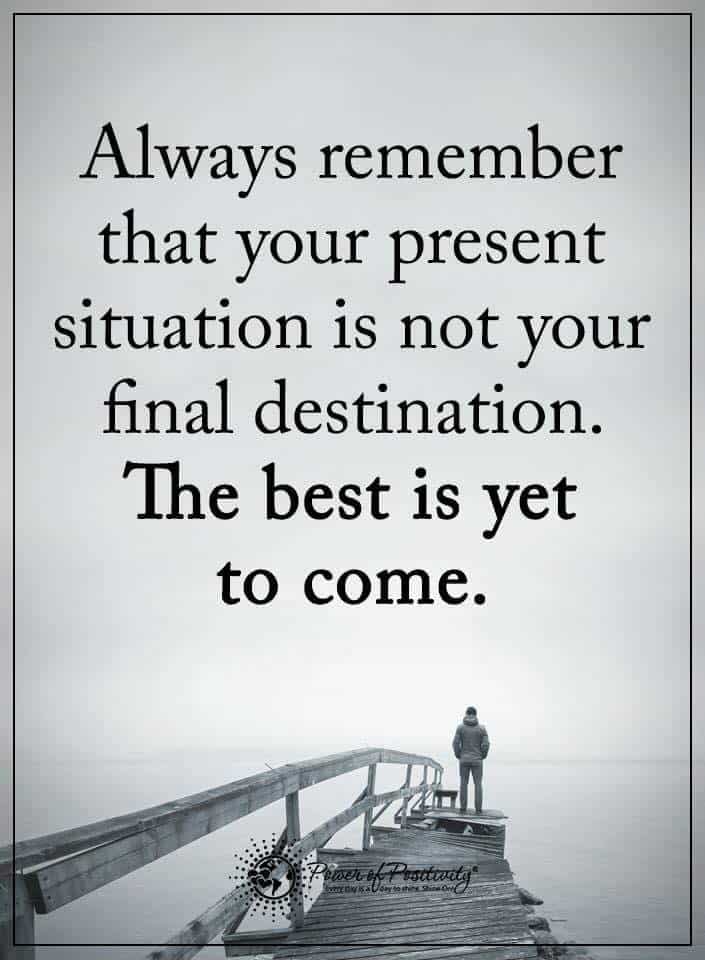
8. Always remember that your present situation is not your final destination. The best is yet to come.

13872809_10153670813337371_4880337474393212524_n

If you feel stuck, just remember that you can change your story whenever you’d like. You choose your path in life, so if you don’t like where it’s led, then carve another one. You have this ultimate power.

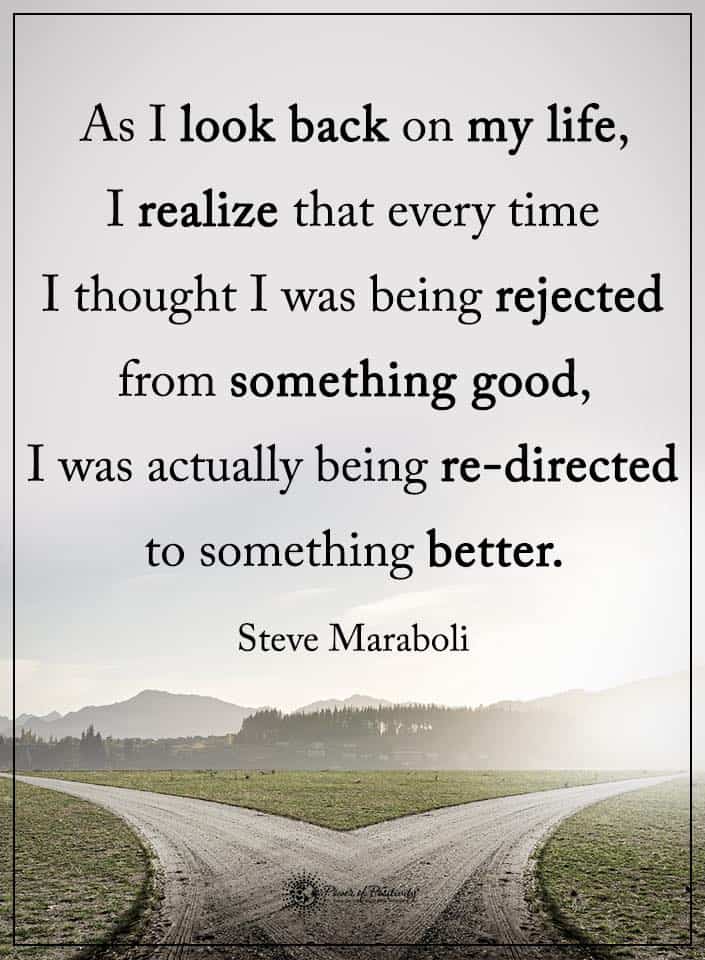
9. As I look back on my life, I realize that every time I thought I was being rejected from something good, I was actually being redirected to something better. – Steve Maraboli

13876302_10153673138712371_830860381181748104_n

Rejections may hurt, but learn the lesson within: life decided that the person, place or thing just wouldn’t serve your soul in the best way, so it directed you to what would uplift, challenge, and help you.

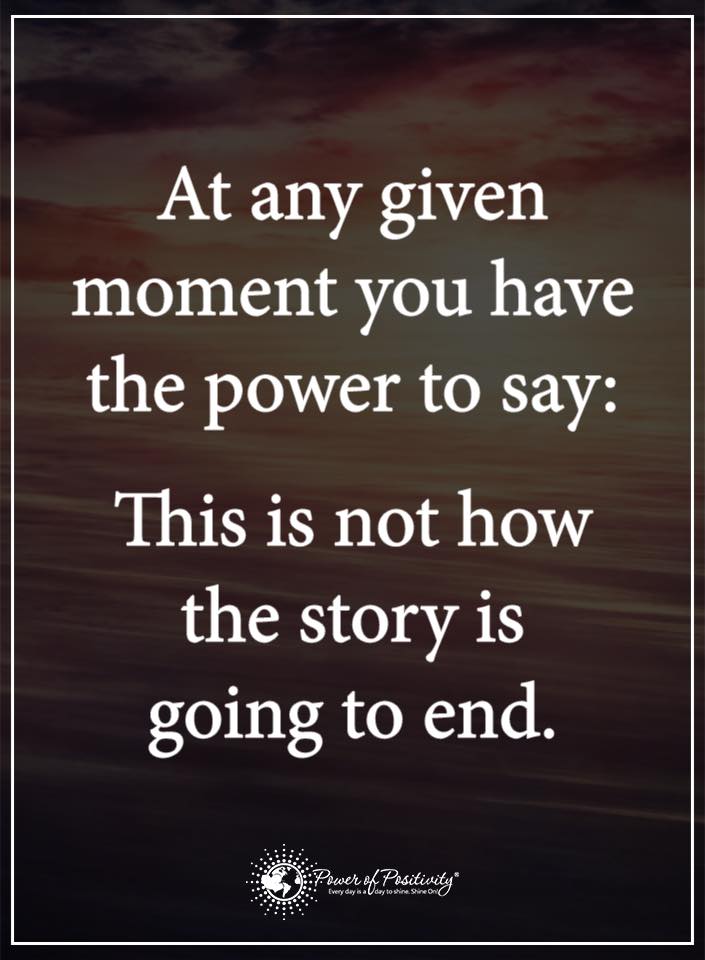
10. At any given moment you have the power to say: This is not how the story is going to end.

13886449_10153682617922371_6830635484228465067_n

Remember, you don’t have to stay in a situation that you don’t like. Honor your soul, and do what feels right for you.

11. It is a sign of great character and strength to be able to lose your attachment to anyone or anything that isn’t good for you.

13895391_10153679509992371_1358362675924163057_n

Related article: 25 Quotes To Remember When You Need Inspiration

You don’t have to keep anything in your life that doesn’t help you grow, learn, or bring you peace. It may seem hard to let go of people, places, or things, but if they don’t make you feel good, you have a responsibility to your well-being to shed anything that brings you down.

(C)Power of Positivity, LLC. All rights reserved

9 Signs You’re Overstressed (And Don’t Know It)

Are you overstressed?

Stress can be the underlying reason for many of our ailments. It lowers the immune system, causing us to get sick and acquire pain in the body. Stress is a normal response that actually enables us to function in a balanced manner, but while under long periods of stress, we can’t see the many symptoms it conjures up.

WebMD explains stress as the following:

“…any change in the environment that requires your body to react and adjust in response. The body reacts to these changes with physical, mental, and emotional responses. Stress is a normal part of life. Many events that happen to you and around you — and many things that you do yourself — put stress on your body. You can experience good or bad forms of stress from your environment, your body, and your thoughts.”

When we are overstressed, we might not even feel the stress. That’s because it masks itself under several symptoms.

Here are 9 signs that you are overstressed and don’t even know it:

pop meme

1. Your body is in pain.

We don’t listen to the body’s whispers until the pain starts to scream. Under high stress levels, your body will start to break down. You can experience stomach issues, diarrhea, ulcers, tense muscles, chest pains, and palpitations. You will get aches all over, arthritis will flare up, and even headaches will be screaming for your attention. Whenever you have pain in your body, become aware of it. Do not ignore the symptoms. Address what’s going on. It isn’t just stress management that helps you heal. Acceptance and awareness that change are the first steps to managing stress.

2. You aren’t sleeping well.

Any fluctuation in sleep patterns, whether sleeping too much from exhaustion or insomnia, must be addressed. Meditation, exercise and a healthy, balanced diet help with sleep issues. But ultimately, you need to find a root to the problem. Are you worrying too much at night? When you are sleeping, are you having nightmares? Our daily events get played out in the subconscious. It impacts your quality of sleep or causes a lack of sleep. Stress impedes a peaceful state of mind. Sleeping patterns do change with age and environmental factors; however, when you are overstressed, sleep is one of the first things that gets affected.

simple life

3. You have weight fluctuations.

Are you overeating or forgetting to eat? Stress will slow down your metabolism and you will gain weight. Change in appetite is a radar to our emotional and physical bodies and how we are being affected. If you are worrying and not addressing the issues, you might lose or gain weight rapidly. When we are overstressed, cells do not get enough oxygen. Food is energy, and what we put in the body is a sign of how we handle things. Are you eating too many sweets? Are you not eating enough? The body is a vehicle, and how we treat it is based on our mental capacity to deal with emotional issues.

4. You can’t stop thinking about work or problems.

If you can’t shut down work, finances, and other challenges for a while to find balance, stress has a hold of your life. Mark Twain said, “Worrying is like paying a debt you don’t owe.” You cannot find a solution until you detach from the problem. The excessive chit chat of worrying can escalate to cause psychological and physical problems. If you are constantly checking your phone, emails, and other forms of communication from work, it is time to really face what’s important in your life. Stress is suffocating you.

5. You can’t sit still.

Avoiding being still is a huge sign that you are overstressed. If you can’t go for a walk, sit in contemplation, do gentle stretching exercises, or just be with your own thoughts, then stress could get the better of you. If anxiety is constant and you can’t relax to even read a book, it’s time to address what’s causing you to avoid being still. Sometimes, the mind is the worst enemy. It’s time you get help with managing your anxiety and fears. An imbalance in the emotional body can trigger stress. Things we avoid get pushed further and further down until we feel it in other body areas.

6. You have little patience with others.

One of the first symptoms of being overstressed is the inability to have patience or tolerance with others. Our loved ones get the wrath from us being under tremendous stress. If you are snapping or getting angry quickly, most likely you are being tormented by too much in your life. It’s not easy to carry the world on your shoulders. Sometimes, we need to be vulnerable and ask for help. The lack of patience in others, and in yourself, is a sign that you need to slow down and smell the roses.

7. You have major mood swings.

When stress levels rise, it impacts our mental health. If you find yourself happy one moment and then immediately crying or enraged, your hormones may feel the impact of too much stress. Bottling up things inside and carrying everything alone doesn’t help. Get help. Talk to others. Make time to find out what’s truly causing you to behave this way. Stress does not only injure the body, but it also compromises and hurts relationships. Stress can enhance anxiety disorders, obsessive compulsive disorders, addictions (from alcohol, drugs, sex or food) and other mental health issues.

8. You have hair loss.

According to Carolyn Jacob, MD, founder and medical director of Chicago Cosmetic Surgery and Dermatology, “Typically, people shed about 100 hairs a day. Most people don’t even notice. Sometimes, a significant stress may spark a change in your body’s routine physiological functions, and cause a disproportionate number of hairs to go into the resting phase at the same time. Then three to four months later, sometimes longer, all those resting hairs are shed. The effect can be alarming. The types of events that disrupt the normal hair cycle may stem from the substantial physiological stresses on your body.” So, if you are experiencing a change in hair loss by the masses, it’s time you take a look at what’s emotionally causing these physical changes.

9. You have a loss of libido.

The loss of libido is one of the subjects most people do not address under stress. They won’t even acknowledge it to themselves or their partners. Whenever stress levels increase, it impacts the stress hormone secretions responsible for sexual response. Stress causes exhaustion and the inability to experience any intimacy. If you are experiencing a decrease or loss in your libido, it may be time to try stress management and other relaxation techniques. Ultimately, your mate shouldn’t be affected by outer issues that aren’t part of your loving relationship. Express your fear and your concerns. Once it’s in the open, it no longer has power over you.

Final Thoughts on Being Overstressed

Life can sometimes be challenging. We constantly put tremendous demands on the emotional, physical and spiritual bodies. It’s up to us to check in with ourselves and get real about what’s important. A little ailment today can land us in the hospital tomorrow. Stress is a silent killer. Let’s listen to the changes that happen in our bodies so we can address them early on. Life is too short to be living in constant chaos.

(C)Power of Positivity, LLC. All rights reserved
Skip to content