Weekly tips, affirmations, and small actions to feel your best.

How to Train Your Brain to Avoid Depression

Depression is one of the most frightening forms of mental illness to encounter, both as a person experiencing it and watching someone else go through it. When you are suffering, you see no hope, even if people are available to help you. Plus, when you see someone else suffering, you may try to help, but they are unwilling to accept help.

To learn how to train your brain to avoid depression, you must throw out the idea that you can only help those who can help themselves. Sometimes, we can’t help ourselves, and we need a helping hand to lift us. Asking for help can be difficult, but mental illness can kill when it becomes bad enough for a person to consider suicide.

If you or someone you know needs help now, text ‘GO’ or ‘HELP’ to 741741 for free, confidential help immediately. The text Crisis Helpline is available 24 hours a day, 7 days a week. The crisis line is prepared to help with issues of abuse, depression, anxiety, grief, eating disorders, suicidal thoughts, and other problems that you may consider a crisis in your personal life.

Beginning to Train Your Brain to Avoid Depression

When you think about feelings of sadness, you are most likely thinking about something that has happened in the past, and you can’t seem to get past it. Moving forward, you must shift your focus to the future instead.

What has already happened cannot be changed. You can relive it or think about how you wish it could have been different, but continuing to relive the negative events of the past won’t help anything.

If you want to move on from the past, you must process what happened and take action right now in the present moment, which will lead you to a better future. For example, if you are dealing with a divorce, there are many negative aspects to focus on, and none of it will change the fact that you are divorcing.

Instead of focusing on that negative, make a list of positive traits that your perfect partner should have. The list is one positive step in the right direction. Keep the momentum going.

turn the page

Picture the Movie of Your Depression Starring: You

Tell the story of your mental illness, including the events that led up to this current mindset of sadness. If your life story were only 15 minutes long, determine how much time this current depressed mood took up.

There was your childhood, teenage years, adulthood, and the epic moments that would be essential chapters in your story. Then, this bad thing happened. Now write the next scene where you overcome seemingly insurmountable hardship to go forward victoriously toward your happy ending.

Avoid Trying to Be the Best

Researchers say that competition and the drive to be the best may lead to depressed thoughts when or if we are unsuccessful in fulfilling our own high expectations for ourselves. The research shows that “When people feel insecure in their social environments, it can focus them on a hierarchical view of themselves and others, with a fear of rejection if they feel they have become too inferior or subordinate. This may increase vulnerability to depression, anxiety and stress.”

If you feel like you’re less than someone else, quit making comparisons. You are a unique and beautiful being, and no one has had the same experiences as you.

14 Healthy Habits That Also Support Brain Health and Help Avoid Depression

There are many ways you can avoid or alleviate the issues while also supporting brain health. You don’t have to do all of these tips, but choose ones that you find enjoyable and relaxing.

1. Visit Somewhere New

Traveling gives you an open mind and heart, allowing you to embrace the positivity all around you. While you might not always be able to go far away, you can visit a town nearby that you’ve never seen before. Seeing a new place can give you a fresh perspective and help you process your thoughts.

2. Focus on the Positive

Your mindset can help you avoid mental health issues. If you stay positive rather than complaining or fixating on the negative, it’ll help you maintain peace. Complaining leaves you stuck in a negative loop, leading to depression and anxiety.

You can control your mind, but you must be willing to shift your thoughts first. Don’t blame others for your feelings because you are the only one in control.

3. Learn Something

Even if you already have the career of your dreams, there’s always more to learn. Learning can help you feel better as it expands your knowledge and gives you purpose. It also reminds you what you’re capable of.

You don’t have to take a full college course for the benefits, either. Find videos or tutorials online to teach you some new tips about your interests. However, if you’re dedicated enough, you can even put your energy into learning a new language.

4. Avoid Overthinking to Beat Depression

Overthinking is a sure way to become depressed. If you can avoid overthinking, it benefits your brain and allows you to steer clear of mental illness. Overthinking is a dangerous habit that affects your thoughts and overall well-being.

When you constantly overthink things, you can’t live in the present. It means you’re fixated on the past and anxious about the future. Pushing those thoughts away can help you focus on the people and things around you right now.

Everyone overthinks sometimes, but you must find a way to let go. When your thoughts threaten to take over, do something that’ll keep you busy until you can overcome them.

5. Do Something Kind for Someone

Doing something for another person is a great way to make yourself feel better. It makes you think about something other than your problems and sadness. Plus, being kind to others promotes a sense of well-being within you.

Find someone who needs your help or a cause that inspires you. Then, see what you can do to make a beneficial change.

Your kindness could be picking up trash from the side of the road or helping a local charity. Or, you could help someone with a task they struggle with.

6. Get Enough Sleep

Sleep improves brain function and prevents mental illness. Getting enough rest is essential for keeping the brain sharp, and it helps you perform better in social situations. You’ll also remember things better and learn quicker.

Your body requires high-quality sleep for your overall health. Research shows that people who don’t get enough sleep are more likely to become depressed than others. If you struggle to fall asleep at night, try avoiding screen-time two hours before bed and avoid caffeine in the afternoon.

7. Stay Busy to Minimize Depression

When you feel like you can’t control your thoughts and feel negativity creeping in, do what you can to keep yourself busy. If you stay busy, you won’t think troublesome thoughts as often, and you’ll forget about your problems for a while. Start staying busy by putting your time and energy into the things important to you right now.

If you aren’t sure where to get started or you’ve already tackled the essentials, there are plenty of other things you can do. Start by finding a new hobby or picking up an old one that you stopped doing in the past. You can do a project or find something productive that you’ve been putting off for a while.

Whatever you choose to do, make sure it keeps your mind busy. It’ll help push away the thoughts that contribute to mental illness while helping you focus on the good all around you.

college students depression

8. Think About Your Social Circle

The people you spend your time with can make a big difference in your life and overall well-being. If the people you spend your time with have a negative attitude, they aren’t the best for your mental health. You might notice that they make fun of people, gossip, or behave in ways that don’t align with your values.

Don’t ignore any of the red flags you see in the people in your life. Distance yourself from toxic people who don’t spend their time and energy on beneficial ideas and tasks. Plus, stop spending time with people who make you feel bad about yourself.

Distancing yourself from toxic people isn’t the only thing you should do regarding your social circle. Focus on building strong relationships with like-minded people. They can still have different opinions and backgrounds than you, but they should have a positive mindset.

Additionally, the people you spend your time with should support you and build you up. Research shows that having social support can protect you from mental illness. Stay in contact with friends and family who love and support you, even when life gets busy.

If you need to meet new people, consider joining a club or picking up a new hobby. You’ll meet other people who want to do productive things with their time, increasing your chances of meeting positive people.

9. Beat Depression by Implementing a Healthier Diet

Your diet affects your brain, potentially causing mental health issues. High-fat diets affect your body in the same way that chronic stress does. When you aren’t eating healthily, you miss out on essential vitamins and nutrients that help your brain.

Eating a healthy diet improves your brain health while helping you avoid mental illness. The nutrients and vitamins also help you think more clearly, allowing you to work through your feelings positively.

A healthy diet requires eliminating high-sugar, high-fat, and processed foods. Instead, eat lean protein, fruits, and vegetables. Aim for foods with omega-3 fatty acids, such as nuts or salmon.

10. Reduce Your Time on Social Media

Sometimes social media is too much for your mind, but you can quickly make a change. Studies show that too much social media can cause depression. It also decreases your self-esteem and can be addicting.

If social media is necessary for staying connected with loved ones, you can still limit your time. Cut back on your daily use, and be aware of when you think it’s affecting you. If you notice negative thinking as you scroll, force yourself to close the app and do something else.

If you can’t help but click on the app when you get on your phone, consider deleting it. Then, you’ll have to log in to the website on a browser, making you less likely to start scrolling habitually.

11. Exercise Regularly

Exercise is one of the best ways to train your brain to avoid mental illness. You can do whatever activity you want, including running, strength training, or yoga. Whatever exercise gets you out of the house, makes you feel connected to your body, and gets your heart pumping will do the trick.

High-intensity exercise releases endorphins in your body, which are chemicals that make you feel good. However, even moderate or low-intensity activities help because they promote nerve cell growth. The growth improves brain function and makes you feel better, improving your mental health.

12. Reduce the Number of Choices You Have to Make Each Day

It can quickly become overwhelming and stressful if you have too many choices. When this situation occurs daily, it can lead to mental illness. Additionally, regularly wanting to make the best possible decision at a moment’s notice can cause depression.

Minimizing the number of decisions you have to make each day helps you avoid depression. Even small choices can cause problems when there are too many of them. Minimizing your last-minute choices can make all the difference, but you can simplify your life.

Start by eliminating simple decisions, such as what you’ll wear to work or eat for breakfast. You can make these choices ahead of time by planning and preparing the night before. It eliminates some of the decision-making of your morning, helping you start on a less stressful note.

13. Minimize Stress to Manage Your Depression

Frequent stress is one of the leading causes of depression, so minimizing it is essential to your mental health. Some of the ways you can manage stress are to:

  • Avoid overcommitting yourself
  • Let go of things you can’t control
  • Practice mindfulness
  • Meditate
  • Plan for unavoidable triggers
  • Avoid procrastination

14. Eliminate or Reduce Alcohol, Drugs, and Nicotine

Frequently drinking alcohol is associated with higher risks of depression, so limit your alcohol intake. Drug use also causes mental illness, and you’ll want to eliminate the use.

Additionally, smoking cigarettes can trigger depression, although you might want nicotine when you’re unhappy. Quitting nicotine can drastically improve your mood and reduce your risk, but it isn’t easy. However, you can do it if you stay focused and ask others to hold you accountable.

recover from depression

Final Thoughts on Train Your Brain to Avoid Depression but Not Your Emotions

Negative thoughts and emotions are normal, even though some people think that avoiding all negative thoughts prevents depression. However, researchers in the Journal of Personality found that an “inclination toward thought suppression is associated with obsessive thinking and emotional reactivity.”

To avoid depressing thoughts, try to learn to observe negative emotions as they happen while also acknowledging the good things about yourself. Don’t let your negative thoughts dictate your life or cause depression.


40 Things Every Woman Should Have By Age 40

Every woman has unique goals and dreams. Many set a specific set of goals to reach by the age of forty.

“The French are true romantics. They feel the only difference between a man of forty and one of seventy is thirty years of experience.” – Maurice Chevalier

While Mr. Chevalier may or may not be accurate in his assessment of female differences in thirty years, it is nonetheless thought-provoking. It is an inevitable fact that time brings about experience. When we’re born, we see the light for the first time, and when we first begin learning, our minds begin evolving. Once we arrive at mid-life, we begin to appreciate its finite nature…and on, and on.

Are there some things that every woman “should” experience by age 40?

Of course, this is a highly subjective proposition.

However, we – at times, tongue-in-cheek – say that this milestone brings about, at the least, a standard set of experiences shared by women that reach age 40.

Here, we take a look at 40 things every woman “should” or may have experienced after four decades of life on this planet. However, we also realize that men may question what they should accomplish–and we address them in a companion article.

Without further delay, 40 things every woman “should have” by age 40:

As you read, please understand that these are suggestions, not rules. These do not necessarily reflect someone’s level of achievement in life. 

women

1. Had such an emotionally-powerful kiss that it will continually remind you of the word “passion.”

2. Had a lover that knew how, when and where to “touch” you in a way that left you in awe and anticipation.

3. An understanding of your family’s medical history (i.e., health genetics) that enables you to take appropriate steps to preserve your well-being.

4. Knowledge of how to confront a friend or someone else close to you without losing self-control.

5. A young child, not your own, that has looked to you for support, compassion, and/or guidance.

6. A place you can call “your own” – one that allows you to remain in comfortable silence with your thoughts.

7. Knowledge of how to cook at least one relatively complicated dish – to at least “acceptable” quality.

8. Having at least one good friend that, inevitably, makes you laugh…

9. And at least one friend that, nonjudgmentally, lets you bawl your eyes out.

10. Something too expensive that you bought, not impulsively, but because you deserved it.

11. Had a dream or vision of yourself so extraordinary that it actually scared you.

12. an experience so enamoring that you’ll gladly retell it in your late years.

13. The realization that old age is inevitable, and you must have a way of funding it.

14. An emotional scar, while deeply entrenched via pain, has strengthened your character.

15. An outfit so lovely that you’d unabashedly wear it in front of anyone, at any time.

16. A routine activity that you do for you, and you alone.

17. Knowing that while your parents made mistakes, they often did their best with what they had.

18. Memories that make you wince; ones that help you appreciate the ones that make you gleeful.

19. Kept a journal or personal record of your deepest thoughts and feelings.

20. A friend you can call at any time to help you out of a jam.

21. Something – a piece of jewelry, a tattoo, a gift, anything – brings a heavy sense of sentimentality.

22. Knowing what you will and will not find personally acceptable in any relationship.

23. A well-kept secret that immediately brings about a smile.

24. An older woman in your life that possesses characteristics you wish to emulate.

25. A sense of spirituality (read: not religiosity) that both nourishes and teaches.

26. A song or musical piece that brings that defines you…

27. Or makes you want to sing at the top of your lungs.

28. A “to-do” list that may or may not be completely checked off is okay.

29. A higher purpose that enables you to roll out of bed even on the toughest of days.

30. A thorough understanding of who you are as a woman – and the potential implications of this knowledge.

Its never too late quote george eliot

31. Accomplish something that nobody can ever take away from you, regardless of circumstance.

32. A photo album, big or small, of forever cherished memories.

33. Lost someone so deeply loved that it will forever leave a void in your soul and a hole in your heart.

34. Having the ability to say “NO” without any further explanation.

Related article: 10 Things You’ll Regret Not Doing Before You’re 30

35. Accepting the person you see in the mirror, imperfections and all – as they’ve likely been earned over time.

36. Any hobby or interest (yes, TV splurges count) that you can get lost in for hours…and hours.

37. A gray hair or two, or a part of your body that you’ll probably never perfect.

38. Had a romantic partner that, even if things didn’t quite work out, brought out your “wild side.”

39. A bit of money set aside, or enough resources in case of an emergency.

40. Realizing that 40 years old is by no means “old.” There’s a lot of living to be done, young lady.

(C)Power of Positivity, LLC. All rights reserved

10 Bedtime Habits of the Most Successful People

Many of us are captivated by success. We love to read success stories, interview successful people, and learn how to become more successful. We especially love to know the “tricks” of success. Think about how much money people have made through the production of success-related media, books, CDs, DVDs, classes, conferences…the list goes on. Tony Robbins, perhaps the most notable success and self-help guru globally, is estimated to be worth nearly half of a billion dollars.

And successful people have been asked just about every question known to man: ‘What do you do in the morning?’ ‘What’s your diet like?’ ‘How do you balance work and home life?’ ‘How much do you work out? and on…and on…

Ever wonder what successful people do before bedtime? We asked this question ourselves and found some of these bedtime habits fascinating.

Ten Bedtime Routines of Highly Successful People

Here are ten things that successful people do before heading to the sack:

“We are such stuff as dreams are made on; and our little life is rounded with a sleep.” – William Shakespeare

1. They read

Behavioral experts have discovered that reading is the very last thing several successful people do before going to sleep. From business magnates like Bill Gates to national leaders like Barack Obama to fashion designers such as Vera Wang – reading is considered a non-negotiable activity for many successful individuals.

2. They have an “unwinding” ritual

One thing most successful people don’t do before bed is work. Of course, some successful people are “workaholics” and continue their work into the late hours. However, many view this as an exception to the rule. To “unwind” is also considered non-negotiable – and there are several ways to do so.

3. They do something nostalgic

Some successful people like to “take a trip down memory lane.” Doing so helps them keep things in perspective – to remember what is truly important in life. Part of success is recognizing when a mental break is needed when the body and mind require something other than the work that all-too-often makes up their day.

4. They daydream

Not a surprise here. Many successful people have attributed daydreaming – aka “mind-wandering” – to breakthroughs that have brought them to the next level of success. This is particularly true of innovators, artists, and other creatives who genuinely appreciate the power behind daydreaming. Aside from the next “big breakthrough,” some successful people will daydream about relaxing the mind, gaining inspiration and wisdom, or developing potential goals.

5. They plan for tomorrow

People that have achieved tremendous success are known for their incredible work ethic – an attribute that often involves working above and beyond the normal “9 to 5” routine. While they may not do anything too demanding before bedtime, they will plan for the next day. Not to mention, this short-time investment pays big dividends. Successful people understand this short planning time makes the execution of tomorrow’s activities clearer… and less stressful.

6. They’ll unplug from everything

Avoiding heavy work, relaxing, and recharging often requires a complete disconnect from the phone, computer, tablet, or another digital device. Further, researchers have discovered that using electronic devices before bedtime makes it much more difficult to fall asleep – an essential part of a successful person’s life.

7. They prioritize family

For many, the phrase “work-life balance” translates to “work-family balance.” For most people, including the very successful, family always comes first. Balancing a heavy workload and quality time with the spouse, kids, pets, etc., can be a difficult task at times but is often considered non-negotiable – and rightly so.

Whether family/pet time is scheduled doesn’t matter to successful people. The great ones always know who helps make them great…and make sure to reciprocate their love.

8. They practice gratefulness

Many successful people take the time to reflect on or write down things that they appreciate in their lives. Some keep a ‘gratitude journal’ to keep things in perspective and serve as a reminder for progress made in various aspects of their lives.

This is a critical habit for successful people, as their day is often riddled with stressful situations. Too much stress breeds pessimism and a pessimistic outlook is not something that successful people can afford.

9. They decompress

As mentioned, successful people too often have to handle stressful scenarios. Any person that has been exposed to high levels of stress over a long duration of time requires a certain period to decompress.

For some, this means hitting the gym. Others like to meditate, listen to relaxing music, or take a hot bath. The list is endless, but the goal is the same: decompression.

10. They abstain from booze

Not wholly abstain, but most successful people refuse to touch alcohol right before bedtime. Whether intentional or not, successful (and all) people abstaining from drinking before bedtime have improved sleep quality.

The National Institute of Health – a preeminent public health organization – has discovered that consuming alcohol before sleep “robs people of deep sleep and REM sleep and keep them in the lighter stages of sleep.”

Other Lifestyle Habits of Successful People

Besides prioritizing sleep, here are some other lifestyle habits of those who achieved great success. Adopt a few of these behaviors for yourself, and you’ll see incredible changes begin to unfold.

1. Get up early

Many well-known successful people swear that getting up early has contributed to their success. They say that rising before sunrise gets their day off to a good start and helps them maximize their time.

2. Start the day by reading a book.

If you like to read, it could signify you’re a successful person. Successful people take time to catch up on the news and ready industry information. Besides that, reading can also lead to a longer life, according to one study. Individuals who read books had a 20% reduction in mortality than people who read other materials like periodicals or online articles.

3. Check communications twice a day

It’s easy to pay attention to your smartphone or computer every time you hear a notification. Highly successful individuals don’t let the constant interruptions stop them from being productive. They make a habit of responding only once or twice a day to texts and emails.

4. Evaluate priorities

There are many things to do in life, but not everything is essential. Highly successful people make a habit of determining what’s important. They know they can’t get everything done. So, every day, they prioritize their to-do list by asking themselves this question:

Will this matter to me tomorrow? Next week? A month? A year?

They focus on what will have a long-term effect on their lives.

5. Love to learn

Successful people are lifelong learners. They are constantly looking for ways to enhance their skills or learn new skills. These folks like to challenge themselves to do difficult things that may be out of their comfort zone.

6. Practice gratitude

Those who are successful know that they are where they are today because of the support of people in their life. They practice gratitude for family, friends, and co-workers who have stood by them on their journey. Successful people find time to thank others and show appreciation because they don’t assume they could have made it without these folks’ help.

7. Monitor their wellness

Successful individuals know the value of healthy self-critic. They understand their strengths and weaknesses. They need to know where they need to change. Successful folks take responsibility for their failures and strive to improve personal growth and others’ benefit.

8. Get outside for sunshine and fresh air

Physical activity is healthy for your mind and body. It helps relieve stress and stimulates your brain. It’s no wonder that many successful people get outdoors. They may play a sport or go hiking, but they prioritize outside activity as a daily habit.

9. Jot down good ideas

A simple notepad and pen beside your bed could determine whether you become a successful person. Successful people realize that creative ideas often come right before they fall asleep. So, instead of trying to remember the vision they had, they jot down their view on the notepad at their bedside. This is a powerful way to allow your creativity to flow without fear of forgetting your concept. During the day, you can carry the notebook around with you or write your thoughts on your smartphone notes.

8 Behaviors That Help You Lose Weight Easier

Losing weight is one of the most challenging things for someone to do. Even well-intentioned and driven people will frequently quit an exercise or nutrition program within a couple of months. Why? Because it can be hard. Really hard. Ask anyone that has lost a significant amount of weight just how difficult it was. Odds are they were faced with obstacle after obstacle, setback after setback, losing a bit of poundage only to put it back on again.

Then there’s this. It is not only losing unwanted pounds but keeping them off. Most of us cannot afford a physical trainer or nutritionist. Most of us must rely on ourselves to navigate this arduous path. But here’s the thing. We tend to overcomplicate the methodology (i.e., “the science) behind losing weight. Sans for someone with a type of metabolic disorder or a genetic predisposition towards obesity, most of us have subconsciously programmed ourselves to interpret the difficulties of losing weight as impossibilities. It’s not impossible if you know what you’re doing.

To this end, we’ve constructed eight simple, scientifically-validated methods of losing weight. You’ll see that none of these methods require anything beyond a bit of willpower, discipline, and knowledge.

8 Behaviors That Promote Your Weight Loss Efforts

Here are eight behaviors, attitudes, and practices that will help you lose those unwanted pounds easier:

lose weight

1. Understand that 30 minutes is plenty

It’s a misguided perception that weight loss requires long workout sessions. Scientists at the University of Copenhagen cite that “no statistically significant changes were found in energy intake or non-exercise physical activity that could explain the different (results) associated with 30 vs. 60 minutes of daily aerobic exercise.”

It gets better. The same study discovered that a half-hour exercise results in 25 percent more weight loss than a full hour.

2. Learn the basics of nutrition and read those labels

Various studies demonstrate that people who understand the elements of nutrition (e.g., fats, carbohydrates, sodium) are more likely to lose weight. Understanding recommended nutrition levels such as Recommended Daily Intake (RDI) equips people with the requisite knowledge to interpret nutrition labels confidently.

Together, a basic knowledge of nutrition and a developed habit of reading food labels before purchasing food items can go a long way in propelling someone forward in meeting their weight loss goals.

3. Keep chugging that H2O

The correlation between lots of water and expedited weight loss is valid – and is so for a variety of reasons. First, drinking water increases the sense of satiety (i.e., “fullness”). Second, natural water contains zero calories – and, since consumption induces satiety – one consumes fewer calories. Naturally, this results in weight loss. Third, folks that develop a preference for water commonly replace other sugar- and calorie-laden beverages (e.g., beer, soda).

Bottom line: drinking plenty of water can stimulate weight loss.

4. “Spice-up” that metabolism

This one is relatively straightforward: spicy food kicks the metabolism into a higher gear. Metabolism is the primary physiological mechanism for converting and “burning” fat.

Aside from the uptick in metabolic rate, spicy foods (similar to water) also help promote feelings of fullness. These two properties can significantly expedite any efforts to lose weight in the cohort.

5. Stock up on high-quality foods

In a study published by Harvard University’s School of Public Health (HSPH), “The strongest evidence shows that calories matter, but focusing on food quality is an equally important part of preventing weight gain and promoting weight loss.”

The HSPH study provides specific examples of such foods, citing unrefined and minimally processed foods. Such foods include vegetables and fruits, healthy fats, healthy protein sources, and whole grains.

6. Don’t “get too comfortable.”

The phrase “don’t get too comfortable, in this case, applies to the level of heat to which we expose our body. Studies demonstrate a correlation between reduced exposure to lower temperatures and increased rates of obesity.

The rationale: when we’re cold, our skeletal muscles must remain active (“shiver”) to create heat. During this period, our bodies are burning excess calories. In contrast, when we’re “warm and cozy,” our muscles remain at rest. The result? We burn fewer calories and store more fat.

7. Don’t eat (heavily) after supper

Despite the myths, you can eat a small bite after supper. Be sure your snack consists of a “light, healthy snack.” Like many other bodily systems, it “winds down” at night, especially when we are asleep. As such, it’s wise to abstain from carb and fat-laden foods before hitting the sack.

Some ideas: 100-calorie snack packs, low-fat yogurt, fruit, or a small serving of popcorn.

8. Plan your meals

“Failing to plan is planning to fail” is certainly applicable here. Do you need to meticulously account for every gram of every ingredient in every meal? No. But, as mentioned, you must possess at least a basic knowledge of food and how the body receives that food.

It’s a good idea to have (at minimum) a basic outline of what kind of food you’ll eat on any given day. For example, eggs for protein in the morning; snack in the mid-morning; chicken and salad at lunch; whole-grain pasta at dinner.

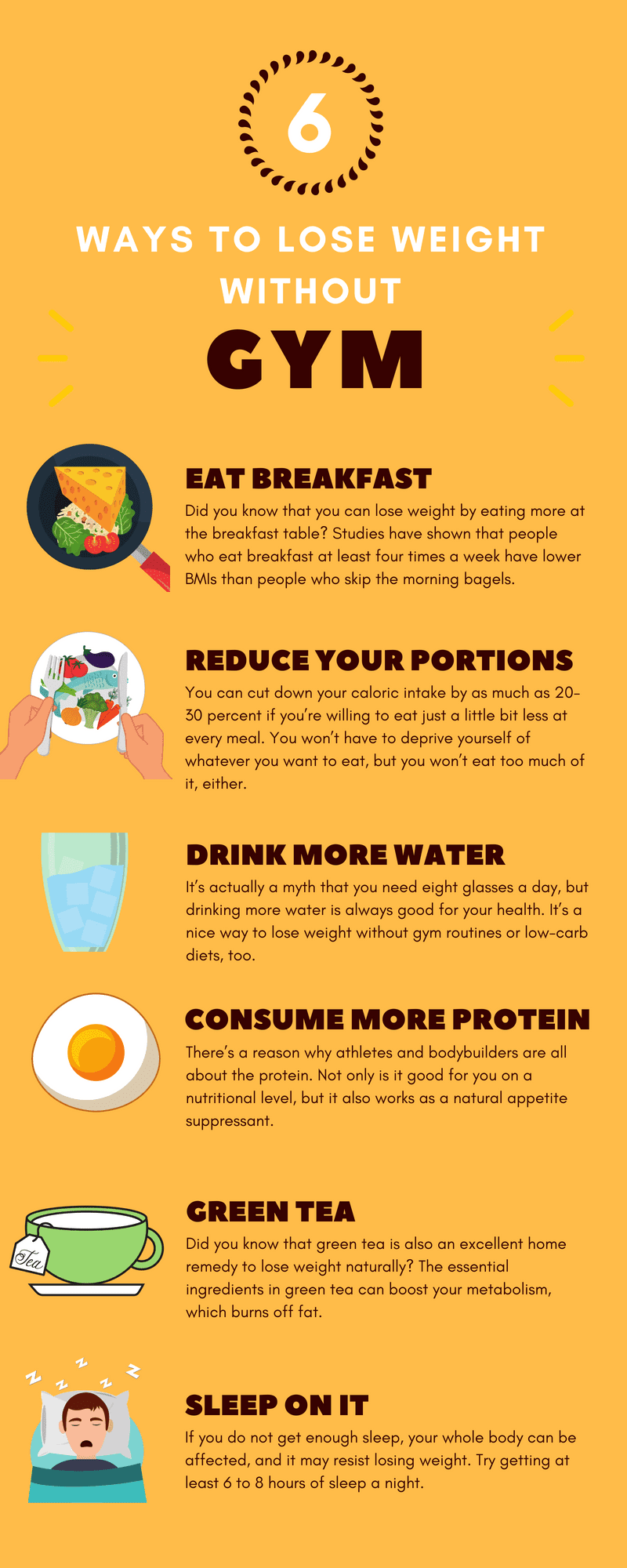
lose weight without gym

Six Foods to Help You Feel Fuller and Lose Weight

If you want to lose weight, it’s essential to consume foods that keep you satisfied longer. In general, foods high in protein and fiber will help you lose weight because they increase digestion time. The longer it takes you to digest foods, the less hungry you will feel.

Processed foods tend to have high energy content and few nutrients, meaning you need more food to reach satiety. However, whole, fresh foods such as grains, fruits, and vegetables have all the vitamins, minerals, and macronutrients the body requires. Below, we will give you a few ideas of foods you can eat to lose weight and keep hunger pangs at bay.

1.     Oatmeal

Many people enjoy eating a bowl of oatmeal for breakfast since it’s fiber-rich and nutritious. You can add fruit such as blueberries or strawberries for additional flavor and calories. Oatmeal contains 140 calories, five grams of protein, and four grams of fiber in a half-cup. It has both soluble and insoluble fiber, improving digestion and adding bulk to stool.

One study found that people who ate oatmeal for breakfast felt more satisfied than those who ate cereal. They also consumed fewer calories at lunchtime because they still felt full from breakfast.

Oatmeal contains a soluble fiber called beta-glucan, which increases satiety hormones and prolongs digestion. If you’re looking to lose weight, eating oatmeal can help you reach your goals while improving gut health.

2.     Potatoes

Potatoes have been scorned in the diet industry because they’re high in carbohydrates. However, they also have moderate amounts of fiber and protein, making them optimal foods for weight loss. In addition, they have Vitamin C and potassium, which help the immune system function properly and lower the risk of heart disease.

Boiled potatoes scored a 323 on the Satiety Index, the highest of all 38 foods measured. They scored nearly seven times higher than croissants at a mere 47. If you allow potatoes to cool for a bit after boiling them, they will form a fiber-like carbohydrate called resistant starch that can help you lose weight.

Potatoes also contain a protein called proteinase inhibitor 2 (PI2), which studies have shown can inhibit hunger.

3.     Eggs

Eggs have been touted as one of the best foods to encourage weight loss. While the yolks contain most nutrients such as choline and Vitamin D, egg whites have around 4-6 grams of protein. One large egg also contains about 5 grams of healthy fats, which can help you control your appetite since they take longer to digest than carbs and protein.

A study of 50 overweight and obese participants revealed that consuming eggs and buttered toast for breakfast instead of cereal and milk increased fullness levels for 4 hours.

A similar study including 48 healthy adults found that eating eggs and a source of fiber resulted in higher satiety than consuming low-fiber cereal and milk.

4.     Greek yogurt

Full-fat Greek yogurt can aid in your goal to lose weight since it contains twice the protein as regular yogurt. It also will improve your gut health due to the high levels of probiotics such as S. thermophilus or Bifidus. These beneficial bacteria can reduce inflammation, gas, and bloating and prevent leptin resistance, which significantly contributes to obesity.

In one 2013 study, women ate a 160-calorie yogurt snack that contained either low, moderate, or high protein content. Those who consumed the high-protein Greek yogurt felt satisfied the longest and less hungry; they also ate dinner later.

If you want to add Greek yogurt to your diet, choose one without added sugar. Also, look for a yogurt that includes “live cultures” on the label, as not all yogurts have added bacteria.

5.     Dark, leafy greens

Leafy greens such as kale, spinach, Swiss chard, and collard greens contain tons of fiber to keep you fuller longer. They also have thylakoids, which are structures inside plants that studies have shown can increase satiety and control appetite.

In addition, leafy greens have essential nutrients such as calcium, potassium, Vitamin C, and K, which improve overall health. Finally, their high water content can make you feel less hungry without consuming many calories, helping you lose weight.

If you want to add these healthy foods to your diet, consider cooking them instead of eating them raw. You can consume a greater volume when you cook them, plus they will be easier to digest.

6.     Legumes

Legumes like black beans, kidney beans, peas, lentils, and peanuts provide essential nutrients while promoting weight loss. They’re packed with fiber, protein, and resistant starch, making them incredibly filling and beneficial for digestion.

In addition, legumes have B vitamins, iron, copper, magnesium, manganese, zinc, and phosphorous. They’re also low in fat, have almost no saturated fat, and are cholesterol-free.

A one-half cup serving of legumes contains only 115 calories, 20 g of carbohydrate, 7–9 g of fiber, 8 g of protein, and 1 g of fat. Legumes are also low on the glycemic index, ranging between 10 and 40 depending on the type.

One study that reviewed nine randomized trials analyzed satiety from pulses, a member of the legume family. The meta-analysis found that participants who ate pulses felt 31% more full than meals consisting of pasta or bread.

lose weight

Final Thoughts on the Importance of Sticking With Your Goal to Lose Weight

If you want to lose weight, you will have to maintain a regular workout schedule and healthy eating habits. This victory doesn’t happen overnight and requires immense sacrifices, causing many people to throw in the towel. However, it’s important to remember that slow and steady wins the race. You’re not competing with anyone else, so you don’t have to sprint toward the goal.

As long as you exercise consistently, drink plenty of water, eat in moderation, and get adequate rest, you will lose weight. Here’s to your success!

10 Regrets You Don’t Want In 10 Years

Growing up, we don’t think much about how our lives will play out. We don’t have to think about the future because we only care about living for today. We don’t have to worry about money because we don’t have to earn it. We don’t care about anything except the present moment, because we have not learned about regrets. And we haven’t yet known the horrors and atrocities of the world. All we care about is having fun with friends, watching our favorite TV shows, and digging up earthworms. Ah, those carefree days – it’s fun to reminisce from time to time, right?

We all want to turn back the hands of time sometimes, back to those days where nothing mattered. However, how about living a life where we don’t have the constant urge to be elsewhere? How about living for today so that we don’t have regrets later on? Simple ideas, in theory, we know, but hard to actually practice.

Well, we believe in taking baby steps to get where you need to be. If you don’t like your life now, you can always change it. If you looked back on your life as it is 10 years from now, would you like what you see?

If not, we’ve come up with this simple list of things you might regret 10 years from now, if you continue living the life you do now. This article isn’t meant to make you feel bad about your life, but rather, to make the changes necessary so you won’t have to live with the burden of regrets later on.

10 Regrets You Don’t Want In 10 Years

regrets

1. Not following your dreams.

According to Bronnie Ware, a palliative nurse from Australia, many of her dying patients listed this as their biggest regret. Ware took care of patients in their last three to twelve weeks of life, and heard many stories and confessions from them all. While she said that all of them found peace before their death, listening to their regrets moved her so much that she actually wrote a bestselling novel about it called “The Top 5 Regrets of the Dying.”

In the book, she said many of her patients had not honored even half of the dreams they wanted to fulfill, and this caused them to have major regrets before the end of their life. They wanted so badly to knock other things off their bucket list, but they had to die knowing they still had dreams.

10 years from now, do you want to look back and realize that you didn’t work toward your goals? Do you want to look back and see all the time that you wasted wondering if you were good enough to live the life you’ve always imagined? Well, here’s the secret – you can live that life NOW. Don’t want until you’re on your deathbed to think about your dreams; live them now, no matter what you have to do to achieve them. Even if you fail, at least you will have tried rather than giving up before you even started.

2. Working too hard.

Ware said that this regret came in at number two, based on the frequency that she heard it. Unfortunately, many people already work too hard even as teenagers. We’ve been spoonfed a bunch of lies about what will truly make us happy, and based on the declining mental health of much of the world, the answer clearly doesn’t lie in how much money we make or how hard we work. What’s the point of it all, really, other than to line the pockets of the wealthy and allow us to pay our bills? At the end of our lives, we won’t care about how much money we have or what we achieved. We’ll remember the human connections we made, or didn’t make.

We’ll think about the memories we made with loved ones and all of the beautiful people we crossed paths with during our time here. Sure, we all have to make money to survive, but don’t work so much that you forget to build a life outside of your job.

3. Not saying what you truly mean.

Coming in at third on Ware’s list, the patients also regretted holding back their feelings. This really doesn’t benefit anyone in the end, because you’ll end up with repressed emotions that will haunt you until the day you die. The person your emotions are directed toward will not know how you truly feel, and will be left in the dark about any issues you have with them. Lying or covering up with truth does no good for anyone, so say what you mean and mean what you say. Not everyone will like it, but at least you can fall asleep at night knowing you live your truth each day and don’t try to sugarcoat it for anyone.

4. Not staying in touch with friends.

People at the end of their lives also regretted losing touch with friends. In 10 years, will you regret not calling up that friend from high school that you wonder about every day? Will you regret not reaching out to the person in your yoga class that you want to get to know better? Don’t let your fear or doubt control your decisions. Reach out to people and take a chance on a new friendship. Life’s too short to live it all in your head; we all require human connection, so don’t be afraid to put yourself out there in order to make new friendships or recover an old one.

5. Not being happy.

We like to think that outside forces control our emotions, but the key to emotional control lies within us. We don’t choose what happens to us, but we can choose how we react to it. Life goes by so fast, so why spend it finding every little thing to complain about? Being happy costs nothing, keeps you healthier, makes life more fulfilling, attracts more positive relationships, and so on. So, unhappiness, then, actually costs MORE in the long run, and can even lead to serious illnesses. Our mental, emotional, and physical health relies on our perception, so if you want to start living a better life now, simply change how you look at things. You’ll discover you have more inner strength than you had ever imagined.

6. Caring too much about what others think.

As a society, we spend a lot of time thinking about what others think of us. However, this does absolutely nothing for our happiness or success whatsoever. What good comes out of fixating on the opinions of others? None. It only drives us insane and leaves us feeling insecure and depressed. So, stop with the madness. Live your truth, work on your life, and stop worrying so much about what everyone else might think. Chances are, they’re so busy with their own lives that they don’t even think twice about yours, anyway.

7. Worrying too much.

We spend A LOT of our lives worrying. No matter what role you play in this world, you have something to worry about. However, will you let this worry take over your life? Will you let the heaviness of the burden drag you down? Or, will you release these worries and realize that this world worries far too much?

At the end of your life, remember that the unpaid bills and debts, what other people think of you, how much money you have, and everything else we worry about won’t really matter. The fleeting nature of life should cause us to shed our worries immediately, but unfortunately, we don’t feel how quickly life goes by until we wake up one day as a 75 year old. Then, we begin to see how small our worries are. But, why not choose to awaken to this truth NOW? Remember: don’t be a worrier; be a warrior!

8. Not taking care of your health.

Everyone likes to think they’re invincible, until they’re not. When we’re younger, it’s easy to think we’ll live forever. It’s easy to think that we can stay up late, eat whatever we want, drink away our weekends, and still think we’ll live to 100. Well, hate to break it to you, but all those decisions will catch up with you someday. Maybe not in 10, 20, or even 30 years, but eventually. So many health problems we face today can be prevented if we just take care of ourselves and honor our minds and bodies, so please give yourself the gift of good health. You won’t regret it later on.

14368628_10153824535217371_1018214254402078996_n

9. Taking life for granted.

Most people take their lives for granted, even though so many little things we experience each day are miracles in their own right. The bees that pollinate the foods we eat, the plants that provide us with nourishment, the air we breathe that gives us oxygen, the water we drink that keeps us hydrated, the sun that shines down on us and gives us life – we should appreciate all of it. Even if you don’t have much in life, you could at least say your thanks for having the basics that the universe provides you with.

Related article: 25 Things You’ll Never Regret Doing

Have an attitude of gratitude, and it will come back to you tenfold.

10. Not living in the moment.

More than anything else, it seems most of us have issues with living in the NOW. We reminisce on the past and wish we could bring it back, or we long for a future that hasn’t happened yet. Either way, we live out of alignment with the present, which means that we’re NEVER truly experiencing life. We’re experiencing moments in our memory, or moments in our imagination. We aren’t experiencing the raw moments, the moments unfolding right before our eyes.

Related article: 5 Ways to Live Without Regrets

If anything, remember that one day, you won’t have any more present moments left to experience. You won’t have road trips to go on, or mountains to climb, or children to kiss goodnight, or a partner to cuddle with. You will have your memories, serving as a reality check. Did you live your dreams, take chances, and say your thanks for every day you awoke? Or, did you file your dreams away in the “Someday” folder, play it safe, and sweat the small stuff?

Above everything else, remember that you and only you have the power to change your life and make it one worth living. It takes hard work, determination, and digging deep in order to live a truly happy, fulfilling life, but at the end of the day, the effort we put in determines the results we get.

If you want to live a life you won’t regret in 10 years, it all starts with what you’re willing to do to make sure that doesn’t happen. You hold the key already, but it’s up to you to find the door.

How to Make Calming Hot Chocolate to Relieve Stress and Anxiety

Most of us try to limit our consumption of chocolate, but did you know that certain chocolates can actually benefit your health? Of course, processed forms of chocolate, such as candy bars, can negatively impact your health, so we don’t recommend the things you’ll find in the checkout lines at the stores. If you want to relieve stress and anxiety in your life, however, hot chocolate made with high-quality ingredients, such as fresh cacao, can do wonders for your well-being.

Plus, winter is in full swing in most parts of the country, so why not make a nice piping cup of hot chocolate to warm your soul on those bitterly cold nights? We’ll talk more about how to make the hot chocolate below, and what sort of benefits you can expect from it.

How to Make Calming Hot Chocolate to Relieve Stress and Anxiety

Even though most hot chocolate contains unhealthy, hidden ingredients, you won’t have to worry about that with this nutrient-packed beverage. You also won’t have to deal with insulin spikes from added sugars, which most packaged hot chocolate will have if you look at the back of the box. Plus, the warming effects of drinking the hot chocolate will help you relax you before you call it a night.

The drink contains healthy fats to stabilize your blood sugar, which will help keep anxiety and insomnia at bay. In addition to providing a source of healthy fats, the raw cacao in the recipe contains magnesium, which helps to induce relaxation. Not to mention, many people lack this vitally important mineral, and not many would object to getting their magnesium in such a delicious way! Plus, the spices, a blend of cardamom, cinnamon, and nutmeg, have anti-inflammatory compounds that can reduce anxiety and stress while adding a lot of flavor to your nighttime beverage.

Also, let’s not forget the countless studies that definitively link dark chocolate consumption with lower stress levels and higher feelings of happiness. In fact, one study found that daily consumption of 40g of dark and/or milk chocolate reduced feelings of stress in females. The response of the adrenal gland, which produces cortisol, was much less, and the researchers concluded that the consumption of dark chocolate helped to buffer the brain’s response to stress.

Without further ado, let’s go over exactly how to make your calming cup of hot cocoa for yourself.

Ingredients

  • 1 cup almond milk (or whatever type of milk you prefer)
  • 1 tablespoon cacao
  • One teaspoon cinnamon
  • 1 teaspoon ghee (or whatever kind of butter you’d like)
  • 1 teaspoon coconut oil
  • Pinch of nutmeg
  • ¼ teaspoon cardamom
  • 1 tablespoon collagen
  • 1 teaspoon vanilla extract

Related article: How To Hypnotize Yourself in 15 Minutes for Stress and Anxiety Relief

Preparation of the hot chocolate

The only part of the recipe that requires heating is the almond milk, so pour it into a pot and heat until boiling. Then, stir in all other ingredients, pour in a mug, and enjoy!

chocolate cake

Experts explain the healthful benefits of eating chocolate cake for breakfast.

If you try out this recipe, let us know how you like it in the comments below!

11 Things Strong Women Do Differently

When you come across a strong woman, you’ll know it the moment she enters the room. Strong women give off a vibe of self-confidence that anyone could spot from a mile away, and she tackles any situation she faces head-on. She might stumble and fall along the path to success, but she never gives up. A strong woman perseveres through the storms life tosses at her, and doesn’t allow a little rain to take away her sunshine. She knows what she wants in life, goes after it, and doesn’t depend on anyone else for what she wants. She stands out because she doesn’t need attention or validation from anyone. Her self-confidence, drive, and ambition come from within, and she’s certainly a force to be reckoned with.

Strong Women Do These Eleven Things Different From Others

Do these sound like any women in your life?

1. She takes some time for self-care.

One of the less obvious keys to success is self-love and self-care because, without those, a successful woman knows she’s already up a creek without a paddle. Successful, strong women know that they can’t possibly reach their goals if they don’t take care of the person in the mirror first. You cannot get from Point A to Point B if you don’t nurture yourself along the journey, and take time out for #1.

strong women

2. She’s not afraid to stand on her own.

A strong woman does not need anyone standing in front, behind, or beside her to get things done. They set their goals, figure out how to achieve them, and then get after it. Simple as that. A strong, successful woman learned a long time ago that no one would come along to save her, so she saved herself. She fights battles, tames dragons, and walks through the fire by herself, without anyone holding her hand. This makes her virtually unstoppable, and she knows it.

3. Strong women do not make excuses.

No matter her life circumstances, she rises with the tides and does whatever she needs to in order to make it to shore. She doesn’t let her mind get in the way of her success, because she knows that she’s more than capable of achieving what she wants. “Mind over matter” is one of her favorite life mottoes, and she certainly lives by it.

Excuses get in the way of results, and a strong woman knows she can’t have both. So, she recognizes that she is her only limit, and in realizing this, she knows that her true power lies in her mindset.

4. She doesn’t waste time complaining.

You can either complain and let yourself be a victim, or you can rise above your challenges and be a warrior. Obviously, she chooses the latter. Although she might get angry or frustrated about something, she doesn’t let it hold her down for too long. She simply gets back up, tries again, and refuses to let petty life problems get in her way.

Complaining only drains her energy, so she chooses to put that energy into something useful and create something out of nothing. She builds castles out of dust because she chooses to make the best of each situation and work with what she’s got.

5. She continually challenges herself.

Complacency is pretty much equal to death in her world, because when you get too comfortable, you stop growing. When you stop growing, you become stagnant, lazy, bored, and depressed. So, to combat these negative feelings, a strong, successful woman will always have goals to tackle. She’ll always have some sort of project or activity going on to keep her mind busy, even if that just means reading one of her favorite books. Whether working on a new business or simply learning a new recipe, a strong woman always challenges herself to try new things and expand her knowledge and skillsets.

6. Strong women stay on top of finances.

Sure, all of us go through hard times in life, and we may even have to start over from scratch at some point. However, a strong, successful woman will do everything she can to stay on top of her money. She’ll cut out absolutely anything unnecessary in order to keep more cash in her pocket, and she won’t buy anything unless she really needs it. She puts that extra money into her dreams, knowing it will pay off in the end.

7. She keeps an open mind and loves to learn.

While strong women tend to have strong opinions and beliefs about things, they also keep an open mind and learn from others. Strong women treat life as a school and know that none of us ever really graduate. Change is inevitable in life, so we must rise to the occasion and use new skills and knowledge constantly if we want to survive. Strong women love to learn new ideas and ways of tackling issues. They are natural problem-solvers and will bury their heads in books and sit in the front row of class to learn all they can to become the best version of themselves.

8. She works to improve all facets of her life, not just her job.

Strong, successful women know that there’s much more to life than just working to bring home a paycheck. If you’re financially wealthy but physically sick, what good does that do for you and your family? Exactly. A strong woman knows she must take time to work on other things in her life besides just her job. So, she makes time for her family and friends, exercises regularly, eats healthy, engages in activities that make her happy and fulfilled, and does whatever she needs to do to be a whole person. She lets her job work her for; not the other way around.

9. She helps everyone around her.

Another facet to success that most people don’t think about is lifting others up around you. After all, what good is a win if you don’t have a team to help you celebrate? Strong women know that there’s more to life than just focusing on themselves, so she gives back to others and hopes that they, too, can reach success in their own lives.

The happiest, strongest people don’t just look out for others and want the best for themselves; they want everyone to get their own slice of the pie, too. No one can reach the top of the pedestal alone, and strong women know that people who work together are more likely to succeed. So, she encourages everyone around her, and may even partner up with some of them in order to achieve her dreams.

10. She manages her time wisely.

The phrase “time is money” still applies today. If you aren’t willing to go out there and make money somehow, someone else will. If you have an idea but don’t act on it, someone else will. Therefore, a strong woman has her priorities straight; she doesn’t waste hours scrolling through endless posts on Facebook, Twitter, or Instagram, she doesn’t binge-watch entire seasons on Netflix, and doesn’t allow herself to get caught up in the petty drama. She allows herself to have downtime, of course, to catch up on shows and social media, but she doesn’t allow them to overtake her life.

“Work first, play later” is a mantra she lives by so that she spends time on the most important things first. She allows time for work and writes down her goals for the day. Then, when she attends to her responsibilities, she takes time for herself. She finds balance in life through managing her time so that mental burnout doesn’t happen.

11. Strong women know how to take risks.

A strong woman knows she must sometimes play on the wild side to get anywhere in life. She knows that without risks, she won’t be able to achieve her goals. However, she takes calculated risks, weighing the options and knowing which steps to take to ensure her success. She doesn’t put all her eggs in one basket, instead prefers to put her assets into several endeavors so that if one fails, she can still pursue the others.

She works smarter, not harder so that her work can actually pay off without leaving her exhausted and lacking resources to continue on her path to success.

(C)POWER OF POSITIVITY, LLC. ALL RIGHTS RESERVED

8 Things Mentally Healthy People Do Differently

Most times when we hear something, anything, being discussed about mental health, the context is usually negative. For example, we hear news anchors describe a violent act committed by someone with “mental health issues.” Less frequently discussed are the positive aspects of mental health – something that we’d like to focus on today. We believe this to be important, as research shows a steady increase in the proliferation of mental health problems.

More specifically, we discuss how mentally healthy people think.

The rationale for this article is to provide a common set of psychological traits in “mentally healthy” people; traits which can then be used as a sort-of “benchmark” for gaining potential insight into our own mental health.

First, three important side notes: (1) nobody is perfectly healthy, neither physically or mentally, (2) this piece is written for entertainment purposes, and (3) should you believe that you suffer from a psychological disorder, it is recommended to seek out help or talk to someone.

“Mental health includes our emotional, psychological, and social well-being. It affects how we think, feel, and act. It also helps determine how we handle stress, relate to others and make choices. Mental health is importance at every stage of life, from childhood and adolescence through adulthood.” – U.S. Department of Health & Human Services

Here are eight things mentally healthy people do differently:

1. They have a positive social circle

Steven Joyal, M.D., and vice president of scientific affairs and medical development at a non-profit mental health research institute, states: “The idea that social interaction is important to mental and physical health has been hinted at and studied for years.”

A meta-study by Brigham Young University analyzed 148 studies of over 300,000 subjects. They sought to learn if a positive social circle has a direct effect on mortality. Researchers concluded that this positive correlation is a direct reflection of the intangible benefits of an active social circle – namely, a circle that counteracts stress through comfort and companionship.

2. They are proactive, rather than reactive

The inclination to consistently improve oneself, as opposed to simply reacting to environmental stimuli, connects to mental health directly. Having a proactive mindset displays self-awareness and a willingness to work towards a long-term goal.

In short, a proactive mindset manifests into a positive mind state, while a reactive mindset demonstrates a lack of self-control. Furthermore, this trait that often evolves into problems with mental health.

3. They care for their body

Understanding that one’s body directly connects to one’s mind is a vital piece of knowledge. A physically active lifestyle is an ubiquitous tendency among those with a healthy state of mind.

Combining a physically active lifestyle with healthy dietary habits is a clear indication that one is mentally healthy. Those that lack either are more prone to mental health issues.

4. They possess good emotional intelligence

Emotional intelligence is simply the ability to understand emotions and their subsequent impacts on mind and body. Capably interpreting what’s going on inside your mind and body subsequently enables you to do something about them.

5. They are self-guided and productive

Being able to guide yourself in a positive way is a surefire sign of mental health. People with mental health problems are often a “victim” of their circumstances. In contrast, mentally healthy people are able to understand their situation and make something positive happen.

So set goals and make them a part of  your daily life, You’ll grow more disciplined and mentally-healthy. Giving way to instant gratification and/or always feeling lethargic may indicate a problem.

6. They’re in control of their behavior

The rare ability to resist most temptations and negative impulses is a sign of mental health. Why? Because to do so requires self-knowledge, resilience, and willpower; three attributes commonly absent within those with a mental health problem.

Furthermore, you’re able to consistently adhere to a positive routine. This is important, as a positive routine is often an indication of a positive state of mind.

7. They accept themselves for who they are

Sadly, many people with a negative self-image often succumb to conditions such as anxiety and depression. Having a positive (not necessarily a “high”) sense of self-worth often indicates a healthy state of mind.

It’s important to understand that we all have things we wish to improve upon. The difference lies in the reaction to such desires. Mentally healthy people will devise a plan, whilst those not so healthy will remain in a static state of mind.

Which leads us to the final item on this list…

8. They have excellent self-realization skills

The current “situation,” whether good or bad, great or terrible, is more astutely interpreted in those with a healthy state of mind. It’s not altogether more uncommon for a mentally healthy person to find themselves in a bad scenario; they just recognize it sooner and take the appropriate, more productive actions.

Those in a negative state of mind – be it “mentally ill” or whatever – are less likely to realize the adverse situation and do something about it.

11 Sentences That Will Change Your Child’s Life

In our modern world, parents have more challenges than ever before in raising children. Money troubles, the strain of work, too many responsibilities, no downtime, and other factors can be huge obstacles in caring for and raising a child. Plus, many parents are still trying to grow up themselves, thus having to raise children while still raising themselves. It can challenge parents to know the right words or sentences to explain the world.

Parenting has certainly changed with the times, but the values we should instill in our children remain the same. Imagine how different the world would be if all children learned humility, grace, kindness, compassion, generosity, patience, respect, and acceptance of all.

With that said, no matter how much time you spend with your children, taking time to instill these vitally important values in them will allow them to flourish into healthy, happy, respectable adults.

Here are 11 sentences that will change your child’s life:

If you want your children to turn out well, spend twice as much time with them and half as much money.” – Abigail Van Buren 

sentences

1. “Always give what you can.”

Unfortunately in our world today, we’ve been brainwashed into thinking that looking out for #1 will bring us happiness. We’ve been taught to treat ourselves to the latest phones and other gadgets because corporations tell us we deserve them. However, if we all grow up learning the opposite – to give as much as we can to others without asking for anything in return – we would almost certainly have a kinder, healthier world.

Teach your children that giving is much more important and valuable than receiving because seeing a smile on someone’s face after you help them out brings greater rewards than a new item ever will. This is one of the most positive sentences you can say to your little ones.

2. “Appreciate the little things in life.”

At the end of the day, it’s the little things that will truly fill your children with love and joy, not the big things. The butterfly flitting past them on a walk through the forest, the trips you go on together, the sight of the sun coming up above the horizon before the world begins to awaken – those are the things they’ll remember.

Teach your children what really matters from a young age, and they will remember this for the rest of their life. They won’t be conditioned to chase the wrong things for acceptance or happiness, and will always take time out of their day to simply appreciate being alive.

3. “Don’t ever settle.”

So many people settle in life, either thinking they don’t deserve better, or they simply get tired of searching. If your soul doesn’t truly feel happy, however, then you can always do better for yourself. Settling in life leads to long-term feelings of apathy, complacency, and depression, and no deserves to feel that way, especially your own flesh and blood.

Teach your children to go after what they want in life, and to never give up. Teach them to go after whatever makes them happy, even if it doesn’t make sense to other people. As long as they find fulfillment and love the life they live, they will not end up settling for less.

4. “Be grateful every single day.”

No matter what you’re facing in life, if you have a roof over your head, water to drink, clothes on your back, some food on the table, and loving people around you, you’re doing better than you think. We need to remind our children of this simple fact of life, because our modern culture teaches us that we are lacking if we don’t have all the latest “essentials.”

Teach your children to remain grateful for all the blessings bestowed upon them, and to not desire anything outside of what they truly need. After all, Buddha said it best: “Desire is the root of all suffering.”

5. “Kindness is the greatest gift you can give.”

Kindness doesn’t cost a penny, yet has great value when given in a selfless manner. If we taught our children to love all, serve all, and don’t expect anything in return, they would grow up to change the world by simply living in congruence with their values.

Teach your children to offer kindness to everyone they meet, even if it’s just returning a smile, helping someone put groceries in their car, or even holding the door open for them. Teach them to remain present in the real world happening around them, because people need help every day, and they can offer it if they keep their hearts open.

6. “Treat everyone with respect, even if you don’t agree with them.”

If we look back in history, so many disagreements, battles, and all out wars have happened due to a difference in opinion and lack of ability to find common ground. Imagine how much suffering we could prevent if we all treated each other with respect, regardless of if we agree on every little thing.

Teach your children these sentences. They will learn to treat everyone they meet with dignity, compassion, and respect, even if they don’t have anything in common with them. Remember, you can give love to others without first taking the time to wonder if they’re worthy of it.

7. “Follow your heart, always.”

This world can pull you in so many different directions that you can’t even think straight, but the truest compass lies within yourself. If you aren’t following your heart, then you are fighting a battle with your own soul, and the only way to win is to give in. Give in to your deepest desires and what awakens the parts of yourself that have been asleep for years, because that’s the only real way to feel alive.

Teach your children that, regardless of what the world may try to tell them, only they know the real answers. Teach them to look within instead of searching outside themselves for the right path, because their heart will guide the way for them in the end.

8. “Don’t let other people steal your joy.”

There are many “mini-lessons” within this one sentence, as we can interpret it in a few different ways. First, teach your children that caring what other people think is a mental prison they will be stuck in the rest of their lives if they don’t learn to free themselves. How do they escape? Of course, by staying true to themselves regardless of how others may perceive them. Teach them that their own opinion of themselves matters much more than others who don’t know their story.

Secondly, teach them that they are only responsible for their own feelings and emotions, and not to let other people drag them into their own misery. They can’t control situations, but they can take charge of how they react to them.

9. “What you think, you become.”

Another insightful lesson from the Buddha himself, this knowledge still applies today. Whatever you think about comes about, so teach your children to be mindful of their thoughts and try to look at things in an optimistic way. Negativity drains their energy, while positivity adds to it. Teach them to look on the bright side of things, and life won’t seem nearly as challenging.

10. “Don’t be afraid to make mistakes.”

This is perhaps one of the most important things you can say to your children before they start growing up and allowing fear to paralyze them. While we should be aware of our surroundings and act with reason, we can’t spend our whole lives in absolute fear of everything around us. We must step outside of our bubble and allow life to happen to us if we ever want to learn and grow. Sure, we might stumble, fall, and run into failures, but that’s inevitable in life.

Teach your children to see opportunities when one door closes, because that just means that wasn’t the right door for them, anyway. Teach them that mistakes are a healthy part of being human, and as long as you learn from them, that’s all that matters in the end.

11. “Treat your environment as your home.”

In these times, this lesson is more important than ever before. If you look around at all the destruction on our planet, it’s largely due to our wasteful practices and mismanagement of resources. You might not realize it, but what we teach our children now will directly impact the future of this planet, so in a sense, you have a responsibility in making sure they have a planet to inhabit. Ask your children, “Would you want to come home to a house full of trash, pollution, and downright mess?” They would probably say no. So, teach them to treat the Earth as their home; pick up trash, only take what they need, and treat the Earth with the kindness and respect she deserves.

(C)Power of Positivity, LLC. All rights reserved
Skip to content