Weekly tips, affirmations, and small actions to feel your best.

Researchers Explain How A Lack of Sleep Can Ruin Your Relationship

“It doesn’t take a study to tell us that a lack of sleep affects our cognitive capacities, but luckily, there are a lot of them. Sleep deprivation can affect everything from cognition to attention to decision-making.” ~ Alice G. Walton: ‘7 Ways Sleep Affects The Brain (And What Happens If It Doesn’t Get Enough).’

Okay, so we’re not going to ramble on about the importance of sleep. You’re a smart group of folks and, more than likely, you’ve dealt with lack of sleep once or twice. Suffice to say that sleep deprivation is considered a public health epidemic by the Centers for Disease Control and Prevention (CDC).

Without a doubt, thinking (aka ‘cognitive’) abilities decline rapidly when we don’t sleep enough. To compensate, we’ll hit the cursed snooze button; borderline-overdose on caffeine; sleepwalk into the office; try miserably to work for eight hours – and get the hell home. The question then becomes: did you learn a lesson? Too many of us don’t for whatever reason.

Many of us don’t prioritize sleeping. This uncomfortable truth negatively affects so many areas of our lives, including relationships.

Lack of sleep is terrible for love

Many studies affirm the physical and mental toll of sleep deprivation. Considering that relationships take up a large part of our time and stamina, it’s hardly surprising to find that lack of sleep can inflict substantial damage.

bed sleep

Let’s talk about how skimping on sleep can wreak havoc on your love life:

1. You’re more impulsive 

June Pilcher, a professor of psychology at Clemson University in South Carolina, states: “Self-control is part of daily decision-making…Studies have also found that sleep deprivation decreases self-control but increases hostility in people, which can create problems in the workplace and at home.” We’re stating the obvious here, but impulsivity and relationships are usually a dangerous mix.

Tip #1: Don’t snap at your spouse or children. So please get at least seven hours of sleep.

2. Your sex drive plummets 

Studies have linked sleep deprivation to low testosterone levels in both men and women. It’s important to understand that not only can sleep deprivation reduce sex drive, but it can result in sexual dysfunction. The potent effects of poor sleep; including fatigue, low energy, and sleepiness, almost always has a dampening – and potentially debilitating – impact on libido.

Tip #2: To help relax and induce sleep, try a quick 10-minute meditation. Focus your attention on the inhale and exhale. Disregard the random thoughts that pop into your head (at first, this will happen a lot!)

3. You’re less attractive

Your partner is with you for many reasons, including your attractiveness. While the innate human tendency to seek out an individual who is physically attractive fades a bit after a while, it is nonetheless important. When we feel healthy, we feel more attractive and confident. In fact, these characteristics are inseparable.

Per one Swedish study, researchers note the following: “Our findings show that sleep-deprived people appear less healthy, less attractive, and more tired compared with when they are well-rested. This suggests that humans are sensitive to sleep-related facial cues, with potential implications for social and clinical judgments and behavior.”

Tip #3: If you are a smoker or coffee-drinker, avoid indulging 4-6 hours before bedtime.

4. You’re less grateful 

Amie Gordon, a psychology professor at the University of California at Berkeley, states:“Poor sleep may make us more selfish as we prioritize our own needs over our partner’s. Make sure to say ‘thanks’ when your partner does something nice.” 

You read that correctly. Indeed, being deprived of sleep can cause someone to forget to say “thanks.Given that it requires almost no effort to utter two words, it must feel like lifting bricks trying to conjure up a meaningful idea.

Tip #4: Make it a habit of falling asleep and waking up at the same time every day.

5. You’re more hostile

Every relationship has disagreements. No amount of sleep you get will negate this fact. However, adequate sleep may just make any verbal spat less aggressive. Janice Kiecolt-Glaser, a relationship scientist at the Ohio State Institute for Behavioral Medicine Research, states: “When people (sleep less), it’s a little like looking at the world through dark glasses. Their moods are poorer. We’re grumpier. Lack of sleep hurts the relationship.”

Tip #5: While a heavy meal prior to bedtime is a bad idea, a small snack may help induce sleep, according to WebMD.


(C)Power of Positivity, LLC. All rights reserved
Sources:
http://www.bmj.com/content/341/bmj.c6614

http://www.dailymail.co.uk/health/article-3148304/How-bad-night-s-sleep-erodes-self-control-Not-shut-eye-makes-impulsive-fuel-addiction.html
http://edition.cnn.com/2015/02/18/health/great-sleep-recession/index.html
https://www.dmarge.com/2017/09/sleep-deprivation-relationships.html
https://www.forbes.com/sites/alicegwalton/2016/12/09/7-ways-sleep-affects-the-brain-and-what-happens-if-it-doesnt-get-enough/#5130df49753c
https://www.nytimes.com/2017/09/04/well/family/relationship-problems-try-getting-more-sleep.html
https://www.webmd.com/sleep-disorders/news/20011004/12-tips-better-sleep-troubled-times

Why You Should Work Out With Your Partner, According To Science

“The US Centers for Disease Control and Prevention recommend at least 2.5 hours of moderate cardio activity or 1.25 hours of vigorous cardio work out activity every week, plus two days of strength training.” ~ Rebecca Harrington

Let’s break down what Rebecca Harrington is saying: (a) we should be doing 90 to 150 minutes of cardio and (b) an hour or so of weight training per week.

“Check and check?” Good for you!

“Not so much?” Don’t feel bad about yourself. You’re not alone, believe us.

Yours truly absolutely despised the idea of working out before getting hooked. In fact, most people who work out regularly hated the idea of exercise at first.

Then they found out a little secret: the payoff – especially how much better exercise makes you feel – is well-worth the initial struggle of motivation.

If you struggle with a less-than-enthused attitude as it pertains to working out, any tip, trick, or “hack” is welcome. In this respect, you may want to consider bringing your partner along.

Why? Well, research gives us a few reasons why we should sweat it out with our better halves.

Here’s why you should work out with your SO:

1. Gives our workout a boost

A few of us appreciate a complete absence of people (as in, zero gymgoers) when hitting the gym. Most of us, though, like at least a couple of people around.

Why is this?

Well, humans don’t like doing things by themselves much – the whole “social creature” thing.

Now scientists are saying that your partner may provide an energy boost while working out. This is especially true if we’re already confident in our physical fitness, and have established an exercise routine.

2. A healthier relationship

Studies show that couples who engage in some challenging physical activity report feeling more satisfied with their partners.

Researchers attribute this effect to the physiological components of working out. This makes sense, as exercise is known for producing feel-good hormones, at least in the short term. It isn’t a stretch of the imagination to think that prolonged exercise by our partner’s side would translate into some long-term relationship benefits.

3. Produces lovey-dovey feelings 

The biological and chemical effects of exercise are potent. Few activities produce a natural cocktail of bodily elixirs – and vigorous exercise is one of them.

In fact, physiologists state that the chemicals produced by the body while working out are the same as those it makes while falling in love.

In short, you’ll probably feel more attracted to your partner by making them your gym buddy.

4. Helps us achieve our fitness goals

When both partners care about fitness, it’s easier to for them to support each other’s goals.

In a recent study involving married men of average weight, researchers found that men were more likely to care about health and fitness if their partner did too. Additionally, the men were more physically active when their wives expressed their encouragement and support.

Exercise is similar to intimacy in the sense that both involve emotional ebbs and flows; physical activity is just a healthier way of expression (and resolution!)

5. Strengthens our emotional bond

Researchers found that a certain synchrony exists between some partners when they work out together. They observed couples matching each other’s walking or running pace, lifting weights in rhythm, and even passing a medicine ball in similar time intervals (from catch to pass.)

Scientists call this phenomenon “nonverbal mimicry,” which assists human beings in their development and strengthening of emotional bonding.

6. Encourages healthy dissolution of stress 

Anyone who goes to the gym will tell you about the extraordinary stress-relieving benefits of exercise.

The reason our body reacts so positively and fully to exercise is simple: the human body is not meant to be a stationary entity. Swiftness of movement and physical mobility are evolutionary traits passed down by our distant ancestors through the millennia.

Too many couples handle stress in unhealthy ways – through avoidance, grumbling, or conflict. We act out like this because we need an outlet – and it’s that simple.

Rather than release pent-up stress via a shouting match, it’s much healthier to allow our the body to take care of it for us. And there’s no better, more robust stress-buster than some physical activity.

Final Thoughts

Please do not fall into the trap of thinking that exercise is tedious. Gym memberships, spinning classes, and high-intensity training are not all there is – far from it.

While the “typical” environment associated with exercise may be the gym, it is by no means the only (or “best”) choice.

The “best” type of exercise is one that you enjoy and makes you feel good about yourself.

Find an activity – biking, walking, tennis, basketball, anything – that you and your partner enjoy.

As long as the chosen form of physical activity helps break a sweat, you – and your relationship – will experience the numerous benefits that exercise has to offer.

Sources:
http://www.businessinsider.com/scientific-reasons-why-exercise-is-good-for-you-2015-11?op=1

https://www.psychologytoday.com/blog/meet-catch-and-keep/201401/5-reasons-why-couples-who-sweat-together-stay-together

5 Techniques To Stop Feeling Like A Failure

We’re not going to start with an “It’s okay to fail repeatedly” sort of talk. Why do we mire ourselves in failure?

Because it’s not okay. It’s not okay to keep failing unless you’re trying to change the world by changing yourself.

*By the way, changing yourself does change the world. So keep at it!

You shouldn’t give two S*iT$ about failing to meet others’ expectations. Forget about conforming to what “society” (yes, including your family) expects of you. Obeying the law and treating others with loving kindness are the only dues you owe.

“Success is not final, failure is not fatal: it is the courage to continue that counts.” ~ Winston Churchill

To truly “fail” is to fail yourself.

You should undoubtedly care about failing yourself. To be clear, to fail yourself isn’t to experience missteps along the way – everyone does.

Please understand that success and failure are defined on an individual level. In much of the developed world, culture promises that things like education, possessions, money, and some religion will make you happy. Maybe these things will, but most likely they will not. Not really – and not over the long-term.

5 Techniques To Stop Feeling Like A Failure

failure

1. Seek happiness internally.

The explanation is simple: People who buy into the promises of society or anyone else are relying on the external world to deliver internal (and highly individualized) happiness. Psychology – and common sense – tells us that this is highly improbable.

2. Breathe

Breathe? Really?! “Don’t I breathe already?”

Yes, but if you’re like many people, you probably breathe very shallowly.

Proper breathing is one of the life’s most precious gifts. Diaphragmic breathing can change your heart, mind, and spirit. It can make us happier, less stressed, and more resilient.

Here’s how to practice diaphragmatic breathing (“belly breathing”) per the Cleveland Clinic:

  1. Sit comfortably, with your knees bent and your shoulders, head and neck relaxed.
  2. Breathe in slowly through your nose so that your stomach moves out against your hand. The hand on your chest should remain as still as possible.
  3. Place one hand on your upper chest and the other just below your rib cage. This will allow you to feel your diaphragm move as you breathe.
  4. Tighten your stomach muscles, letting them fall inward as you exhale through pursed. The hand on your upper chest must remain as still as possible.

Start by practicing this technique 5-10 minutes every day.

3. Allow yourself to feel

Personal failure can take a heavy emotional toll – and this is okay. Remember that it is not the situation that determines your happiness, but your reaction to that situation.

Feel afraid, sad, frustrated, confused…whatever you need to feel at that time – but do so non-judgmentally. Be kind to yourself.

Buddhism calls this type of emotional processing acceptance. We can accept these emotions and feel them without attaching to them.

Proper breathing activates the parasympathetic area of the nervous system (PNS), which suppresses the fight-or-flight response. Fight-or-flight is responsible for fear, anger, and all other negative emotions.

Another simple breathing exercise just for this purpose:

  1. Inhale through your belly for 3 seconds. Pause briefly.
  2. Exhale for 5-6 seconds.
  3. Repeat 6 times.

Congratulations. You just activated the PNS!

Please try this the next time someone cuts you off in traffic. You’ll be amazed!

4. Understand the benefits of failure

We’ll quote Churchill one more time:

“Success is the ability to go from one failure to another with no loss of enthusiasm.”

So let’s critique ole’ Winston a bit. We’d all love nothing more than to fail and remain enthusiastic. But unless you’re a Yogi or monk, it’s probably not possible.

What’s possible is recognizing the benefits of failure – and there are many. Here are three:

First, failure is inseparable from self-realization and accomplishment.

Second, failure strengthens our character and willpower.

Third, it is through failure that we learn who we are – and how much further we must go.

“Character is what you are in the dark.”

Failure is an excellent teacher of character because it has a way of exposing us to the dark.

failure

5. Occupy your mind

Time to get to work!

In all seriousness, there may not be a better way of overcoming the fear of failure than using your beautiful brain.

Nothing takes your mind off of the negative like hard work. On the other hand, if you need a break, take one! Engage in a hobby or find a new one, take a nap, read a good book – whatever you enjoy! Joyful distraction can be productive too! Just don’t get lazy.

Occupy your mind, and you’ll have much less to be afraid of!

10 Self Esteem Tricks to Feel Proud of Where You Are Right Now

“Love who you are, embrace who you are. Love yourself. When you love yourself, people can kind of pick up on that: they can see confidence, they can see self-esteem, and naturally, people gravitate towards you.” – Lilly Singh

Everyone needs a boost every once in a while. As much as we like to think that our self-esteem is fine, it always helps to give ourselves little boosts and reminders. If you find that your day-to-day life could use a little self-esteem boost, never fear. You’re not the only one, not by a long shot!

“Recognizing inner worth, and loving one’s imperfect self, provide the secure foundation for growth. With that security, one is free to grow with enjoyment, not fear of failure — because failure doesn’t change core worth,” says the author of The Self-Esteem Workbook Glenn R. Schiraldi, Ph.D.

10 Self-Esteem Tricks To Make You Feel Proud Of Where You Are Right Now

If you’re looking to find tricks that will help boost your self-esteem whenever you need it, look no further. You’ll be able to get your own self-esteem back up in no time.

1. Look at your life objectively

If things aren’t going so well, take a step back. Are they really that bad? It doesn’t do anyone any good to compare your suffering to someone else’s, but stepping back and looking at your life and situation objectively can help you stop feeling so low. After all, things probably aren’t as bad as they seem at first. Once you’re able to see that, your self-esteem will bounce back easily.

2. Admire past achievements

When your self-esteem feels like it’s falling, don’t forget to look back at all the things you’ve accomplished. Look at where you were two years ago versus where you are now. Look back on all your school awards, your accomplishments, job advancements or relationship milestones. Whatever reminds you of how far you’ve come! It’ll make you feel much better.

3. Acknowledge 5 positive things

Sometimes, it can be hard to see the good things in life, and that can damage our self-esteem. When that happens, try pointing out five positive things about yourself and your life. Maybe you’re good at making people feel better, or great at handling difficult phone calls. No positive thing is too big or too small to make you feel better. Remember, “Reminding yourself of all your assets is a sure confidence booster,” says licensed psychologists Leslie Sokol, Ph.D. and Marci Fox

4. Detox your social media

Seeing the carefully constructed lives of all the people around us can really start to put us in the dumps. It looks like people are doing and achieving so many amazing things, and it feels like we’re just stuck. To boost your self-esteem, turn off your social media. Delete your apps, log out, and focus on your life. Enjoy your time with friends and family without documenting it on Instagram or Snapchat.

5. Read an old diary

If you have a journal that you’ve kept since high school, then a good way to feel a little better about yourself is to read back through it. All of your silly, high school drama will seem so hysterical now. It’s a good way to remind yourself that you’re not that person anymore, and thank god!

6. Give yourself a pep talk

Yep, out loud. Talking to yourself is a great way to shake yourself out of feeling poorly. Not only that, but talking out loud to yourself is guaranteed to make it easier to internalize your messages.

Remind yourself that, despite your problems, you are a unique, special, and valuable person, and that you deserve to feel good about yourself. You are, after all, a miracle of consciousness, the consciousness of the universe,” adds psychiatrist, philosopher and author Neel Burton, MD.

So, when you’re feeling particularly low, give yourself a pep talk. Treat yourself the way you would a close friend.

self-esteem

7. No need to be perfect

Analyze your perception of what ‘perfect’ means. Are you trying to reach the heights of someone else, or are you trying to achieve an impossible standard? Letting yourself stop worrying about being perfect can be an amazing self-esteem boost.

Ariana Grande once said, “Be happy with being you. Love your flaws. Own your quirks. And know that you are just as perfect as anyone else, exactly as you are.” Remember, perfection is entirely subjective. Doing your best can be perfect, and your best won’t be someone else’s best. It’s all about doing what’s right for you.

8. You’re number one

Sure, doing things for friends and family members is important, but you have to remember that it’s okay to put yourself first sometimes. If you need a day to relax, it’s okay to say “no” sometimes. Don’t be afraid to put yourself first if you need to have time to let your self-esteem reboot. It’s okay to treat yourself when things get too much!

9. Be spontaneous

Get in your car and take a road trip one town over! Go out to a new bar! Play a game you usually wouldn’t, or read a genre of book you’ve never tried before. Being spontaneous and acting out of character can be a great way to change up your life and give you a little boost of excitement. When we’re feeling low, sometimes all we need is a little change of scenery.

10. Hang with friends

This is a sane way to remind yourself how loved and appreciated you are. When you’re not feeling so hot, getting together with friends is an automatic self-esteem booster. After all, friends are there to lift you up and validate you.

A healthy dose of skepticism and uncertainty about ourselves is a good thing because it helps us make better decisions. No one knows everything or has perfect instincts, and having good friends on whom we can rely for advice helps improve our sense of self-confidence and make better decisions,” says psychologist and author Irene S. Levine, Ph.D.

Don’t be afraid to reach out when you need some self-esteem boost. Your friends will always have your back!

Final thoughts on boosting your self-esteem

No matter how you usually feel in your day-to-day life, it’s probably true that your self-esteem isn’t always infallible. You may need a reminder from time-to-time, like everyone. Learning the best way to boost your self-esteem will make it easier for your self-esteem to stay high.

References:
https://www.psychologytoday.com/blog/nurturing-self-compassion/201703/8-steps-improving-your-self-esteem
https://www.psychologytoday.com/blog/think-confident-be-confident/201001/six-ways-boost-your-self-esteem
https://www.psychologytoday.com/blog/hide-and-seek/201205/building-confidence-and-self-esteem
https://www.psychologytoday.com/blog/the-friendship-doctor/201110/five-ways-friends-help-build-our-self-confidence

10 Quality Behaviors of A Friend For Life

“There is nothing on this earth more to be prized than true friendship.” – Thomas Aquinas

Friendship is one of the many amazing types of relationships that we can have with other people. For some people, friendship means having a lot of good friends. For others, it means having just a few close friends. And for some people, having one quality friend for life is enough.

Pastor, author, educator, and radio preacher Charles R. Swindoll once mentioned, “I cannot even imagine where I would be today were it not for that handful of friends who have given me a heart full of joy. Let’s face it, friends make life a lot more fun.

Yes, friends make life worth living, but how do you know when you’ve found that one person who is going to be your friend for life? There are plenty of ways to tell when someone will stand up to the many trials and tribulations that come with being a best friend for life.

10 Behaviors of A Quality Friend For Life

1. They call us out when we’re wrong

A quality friend for life is going to be our conscience. They won’t let us get away with being wrong, especially when they know that we would rather be corrected. A quality friend won’t call you out just to argue, however, but they will let you know when you’re in the wrong, and they’ll make sure that they always have your back to correct you in any situation.

Certified psychiatrist and the director of the Cleveland Clinic Robert Rowney, D.O. says, “If it’s a superficial friend or a new friend, they’re not going to say anything that may be off-putting… But if it’s a real friend — someone you truly trust — they know they can tell you exactly what’s on their mind. People who are open and straightforward are some of the most important types of friends to have.

2. They’re always there

Not physically- but they’re always extremely present when you’re with them. They don’t zone out or look at their phones when you’re in the middle of talking with them. Rather, a quality friend will make sure that they’re always listening to you, and responding to what you’re saying. They respect your thoughts, feelings and opinions and they’ll always be there – not somewhere else, while you’re talking.

3. They listen

And we mean really listen. A quality friend will be able to remember your opinions on anything, and they’ll always listen when you’re talking. They don’t just wait for their turn in the conversation.

Good listeners really put everything down and focus on [the person in front of them]. And as a result, the other person becomes instantly aware that they have an interest in what they have to say,” says assistant professor at the University of Maryland School of Social Work Paul Sacco, Ph.D.

Quality friends actively engage in your discussion, and they’ll be able to give you strong and real opinions on what they think. You’ll be able to have a real, two-way discussion when you’re talking with a quality friend.

4. They’re there for us during the good times …

A quality friend is always going to be there for you when things are going good. They won’t be jealous or feel threatened by your success. They’re genuinely happy for you, and they genuinely want to see you succeed. You know that you have a quality friend when they’re the first person that you want to tell when it comes to all of the things going good in your life.

5. …and the bad times

But more importantly, your quality friend will be there for you when things aren’t going so well, either. They’re always going to be there to support you during bad breakups, job losses, fights with your partner or your family, and anything else that can go wrong in life. They’re not only invested in your friendship because you’re happy, but because they enjoy you as a person.

6. They help keep your stress under control

When life is going wrong, or your daily stressors are getting too much, your quality friend is going to make sure that they help you keep your stress under control. They’re always going to know when you need to check out and do something that isn’t stressful – like take a break or go out and do something fun.

Is that for real?

Yep, a study by the American Psychological Association mentions, “When a best friend was not present, there was a significant increase in cortisol and a significant decrease in global self-worth as the negativity of the experience increased. When a best friend was present, there was less change in cortisol and global self-worth due to the negativity of the experience.

7. They also keep us humble

A quality friend will hype us up when we deserve it, but they won’t hesitate to let us know when we’re not doing our best, and that we can always do better. They’re there to make sure that your accomplishments get celebrated, without letting your ego expand. They remind you of your roots. A real friend won’t let you forget where you came from.

As Rowney mentions, “They knew you before you made it big or achieved any accolades. They know the deep-down, base version of you. So not only will they support you when you succeed, but they remind you [of] where you came from.

friends-quote

8. They always have your back

No matter what drama or trouble you get into, a quality friend for life is going to have your back. Whether it’s confronting a bad ex, or dealing with being unfairly passed over for a job promotion, your quality friend will always be the first one there to support you.

Honesty isn’t always an easy thing, but it’s important to your bond. Swallowing that pill and being the best friend you can by being open with them always works out better,” adds Rowney.

Quality friends won’t ever let anyone treat you poorly, and they’ll always defend you against people who want to hurt you.

9. Your friendship is a priority

For some people, friendship doesn’t come first. Their families, jobs, relationships … all of those are things that can come before your friendship. But a quality friend for life will always make sure that your friendship is one of the top priorities in your lives. They’ll make sure that they always make time for you, no matter what.

10. They practice forgiveness

People fight. You can’t get through a relationship with any person without having an argument or two. For some people, getting into one disagreement spells the end of friendship. But for a quality friend, they will always learn to forgive you for your misgivings, just the way that you’ve learned to forgive them.

Randy Taran, author and producer of Project Happiness adds, “When conflicts come up, real friends have the courage to reach out directly rather than gossiping and letting irritations grow. Real friends understand, and because they understand they are capable of forgiving.

Your friendship is for life, no matter what.

Final thoughts

A quality friend is someone who will be by your side no matter what. They’ll be there through the good times and the bad times. They’ll have your back, and won’t let anyone talk badly about you. You never have to worry about losing them, because they won’t ever want to lose you, either. That’s how you know that you have a quality friend for life.

https://youtu.be/PlNgf2RRH0U

(C)Power of Positivity, LLC. All rights reserved
References
http://www.huffingtonpost.in/entry/qualities-of-real-friends_n_5709821
http://www.huffingtonpost.in/entry/habits-of-good-listeners_n_5668590
http://psycnet.apa.org/record/2011-19550-001
http://www.huffingtonpost.in/entry/best-friend-benefits_us_5756e1e5e4b0ca5c7b5012d4
https://www.huffingtonpost.com/randy-taran/conscious-relationships_b_5644654.html

How To Make Your Brain Stop Worrying, According to Science

Did you know that we have ‘two’ brains? We may have one structurally, but cognitively, we have two. There’s the “thinking” brain and the “non-thinking” brain. Our brains are wired to worry first and think second.

New York University (NYU) brain scientist Joseph LeDoux sums it up nicely: “connections from the emotional systems to the cognitive (thinking) systems are stronger than connections from the cognitive systems to the emotional systems.”

The system that Dr. LeDoux is talking about is the limbic system, which is a set of structures deep within the breath that evokes an emotional response. The limbic system, which includes the hippocampus and amygdala, is the oldest within the brain.

The thinking part of our brain, the prefrontal cortex (PFC), is the newest. This helps explain why, though we’re intelligent creatures, we sometimes make dumb decisions. Maybe we’ll buy something on “sale” out of fear the sale will expire, or we’ll reach for a pint of Ben and Jerry’s, though we need to “weigh-in” the morning after.

The worrying brain will overrule the thinking brain every time if we don’t know to override it.

And make no mistake, it is essential to know how to overrule the worrying brain.

We’re overwhelmed by stimulation because of the fast-paced, 24/7, “always-on” society designed for us. Whether positive or negative, stimulation activates the brain’s fight-or-flight (FoF) response.

Overstimulation plus overwhelm equals terrible decisions. Remember this formula: (Os + Ow = Bd).

According to the National Institute of Mental Health, over 18 percent of American adults suffer from anxiety disorders, characterized as excessive worry or tension that often leads to other physical symptoms.  ~ California Institute of Technology

Overriding the Limbic System

Suppose you could see inside your brain when your eyes meet some object of your delight (shoes, clothes, a handsome man, a beautiful woman). In that case, you’d see massive electrical activity firing from the limbic system to your cortex.

Your emotional brain is telling your thinking brain what to do.

There’s some good (excellent!) news and some bad news. The good news is that you can override your limbic system’s tendency to let emotions control your life. The bad news is that it takes time and effort.

But if you’re willing to invest that time and effort, you’ll reap some incredible rewards.

As an incentive, please take out a piece of paper and pen (I’ll do the same, I promise!)

Write down three benefits you can think of if emotions didn’t control your life. Take two to three minutes. Please don’t move on until you’ve written down these three benefits – it’s essential to the rest of this article.

For example, you could jot down these desired outcomes:

  1. Be less stressed
  2. Save more money
  3. Be more productive

Keep this list somewhere you can see it! It’ll serve as a great motivator when things get tough.

How To Stop Worrying So Much

We aim to reverse the brain’s default pathway from the limbic system to the cortex. To get your brain’s cortex telling the limbic system what to do!

We will discuss five steps that will help you control the worrying brain if studied and regularly practiced. It helps to keep a journal, as these steps require delving into your thoughts. Writing your thoughts on paper will do two things: (1) help you remember the five steps, and (2) provide context to fleeting thoughts.

Susan Krauss Whitbourne, Ph.D., Professor Emerita of Psychological and Brain Sciences at the University of Massachusetts Amherst, gives us a “five-step playbook” for successfully overriding the limbic system:

1. Examine your irrational beliefs.

We often have illogical beliefs that lead us to see threats where no threat exists. These beliefs involve our need to live up to life’s “musts.” Find a realistic balance between your ideal and your actual self, and your worries will retreat.

worrying

2. Learn how to talk your way through your feelings.

In cognitive-behavioral therapy, clients learn to counter their illogical thoughts with more clear-headed evaluation. Much of this process involves substituting people’s negative ways with more neutral or positive thoughts.

3. Set your feelings aside when you make crucial decisions.

Emotional arguments easily sway us. Trial lawyers do a successful business by appealing to jurors’ emotions, hoping they will let their sympathy for the victim outweigh their judgments about legal liability. No human will ever be utterly dispassionate in such situations, but the more you separate logic from emotion, the more likely you’ll make fair and reasoned choices.

4. Get support from someone who can help you.

Our emotions react quickly and forcefully to specific experiences and try as we might, we can’t rein in those feelings. This is why sponsors are so crucial to programs such as Alcoholics Anonymous. That other person can serve as your “cortex” when your own is heavily influenced by an addiction that is ruling your limbic system.

5. Build confidence in your self-control.

According to the notion of self-efficacy, people can gain control over their problematic behaviors when they see themselves as able to exert that control. As you gain strength from good decisions, from conquering your worries or controlling your impulses, you gradually find that those impulses and fears dominate you less and less.

How to Stop Worrying So Much

Now that you recognize these traits, how do you fix this issue? Take a look at these tips.

1.     Only focus on the things you can control.

Many of our problems in life stem from our attitudes about situations rather than reality itself. The more we try to control other people or events, the less happy we will feel. So, it’s crucial for your mental health to only focus on managing your behaviors, thoughts, and emotions.

After all, there’s nothing else in this world that you have power over but yourself. Try your best and leave the rest up to fate, karma, or whatever you want.

There’s only so much we can do in this lifetime. You have done your part as long as you’re a kind-hearted person who compassionately treats yourself and others.

2. Simplify your life to avoid worrying.

Minimalism has become very popular because it makes life simpler and saves money in the long run. Accumulating material things makes no sense anyway because we can’t take them. Advertisements appeal to our emotions and make us believe we need the latest gadget, food, or beauty product to feel special.

However, once you buy something, you still don’t feel satisfied. That’s because nothing outside ourselves can ever make us feel complete.

So, more people have turned to minimalism to reduce expenses, worries, and complexities of life. Remember, we’re spiritual beings having a human experience, so material items can never bring lasting fulfillment. Only realizing your true nature can, and that’s discovered within yourself.

3. Help others.

Worrying tends to dissipate when we focus more on others instead of ourselves. Studies show that people who volunteer, for instance, have greater satisfaction and well-being. The study examined data from nearly 70,000 UK participants who answered surveys about their volunteering habits and well-being. They filled out surveys every two years from 1996 to 2014.

Compared to those who didn’t volunteer, people who had volunteered within the past year had improved mental health. The effect was especially pronounced for people who frequently volunteered (at least once per month).

We’re all in this together, and miracles happen when we break down the walls we’ve built and reconnect. We remember that we’re all humans just trying to understand life, and we get farther by helping each other.

4. Live in the moment.

Where else can you live, after all? The past is behind you, and the future hasn’t happened yet. So dwelling on either leads to poor mental health. Live in the here and now, and watch the beauty of life unfold all around you. Rooting yourself in the present opens yourself to more significant opportunities and happiness. So, avoid worrying about life by simply being here and taking it all in. You can’t control everything around you but have power over your reactions.

5. Practice meditation or mindfulness to quell worrying.

We mention meditation quite often in our articles, but it’s for a good reason. Not only does meditation lower stress and anxiety, but it also improves physical health. It reduces heart rate, high blood pressure, and the risk of heart disease and strokes. While the primary goal of any spiritual practice is to reach the highest state of consciousness, it’s also an excellent tool for lowering daily stress.

Even corporations have recommended meditation to employees because of its proven benefits on well-being, productivity, and concentration. Mindfulness isn’t difficult to practice; it’s simply about learning to separate your ego from your true self. As you meditate more often, your awareness increases, watching your thoughts rather than becoming attached to them.

6. Eat a healthy diet.

Our food affects every cell in our bodies, either healing us or contributing to disease, depending on our choices. Processed foods deplete the body and mind of oxygen, making us feel lethargic, depressed, and anxious. Whole, fresh foods give us life, as we’ve evolved to eat only from nature.

Our bodies don’t recognize modern lab-created foods, so if you want to feel mentally sharp, try to eat healthy, clean foods. Fruits, vegetables, nuts, seeds, grains, tofu, and low-fat dairy fall under this category. Also, olive oil or avocado oil is healthy in moderation, providing omega-3 fats for brain health.

Finally, caffeine has been implicated in increasing anxiety, so it’s best to avoid coffee and energy drinks if they affect you negatively.

7. Get your body moving.

Worrying happens when you have pent-up anxiety or tension that isn’t released. With the advent of modern desk jobs, it’s no wonder why we have an anxiety and depression epidemic. Our ancient minds and bodies still require regular movement to maintain optimal health. So, if you feel anxious or stressed, go for a jog or any other form of exercise that gets your heart pumping.

8. Avoid overusing technology.

We’ve centered our lives around technology nowadays but forget that it isn’t the point of life. Specific technologies such as medical advancements, GPS, and computers have improved society exponentially.

However, in particular, smartphones have been quite detrimental due to their constant stimulation—much of our worrying stems from scrolling endlessly on social media or reading the news too often.

If you want to reduce your stress, one of the best things you can do is avoid or limit your technology use. Remember that it’s a tool, not something to use when you feel bored or escape reality.

worrying

Final Thoughts on Finding Ways to Stop Worrying

In today’s world, stress and worries have reached an all-time high. The ever-increasing complexity of modern life makes it challenging to remain focused, calm, and optimistic. However, even if things seem hopeless, we can still control our worrying through mindfulness, healthy living, and minimalism. We can’t govern the world, but we can regain our power by managing ourselves.

After all, the man who conquers himself possesses greater power than thousands of men in battle. So, remember your inner strength and don’t let the world affect you so much. You’re the universe expressing itself as a human being, so you have more power than you think.

5 Positive Things That Immediately Happen When You Distance Yourself From Negativity

Negativity doesn’t have to surround us in our day to day lives. Sure, sometimes we can avoid negative people or situations, but they don’t have to be the things that we interact with the most. For a lot of people, negative energy is the one thing keeping them from feeling fulfilled in their life. Maybe they have a family member, or a friend, who is always bringing negativity around with drama or complaints. It can be frustrating to deal with.

Many people find that once they distance themselves from the negative people or situations, their lives change for the better. And the changes in their lives happen almost immediately, too! When people distance themselves from negativity, they’ll find that positive things fill in that space where the negativity used to be.

5 Positive Things That Happen When You Leave Negativity Behind

“The only time you fail is when you fall down and stay down.” – Stephen Richards

Let go of negative thinking and watch wonderful things happen in your life.

1. Your thoughts become more positive

The one thing that happens immediately after distancing yourself from negativity, is a shift in the way that you’re thinking. When surrounded by negative energy, your thoughts will also become more and more negative. You may find it harder and harder to think of the silver lining in situations, or slight inconveniences can sometimes ruin your whole day.

That is a result of being surrounded by too much negativity. When you distance yourself, you’ll find that your positive thoughts now have room to come back. You won’t be weighed down by negative thoughts anymore.

2. You’ll feel better physically

It’s no secret that negativity causes stress, and stress causes health problems. When you’re surrounded by other people’s negativity, you may find that it’s harder to regulate your own positive and negative reactions and emotions. This can lead to you feeling stress more frequently and for longer periods of time. Stress is known to weaken the immune system, and cause you to feel wrung out and exhausted.

Assistant professor of anesthesiology at the School of Medicine Dr. Peter Nagele, MD said, “Our findings need to be replicated, but we think this is a good starting point, and we believe therapy with nitrous oxide eventually could help many people with depression …  It’s kind of surprising that no one ever thought about using a drug that makes people laugh as a treatment for patients whose main symptom is that they’re so very sad.”

If you find that you’re feeling more sickly than usual, it may be time to evaluate how much negativity is being let into your life. And the minute you distance yourself from that negativity, you’ll start to feel healthier and more like yourself.

3. You’re happier

Negativity causes negative emotions. Before, you may have felt sad or angry or frustrated more often. When you’re surrounded by negativity, it’s hard to find reasons to feel happy or positive. However, once you distance yourself from negativity, your positive emotions will start to show themselves again. Instead of becoming frustrated at a slight inconvenience, you’ll find that you’re able to more easily laugh it off.

Remember what William James once said, “We don’t laugh because we are happy, we are happy because we laugh.

Instead of feeling sad, you’ll be able to enjoy life and feel happier. Whether the cause of the negativity was a person, or a situation, the minute you start to distance yourself from it, you’ll be much happier.

negative people

4. You complain less

Let’s face it: being surrounded by people who complain a lot makes it easier for us to justify all of the times that we complain. And nobody likes complaining! It doesn’t really feel as good as we think it does, and it doesn’t do anything to attract positive people to us.

Life coach and author Tandee A. Victor says, “Complaining can completely ruin your life by taking all the happiness out of it. When you constantly complain, you develop a negative mentality about everything. That leads to discontent and inner turmoil.

When you’re surrounded by negativity, you may find that you complain about things a lot more than you would otherwise. Once you start to distance yourself from that negative energy, you’ll find that you have a lot less to complain about. In fact, you may find that you no longer feel the need to complain at all!

5. You attract more positive people

Despite the old saying that opposites attract, there’s nothing about negative people and negative energy that attracts positivity. When you’re surrounded by negativity, that’s the only thing that you’re going to be attracting in life. More negative people, more negative situations. But, the minute that you kick that negativity to the curb, you’ll find that you attract more positive people in your atmosphere.

Negative thoughts and feelings about yourself will draw more negative people and experiences, thus validating your undesirable feelings! To have positive people in your life, you must first be positive about yourself and your life as it is now. Being optimistic gives you a brighter outlook and more gratitude for what you have, and that radiates higher energy, which naturally attracts positive people, circumstances and events,” says author, media expert and life coach Carol Whitaker

It’s easier to think, feel and stay positive when you’re surrounded by such happy, good and positive energy. You’ll be surrounded by good people and good things, rather than an endless feedback loop of negative energy.

soothing

Final thoughts

A lot of people don’t notice that they’re surrounded by negativity until they start to distance themselves from it. The amazing change between being surrounded by negativity, and being surrounded by positivity is simply one of the best feelings that anyone can experience. Not only is it good for your mental and physical health, but it’s good for your whole life and the people surrounding you.

5 Signs Someone You Love is Treating You Poorly (And How To Stop It)

“Sometimes we spend more efforts with people that are strangers in terms of making an impression than the person that’s closest to us. And you just gotta remember not to take for granted that person that’s closest to you.” – Michael Douglas

No one wants to think that their partner is treating them poorly. Sometimes, when we’re being treated like crap, we don’t even notice until it’s far too late. However, the people around us often do notice what’s going on. You may find that your friends and family have tried to discuss this exact issue with you. It’s a hard thing to come to terms with.

There are definite signs that we can keep an eye out for when someone we love is treating us poorly. By recognizing the signs, you’ll be able to make the bad treatment stop, or find a way to get out of that relationship entirely. No one deserves to be treated with anything less than complete respect and love when it comes to their relationships.

5 Signs Someone You Love Is Treating You Poorly

1. You’re being taken for granted

You might not notice right away that this is the case. But consider how much you’re doing for your partner versus what they do for you. Is your relationship equal? Sometimes we have to take on more responsibility in our relationships, but the point is to do so in order to help our partners. But if you find that you’re constantly doing things for your partner and can’t seem to remember the last time they did something for you, you might just be getting taken advantage of.

We wouldn’t wash ourselves with dirt and expect to be clean. We also wouldn’t bang our head against a wall in attempt to cure a headache. So, why do any of us invest in relationships that deplete our energy and self-worth?” says Kimberly Keys, author and past division president of the American Counseling Association.

In order to turn this around, you’ll want to sit with your partner and have a serious discussion about the equality of your partnership. Your partner may not be aware they’re taking advantage of you because you’re always willing to help them when they need it.

2. Your partner doesn’t respect you

If you find that your partner often talks over you or teases you in ways you don’t enjoy being teased, you may be facing a partner who doesn’t respect you. Other signs of lack of respect include your partner exhibiting passive aggressive behavior towards you.

Lack of respect can show up in many different forms. One is the lack of forward-moving actions. Others are verbal or emotional abuse, and passive-aggressive behavior. All of these forms of abusive behavior can be so subtle that it is hard to recognize it for what it is,” says professor of philosophy Berit Brogaard, D.M.Sci., Ph.D.

When these signs start to show up, it’s important to let your partner know that you demand a certain amount of respect in your relationship or it’s never going to work. If your partner refuses to move forward and work on their level of respect for you, it might be a good idea to let the relationship run its course. You deserve to have a partner who will respect you, the choices that you make, and the person that you are.

relationships

3. Your partner oversteps your boundaries

Have you told your partner that certain things bother you, and you would prefer that they didn’t do those things to or around you? I’m sure many of us have had those kinds of discussions. Most adult relationships do! However, if you find that your partner is constantly crossing your boundaries when it comes to the things that you would prefer not to happen, then this is a big sign that your partner is treating your poorly.

Your boundaries should be firm, and your partner should always respect them. If this happens, it’s time to have a serious talk with your partner about your boundaries, and how it makes you feel when they get crossed. If they can’t respect your boundaries, then it’s definitely time to find a partner who can.

When couples are clear about the boundaries for their own relationship, what the rules, goals, and expectations are, the relationship can be stable,” says clinical psychologist Ryan Howes.

4. Your partner doesn’t meet your emotional or physical needs

A sign that your partner is treating you poorly is their inability to meet your needs, whether those needs be physical or emotional. Your partner may be very sweet, but your sex life could be extremely lacking. Or, your relationship may be all about sex and you’re not getting your emotional needs met. Your partner might be entirely focused on themselves in either area, which leaves you without the type of emotional or physical support that you need from them.

Loving relationships are a process by which we get our needs met and meet the needs of our partners too… When it is not, then things turn sour, and the relationship ends,” says psychologist and dating expert Jeremy Nicholson.

Going to a counselor may be a way to get your relationship back on track, especially if you both feel that it’s something you want to keep pursuing.

5. Your partner doesn’t take interest in how you’re feeling

You may notice that you’re the one who always asks how your partner is doing, if they need anything, and how they’re feeling. If your partner doesn’t seem to be able to do the same for you, it’s a sign that your partner is treating you poorly and you’re not getting what you need out of the relationship.

Maybe your partner just never considers that they have to ask to get an answer, or maybe they’re in a very stressful time in their life that makes them a bit inconsiderate. Whatever the reason, making sure your partner knows a relationship is a two-way street may be the way to get this type of behavior to turn itself around.

Final thoughts

It doesn’t feel good to be treated poorly by your partner, especially if it’s something neither of you can control. Sometimes, life gets in the way and we stop putting our best foot forward in our relationships. It happens! But, you should always know that it’s your right to demand to be treated fairly and with respect. If your partner loves you and wants to do what’s best, they will turn their behavior around. If not, you can always find someone who will treat you the way you deserve.

Experts Explain 10 Ways Your Self-Esteem Affects Your Relationship

“Self-esteem is as important to our well-being as legs are to a table. It is essential for physical and mental health and for happiness.” – Louise Hart

Ask yourself honestly: how do you feel about yourself? Could your self-esteem be a little better? All of us struggle with self-esteem issues every once in a while. Unfortunately, some of us have it worse than others when it comes to having low self-esteem. You may feel like your self-esteem only affects you.

After all, it is called self-esteem! But the fact of the matter is, your self-esteem can affect your relationships with other people.

Low self-esteem can make you test or sabotage relationships that have potential, or settle for relationships in which you’re treated in a way that matches your beliefs about yourself,” says clinical psychologist Suzanne Lachmann, Psy.D.

However, there are ways to turn it around. If you’re feeling like your low self-esteem could be affecting your relationships, check the signs and see how to turn it around.

10 Ways Your Self-Esteem Destroys Your Relationship And How To Avoid It

1. You start having limited relationships

When you have low self-esteem, you’re not very confident. This can make it harder for you to approach other people, and for other people to approach you. What happens then?

You’re willing to commit yourself to the person who expresses interest in you. You become much less discriminating about who you choose. You may even be willing to put up with behavior that doesn’t satisfy you, because you feel lucky to have anyone at all, even though you are aware you are not happy,” adds Dr. Lachmann.

When you work on feeling better about yourself and having more confidence, your relationships will branch out. You’ll have more friends and work relationships, as well as romantic ones.

2. You suffer from lack of confidence

The lack of confidence when it comes to low-self-esteem means that you may allow people to walk all over you. You’re not confident enough to assert your boundaries and “you will be unable to ask for what you want or set limits on what you don’t want,” adds relationship coach Deborah Roth.

Learning better communication skills will help turn your confidence around. When your confidence is better, so is your self-esteem. Then, you’ll be able to have relationships with other people without feeling as if you’re being taken advantage of.

3. Self-expression becomes a challenge

When you have low self-esteem, you may have a harder time expressing yourself. When you’re not able to say the things you want to say, and be truthful about your thoughts and feelings, your relationships suffer. Learn how to better express your thoughts and feelings, even if you have to take baby steps to do it. Writing letters or emails can help bolster your confidence in saying what you mean.

4. You’re constantly taken for granted

When you have low self-esteem, people tend to take you for granted. This is because your low self-esteem makes it harder for you to stand up for yourself. Learn how to say “No” and assert your boundaries. It may take some effort, but in the long run you’ll be able to avoid the bad and abusive relationships with people who are looking for someone with low self-esteem to control.

5. Not enough energy into your relationships

When you have low self-esteem, it may cause you to make mistakes in your relationships. One of these mistakes is not putting enough energy or effort into your relationship, because you feel like it doesn’t matter anyway.

You may take on a victim mentality. This means you will blame everyone and everything for how you feel. You will not be able to relate to others well because you will act like a victim rather than an equal,” says life coach Karl Perera.

Learning to build up your self-esteem means that you’ll be able to put the same time and energy into relationships that you deserve to get back. Sometimes, just putting in the effort will help bolster your self-esteem.

self-esteem

6. You have low self-acceptance

Having low self-esteem means that you also have low self-acceptance. If you’re unable to accept yourself, then you won’t be able to be accepted in your relationships, either. Learn to accept your flaws and shortcomings, instead of beating yourself up for things that you can’t control. When you learn to let go, you can learn to accept yourself for who you are.

7. Perception is a mind game

What you believe to be true is often what you perceive. Low self-esteem can make your perception of the world around you way off. If you feel poorly about yourself, you may start to believe other people feel poorly about you as well. Learn to accept what the people around you say, and believe them for what it’s worth. If someone tells you they like you, learn to believe them.

8. Misunderstandings arise in relationships

When you lack self-esteem, you lack confidence, and without confidence, you may be prone to more misunderstandings in your relationships. You may allow people to believe something that isn’t true because you lack the self-esteem to correct them.

It’s important in any relationship to be able to express what you need … If you don’t share those needs because you’re afraid of your partner’s response, you’ll become increasingly frustrated and [they’ll] just feel hurt or confused,” say Shirley McNeal, Ph.D, and relationship coach Nancy Philpott.

Building up your confidence will allow you to correct misunderstandings before they cause rifts in your relationships.

9. Drama becomes inevitable

A lack of self-esteem can also cause drama in a relationship. Misunderstandings, hurt feelings, exhausting arguments … all of these things can stem from one’s low self-esteem. When you’re able to confront the source of the drama, the drama is more easily dealt with. When focusing on building your self-esteem, you’re also able to focus on making sure your relationships stay drama-free.

10. Lack of fun

You may find that you don’t go out as often as you would like, or turn down invitations to have fun with your friends. Low self-esteem can make it so that you’re not having as much fun as you could. A good way to deal with this is to go anyway. Even if you’re feeling low, getting out and being around people who care about you can be a great help.

Final thoughts

Low self-esteem can be frustrating for anyone to deal with. You may not notice at first, but your relationships can suffer when it comes to low self-esteem. It may even be something that can end a relationship altogether.

Bolstering your self-esteem will make dealing with it easier, as well as repairing your relationships. Talking to a trusted friend, family member or therapist can also help put your self-esteem back on the right track.

When you notice yourself thinking you’re not lovable, or that no one will ever find you attractive, you need to stop and talk back to yourself in a positive way. Tell yourself that the negative talk is not realistic, but just a distortion, says social psychologist Heidi Riggio, PhD.

Opening up to people can be just the thing you need to work through whatever it is that’s keeping your self-esteem low, and bring it back up so you can enjoy and experience life.

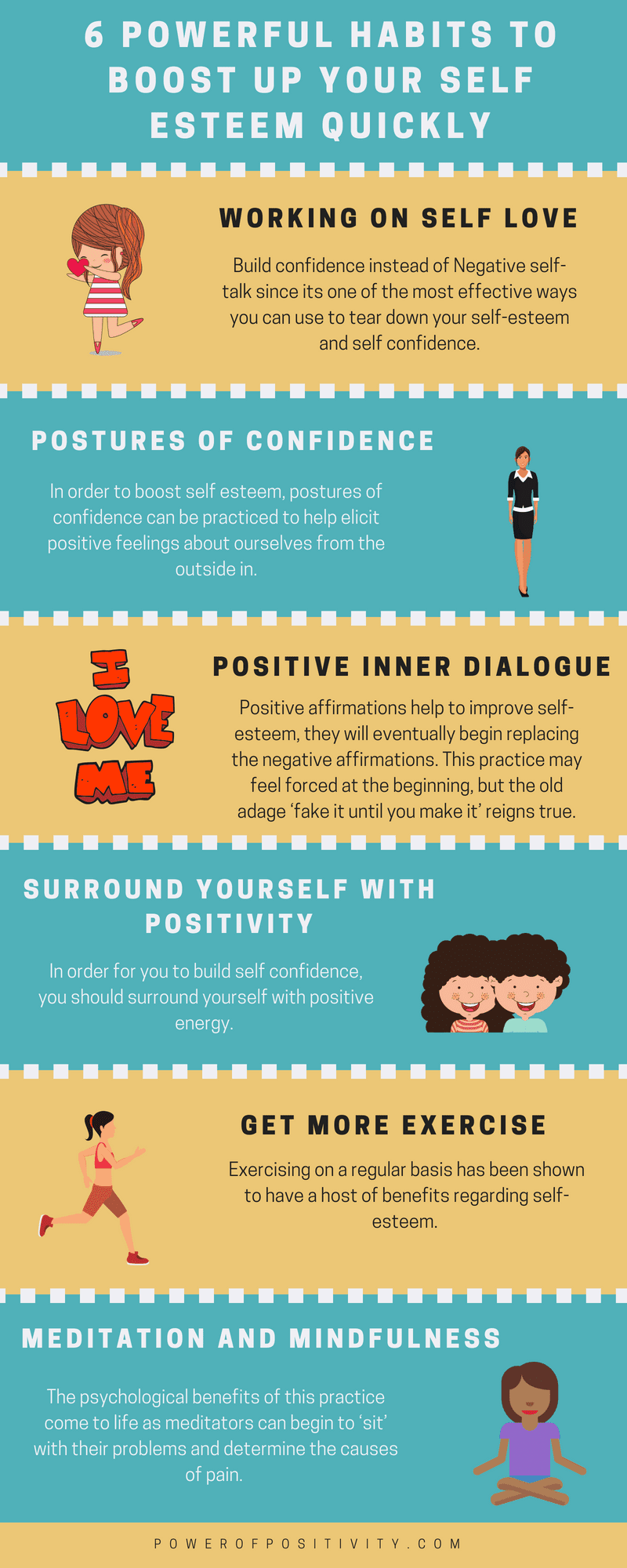
Boost self esteem

Share this Image On Your Site

(C)Power of Positivity, LLC. All rights reserved
References:
https://www.psychologytoday.com/blog/me-we/201312/10-ways-low-self-esteem-affects-women-in-relationships
http://www.yourtango.com/experts/yourtango-experts/15-ways-your-self-esteem-can-make-or-break-your-relationship-expert
https://www.bustle.com/articles/157502-11-ways-low-your-self-esteem-is-affecting-your-relationship
http://www.more-selfesteem.com/relationships.htm
https://www.everydayhealth.com/sexual-health/how-low-self-esteem-affects-your-relationships/
Skip to content